
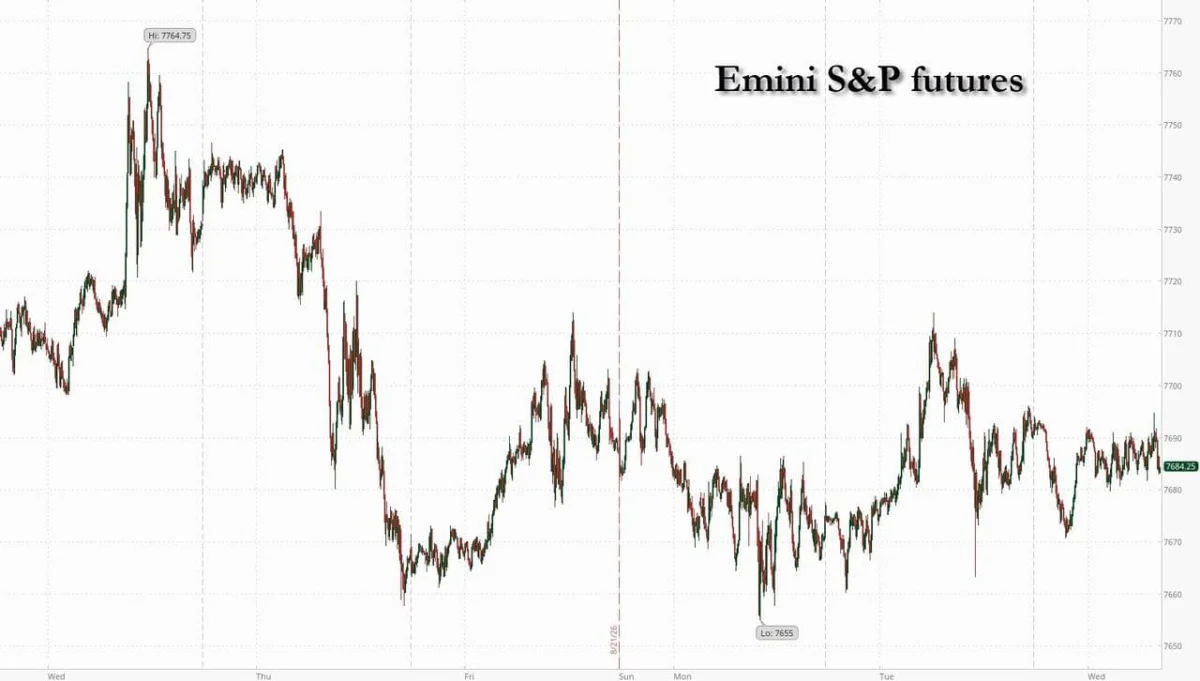
Global financial markets are poised for a pivotal day, with investors meticulously awaiting the release of the Personal Consumption Expenditures (PCE) price index, the Federal Reserve’s preferred inflation gauge, and the highly anticipated earnings report from semiconductor titan Nvidia. These key events are unfolding against a backdrop of subdued stock futures, slipped Treasuries, and a notable stumble in crude oil prices, largely influenced by optimism surrounding a potential US-Iran deal. As of 8:00 AM ET, S&P 500 futures remained largely unchanged, while Nasdaq futures registered a modest drop of 0.2%, reflecting a cautious sentiment ahead of the major announcements.
The pre-market activity offers a mixed picture of investor positioning. Nvidia (NVDA) and Marvell Technology (MRVL), both central to the artificial intelligence narrative, managed slight gains of 0.2%. However, the broader semiconductor sector remained flat, with memory chip stocks declining by 80 basis points, and Korean equities down 46 basis points. Software stocks experienced a 1.3% dip, yet the segment of unprofitable technology companies remarkably rose by 83 basis points. This divergence, as noted by market strategists, points towards a continued strategy of de-risking, where capital flows are concentrated into established AI leaders like Nvidia and Marvell, for which expectations remain robust. However, a stronger-than-anticipated earnings print from Nvidia could potentially have a more significant ripple effect across the broader AI ecosystem than on the individual stocks themselves, signaling a potential shift in capital allocation.
Across other market segments, cyclical and defensive stocks presented a mixed performance, with the healthcare sector notably trending upwards, while energy stocks faced headwinds. Bond yields experienced a marginal increase of 1-3 basis points, contributing to a bear flattening of the yield curve, partially reversing some of the previous day’s gains. This movement in the Treasury market is particularly scrutinized following reports from JPMorgan, confirming earlier observations, indicating "chatter of CTAs accelerating buying as 10Y yield approaches / breaches 4.60%." This suggests a critical threshold for long-term yields that could trigger significant algorithmic trading activity. The US Dollar saw an uptick, while crude oil prices extended their decline on the back of growing optimism regarding a potential US-Iran deal, though WTI crude is anticipated to find support at the $80 per barrel mark until a formal agreement is announced. Base metals showed strength, precious metals weakened, and agricultural commodities presented a mixed but net higher performance. Today’s macro agenda is dominated by the PCE report, with consensus forecasts for headline PCE at +0.1% month-over-month (MoM) and +3.6% year-over-year (YoY), and core PCE projected at +0.3% MoM and +3.3% YoY. The day culminates with Nvidia’s highly anticipated earnings report after the market closes.
The Nvidia Earnings Nexus: A Bellwether’s Moment for AI
The spotlight today shines intensely on Nvidia, whose earnings release after the market close is widely expected to be a decisive factor in shaping overall market sentiment. Nvidia, a semiconductor titan with a market capitalization exceeding $2 trillion, has become synonymous with the artificial intelligence revolution. Its performance and forward guidance are not merely a reflection of a single company’s health but are considered a barometer for the entire AI industry and, by extension, the broader technology sector.
In premarket trading, the "Magnificent Seven" cohort of mega-cap tech stocks presented a mostly positive front, signaling investor enthusiasm. Nvidia itself climbed a modest 0.2%, alongside Meta Platforms (+1.5%), Amazon (+0.2%), and Alphabet (+0.1%). Apple remained flat, while Tesla (-0.1%) and Microsoft (-0.7%) experienced slight declines. This collective performance underscores the market’s eager anticipation, not just for Nvidia’s raw numbers, but for the qualitative insights it will offer regarding the trajectory of AI investment and demand.
Despite the prevailing optimism, Nvidia’s stock has historically demonstrated a peculiar pattern, falling the day after each of its previous four earnings reports. Options markets are currently pricing in a significant 5.4% move in either direction following today’s results, reflecting the high stakes involved. Analysts expect Nvidia to report revenue nearly doubling from a year ago, a testament to the insatiable demand for its high-performance GPUs. However, market attention extends beyond these headline figures. Investors are particularly keen on understanding the company’s commentary on spending patterns by its largest customers, the overarching outlook for AI demand, and the implications of a recent wave of financing deals within the AI ecosystem.
Stephanie Niven, a portfolio manager at Ninety One, articulated this sentiment, stating, "What’s really going to matter here is the guide. And it’s not the growth that’s the question, but the rates at which that growth is either accelerating or decelerating." This highlights the market’s focus on future momentum and sustainability rather than just current performance. Nvidia’s stock experienced a seven-session losing streak before bouncing back on Tuesday, a period of weakness that some analysts believe might have subtly lowered the bar for the immediate quarter’s results. However, Florian Ielpo, head of macro at Lombard Odier Investment Managers, cautioned that this recent dip "does not materially lower the bar for the outlook," emphasizing the continued high expectations for future guidance. The broader semiconductor index (Philly Semiconductor Index) has seen its share of volatility, down 20.8% from its June peak, though still up a robust 63.6% year-to-date. This volatility reflects investor attempts to discern genuine growth from speculative fervor. An unnamed analyst, Li, commented on the potential for market "indigestion" following the report. Li suggested that while a broad equity sell-off might tempt a "buy the dip" strategy, a widening of credit spreads would signal caution. Conversely, if spreads remain tight, and fundamentals appear sound despite a market sell-off, it could present an opportunity to reinforce conviction in the AI and broader tech sectors.
Inflation’s Crucible: The PCE Report’s Crucial Read
Equally significant on today’s economic calendar is the release of the Personal Consumption Expenditures (PCE) price index for July. This report holds immense weight as it is the Federal Reserve’s preferred measure of inflation, guiding its monetary policy decisions. Economists widely anticipate a moderation in inflationary pressures, with the consensus forecasting a headline PCE increase of 0.1% MoM and 3.6% YoY. If realized, the 3.6% annual increase would mark the smallest rise in four months, signaling a welcome deceleration in the pace of price hikes. Core PCE, which strips out volatile food and energy components, is expected to rise by 0.3% MoM and 3.3% YoY.
Analysis of the report’s components suggests that more than half of July’s core PCE deflator gain could be attributed to portfolio-management fees, with potential downward revisions in September. Nominal consumer spending is projected to have risen by a modest 0.1%. This anticipated slowdown in consumer spending is not necessarily a cause for alarm, as economists attribute some of the softness to activity being pulled forward into June, influenced by events such as Amazon Prime Day and the FIFA World Cup. These seasonal and event-driven factors can temporarily skew monthly data without necessarily indicating a fundamental weakening of consumer demand.
For the Federal Reserve, the PCE report is critical for assessing progress towards its 2% inflation target. A sustained trend of moderating inflation could provide the central bank with greater flexibility in its interest rate policy, potentially easing pressure for further rate hikes. However, the path to disinflation is rarely linear. Ulrich Urbahn, a strategist at Berenberg, offered a nuanced perspective: "PCE can ease the immediate macro stress, but it cannot alone solve the Treasury-market problem." He elaborated that a more durable bullish outcome would require not just soft core inflation, but also calmer oil prices, clear evidence of stable demand, and a subsequent decline in long-end yields that is not solely reliant on Treasury liquidity measures. This underscores the complexity of the current economic environment, where inflation, monetary policy, and fiscal dynamics are intertwined. The Fed’s dual mandate of maximum employment and price stability means it must carefully weigh all incoming data, and today’s PCE report will be a crucial piece of that puzzle.
Geopolitical Winds and the Oil Market’s Tumble
A significant factor influencing today’s market dynamics, particularly in the commodities sector, is the evolving geopolitical landscape in the Middle East. Brent crude extended its decline, falling by approximately 9% for the week, as diplomatic efforts to normalize shipping flows through the critical Strait of Hormuz gained traction. The latest developments include reports of Iran and Oman actively working towards a potential deal to resume shipping through the vital waterway. This optimism has directly contributed to the sharp drop in oil prices, with WTI crude oil futures down about 2.5% amidst reassessments of the Middle East supply outlook.
The Strait of Hormuz is one of the world’s most strategically important chokepoints for oil shipments, with roughly a fifth of global oil supply passing through it daily. Historically, tensions in the region, particularly involving Iran, have often led to spikes in oil prices due to concerns over supply disruptions. Therefore, any signs of de-escalation or agreements to facilitate safer passage have an immediate and pronounced impact on energy markets. Reports from various outlets, including The New York Times, Axios, and Russia’s RIA Novosti, have suggested that the US administration does not anticipate a renewed full-scale conflict with Iran and is actively engaging in diplomatic initiatives. The RIA Novosti report, citing Iranian and Pakistani sources, even mentioned a potential US-Iran ceasefire to be announced in the coming days, explicitly including freedom of shipping via Hormuz.
This amalgamation of positive headlines has pushed oil prices lower, with Brent slipping below $86 per barrel. While WTI may find support around $80 per barrel until a concrete deal is announced, the overall trend reflects a reduction in the geopolitical risk premium that has buoyed oil prices in recent weeks. The implications extend beyond immediate energy costs, influencing broader inflation expectations and, consequently, central bank policy considerations. Lower oil prices can alleviate some of the cost pressures on businesses and consumers, contributing to the disinflationary trend sought by central banks worldwide.
The Bond Market’s Contradictions: Yields, Auctions, and the "Bessent Put"
The bond market today presents a complex picture, with Treasuries holding small losses in early US trading, effectively erasing a portion of Tuesday’s advance. This movement occurs ahead of the crucial PCE inflation gauges and, later today, the monthly 5-year note auction. The ongoing decline in oil prices, which in recent sessions has often correlated with lower yields, is somewhat limiting the extent of Treasury losses. Front-end yields are up approximately 2 basis points, while long-end tenors show little change, extending the recent yield-curve flattening trend. The benchmark 10-year Treasury yield is currently hovering near 4.64%, marginally higher on the day and slightly cheaper compared to its UK and German counterparts.
A point of particular interest for bond market participants is the "chatter of CTAs accelerating buying as 10Y yield approaches / breaches 4.60%," as reported by JPMorgan. Commodity Trading Advisors (CTAs) are systematic quantitative funds that often employ trend-following strategies. Their potential increased buying interest at a specific yield level could signify a technical inflection point, potentially providing a floor for yields. This ties into the broader discussion around a potential "Bessent put," a concept suggesting that Treasury Secretary Janet Yellen, or the Treasury Department more broadly, might take actions or make statements aimed at supporting the bond market, particularly if yields rise to levels deemed detrimental to financial stability or government borrowing costs. Our rates strategists have recently explored what other measures a more interventionist Treasury could pursue, indicating the market’s sensitivity to potential official intervention in the face of rising long-term yields.
Today’s schedule includes a $70 billion 5-year note auction at 1:00 PM New York time, with a "when-issued" (WI) yield near 4.36%. Last month’s 5-year sale yielded 4.408%, marking the highest result since December 2024, reflecting the rising cost of government borrowing. Additionally, new 2-year notes are holding small gains against Tuesday’s 4.204% auction stop, with yields just below 4.20%. The auction cycle will conclude on Thursday with a $44 billion 7-year note auction. The calendar for investment-grade (IG) credit new issues is anticipated to be light through month-end, following three borrowers selling a combined $3.7 billion on Tuesday. These auctions are critical tests of demand for US government debt, particularly in an environment of elevated interest rates and ongoing quantitative tightening by the Federal Reserve.
Global Market Performance: A Divergent Landscape
Across global markets, a nuanced picture emerges, characterized by regional strengths and weaknesses influenced by local economic data, corporate earnings, and geopolitical currents.
Asia Pacific: Asian stocks largely rose, led by a robust advance in heavyweight chipmakers like Samsung and TSMC, buoyed by the anticipation surrounding Nvidia’s earnings. The MSCI Asia Pacific Index climbed 0.7%, heading for a second consecutive day of gains. South Korea’s KOSPI notably outperformed, driven by its tech-heavy constituents, while Japan’s Nikkei 225 also advanced after an initial dip. Chinese equities, including the Hang Seng and Shanghai Composite, found support amidst a deluge of earnings reports and news of Alibaba founder Jack Ma increasing his stake in the company, signaling confidence in its long-term AI prospects. However, Australian stocks bucked the regional trend, falling after the nation’s core inflation data for July came in stronger than analysts expected, raising the probability of a Reserve Bank of Australia rate hike. Abrdn analysts expressed a positive outlook on Chinese internet firms like Tencent and Alibaba after their recent sell-off, alongside financials and high-dividend consumer shares. India is also starting to see positive earnings revisions, particularly in the financials sector.

Europe: European bourses (STOXX 600 +0.1%) are mostly firmer this morning, albeit with modest gains, as markets grapple with ongoing geopolitical uncertainty and the impending Nvidia earnings. Consumer Products, Basic Resources, and Travel & Leisure sectors took the lead, suggesting a cyclical tilt in today’s session. However, the technology sector lagged, facing pressure from several fronts: a downgrade for SAP (-4%) at UBS, a broader drift in European software names following Google’s announcement of Gemini Enterprise for financial services, and disappointing results from Intuit. In corporate news, Banco BPM acknowledged an unsolicited offer from MPS, SoftwareOne reported strong H1 revenue, while Ambu saw a significant decline (-16%) after a guidance downgrade. The FTSE 100 quarterly review indicated easyJet and Ithaca Energy are set to join the index, with Entain and Persimmon slated for removal.
Currency Markets: The Bloomberg Dollar Spot Index remained largely unchanged. The Australian dollar emerged as the best performer among major currencies, reacting to its unexpected inflation overshoot, which strengthened the case for an RBA rate hike. The Canadian dollar stabilized against the USD after Monday’s decline, even amidst Canada’s announcement of new tariffs on US products, including a doubling of counter-tariffs on US steel and aluminum, set to become effective September 8 on $20 billion worth of US exports.
Commodities Beyond Oil: While crude oil captured headlines with its decline, other commodities showed divergent trends. Copper held near a record high, indicative of tight short-term supplies despite some easing of a severe market squeeze. Gold prices were down, reflecting diminished safe-haven demand amidst a more optimistic geopolitical outlook. Bitcoin remained steady around the $80,000 mark, continuing its recent consolidation. Agricultural commodities presented a mixed but net higher performance.
Corporate Insights Beyond the Headlines
Beyond the immediate market-moving earnings, other corporate developments offer glimpses into broader industry trends. Northrop Grumman’s CEO stated that the Trump administration’s "Golden Dome" space defense system, a program potentially costing over $1 trillion, is becoming "very tangible" for defense contractors, with her company expecting a "decent share." This highlights the significant and growing investment in space-based defense capabilities, driven by evolving global security challenges.
In the automotive sector, Hyundai unveiled the largest product push in its history, announcing more than 100 model launches and refreshes. This ambitious strategy aims to challenge Toyota’s dominance in the highly competitive US hybrid market, underscoring the accelerating transition towards electrified vehicles and the fierce competition among automakers to capture market share in this evolving landscape.
Key Economic Indicators and Central Bank Watch
Today’s US economic data calendar is packed with critical releases that will provide further insights into the health of the economy and potential implications for monetary policy. In addition to the PCE price indexes, July’s personal income and spending data, July’s preliminary durable goods orders, and the second estimate of 2Q GDP are all scheduled for release at 8:30 AM New York time. These reports will offer a comprehensive view of consumer behavior, business investment, and overall economic growth.
The Federal Reserve’s perspective will also be on display, with Richmond Fed President Tom Barkin scheduled to speak unscripted in a panel discussion at 11:45 AM New York time. His comments will be closely scrutinized for any clues regarding the Fed’s current thinking on inflation and interest rates. This follows recent hawkish comments from Boston Fed President Susan Collins, who, despite being a non-voter, published an essay stating that without more sustained disinflation progress, it would be "appropriate to tighten policy soon." Such statements from central bank officials, regardless of their voting status, provide valuable signals to the market about the potential direction of monetary policy. The divergence of views within the Fed, and their data dependency, mean that every piece of incoming information, particularly inflation and growth data, is vital for shaping market expectations for future rate decisions.
In summary, global markets are navigating a complex tapestry of anticipated corporate performance, crucial inflation data, and shifting geopolitical realities. The outcomes of Nvidia’s earnings and the PCE report will undoubtedly set the tone for the coming days, influencing investment strategies and shaping the broader economic narrative as central banks continue their delicate balancing act.

