
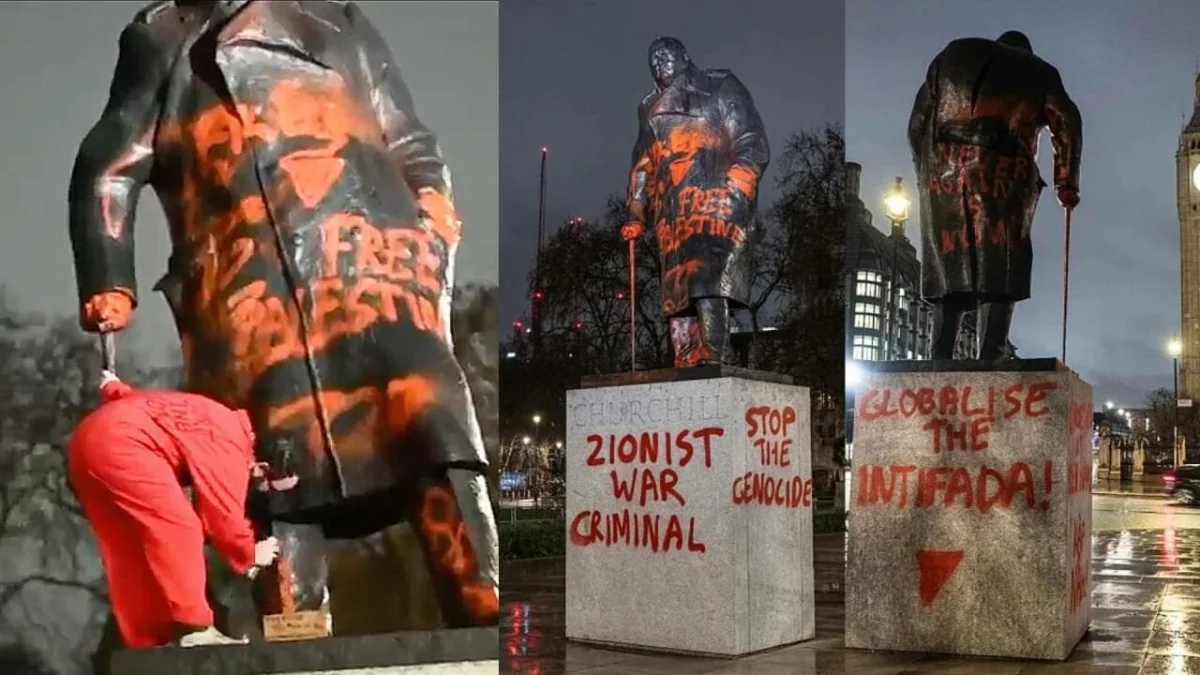
A Dutch activist who climbed and defaced the statue of Winston Churchill in London’s Parliament Square, emblazoning it with phrases such as "Zionist war criminal," "Globalise the Intifada," and Hamas-style red triangles, has been acquitted of criminal damage charges at Southwark Crown Court. The verdict, delivered after the activist, Olax Outis, argued the graffiti was not permanent and could be washed off, has sparked widespread outrage and ignited a contentious debate over the boundaries of protest, the interpretation of criminal damage, and the perceived double standards within the UK’s legal system regarding politically charged demonstrations.
The Incident: Defacement and Rapid Response
The incident, which occurred earlier this year, saw Olax Outis, also known as Caspar San Giorgi, a 39-year-old Dutch national, scale the iconic monument dedicated to Britain’s wartime leader. Dressed in a red boiler suit bearing the slogan "I support Palestine Action," Outis proceeded to spray-paint a series of messages onto the statue and its plinth. Prosecutor Peter Ratliff detailed to jurors that the front of the statue was marked with "Free Palestine" and distinctive red triangles, while the rear bore the phrase "Never Again Is Now." The plinth itself was defaced with "Globalise the Intifada," "Stop the Genocide," "Zionist war criminal," and a Dutch line which Outis later translated as "The Hague sends their regards."
The act of vandalism did not go unnoticed. A Greater London Authority (GLA) heritage warden, observing the defacement, promptly alerted the authorities. Police officers were on the scene within a remarkable two minutes, apprehending Outis. The swift response underscored the heightened security and monitoring of such prominent national monuments, particularly in an era of frequent protest and cultural contention. Following the arrest, specialist cleaners were dispatched to commence the laborious and costly restoration process. Initial estimates presented to the court put the damage and cleaning bill at £11,970. Subsequent reports on the restoration costs specified more than £7,000, which included £612 plus VAT for police barriers required during the cleanup, and £6,504 plus VAT for the emergency cleaning and restoration work itself.
The Defence and Controversial Verdict
During the trial at Southwark Crown Court, Outis entered a plea of not guilty to criminal damage. His defence hinged primarily on the argument that the paint used was washable and therefore did not constitute permanent damage to the statue. Furthermore, he contended that his actions were a form of "sending a message to parliament" and were undertaken with the intention of "preventing a crime," implying a broader political motivation to highlight alleged injustices.
The jury, after considering the evidence and arguments, returned a verdict of not guilty, a decision that has sent shockwaves across political and social commentaries in the UK. The acquittal, based on the premise that washable paint does not equate to criminal damage in this context, has opened a Pandora’s Box of questions regarding the interpretation of legal statutes concerning property defacement and the extent to which protest can mitigate culpability for actions that incur significant public expense.
In the dock, Outis remained unrepentant, demonstrating an unwavering commitment to his cause. "I’m proud to be a citizen of The Hague," he declared to the court. He further articulated a desire for a larger platform: "If I had a larger canvas and more time, I would have written if Keir Starmer doesn’t come to The Hague, The Hague will come for him. My wish is to see him on trial in The Hague." Reflecting on the verdict itself, he stated, "Whether you convict me or not is not too much of a concern for me. Whether I get acquitted, deported, imprisoned for years, I can be proud of having spoken about injustice and I have accounted for my actions. I will accept your judgement." Prior to the trial, Outis had already claimed responsibility for the stunt online, asserting he had come to Britain specifically to "deface a statue of one of history’s most well-known war criminals, Winston Churchill," whom he controversially equated to "the Keir Starmer of his time."
Official and Public Reactions: Outrage and Accusations of a "Two-Tier" Justice System
The initial act of vandalism in February had drawn swift condemnation from official quarters. Downing Street branded the defacement "completely abhorrent," emphasizing Churchill’s status as "a great Briton" who "must be held to account." The Home Office echoed this sentiment, calling the vandals "a disgrace," while the Greater London Authority expressed its profound dismay, stating it was "appalled." Six months later, the jury’s decision to clear Outis of criminal charges starkly contrasted with these earlier official positions.
The acquittal has provoked a torrent of furious reactions from various segments of society, particularly those concerned with heritage, public order, and the perceived politicization of the justice system. Heidi Bachram, whose family members were tragically murdered and taken hostage by Hamas, voiced her disbelief and anger, describing the country’s legal system as "a nasty joke" and arguing that Outis "should have been deported." She critically highlighted the perceived disparity, noting that a foreigner could "paint a threat to Jews on the statue of our greatest leader with the added red triangle to make clear it isn’t the ‘peaceful’ version of Intifada and GET AWAY WITH IT." This statement alluded to the red triangle symbol, which has been associated with Hamas’s visual propaganda.
Media personalities and social commentators also weighed in heavily. Martin Daubney of GB News expressed his exasperation, exclaiming, "It is pathetic! It is astonishing! I cannot believe the country we live in!" Social policy analyst Dr. Rakib Ehsan, while appearing on GB News, acknowledged that "many people find it an abhorrent form of protest." Other commentators, such as Alex Armstrong, warned that the ruling was "disgusting" and would "only embolden far-left thugs to vandalise our national hero’s statue time and time again," questioning whether the same injustice would occur if statues of figures like Gandhi or Mandela were defaced. The sentiment was echoed by Tony, who declared the verdict a "Green light for these bastards to do the same to anything else," provocatively asking how the reaction would differ if similar actions were taken against a mosque.
A central theme emerging from these criticisms is the accusation of a "two-tier justice system." Critics pointed out the apparent contradiction where the Metropolitan Police and Greater Manchester Police had spent the previous winter issuing warnings that slogans like "Globalise the Intifada" could lead to arrest. Yet, the very words, spray-painted in red on a national monument, were dismissed as non-criminal damage by a jury, based on the activist’s assertion that the paint was removable. This disparity fuels the argument that certain forms of protest, particularly those aligned with specific political narratives, are treated with leniency compared to others.
Broader Context: The UK’s Unfolding Culture Wars and Historical Revisionism
The acquittal of Olax Outis does not occur in a vacuum; it is deeply embedded within the ongoing cultural wars in the United Kingdom, particularly concerning historical figures and national identity. Winston Churchill, while revered by many as a symbol of British resilience and leadership during World War II, has also become a focal point for criticism regarding his imperialist views, colonial policies, and racial remarks. This duality in his legacy makes his statue a frequent target for activists seeking to challenge traditional narratives of British history.
This context is further illuminated by other recent developments. Last week, it was revealed that the Bank of England had allocated over £85,000 to research the potential removal of Churchill’s image from the £5 note. Consultants reportedly advised officials that portraits of "notable Britons" were "elitist and divisive," presenting a "backward-looking vision of the UK that carries too great a risk of division and controversy." This initiative sparked fierce debate, with figures like Nigel Farage lambasting the plan as "absolutely crackers" and Kemi Badenoch, the Secretary of State for Business and Trade, condemning it as "erasing our history." The idea of replacing historical figures with images of hedgehogs and puffins, as reportedly suggested by consultants, has been met with both amusement and anger.
Simultaneously, the UK has been subjected to recommendations from international bodies. The UN’s racial discrimination committee, for instance, has advised Britain to erect statues of people of African descent as a form of atonement for slavery. This recommendation comes at a time when the UK has already witnessed significant public debate and action surrounding its own historical monuments, with statues being pulled down, defaced, or boxed up following movements like Black Lives Matter. Churchill’s statue itself was notably boarded up in 2020 during the height of such protests, a stark visual representation of the deep divisions within society over how to confront and represent its past. Sadiq Khan’s Commission for Diversity in the Public Realm, established to review and update London’s public spaces, has been a key driver in this evolving landscape.
The perceived double standard in public art and protest is further highlighted by the recent unveiling on Trafalgar Square’s Fourth Plinth of Tschabalala Self’s five-metre "Lady in Blue." Marketed as an "everywoman" and a "symbol of confidence and purpose," and celebrated by outlets like CNN as a victory for being "not another White man," this contemporary artwork stands in the ceremonial heart of the capital, directly opposite Nelson’s Column. Critics argue that this public art, funded by the same public art machine that sometimes treats British victory as an embarrassment, would undoubtedly elicit an "industrial" level of outrage and condemnation if it were to be defaced with similar red paint, a stark contrast to the outcome of the Churchill statue incident.
Implications for Law, Protest, and Public Discourse
The acquittal of Olax Outis carries significant implications across legal, social, and political spheres. Legally, the verdict could be interpreted as setting a precedent, potentially emboldening future activists to engage in similar acts of "washable" defacement, arguing that such actions do not meet the threshold for criminal damage. This raises critical questions for prosecutors and lawmakers about the clarity and application of criminal damage laws in the context of protest. It also highlights the tension between the right to protest and the protection of public property, particularly historical monuments that hold varied meanings for different segments of the population.
Socially, the verdict is likely to deepen existing societal divisions. For those who view Churchill as an unblemished national hero, the acquittal represents a profound disrespect for history and a capitulation to extremist ideologies. For activists and those who believe in challenging traditional narratives, it might be seen as a validation of direct action and a symbolic victory against perceived injustices. The heated public discourse surrounding the trial and its outcome underscores the profound disagreements within the UK about its past, its present values, and the acceptable forms of expressing dissent.
Politically, the ruling may exert pressure on the government to review legislation pertaining to protest and public order offences. The accusations of a "two-tier" justice system, if they gain traction, could erode public trust in legal institutions and fuel calls for reforms to ensure perceived fairness and consistency in the application of the law. The ongoing debates about historical statues and national identity are likely to intensify, requiring policymakers to navigate a complex landscape of heritage preservation, freedom of expression, and social cohesion. The verdict on the Churchill statue is more than just a legal outcome; it is a significant moment in the unfolding narrative of Britain’s struggle with its own identity and its place in a rapidly changing global context.

