

The burgeoning PropTech sector, characterized by its rapid innovation and intense competition, faces a persistent challenge: the foundational need for robust, real-time property data. While building proprietary data infrastructure might appear to offer ultimate control and customization, the reality for most growing platforms is a time-consuming and resource-draining endeavor. This article explores the critical "build vs. buy" decision for real estate data infrastructure, highlighting how strategic API partnerships, such as those offered by Mashvisor, present a more agile and scalable solution, enabling PropTech companies to accelerate product development, enhance market intelligence, and achieve sustainable growth.
The Inherent Hurdles of Building In-House Real Estate Data Infrastructure
The allure of complete control over data pipelines and analytics is undeniable for ambitious PropTech firms. However, the practicalities of establishing and maintaining nationwide property data infrastructure are formidable. This process typically involves months, if not years, of dedicated engineering effort, significant financial investment, and ongoing operational overhead.
The Hidden Costs of Data Team Construction:
Developing a comprehensive internal data system necessitates specialized expertise, including data engineers, analysts, and compliance officers. The creation of robust data pipelines to collect, clean, normalize, and validate vast quantities of property information across diverse markets is a complex undertaking. This process demands constant attention to detail, ensuring data consistency and accuracy, which are paramount for user trust and product reliability.
A significant consequence of this internal development is the diversion of crucial engineering resources away from core product innovation. Instead of focusing on features that differentiate their offerings and drive user engagement, development teams find themselves bogged down in the intricacies of data management. This can lead to extended development cycles, delayed product launches, and a diminished competitive edge in a market that demands rapid iteration.
Data Licensing, Compliance, and Maintenance Complexities:
The U.S. real estate market is notoriously fragmented, with data access often governed by a patchwork of Multiple Listing Services (MLS), each with its own unique licensing agreements, update frequencies, and data access protocols. Navigating these complexities, especially when operating across multiple states or regions, is a significant administrative and legal challenge. Ensuring compliance with data privacy regulations and licensing terms adds another layer of complexity, often requiring dedicated legal and compliance teams.
Furthermore, integrating and maintaining data for specialized analytics, such as rental income projections or short-term rental performance (akin to an Airbnb data API), introduces further challenges. These datasets require continuous updates and normalization across thousands of micro-markets. Without dedicated domain expertise and sophisticated data management systems, the accuracy of this data can fluctuate, directly impacting the credibility of the platform and the trust of its users.
The Extended Time-to-Market Conundrum:
In today’s fast-paced PropTech landscape, a 12-month implementation timeline for a critical feature like data integration is often untenable. Such delays can result in missed market opportunities, a loss of early adopter momentum, and a significant disadvantage compared to competitors who have adopted more agile data strategies. As reported by Forbes, businesses simply cannot afford such lengthy implementation periods in the current dynamic market. This reality compels many companies to seek external solutions that can deliver data capabilities far more rapidly.
The Strategic Pivot: Embracing Real Estate Data API Partnerships
Recognizing the inherent limitations and substantial costs associated with building in-house data infrastructure, many forward-thinking PropTech companies are opting for a more strategic approach: partnering with specialized real estate data providers through APIs. This model transforms data from a complex engineering problem into an empowering, readily accessible capability.
Seamless API Integration for Accelerated Deployment:
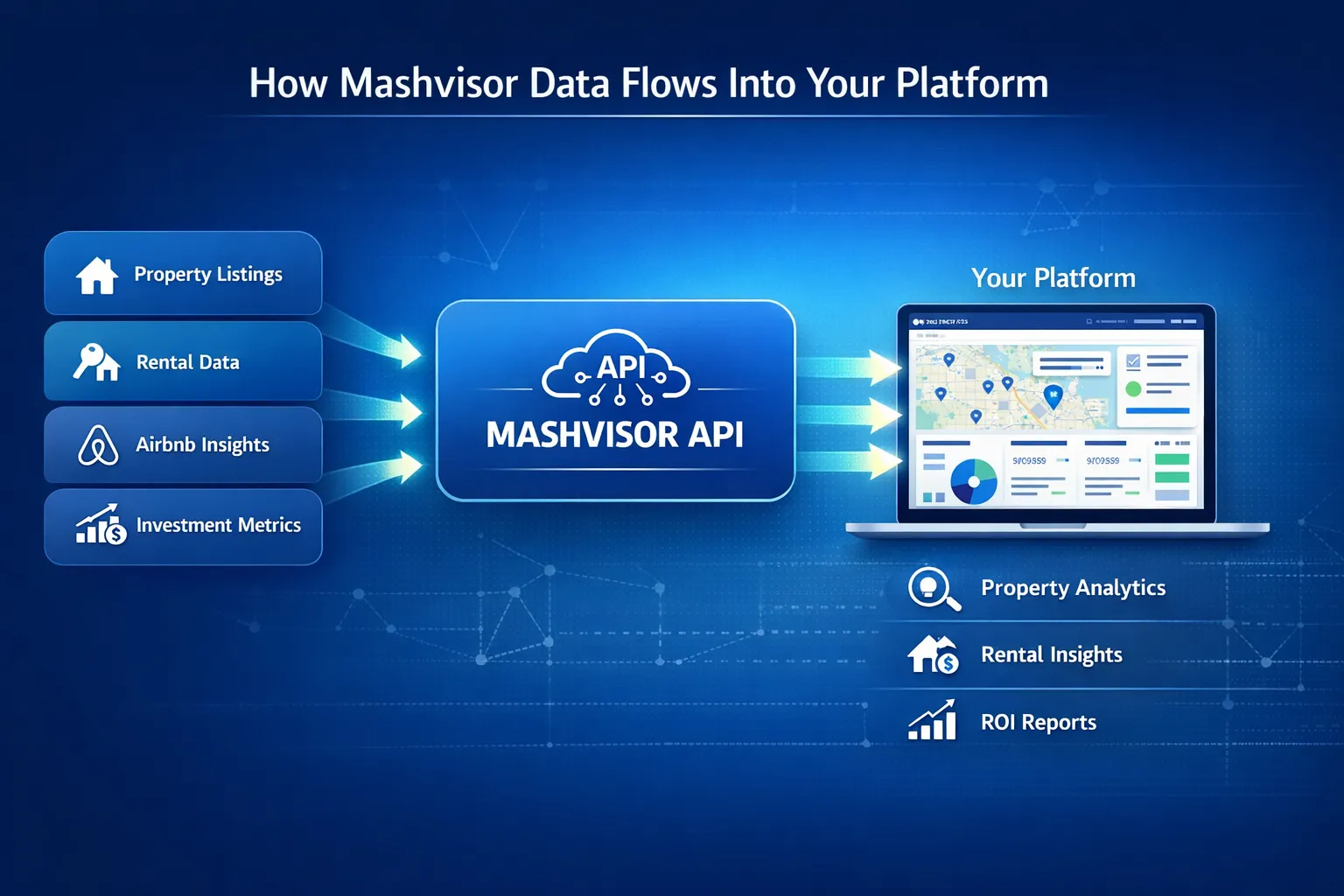
Mashvisor’s real estate data API, for instance, is designed for straightforward integration, providing immediate access to a wealth of property analytics and investment insights. Instead of constructing intricate data pipelines from scratch, platforms can connect to standardized API endpoints that deliver consistent, analytics-ready information. This significantly reduces development complexity, allowing teams to transition from concept to deployment in a matter of weeks rather than months. The API documentation provides a clear roadmap for developers, outlining available endpoints, datasets, and integration capabilities, thereby streamlining the technical implementation process.
Unified Access to Comprehensive Data Sets:
A key advantage of partnering with established data providers like Mashvisor is the ability to access a broad spectrum of integrated datasets through a single API. This typically includes traditional property data, detailed rental performance metrics, and short-term rental (STR) analytics. By consolidating these diverse data layers, businesses can avoid the operational overhead of managing multiple vendors and disparate data sources, offering their users a more cohesive and comprehensive analytical experience. The Mashvisor API, for example, encompasses a wide array of data points, including property details, ownership information, estimated market value, rental comps, short-term rental demand, occupancy rates, and historical performance data, providing a holistic view of property investment potential.
Designed for PropTech Ecosystems:
The Mashvisor API is specifically tailored to meet the needs of PropTech platforms and property marketplaces. It functions as a foundational infrastructure layer, enabling partner companies to retain full control over their branding, user experience, and product roadmap. This allows them to concentrate on delivering unique value propositions and enhancing customer engagement, leveraging Mashvisor’s data expertise without compromising their distinct market identity. This focus on seamless integration and data provision positions Mashvisor as a leading provider of real estate data solutions for companies seeking efficient and reliable data integration.

The Tangible Benefits of Speed and Scalability
The decision to partner for data access yields significant advantages in terms of time-to-market and operational scalability.
Accelerated Product Development Cycles:
By bypassing the protracted stages of data sourcing, cleaning, and validation, engineering teams can immediately begin developing user-facing tools and analytics. This dramatically shortens the product development cycle, allowing companies to rapidly test new features, gather user feedback, and iterate on their offerings. For example, instead of dedicating months to building data pipelines, a startup can integrate an API and launch a functional minimum viable product (MVP) within days or weeks, enabling them to quickly validate market demand and acquire early users.
Scalable Growth Without Infrastructure Overhaul:
As businesses expand, whether by entering new geographic markets or increasing their user base, their data infrastructure needs evolve. Internal solutions often require significant re-engineering to accommodate this growth. In contrast, API-driven solutions offer inherent scalability. Mashvisor’s nationwide coverage, for instance, allows platforms to expand their reach instantly without the operational burden of assembling new datasets or managing additional vendor relationships. This scalability is further supported by a usage-based pricing model, ensuring that costs align with actual data consumption, making it a financially viable option for businesses of all sizes.
Reallocating Engineering Resources for Strategic Impact:
Outsourcing data infrastructure management frees up internal engineering teams to focus on core product differentiation. This strategic reallocation of resources enables companies to invest more heavily in user experience enhancements, innovative analytics, and customer support – areas that directly contribute to competitive advantage and long-term growth. This operational efficiency is a primary driver behind the increasing adoption of API data partnerships in the PropTech sector.
Ensuring Reliability, Coverage, and Compliance Without Operational Burden
While speed to market is crucial, sustained success hinges on the reliability, comprehensiveness, and compliance of the data provided.
Nationwide Data Coverage for Consistent Insights:
Mashvisor’s commitment to nationwide real estate data coverage eliminates the need for fragmented data acquisition strategies. This unified approach ensures that analytics remain consistent and comparable across different markets, a critical factor for data-driven tools that serve a broad user base. By providing a single, reliable source of information, Mashvisor empowers platforms to deliver consistent insights to their users, regardless of their geographic focus.
Continuous Data Updates and Maintenance:
The real estate market is dynamic, with constant fluctuations in listings, rental performance, and market conditions. Maintaining accurate datasets internally requires continuous monitoring, validation, and updates. Through a partnership with Mashvisor, these responsibilities are managed by the data provider. Users receive structured, up-to-date datasets ready for analysis, significantly reducing operational overhead. This ensures the delivery of dependable long-term rental and short-term rental analytics without requiring dedicated internal resources.
Simplified Compliance and Licensing Management:
Data compliance is a critical, yet often overlooked, aspect of scaling a real estate platform. Navigating the intricate landscape of API data licensing, permissions, and usage requirements across multiple data sources can introduce significant legal and operational risks. By leveraging a partnership with a provider like Mashvisor, companies can delegate these complex compliance considerations. The API infrastructure is designed to manage licensing requirements and data standardization, allowing businesses to focus on their core competencies.
Identifying the Optimal Beneficiaries of Data Partnerships
While a wide array of real estate businesses can benefit from data API partnerships, certain segments are particularly well-positioned to capitalize on this model.
PropTech Startups:
For startups operating under intense pressure to achieve product-market fit rapidly, building internal data infrastructure is often an insurmountable hurdle. Utilizing PropTech API solutions allows them to bypass this bottleneck, enabling faster development of minimum viable products (MVPs) while still offering professional-grade insights. This accelerated launch capability is crucial for validating business models, attracting early investment, and gaining traction in a competitive market.
- Mini Case Study: Propese’s Rapid Launch
Propese, a PropTech startup, successfully launched an investment deal validation engine for short-term rentals in under 48 hours by leveraging Mashvisor’s API. Instead of spending months on data pipeline development, national listing aggregation, and rental performance data normalization, their engineering team focused exclusively on product features and user experience. This agility allowed them to quickly test market demand, onboard early users, and iterate based on real-world usage, demonstrating the profound impact of API integration on startup agility.
Real Estate Marketplaces:
Property marketplaces are increasingly differentiating themselves by offering insights beyond simple listings. Integrating analytics powered by a reputable real estate API provider enhances their value proposition by providing users with data on investment potential, projected rental income, and market comparisons. This moves the platform beyond a transactional tool to a valuable resource for informed decision-making.
Investment Platforms and SaaS Tools:
Platforms catering to real estate investors, brokers, or property managers require sophisticated property analytics across multiple markets. An API integration allows these platforms to deliver crucial metrics like ROI projections, rental yield estimates, and market performance indicators through a unified interface. This facilitates scalable product growth and ensures consistent data quality across their service offerings.
AI and Analytics Platforms:
The rise of AI-driven solutions in real estate has created a demand for structured, readily accessible data. Instead of building new data pipelines from scratch, AI platforms are increasingly adopting API partnerships to integrate real estate data into their models and dashboards. Mashvisor’s standardized outputs and broad market coverage simplify the process of incorporating property intelligence into recommendation engines, forecasting tools, and advanced analytics applications.
Who Benefits Most from a Mashvisor Data Partnership:
| Platform Type | Primary Advantage |
|---|---|
| PropTech Startups | Accelerated Minimum Viable Product (MVP) Launch |
| Property Marketplaces | Enhanced Value Proposition with Analytics |
| Investment Platforms & SaaS | Seamless Integration of Investment Insights |
| AI & Analytics Platforms | Access to Structured Real Estate Data |
When a Partnership Might Not Be the Best Fit:
It is important to note that a real estate data API partnership is not universally advantageous. Companies with highly specific, niche data requirements that cannot be met by off-the-shelf API offerings, or those prioritizing complete, ground-up control over every aspect of their data infrastructure for unique competitive reasons, might find internal development more suitable. However, for the vast majority of production-grade tools and platforms relying on reliable, continuously updated data, an API partnership offers a superior strategic path.
Conclusion: The Strategic Imperative of Data Partnerships
In the fast-evolving PropTech landscape, the decision to build or buy real estate data infrastructure is a pivotal one. While internal development offers theoretical control, the practical realities of cost, time, and ongoing maintenance often present significant obstacles. A strategic real estate data API partnership, such as the offering from Mashvisor, provides a compelling alternative.
By integrating production-ready datasets, companies can bypass the complexities of data aggregation, normalization, and updates. This leads to accelerated product launches, nationwide market coverage, and reliable property intelligence without the substantial operational overhead. The ability for engineering teams to focus on core product innovation and user experience, while relying on a trusted data provider for infrastructure, is a key enabler of sustainable growth and competitive differentiation.
For companies contemplating their data strategy, engaging with a provider like Mashvisor can offer invaluable insights. A direct discussion about product roadmaps and launch timelines can help determine the most effective integration approach, whether an API partnership is the immediate solution or a future consideration. This pragmatic approach ensures that businesses can leverage data effectively to achieve their strategic objectives in the dynamic real estate market.
Frequently Asked Questions
What is a Real Estate Data API Partnership?
A real estate data API partnership allows companies to integrate market and property datasets directly into their products via an Application Programming Interface (API), eliminating the need to build and maintain their own data infrastructure. This accelerates access to analytics and reduces engineering and operational complexity.
Why Partner with Mashvisor Instead of Building Your Own Real Estate Data Team?
Building an internal data system is time-intensive, requires significant hiring, and involves ongoing maintenance costs. Partnering with a specialized provider like Mashvisor delivers ready-to-use datasets, enabling faster product launches with considerably lower overhead.
How Long Does a Real Estate API Integration Take?
Most API integrations can be completed within a couple of weeks, though the exact timeline depends on the complexity of the specific product. This is a stark contrast to developing internal data pipelines, which can take many months.
What Does the Mashvisor API Provide?
The Mashvisor API offers a comprehensive suite of data, including property details, rental income estimates, investment metrics, and short-term rental insights. It provides access to both current data and historical performance data for up to 36 months.
Who Should Use a Real Estate Analytics API?
PropTech startups, real estate marketplaces, investment platforms, SaaS tools, and analytics platforms that require robust property data and insights are the primary beneficiaries of real estate analytics APIs like Mashvisor’s.
Can Startups Afford a Real Estate Data API Partnership?
Yes, Mashvisor offers a usage-based pricing model, allowing startups to scale costs in alignment with their actual data consumption. This makes the service accessible and affordable even for early-stage companies.

