
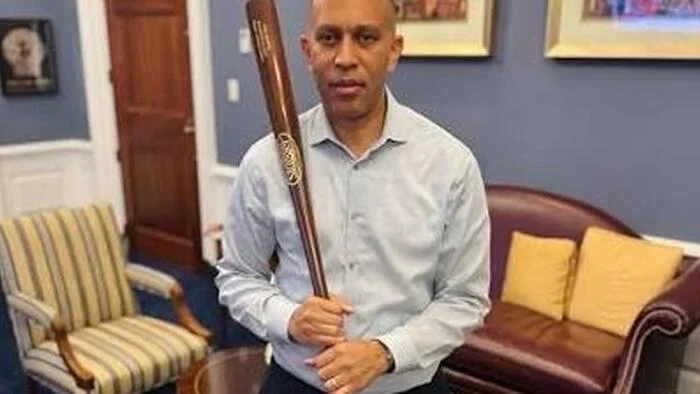
House Minority Leader Hakeem Jeffries has intensified calls for a significant restructuring of the United States Supreme Court, signaling a readiness to pursue radical changes should Democrats secure a trifecta in Washington. These pronouncements, coming amidst a charged political climate and ahead of critical midterm elections, underscore a growing Democratic frustration with the Court’s conservative majority and its recent landmark decisions. Jeffries’ rhetoric, which has previously included symbolic gestures like brandishing a baseball bat on social media, positions judicial reform as a central plank of the Democratic platform, raising profound questions about the future of judicial independence and the balance of power in American governance.
The Escalation of Judicial Reform Rhetoric
The debate over the Supreme Court’s structure has simmered for years, but recent events have brought it to a boiling point. House Minority Leader Jeffries has emerged as a leading voice advocating for an overhaul, articulating a vision that includes 18-year term limits for justices and an expansion of the Court to create an instant liberal majority. These proposals are not new to the political discourse but gain significant weight when championed by a figure poised for potential leadership in Congress.
Jeffries’ recent statements, reported by outlets like The Washington Times, indicate a refusal to "foreclose any single one of" a "variety of different options" for changing the Court. He has openly criticized the current conservative majority, describing it as "basically a subsidiary of the MAGA Republican Party." This framing suggests a belief among some Democrats that the Court has become overtly politicized and is no longer acting as an impartial arbiter of the law but rather as an extension of one political faction.
The "baseball bat" incident, a social media post where Jeffries was depicted with the sports equipment, has been interpreted by critics, including legal scholar Jonathan Turley, as a symbolic gesture of "rage politics" aimed at signaling a confrontational stance towards established institutions and pandering to a more radical base. This imagery, combined with increasingly strong rhetoric, highlights the intensity of the political struggle surrounding the judiciary.
Background and Context: A Court Under Scrutiny
The calls for Supreme Court reform have intensified following a series of high-profile decisions by the Court’s conservative majority. While the original article specifically mentions the Court ruling against racial gerrymandering, which surprisingly aligns with broader public sentiment, other decisions, such as the overturning of Roe v. Wade in Dobbs v. Jackson Women’s Health Organization (2022), have been far more polarizing and have fueled widespread public and political discontent among liberals and progressives. These rulings have led many Democrats to conclude that the Court has become an activist body, overstepping its bounds and imposing a conservative agenda.
The current ideological composition of the Supreme Court, with a 6-3 conservative majority, is largely a result of appointments made during Republican presidencies, particularly under former President Donald Trump, who appointed three justices: Neil Gorsuch, Brett Kavanaugh, and Amy Coney Barrett. These appointments shifted the Court’s balance significantly, leading to the conservative supermajority that has since delivered rulings challenging long-standing precedents.
Historically, the Supreme Court has often been at the center of national political debates, particularly during periods of profound societal change. However, direct threats to fundamentally alter its structure are rare and historically controversial. The most famous precedent for "court packing" attempts dates back to President Franklin D. Roosevelt’s proposal in 1937, following a series of rulings that struck down New Deal legislation. Roosevelt’s plan to expand the Court from nine to as many as fifteen justices was met with bipartisan opposition and ultimately failed, largely due to concerns about politicizing the judiciary and undermining its independence. This historical episode serves as a cautionary tale for those contemplating similar measures today.
Key Proposals and Their Advocates
The Democratic proposals for judicial reform generally coalesce around two main ideas: term limits for justices and expanding the number of seats on the Court.
-
18-Year Term Limits: This proposal suggests that Supreme Court justices would serve fixed terms, typically 18 years, rather than the current lifetime tenure. After their term, they might transition to a lower federal court or retirement. Proponents argue that term limits would depoliticize the appointment process by reducing the high stakes associated with lifetime appointments, create a more regular and predictable turnover on the Court, and ensure that the judiciary remains more responsive to contemporary societal norms without being directly subject to political pressures. Critics, however, warn that it could undermine judicial independence by making justices more aware of their limited time on the bench, potentially influencing their rulings or making them susceptible to political calculations as their term nears its end. Furthermore, enacting term limits would likely require a constitutional amendment, a difficult and lengthy process, or a controversial legislative act whose constitutionality would almost certainly be challenged.
-
Expanding the Court (Court Packing): This proposal involves increasing the total number of Supreme Court justices beyond the current nine. The stated goal for Democrats is to "create an instant liberal majority," thereby shifting the Court’s ideological balance to align with what they perceive as broader public opinion or their political agenda. This is the most direct and controversial method of altering the Court’s composition. Proponents, including Jeffries, Rep. Jamie Raskin (D., Md.), whom Jeffries has indicated would be a "driving force" behind these changes, and Sen. Elizabeth Warren (D., Mass.), argue it is necessary to restore balance and prevent the Court from acting as a partisan body. Former Obama Attorney General Eric Holder has explicitly linked this to the "acquisition and use of power if there is a Democratic trifecta in 2028," highlighting the strategic political motivation behind the proposal.
Public Opinion and Counterarguments
While proponents argue that the Court is out of step with "widely held public opinion," polling data presents a more nuanced picture. Jonathan Turley points to polls showing that "the majority of the public supports virtually all of the recent major rulings," including the ban on racial gerrymandering. This suggests a disconnect between the Democratic leadership’s narrative and the actual sentiment of a significant portion of the electorate regarding specific outcomes. Public trust in the Supreme Court, while fluctuating, remains a critical factor in these debates. A 2023 Gallup poll, for instance, indicated that public confidence in the Supreme Court remained low but stable, with 27% expressing "a great deal" or "quite a lot" of confidence, a figure that has seen significant partisan divergence.

Critics of court packing and other radical reforms often emphasize the foundational role of the Supreme Court as a "counter-majoritarian institution," as envisioned by the framers of the Constitution. James Madison, in Federalist No. 10, warned against the dangers of "factions" united by "some common impulse of passion, or of interest, adverse to the rights of other citizens, or to the permanent and aggregate interests of the community." Legal scholars like Turley argue that the current push for judicial overhaul exemplifies Madison’s concerns, representing an opportunistic attempt by a political faction to reshape institutions to advance its interests rather than uphold the broader principles of justice.
Furthermore, critics argue that politicizing the Court by expanding it through legislative means would set a dangerous precedent, potentially leading to a cycle where future Congresses could continually expand or contract the Court based on their political agenda. This "Nike School of Constitutional Law," as Turley terms it ("just do it"), could destabilize the judiciary, erode public trust in its impartiality, and ultimately weaken the rule of law. The irony is not lost on observers that President Trump, often criticized by Democrats for his attacks on institutions, also routinely criticized conservative justices when their rulings went against his administration, underscoring that dissatisfaction with judicial outcomes is not confined to one political ideology.
Broader Impact and Implications
The proposed changes to the Supreme Court carry profound implications for American democracy, the separation of powers, and the long-term stability of the judicial system.
-
Constitutional Balance: The Supreme Court serves as one of the three co-equal branches of government, designed to act as a check on both the legislative and executive branches. Fundamental alterations to its structure, particularly those driven by partisan objectives, risk upsetting this delicate balance and concentrating power in the hands of the political branches.
-
Judicial Independence: The principle of judicial independence, wherein judges are free to make decisions based on law and fact without external pressure, is a cornerstone of the American legal system. Lifetime tenure for Supreme Court justices is intended to insulate them from political pressures. Term limits or court expansion, if perceived as politically motivated, could compromise this independence, making future justices more susceptible to political influence.
-
Erosion of Public Trust: While public trust in the Court is already a concern, implementing highly contentious reforms could further erode public confidence in the judiciary’s impartiality. If the Court is seen as merely another political battleground, its ability to serve as a final arbiter of legal disputes and constitutional questions could be severely diminished.
-
Precedent for Future Actions: A successful effort to pack the Court by one party could set a precedent for the opposing party to do the same whenever they gain control, leading to an endless cycle of judicial expansion and contraction. This "judicial arms race" would render the Court a perpetually shifting body, undermining its authority and predictability.
-
Achieving Political Goals: As highlighted by Harvard Professor Michael Klarman, some view court packing as a necessary precursor to enacting a broader "radical agenda" that might otherwise be struck down by the Supreme Court. The explicit linking of judicial reform to the "acquisition and use of power" by figures like Eric Holder suggests that for some, the proposals are less about abstract judicial philosophy and more about securing political outcomes.
The Path Forward: Legislative and Constitutional Hurdles
Implementing the proposed changes is fraught with legislative and constitutional challenges. Expanding the Court could theoretically be done through a simple legislative act of Congress, as the Constitution does not specify the number of justices. However, the constitutionality of such a move, if seen as an attempt to undermine the judiciary, would almost certainly be challenged, likely ending up before the very Court it seeks to reform. This would create an unprecedented constitutional crisis, with the Supreme Court forced to rule on the legitimacy of an act designed to alter its own composition.
Term limits, on the other hand, are widely believed by legal scholars to require a constitutional amendment, a process that demands a two-thirds vote in both the House and Senate, followed by ratification by three-quarters of the states. This is a formidable hurdle, historically difficult to achieve, especially on an issue as divisive as judicial restructuring.
As the nation approaches its 250th anniversary, the debate over the Supreme Court’s future takes on added significance. The calls to fundamentally alter an institution that has played a key role in maintaining the stability of the American republic for centuries underscore the current political polarization. Whether these proposals are seen as necessary reforms to adapt to modern challenges or dangerous acts of "factional politics" that risk lasting damage to the constitutional system remains a central question for American democracy. The outcome of these debates will undoubtedly shape the character of the U.S. judiciary and the balance of power for generations to come.

