
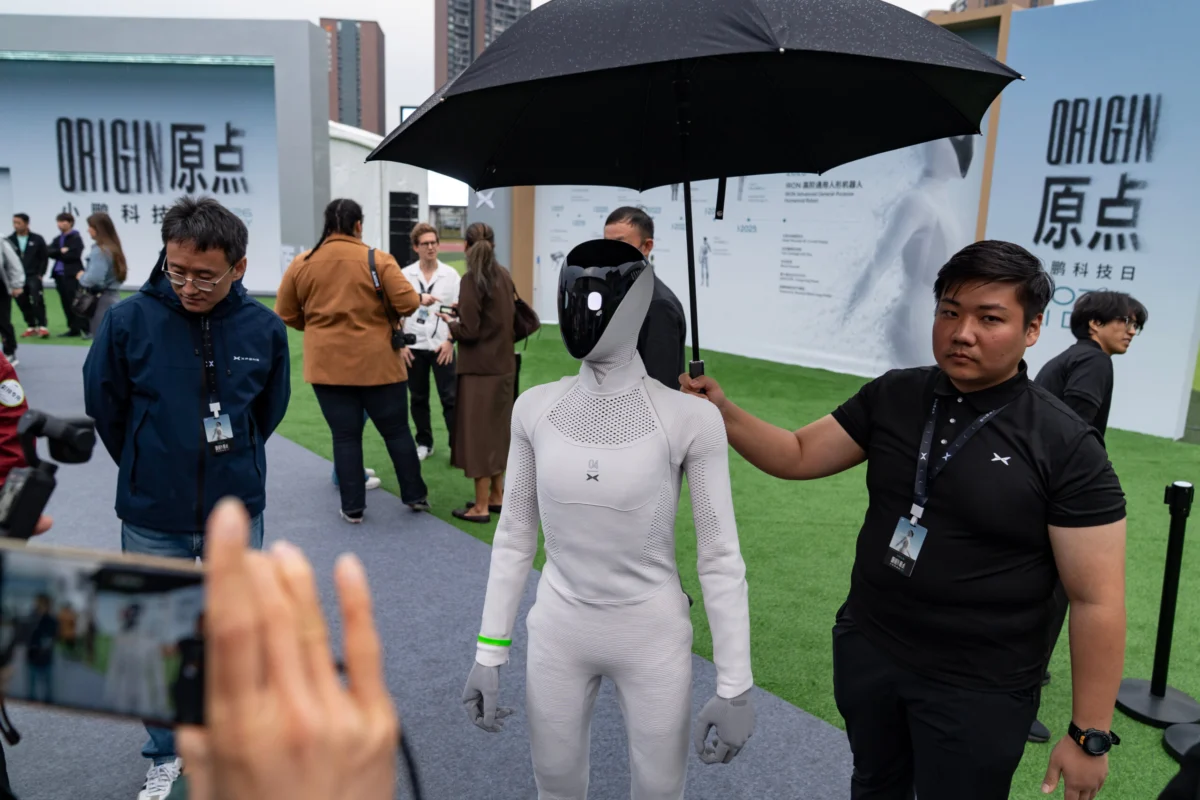
Guangzhou, China – In a bold declaration of its expanding technological ambitions, Chinese electric vehicle (EV) manufacturer XPeng Inc. officially unveiled its advanced general-purpose humanoid robot, named IRON, at the company’s highly anticipated AI Day event on Wednesday, November 25, 2026. The revelation signals XPeng’s aggressive pivot into the burgeoning field of robotics, with co-president Brian Gu articulating a vision where household robots could transition from science fiction to everyday reality within the next few years.
Speaking from Beijing, Gu informed CNBC that while initial deployment would target commercial settings, the transition to home environments could follow swiftly. "Maybe after successful deployment into commercial settings, maybe another one to two years, we can start thinking about deploying into home settings," Gu stated, underscoring the rapid pace of technological advancement. "Technology is moving at a much faster clip."
The Dawn of IRON: A New Era for XPeng’s AI Ambitions
The debut of IRON at XPeng’s AI Day was a meticulously orchestrated event, showcasing the company’s commitment to pushing the boundaries of artificial intelligence beyond its core automotive business. The humanoid robot, a product of years of research and development, represents a significant leap in bipedal locomotion, dexterous manipulation, and cognitive AI. While specific technical specifications were not exhaustively detailed, demonstrations hinted at its ability to navigate complex environments, interact with objects, and respond to human commands with a degree of fluidity previously unseen in many commercial prototypes.
XPeng’s strategic roadmap for IRON is ambitious and clearly defined. The company plans to commence mass production of the humanoid in January of the upcoming year, 2027. Following this, the first quarter of 2027 will see IRON robots undergoing rigorous training as store assistants within XPeng’s extensive network of retail car locations. This controlled commercial environment will serve as a critical proving ground for the robot’s capabilities, allowing XPeng to refine its performance, safety protocols, and human-robot interaction models in real-world scenarios. Sales are projected to begin in the second quarter of 2027, with initial deliveries expected later in the year. This aggressive timeline underscores XPeng’s confidence in its technological readiness and its desire to capture an early lead in the rapidly evolving humanoid robotics market.
Central to IRON’s capabilities is XPeng’s newly announced "Turing Physical AI Architecture." This innovative framework, revealed on the same day, is designed to integrate advanced AI algorithms with real-time decision-making technologies, enabling seamless control not only over humanoids but also over the company’s autonomous vehicles. This unified architecture suggests a synergistic approach, where advancements in one domain can directly benefit the other, creating a robust and versatile AI ecosystem. The "Turing" moniker itself evokes the pioneering spirit of artificial intelligence, signalling XPeng’s aspiration to set new industry benchmarks.
From Electric Vehicles to Humanoids: XPeng’s Diversification Strategy
Founded in 2014, XPeng initially established itself as a formidable player in the electric vehicle industry, quickly becoming a key competitor to international giants like Tesla within the Chinese market. The company gained early recognition for being one of the first to roll out advanced driver-assist technology in mainland China, a feat that predated Tesla’s widespread deployment in the region. XPeng’s strategic vision, however, has always extended beyond traditional automotive manufacturing. Over the years, it has systematically diversified its technological portfolio, investing heavily in proprietary artificial intelligence chips, venturing into the realm of personal flying vehicles, and most recently, making a significant commitment to robotics.
This broad diversification strategy reflects a growing trend among leading technology companies to build comprehensive "smart mobility ecosystems" or "AI-first" platforms. By developing core competencies in AI, autonomous driving, advanced hardware, and now robotics, XPeng aims to position itself as a holistic technology provider rather than solely an EV manufacturer. The company’s robotics unit, established as a separate entity, garnered significant investor confidence this past summer, raising an impressive $900 million in its inaugural funding round. Led by prominent venture capital firm IDG Capital, this round valued the robotics unit at a substantial $6.3 billion, highlighting the perceived long-term potential of its humanoid endeavors, despite the broader market sentiment surrounding XPeng’s core automotive business.
Navigating Market Headwinds: Investor Skepticism vs. Robotic Promise
Despite the ambitious strides in robotics, XPeng has faced considerable headwinds in its primary EV market. The broader downturn in the Chinese automotive sector, characterized by intense competition, price wars, and a saturation of new models, has weighed heavily on the company’s financial performance and investor confidence. XPeng’s shares, dual-listed in New York and Hong Kong, have experienced a significant decline, dropping more than 55% over the past year amidst widespread sector declines. This market skepticism extends to the company’s diversification efforts, with some investors questioning the allocation of resources to nascent, high-risk ventures like humanoid robotics while the core EV business grapples with profitability challenges.
The nascent humanoid robotics industry in China has itself been under increasing scrutiny from regulators regarding financing mechanisms in recent months. High-profile incidents, such as the initial public offering (IPO) and subsequent stock slump of fellow robotics firm Unitree, coupled with a rapid influx of capital into the sector, have raised critical questions about the commercial viability and the true efficacy of the underlying technology. Industry analysts and government bodies are increasingly demanding clearer pathways to commercialization and tangible returns on investment, shifting focus from speculative hype to practical application and sustainable business models.
However, Brian Gu remains steadfast in his conviction about XPeng’s unique position. He argues that the company’s robotics division stands apart due to its rare and powerful combination of integrated hardware, sophisticated software, and a clear vision for real-life use cases. This "full-stack" approach, as he describes it, contrasts sharply with many other startups in the sector, particularly in China, which often specialize in only a portion of the technology, such as developing advanced robotic hands, sophisticated AI-powered brains, or specific locomotion systems. Many of these firms operate as original equipment manufacturers (OEMs), with the ultimate responsibility of integrating these disparate parts into a functional robot falling to another company. Gu anticipates that the planned commercial launch of IRON next year will serve as a powerful validation point, attracting more investors who recognize the comprehensive strength of XPeng’s approach.
The Engineering Challenge: Synergy of Hardware and Software
The development of a truly general-purpose humanoid robot presents an formidable engineering challenge, one that XPeng’s leadership has experienced firsthand. He Xiaopeng, XPeng’s co-founder and CEO, a software engineer by training, initially believed that software held the key to solving "everything." However, his deep dive into the electric vehicle business brought a profound realization: "after he got into the EV business he realized how hard it is to make hardware… really do the things that you want to do safely and consistently," Gu recounted. This newfound appreciation for hardware complexity has undoubtedly informed the integrated development philosophy behind IRON.
The complexity of humanoid robotics lies not merely in isolated functions but in the seamless coordination of multiple advanced systems. As Gu articulated, "You can always make the head talk, you can always make the leg run, you can always make the hands to do certain tasks." The true differentiator, he explained, is the ability to perform these tasks simultaneously and consistently: "But doing a task while you’re walking and answering questions at the same time, that’s the most challenging part. And then doing everything well, not falling down, not getting distracted. The model has to work in sync." This emphasis on integrated, real-time performance in dynamic environments highlights the sophisticated AI and control systems required for IRON to operate effectively and reliably.
Strategic Autonomy: Chips and Supply Chain Resilience
In an era marked by increasing geopolitical tensions and global supply chain vulnerabilities, particularly concerning advanced semiconductor chips, XPeng’s strategic independence in chip development offers a crucial advantage. Gu revealed that XPeng’s robotics development primarily leverages the company’s existing driver-assist chips, which it already possesses and produces. This internal capability significantly insulates the robotics unit from the impact of U.S. restrictions on the sale of advanced Nvidia chips to China, a measure that has affected other Chinese tech firms. "Right now we don’t see any change to our supply chain, and also ability to have these chips," Gu affirmed, highlighting a level of resilience that many competitors lack.
This strategic foresight in chip autonomy is further contextualized by past movements within the industry. Notably, in 2023, Xinzhou Wu, who previously headed XPeng’s autonomous driving division, departed the company to take on a leadership role in Nvidia’s automotive chip business. This move underscores the critical importance of chip technology in both autonomous driving and, by extension, advanced robotics, and XPeng’s continued ability to develop and utilize its own chips provides a strong foundation for its diversified tech portfolio.
The Profitability Paradox: Robotics vs. Automotive Margins
Perhaps one of the most compelling arguments for XPeng’s aggressive foray into robotics is the potential for significantly higher profit margins compared to the fiercely competitive and often capital-intensive automotive business. Brian Gu explicitly stated, "It’s much easier to be profitable for the robotics business than the autos business." This assertion stems from several factors unique to the robotics sector. Once the substantial upfront research and development costs are amortized, the production of robots, particularly with modular designs and advanced manufacturing techniques, can scale more efficiently. Furthermore, robotics solutions often involve a higher proportion of software-driven value, which typically carries higher margins than hardware manufacturing. The potential for recurring revenue streams through software updates, maintenance contracts, and specialized applications further enhances profitability prospects.
Gu projects that robotics could become a meaningful component of XPeng’s overall business within the next two to three years, with profitability potentially arriving as early as next year. He stressed that this value would "dramatically" increase once robots successfully penetrate household settings, unlocking a vast consumer market. This vision underscores the long-term financial incentive driving XPeng’s diversification, aiming to offset the cyclical and competitive pressures of the automotive market with a high-growth, high-margin business segment.
The Road to the Home: Safety, Ethics, and Unstructured Environments
While the commercial deployment of IRON in controlled retail environments is an ambitious first step, the transition to household settings presents an entirely new set of challenges and ethical considerations. Gu candidly acknowledged these complexities, noting that homes are far less structured and predictable than commercial spaces. The presence of vulnerable individuals, such as elderly people, children, and pets, necessitates an even higher standard of safety, reliability, and contextual awareness for domestic robots. Robots must be capable of reacting appropriately to emergency situations, navigating dynamic layouts, and understanding nuanced human commands and behaviors.
These stringent requirements place immense demands on battery power, requiring highly efficient and long-lasting energy solutions. More critically, they demand an unparalleled level of performance consistency, ensuring that the robot operates flawlessly and safely day in and day out, without errors or malfunctions that could pose risks to human occupants. Beyond technical hurdles, the prospect of autonomous robots in homes raises profound ethical questions concerning privacy, data security, decision-making autonomy, and the psychological impact on human residents. Regulators globally are already grappling with frameworks for AI ethics and robot safety, and XPeng, like all pioneers in this space, will need to navigate these complex societal discussions responsibly.
Broader Implications: Shaping the Future of AI and Work
XPeng’s aggressive timeline for commercializing humanoid robots holds significant implications for the broader robotics industry and the future of work. A successful deployment of IRON in retail settings could serve as a powerful catalyst, accelerating the adoption of general-purpose humanoids across various sectors, from logistics and manufacturing to healthcare and hospitality. It could ignite a new wave of investment and innovation, prompting other tech giants and startups to redouble their efforts in this transformative field.
The emergence of sophisticated humanoid robots also prompts a societal re-evaluation of human labor and economic structures. While robots like IRON are designed to automate repetitive or hazardous tasks, they also have the potential to create new job roles in robot maintenance, programming, supervision, and human-robot interaction design. China, with its national strategic emphasis on AI and advanced manufacturing, is positioning itself at the forefront of this technological revolution. XPeng’s endeavors, therefore, are not merely corporate initiatives but contribute to a larger national narrative of innovation and global technological leadership.
Conclusion: A Vision for an Autonomous Future
XPeng’s unveiling of the IRON humanoid robot and its ambitious deployment schedule marks a pivotal moment in the company’s trajectory and in the broader narrative of artificial intelligence. By leveraging its expertise in autonomous driving and AI chip development, XPeng is attempting to bridge the gap between intelligent vehicles and intelligent machines, striving to create a seamless, AI-driven future. While the path ahead is fraught with technical challenges, market skepticism, and ethical considerations, Brian Gu’s vision of a future where humanoid robots become integral to both commercial and domestic life within a few short years underscores a profound belief in the accelerating power of technology. As IRON prepares to step into XPeng’s showrooms, it carries not just the hopes of a company, but the potential to redefine human interaction with technology and shape the very fabric of daily life in the decades to come.

