
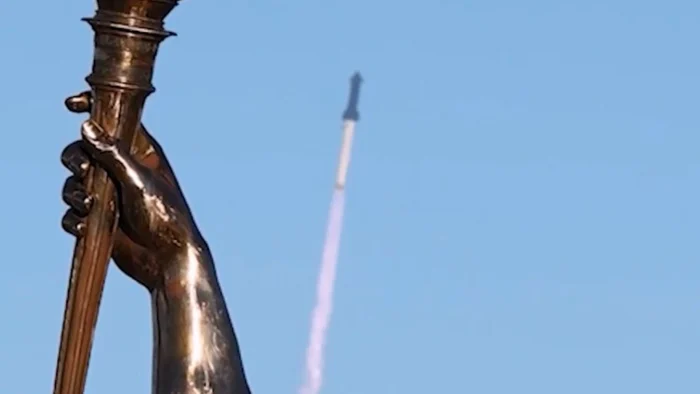
The commercial space industry witnessed a stark contrast in fortunes this past weekend, with Elon Musk’s SpaceX achieving a landmark success in its Starship development while United Launch Alliance (ULA) experienced a significant setback with its new Vulcan rocket. On Saturday, SpaceX successfully demonstrated a crucial component of its rapid reusability strategy by catching the upper stage of its Starship rocket with mechanical "chopstick" arms on its launch tower at Starbase, Texas. This historic achievement, marking the first time an orbital class upper stage has been recovered post-flight, stands in sharp relief against the backdrop of ULA’s Vulcan Centaur rocket suffering a total mission failure just 24 hours later on Sunday, losing 40 satellites for Amazon’s Project Kuiper.
A Milestone for SpaceX: The Starship Upper Stage Catch
SpaceX’s Saturday mission, designated Integrated Flight Test 4 (IFT-4), was a critical step in the development of its ambitious Starship program. The massive two-stage rocket system, comprising the Super Heavy booster and the Starship upper stage, launched from Starbase, Texas, with the primary objective of demonstrating full-stack reusability. While the original plan included a dual catch – both the Super Heavy booster and the Starship upper stage – the Super Heavy booster’s landing was diverted due to a guidance anomaly, leading to a controlled splashdown in the Gulf of Mexico. However, previous test flights have already achieved successful Super Heavy catches, validating that aspect of the system.
The true highlight of IFT-4 was the successful recovery of the Starship upper stage. After performing a complex re-entry maneuver, the stainless-steel spacecraft executed a precise "belly flop" descent, then reoriented itself vertically using its Raptor engines for a powered landing. Crucially, the giant "chopstick" arms, part of the "Mechazilla" launch and catch tower, swung into action, gently cradling and securing the 50-meter-tall Starship as it descended. This unprecedented maneuver signifies a monumental leap towards SpaceX’s vision of rapid and cost-effective space access.
Louie DiPalma, an aerospace and defense analyst at William Blair, encapsulated the significance in a note, stating, "A Weekend Tale of Two Cities: Historic Starship Catch Contrasts With Another ULA Vulcan Mishap." DiPalma elaborated, "On Saturday, SpaceX made history by using its ‘chopstick’ mechanical arms to successfully recover Starship, marking the first time that a rocket’s upper stage has been recovered after reaching orbit. In our view, this Starship catch will take the throne for the most famous catch in history from Willie Mays’ 1954 World Series catch in Major League Baseball’s fall classic." Beyond the recovery demonstration, the mission also successfully deployed 26 of SpaceX’s third-generation Starlink satellites into low Earth orbit, further bolstering its rapidly expanding satellite internet constellation. This dual success underscores SpaceX’s relentless pursuit of its long-term goals for Starship, which include not only satellite deployment but also lunar and Martian missions, and even point-to-point terrestrial travel.
The Ambitious Vision of Starship Reusability
The Starship program represents a paradigm shift in space transportation. Unlike traditional rockets that are largely expendable, Starship is designed for complete and rapid reusability, akin to commercial aircraft. The Super Heavy booster, standing at 69 meters tall, is powered by 33 Raptor engines, while the Starship upper stage, with its 6-9 Raptor engines, is designed to carry over 100 metric tons to orbit. The "chopstick" system on the Starbase launch tower is central to this reusability. By catching both stages directly at the launch site, SpaceX aims to eliminate the need for costly and time-consuming barge landings and refurbishment processes, drastically reducing turnaround times and operational expenses.
SpaceX’s journey to this point has been characterized by a rapid iterative development approach, featuring numerous test flights and occasional spectacular failures, each providing invaluable data. The company has already perfected the reusability of its Falcon 9 first stage, which routinely lands back on drone ships or land, enabling hundreds of successful missions. The Starship program takes this concept to an entirely new level, aiming for "airline-like" operations where a rocket could potentially fly multiple times a day. This ultimate goal of rapid reusability is seen by many industry experts as the key to making space travel and large-scale space infrastructure development economically viable, opening up possibilities for orbiting data centers, lunar bases, and crewed missions to Mars.
ULA’s Vulcan Centaur Suffers Mission Failure
In stark contrast to SpaceX’s triumph, United Launch Alliance (ULA) experienced a significant setback on Sunday. Its Vulcan Centaur rocket, on its second commercial flight (LV-01), suffered an anomaly minutes after launch from Cape Canaveral Space Force Station in Florida. The rocket, carrying 40 satellites for Amazon’s Project Kuiper broadband internet constellation, failed to reach its intended low Earth orbit, resulting in the total loss of the mission and its valuable payload.
According to preliminary reports and telemetry data, the anomaly occurred during the firing of the Centaur V upper stage. While the Vulcan’s two BE-4 main engines performed as expected during the booster phase, the upper stage propulsion system, powered by two RL10C-1-1 engines, did not achieve the necessary orbital velocity. ULA confirmed the failure, initiating a thorough investigation to determine the root cause. This incident marks ULA’s first total mission failure since the joint venture between Boeing and Lockheed Martin was formed in 2006, representing a significant blow to the company’s reputation and its new flagship rocket.
Amazon’s Project Kuiper acknowledged the incident, stating on X (formerly Twitter) that "there is risk with any launch, and that’s especially true for inaugural missions like LV-01." The company added, "ULA has been a trusted partner for Amazon, and we believe they’ll learn from this mission and deliver on their long-term plans for Vulcan." While expressing confidence in ULA, the loss of 40 satellites represents a substantial delay and financial impact for Amazon’s ambitious satellite internet project, which aims to compete directly with SpaceX’s Starlink. Each Kuiper satellite is estimated to cost millions of dollars, in addition to the launch service fees.
Background: United Launch Alliance and the Vulcan Program
United Launch Alliance was established in 2006 as a 50/50 joint venture between aerospace giants Boeing and Lockheed Martin. For many years, ULA was the dominant U.S. launch provider, serving critical national security missions for the Department of Defense, NASA, and other government agencies, using its highly reliable Atlas V and Delta IV rocket families. The Atlas V, in particular, utilized the Russian-made RD-180 engine for its first stage, a dependency that became a point of geopolitical concern following geopolitical tensions.
The Vulcan Centaur program was conceived in 2015 as ULA’s next-generation launch vehicle, designed to transition off the Russian RD-180 engines and eventually replace both the Atlas V and Delta IV. Its development has been a lengthy and costly endeavor, aimed at offering a more competitive, modular, and powerful alternative to its legacy rockets, capable of launching a wide range of payloads from LEO to deep space. The Vulcan’s first stage is powered by two BE-4 engines developed by Blue Origin, while its Centaur V upper stage uses Aerojet Rocketdyne’s RL10 engines, a well-proven design.
ULA’s struggles have unfolded during an era dominated by SpaceX’s rapid rise and its perfection of reusable launch technology. Over the past three years, the Vulcan system had completed four successful missions, including its inaugural flight in January 2024 carrying Astrobotic’s Peregrine lunar lander and the second flight (which failed) carrying the Kuiper satellites. This pales in comparison to SpaceX’s nearly 500 successful missions over the same period, predominantly using its Falcon 9 and Falcon Heavy rockets. The Vulcan anomaly will likely negatively impact its suppliers, such as Karman Space & Defense, which provides composite structures for the rocket. Blue Origin, another key supplier for the BE-4 engines, has also faced its own challenges in achieving volume launches and suffered a major explosion to its launch pad in May, further highlighting the complexities and risks inherent in advanced rocket development.
The Satellite Internet Race: Starlink vs. Kuiper
The contrasting fortunes of SpaceX and ULA have direct implications for the burgeoning low Earth orbit (LEO) satellite internet market. SpaceX’s Starlink constellation is by far the largest, with over 6,000 satellites currently in orbit, providing internet services to millions of subscribers worldwide. The deployment of 26 third-generation Starlink satellites during the IFT-4 mission further solidifies its lead.
Amazon’s Project Kuiper is a direct challenger to Starlink, aiming to deploy over 3,200 satellites to provide global broadband internet access. The failure of ULA’s Vulcan Centaur to deliver 40 Kuiper satellites represents a significant setback for Amazon’s deployment schedule. While Amazon has secured multiple launch contracts with various providers, including ULA, Blue Origin’s New Glenn, and Arianespace’s Ariane 6, the reliance on nascent rockets introduces inherent risks. The timely deployment of these constellations is crucial for securing market share and achieving profitability in a highly competitive sector. Each launch failure for a Kuiper mission directly impacts Amazon’s ability to roll out services and scale its network.
Industry Reactions and Broader Implications
Louie DiPalma’s "Weekend Tale of Two Cities" perfectly captures the divergent trajectories of the two companies. SpaceX’s relentless innovation in reusability has fundamentally altered the economics of space access, driving down launch costs and increasing launch frequency. The Starship catch marks a critical milestone on the development path toward achieving rapid reusability, a capability SpaceX envisions will make space transportation as routine and affordable as air travel.
The ULA Vulcan failure, conversely, underscores the inherent challenges and risks in developing new launch vehicles, even for experienced players like ULA, Boeing, and Lockheed Martin. While ULA has historically boasted an impressive reliability record with its Atlas V and Delta IV, the transition to Vulcan has been protracted and now faces a significant hurdle. This anomaly could lead to further delays for future Vulcan missions, impacting not only Amazon Kuiper but also other commercial and government customers, including critical national security payloads.
The incident is likely to intensify scrutiny on ULA’s development process and its ability to compete effectively in a market increasingly dominated by SpaceX’s cost-effective and highly reliable Falcon family. It also highlights the growing disparity in launch capabilities and operational tempo between SpaceX and its competitors. As Elon Musk once colorfully put it on a SpaceX earnings call, referring to his company’s engineering prowess, it’s akin to "the New York Yankees playing in Little League baseball."
This weekend’s events have profound implications for the commercial space sector. SpaceX’s achievement pushes it closer to the full reusability of its mega-rocket, which promises to drive down costs to unprecedented levels, making activities like launching large data centers into orbit or establishing lunar outposts economically viable. The growing dominance of one player, particularly one so focused on rapid, low-cost access, could lead to discussions among competitors and customers about the structure of the industry and potential regulatory considerations, not to stifle innovation but to ensure a competitive and resilient launch ecosystem for critical national and commercial interests.
The path forward for the global space industry is increasingly defined by the pursuit of reusability and efficiency. As private companies continue to push the boundaries of what’s possible, the contrast between groundbreaking success and unexpected setbacks serves as a potent reminder of the complex and challenging nature of space exploration and commercialization. The coming years will undoubtedly see continued rapid advancements, further reshaping the landscape of access to space and its utilization for communication, science, and human expansion.

