

The global stock market has once again captured widespread attention, with valuations soaring to unprecedented levels, largely driven by the burgeoning enthusiasm surrounding Artificial Intelligence (AI). This rapid ascent has inevitably ignited a familiar debate: Is the current AI boom a sustainable technological revolution, or is it merely another speculative bubble poised for an inevitable, dramatic correction? Investors, economists, and market analysts are grappling with the potential implications for retirement savings and broader economic stability, drawing parallels to previous periods of market frenzy.

The prevailing sentiment among cautious observers is that while AI undoubtedly represents a significant technological leap, the pace and scale of current investment may be disproportionate to immediate, tangible returns. This concern evokes memories of the dot-com crash of the early 2000s, an era characterized by fervent speculation in internet-related companies that often lacked robust business models or profitability. The experience of that period, which saw many investors suffer substantial losses, continues to shape perceptions of rapid technological surges.
The Genesis of the AI Boom

The current AI narrative is multifaceted, rooted in several key developments:
- Breakthroughs in Generative AI: The emergence of sophisticated large language models (LLMs) and generative AI applications has demonstrated capabilities previously thought to be years away. These technologies can create text, images, code, and more, promising to revolutionize industries from content creation to software development.
- Exponential Growth in Computing Power: Advances in semiconductor technology, particularly in graphics processing units (GPUs), have provided the computational backbone necessary for training and deploying these complex AI models. Companies like Nvidia have seen their valuations skyrocket as demand for their specialized chips explodes.
- Widespread Adoption and Investment: Major technology companies are heavily investing in AI research, development, and integration into their existing products and services. Venture capital funding for AI startups has reached record highs, attracting both institutional and retail investors eager to participate in what is widely perceived as the next frontier of innovation.
This confluence of technological progress, market enthusiasm, and significant capital allocation has propelled AI-related stocks to extraordinary valuations. However, the speed of this growth has led many to question whether fundamentals can keep pace, or if the market is entering a phase of irrational exuberance.

Historical Precedents: Lessons from Past Cycles
Concerns about an "AI bubble" are not isolated; they are part of a recurring pattern in financial history where transformative technologies lead to periods of intense speculation. Examining past market cycles provides crucial context:

The Dot-Com Bubble (1997-2000): This period saw the NASDAQ Composite Index surge from under 1,000 points in the mid-1990s to over 5,000 in March 2000, driven by excitement over the commercialization of the internet. Companies with "dot-com" in their names, regardless of profitability, attracted massive investments. When the bubble burst, the NASDAQ plummeted by nearly 78% over the next two years, wiping out trillions in market value. Many companies failed, but resilient innovators like Amazon and Google eventually emerged stronger, demonstrating that while the speculation was excessive, the underlying technology was indeed revolutionary.
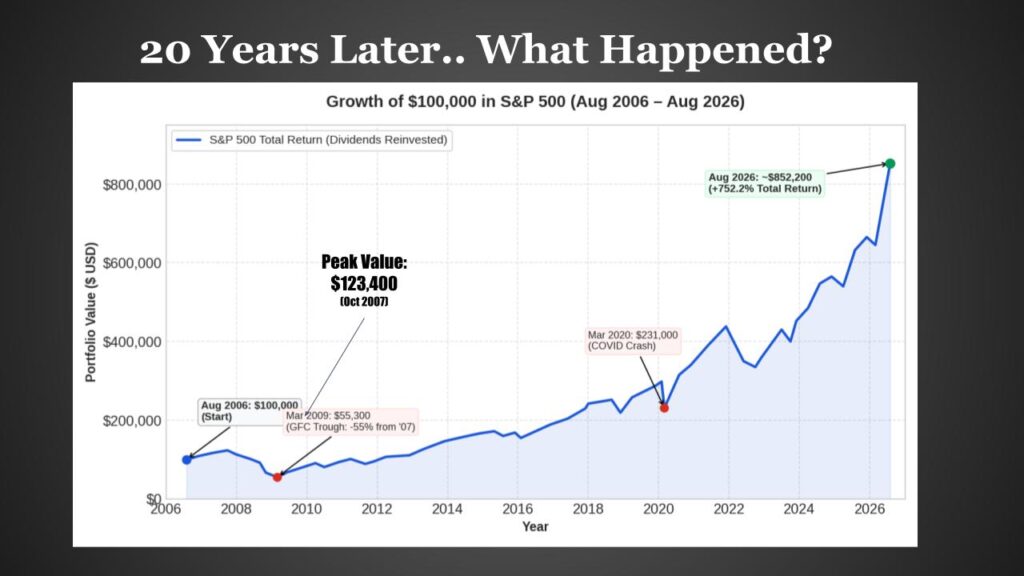
The Great Financial Crisis (2008): While not a technology bubble, the GFC stemmed from irrational exuberance in the housing market, fueled by subprime lending and complex financial instruments. The S&P 500 Index lost approximately 57% from its peak in October 2007 to its trough in March 2009. This crisis underscored the systemic risks associated with unchecked speculation and inadequate regulation.

Despite the severity of these downturns, historical data reveals a persistent upward trend in global markets over the long term. For instance, a hypothetical $100,000 investment in a broad market index in 2006, even accounting for the GFC and the brief but sharp COVID-19 crash in 2020, would have appreciated significantly over the subsequent two decades. This enduring growth highlights the market’s capacity for recovery and long-term value creation, often overshadowing temporary periods of volatility when viewed through a wider lens.
Beyond Financial Metrics: Global Progress and Productivity
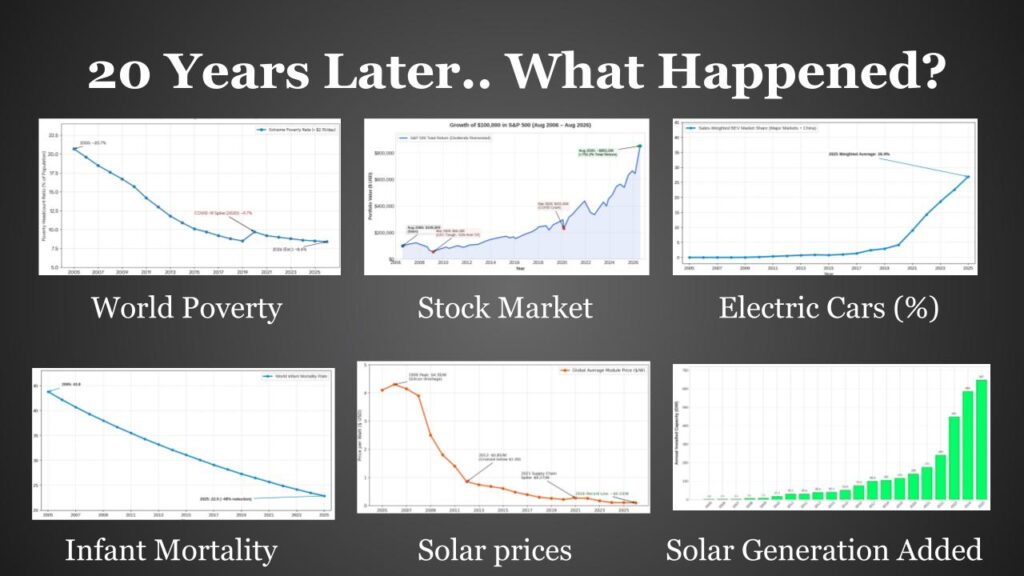
The narrative of perpetual market anxiety often overlooks broader indicators of human progress. Over the past two decades, concurrent with significant market events, the world has witnessed remarkable advancements:
- Poverty Reduction: The percentage of people living in extreme poverty globally has dramatically fallen, from over 20% in 2005 to approximately 8% today, a testament to global economic growth and development initiatives.
- Improved Health Outcomes: Infant mortality rates have been halved, reflecting advancements in healthcare, sanitation, and nutrition worldwide.
- Clean Energy Transition: Solar power technology has become approximately 40 times cheaper, making clean energy increasingly competitive. In the past year alone, new solar generation capacity equivalent to 647 nuclear power plants was added, underscoring a significant shift towards sustainable energy sources.
- Electric Vehicle Adoption: Sales of pure electric vehicles have surged from negligible numbers to roughly a quarter of all new cars sold globally last year, with some nations like Norway approaching 100% adoption, signaling a profound transformation in transportation.
These advancements underscore a fundamental economic principle: prosperity fundamentally derives from productivity. The financial system and stock market, while crucial mechanisms for capital allocation and wealth creation, are ultimately reflections of underlying human ingenuity and productive capacity. When a system faces a crisis, societies possess the tools and resilience to adapt, innovate, and reconstruct. The core drivers of economic well-being—human labor, intellectual capital, and technological innovation—persist and evolve, irrespective of temporary market fluctuations.
AI, in this context, is viewed by many as a powerful new "cognitive nail gun." It represents a tool that can drastically boost efficiency and productivity across numerous sectors by automating complex cognitive tasks. This amplification of human and machine capabilities holds the potential to unlock new levels of economic growth, create novel industries, and solve previously intractable problems.
Implications for Labor and Wealth Distribution

While the productivity gains from AI are considerable, the technological shift is not without challenges. AI, like previous waves of automation (e.g., industrial machinery, personal computers, the internet), is expected to displace workers in certain roles, particularly in entry-level office jobs, software development, and potentially transportation. However, history suggests that such disruptions often lead to the creation of new industries and job categories that were previously unimaginable. The internet, for example, initially sparked fears of job losses but ultimately fueled a massive digital economy that created millions of new roles.
A critical economic implication is the potential for further wealth concentration. New technologies frequently reward those who own the underlying intellectual property, infrastructure, and early-adopting enterprises. Shareholders of major technology firms stand to benefit significantly from AI-driven efficiency gains. This trend raises important questions about equitable distribution of prosperity and the need for adaptive social and economic policies to manage these shifts.

Investor Psychology and Overcoming Market Fear
Beyond economic fundamentals, investor behavior plays a significant role in market dynamics. Human beings are inherently wired for danger detection, a trait that served survival in ancestral environments. However, in modern financial contexts, this evolutionary predisposition can manifest as excessive fear and anxiety, often amplified by the 24/7 news cycle. Financial media, by its nature, often prioritizes sensational and alarming narratives, contributing to a pervasive sense of apprehension among investors.

This "fear itself" can lead to irrational decision-making, such as selling assets during market downturns, thereby locking in losses and missing subsequent recoveries. Behavioral economics identifies several biases at play:
- Loss Aversion: The psychological tendency to prefer avoiding losses over acquiring equivalent gains.
- Recency Bias: Overemphasizing recent events while underestimating the significance of long-term trends.
- Anchoring Bias and Contrast Effect: Evaluating current conditions based on arbitrary reference points or comparing them unfavorably to perceived past highs, rather than objective fundamentals.
To counter these biases, financial experts advocate for a disciplined, long-term investment strategy, typically involving diversified portfolios and consistent contributions, irrespective of short-term market noise. Acknowledging that market volatility is normal and that progress is often made despite perceived crises can help investors maintain perspective. Cultivating a mindset of resilience—the ability to adapt to any new situation—is crucial. This involves focusing on continuous learning, taking proactive steps, and seeking objective information rather than succumbing to fear-mongering.

Embracing Change as an Experiment
Viewing major technological shifts, such as the advent of AI, as "grand experiments" rather than existential threats can foster a more constructive approach. This perspective encourages curiosity, learning, and proactive engagement. For individuals, this means understanding the capabilities of AI, exploring its applications, and adapting skills to leverage new tools. For policymakers, it involves developing frameworks that maximize the benefits of AI while mitigating its risks, including addressing job displacement and ensuring ethical deployment.

The current AI boom, like the internet revolution before it, presents both opportunities and challenges. While speculative excesses may lead to market corrections, the underlying technological advancements are poised to drive substantial productivity gains and reshape the global economy. By understanding historical patterns, focusing on fundamental economic drivers, and cultivating a rational, resilient mindset, investors and individuals can navigate this transformative era with greater confidence and optimism.

