
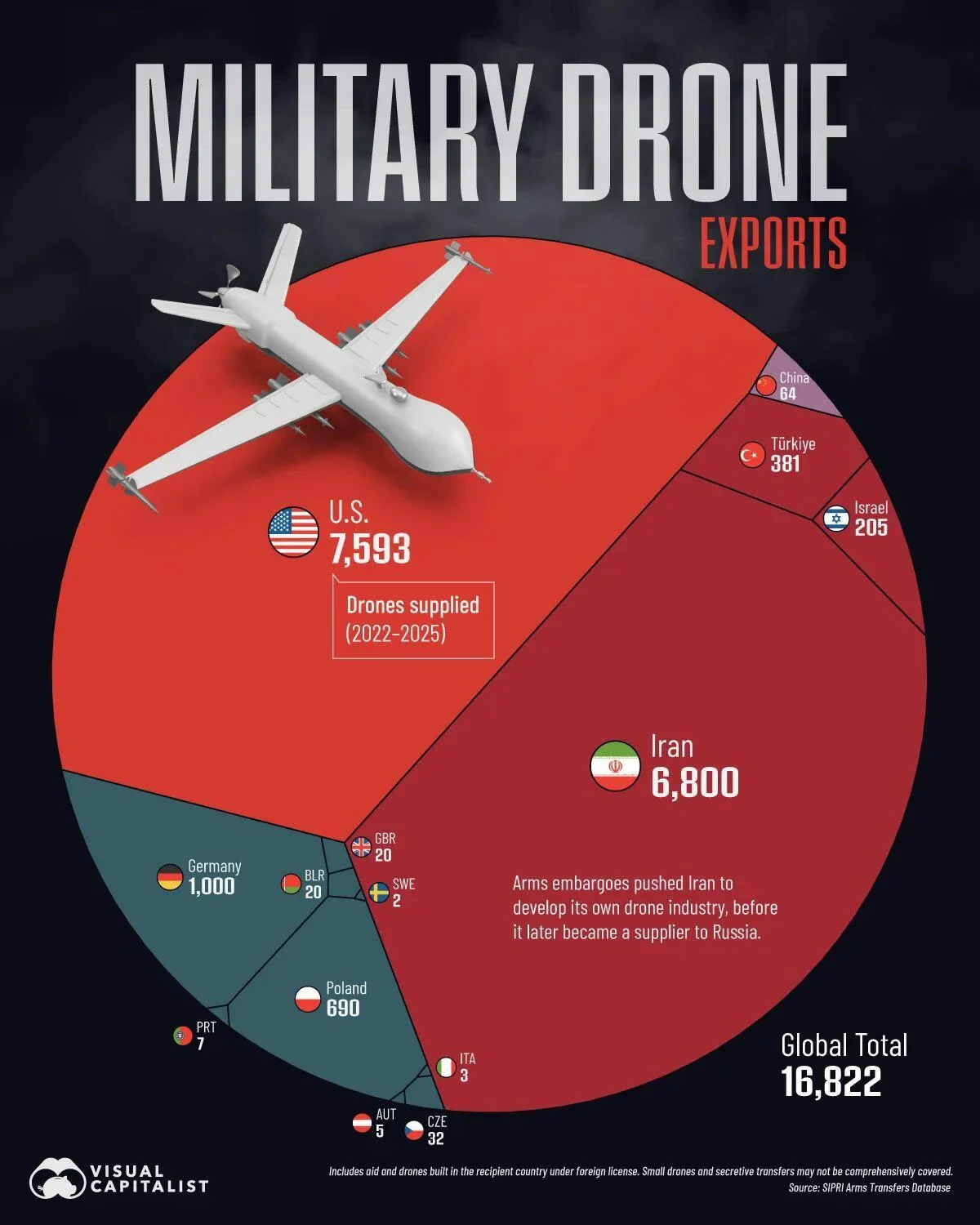
The global landscape of military drone proliferation has undergone a dramatic transformation between 2022 and 2025, with data from the Stockholm International Peace Research Institute (SIPRI) revealing an unprecedented concentration of exports from just two nations: the United States and Iran. Together, these two countries supplied a staggering 86% of the 16,822 military drones exported worldwide during this four-year period. The U.S. led with 7,593 units, accounting for 45.1% of the global total, closely followed by Iran, which exported 6,800 units, representing 40.4%. This dominance underscores a critical shift in defense capabilities and geopolitical alignments, largely driven by the demands of ongoing conflicts, particularly the war in Ukraine. While other nations like Germany, Poland, and Türkiye contributed to the market, their volumes paled in comparison to the two leading exporters, highlighting a highly bifurcated supply chain for these increasingly vital weapons systems.
The Bifurcated Global Drone Market: US to Ukraine, Iran to Russia
The vast majority of these exports were directed towards specific conflict zones, illustrating the direct impact of geopolitical tensions on arms transfers. An overwhelming 95% of U.S. drone exports during this period were sent to Ukraine, primarily as military aid to bolster its defense against the Russian invasion. These transfers were crucial in equipping Ukrainian forces with modern reconnaissance and attack capabilities, playing a significant role in shaping battlefield dynamics. Conversely, nearly all (99%) of Iran’s drone exports were directed to Russia, providing Moscow with critical offensive capabilities, particularly in the form of one-way attack drones. This stark division in recipients highlights a weaponized proxy dynamic, where the two primary global drone suppliers are effectively arming opposing sides of a major international conflict.
The total volume of 16,822 military drones exported by 14 countries globally between 2022 and 2025 marks a substantial increase in the trade of these systems. Beyond the top two, Germany ranked third with 1,000 units (5.9%), followed by Poland with 690 units (4.1%), and Türkiye with 381 units (2.3%). Israel, a long-standing pioneer in drone technology, exported 205 units (1.2%), while China, despite its robust domestic production, accounted for only 64 units (0.4%) in exports. The remaining seven exporting nations, including Czechia, Belarus, the UK, Portugal, Austria, Italy, and Sweden, contributed a combined total of fewer than 100 units, demonstrating the significant gap between the leading powers and the rest of the market.
Evolving Export Patterns: US Fluctuation and Iran’s Consistency
The export patterns of the United States and Iran exhibited distinct trends over the four-year period. U.S. military drone exports saw a dramatic surge and subsequent decline. Starting with 1,010 units in 2022, shipments increased significantly to 2,962 in 2023 and peaked at 3,219 in 2024. However, 2025 witnessed a sharp reduction, with U.S. exports plummeting to just 402 units. This decline in 2025 largely coincided with a period where new U.S. military aid packages to Ukraine faced legislative hurdles and came to a temporary halt, underscoring the direct correlation between political decisions and arms transfer volumes. The majority of U.S. drones shipped in 2025, specifically 291 loitering munitions, were destined for Taiwan, which has emerged as a significant importer of military drones amidst rising regional tensions. Ukraine still received 100 U.S.-made loitering munitions that year, but these were notably paid for by the United Kingdom, further illustrating the shift in direct U.S. supply.
In contrast, Iran maintained a remarkably consistent export volume after an initial ramp-up. From 735 units in 2022, Iranian exports rose to 2,031 in 2023 and remained stable at 2,032 in 2024 and 2,002 in 2025. This steady flow positioned Iran as the largest exporter in 2025 by a significant margin, solidifying its role as a consistent supplier to its strategic partners. This sustained output reflects Iran’s long-term investment in its indigenous drone industry, developed partly in response to stringent international arms embargoes that tightened over time before their expiration in 2020. The ability to maintain such a consistent supply, often involving the transfer of technology for licensed production in buyer countries like Russia for its Shahed-136 drones, demonstrates the maturity and strategic importance of Iran’s drone program.
The Rise of One-Way Attack Drones and Loitering Munitions
A critical insight from the SIPRI data is the prevalence of one-way attack drones and loitering munitions, which constituted 97% of the global total. These systems, designed for a single strike before being destroyed, represent a cost-effective and often decisive tool in modern warfare. Their high volume explains how a relatively small number of wartime transfers can rapidly accumulate into thousands of units. Every drone the U.S. sent to Ukraine during this period, for instance, was of this disposable type, highlighting their perceived utility and strategic value in high-intensity conflicts. Examples include the Switchblade series and Phoenix Ghost drones, which have been widely deployed for tactical strikes against Russian forces.
The adoption of these systems has had a profound impact on battlefield tactics. Loitering munitions, often referred to as "kamikaze drones," provide forces with precision strike capabilities against fleeting targets, enabling rapid response and reducing risk to personnel. Their relatively low cost compared to traditional missiles or manned aircraft makes them attractive for sustained campaigns. However, their proliferation also raises concerns about escalation, target discrimination, and the changing nature of military accountability. The sheer numbers involved also indicate a shift from traditional, reusable combat aircraft to an expendable, distributed strike capability, which can overwhelm conventional air defenses.

Turkey’s Strategic Niche: Diversified Reach and Advanced Systems
While the U.S. and Iran dominated in sheer numbers, Türkiye carved out a unique and strategically important position in the global drone market. Ranking fifth by the number of drones exported (381 units), Türkiye distinguished itself by having the most diversified customer base. It supplied military drones to 28 countries from 2022 to 2025, representing more than half of the 54 countries that imported military drones during this period. This is nearly three times the customer reach of the U.S. or China, which each supplied 10 countries.
Türkiye’s buyers are geographically diverse, spanning 12 countries in Africa, as well as NATO members like Poland and Romania, and other strategic partners such as Pakistan, Kuwait, and Ukraine. This wide distribution reflects Türkiye’s successful defense diplomacy and the proven combat effectiveness of its flagship drone, the Bayraktar TB2. Unlike the predominantly one-way attack drones exported by the U.S. and Iran, approximately three-quarters of Türkiye’s exports were larger, multi-mission aircraft like the TB2. These drones are designed for repeated missions involving intelligence, surveillance, reconnaissance (ISR), and precision strikes, offering a different set of capabilities to importing nations. Türkiye supplied 281 of the 486 larger drone aircraft exported worldwide, accounting for 58% of this category.
This distinction is crucial when evaluating market influence. SIPRI uses a second metric, the Trend-Indicator Value (TIV), which assigns a standardized value to weapons based on their production cost and military capability, rather than just unit count. By this measure, which better reflects the military capability transferred, Türkiye was the largest drone exporter of the period. This highlights that while its unit numbers were lower, the qualitative impact of its exports, primarily larger and more sophisticated platforms, was significantly higher. The success of Turkish drones in various conflicts, including Nagorno-Karabakh, Libya, and Ukraine, has significantly boosted their international appeal, positioning Türkiye as a key player in the market for advanced, reusable Unmanned Aerial Vehicles (UAVs).
The Broader Landscape and Other Key Exporters
Beyond the top two, and Türkiye’s unique role, other nations also contributed to the global drone market, albeit on a smaller scale. Germany’s 1,000 drone exports, all delivered in 2025, were exclusively loitering munitions sent to Ukraine as aid, partly filling the gap left by the reduction in U.S. supplies. This demonstrates European efforts to bolster Ukraine’s defense capabilities independently. Poland, with 690 units, also contributed to the European drone supply chain, potentially leveraging its growing defense industry and regional alliances. Israel, a long-established leader in drone technology, exported 205 units, likely comprising a mix of reconnaissance and attack drones, continuing its role as a specialized supplier to various nations.
China, despite its advanced drone manufacturing capabilities and significant domestic market, registered only 64 exports. This relatively low figure could be attributed to several factors, including a focus on domestic requirements, strategic export controls, or a preference for larger, more complex systems that are fewer in number but higher in TIV. The collective contribution of the bottom seven exporters — Czechia, Belarus, the UK, Portugal, Austria, Italy, and Sweden — amounted to only 89 drones, underscoring the highly concentrated nature of the military drone export market.
Geopolitical Implications and Future Outlook
The overwhelming dominance of the U.S. and Iran in military drone exports, coupled with their direct involvement in arming opposing sides of a major conflict, carries significant geopolitical implications. It solidifies existing alliances and exacerbates rivalries, turning the global drone market into a key arena for strategic competition. The widespread availability of these systems, particularly the cost-effective one-way attack drones, lowers the barrier to entry for states and non-state actors alike, potentially leading to increased instability in various regions. The consistent supply from Iran to Russia, in particular, raises concerns about the effectiveness of international sanctions and the resilience of illicit arms networks.
The future of military drone exports is likely to see continued growth and diversification. The lessons learned from the Ukraine conflict, where drones have played an unprecedented role in reconnaissance, targeting, and direct engagement, will undoubtedly influence future defense doctrines and procurement strategies worldwide. Demand for both sophisticated multi-mission UAVs and high-volume, disposable loitering munitions is expected to remain high. Furthermore, advancements in artificial intelligence, swarm technology, and counter-drone systems will continue to shape the development and deployment of these weapons. The role of countries like Türkiye, which offer a different class of drones and a broad customer base, will become increasingly important in providing alternatives to the U.S.-Iran duopoly, potentially fostering a more diversified and competitive market in the years to come. The period of 2022-2025 will be remembered as a pivotal moment, marking the true emergence of military drones as a central and transformative element of global warfare and international security.

