
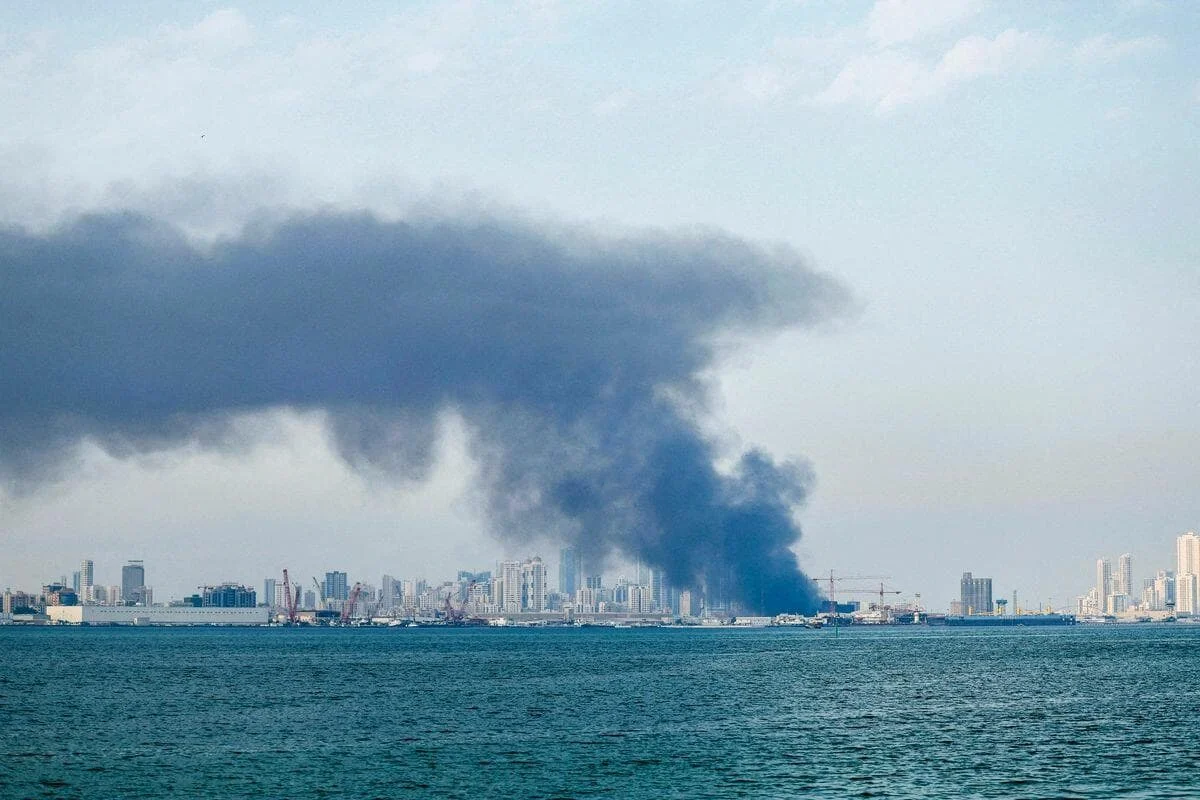
The United States Navy is undertaking a comprehensive evaluation of the future of its crucial Middle East headquarters, Naval Support Activity Bahrain (NSA Bahrain), following significant damage sustained during recent months of escalated conflict with Iran. This strategic reassessment comes after a period of intense hostilities that saw Iranian forces targeting the Bahrain-based installation, prompting a high-level review of the viability and sustainability of current U.S. military outposts in the region.
Escalation and Damage Assessment
The confirmation of extensive damage to NSA Bahrain came directly from acting Navy Secretary Hung Cao on September 9, during an interview conducted as he concluded a visit to a shipyard in Philadelphia. Cao stated unequivocally, "They blew the hell out of Bahrain," marking the first direct and official acknowledgment of the severe impact on the facility. This statement followed earlier indications from open-source imagery that suggested the naval base had suffered considerable damage. The attacks by Iranian forces commenced shortly after U.S. and Israeli forces launched strikes on Iran on February 28, initiating a retaliatory cycle that has profoundly affected the operational landscape for U.S. forces in the Middle East.
Naval Support Activity Bahrain: A Strategic Nexus
For decades, NSA Bahrain has served as the bedrock of U.S. naval operations in the Middle East, functioning as the headquarters for the U.S. Naval Forces Central Command (NAVCENT) and the U.S. Fifth Fleet. Established in 1993, the base is strategically located in Manama, Bahrain, providing a critical logistical and operational hub for maintaining maritime security, conducting counter-terrorism operations, and safeguarding vital shipping lanes, including the Strait of Hormuz – a choke point through which a significant portion of the world’s oil supply passes. The base supports a diverse array of naval assets, including warships, aircraft carriers, destroyers, and patrol boats, and houses thousands of U.S. military personnel, civilian employees, and their families. Its importance extends beyond naval operations, acting as a regional command center for intelligence gathering, diplomatic outreach, and joint exercises with allied nations. The robust infrastructure, including piers, maintenance facilities, administrative buildings, and housing units, underscores its role as an indispensable asset for projecting U.S. power and ensuring regional stability. The disruption to such a central hub, therefore, carries profound operational and strategic implications for the entirety of U.S. interests in the region.
A Chronology of Conflict and Consequences
The recent escalation traces its roots to the U.S. and Israeli strikes on Iran on February 28. While the precise nature and targets of these initial strikes remain subject to classified details, they were widely understood to be in response to or pre-emptive actions against Iranian-backed threats or activities in the region. Immediately following these strikes, Iranian forces initiated a series of retaliatory attacks, with NSA Bahrain becoming a primary target.
The intensity of these attacks led to significant damage at the base, necessitating the displacement of personnel. At a Navy town hall event on August 31, a sailor who had been affected by the events at NSA Bahrain directly questioned Chief of Naval Operations Adm. Daryl Caudle regarding the return of personal belongings left on the base. Adm. Caudle’s response indicated the severity of the situation and the uncertainty surrounding the base’s immediate future: he confirmed that while the service was developing a plan to reunite personnel with their possessions, there were no plans to return to the base "anytime soon." This official stance, reiterated by acting Secretary Cao’s later comments, underscores the operational pause and strategic rethinking currently underway.
Beyond the physical damage to the base, the ongoing conflict has exerted considerable pressure on deployed forces. Reports emerged last month detailing the strains faced by the crew of the aircraft carrier USS Abraham Lincoln, which had been supporting combat operations in the Middle East for months. The Navy acknowledged that combat actions had disrupted traditional supply hubs in the region, posing logistical challenges. Despite these disruptions, the service maintained that the Lincoln’s crew continued to have access to essential resources, including clean water, healthy meal options, and functional air conditioning, highlighting efforts to mitigate the impact on personnel welfare amidst a challenging operational environment. In the past week, U.S. forces reported striking 10 Iran-linked tankers, identified as part of a shadow network, in retaliation for ongoing Iranian missile attacks targeting U.S. warships, further illustrating the dynamic and dangerous nature of the current conflict.
The Evolving Threat Landscape
The recent attacks on NSA Bahrain highlight a significant shift in the capabilities and tactics employed by Iran and its proxy forces. Retired Army Gen. David Petraeus, who previously led the U.S. Central Command (CENTCOM), responsible for U.S. military operations in the Middle East, articulated this change in an interview with The Cipher Brief last month. Petraeus stated unequivocally that the current U.S. military outposts in the region "are no longer viable" in the face of the evolved threat.
This assessment is largely driven by Iran’s substantial advancements in its drone and missile programs. Over the past decade, Iran has invested heavily in developing a diverse arsenal of unmanned aerial vehicles (UAVs) and ballistic and cruise missiles, significantly enhancing their range, precision, and destructive power. These capabilities include a vast inventory of sophisticated drones, such as the Shahed series, known for their extended range and ability to carry substantial payloads, as well as various short- and medium-range ballistic missiles capable of striking targets across the Persian Gulf. The proliferation of these weapons, coupled with Iran’s willingness to deploy them directly or through proxies, has fundamentally altered the security calculus for fixed installations like NSA Bahrain.
Petraeus noted that the current commander for U.S. forces in the region, Adm. Brad Cooper, has largely overseen recent combat operations from a distance, rather than from CENTCOM’s forward headquarters at the Al Udeid Air Base in Qatar. This operational adaptation is a direct consequence of the increased risk posed by Iranian capabilities. "This is a result of the Iranians having capabilities they didn’t have before, in terms of the numbers of drones and the numbers of missiles with the range required to hold our facilities at risk and to strike them and to kill our soldiers and wound them," Petraeus explained. The ability of Iran to project power accurately and with significant destructive potential means that traditional, large, fixed bases now present readily identifiable and vulnerable targets, compelling a re-evaluation of force protection strategies and overall operational footprint. Throughout the conflict, U.S. forces have been actively engaged in efforts to degrade these Iranian capabilities, targeting missile launchers, drone production facilities, and storage sites, yet the persistent threat remains a critical factor in strategic planning.
Rethinking U.S. Force Posture in the Middle East
The damage to NSA Bahrain and the evolving threat landscape have intensified a long-standing debate within U.S. defense circles regarding the efficacy and safety of maintaining large, fixed military installations in volatile regions. Jim Webb, a U.S. Marine infantry veteran and independent national security consultant, echoed Petraeus’s concerns, stating that Cao’s comments suggest the current U.S. force posture in the Middle East "is unsustainable without continuing to be under attack." Webb argued, "I don’t think there’s any way, you know, in the short, medium, or potentially even long term, that we can adequately defend a place like NSA Bahrain, or let alone the rest of the logistics bases there." He further elaborated that keeping U.S. troops at such bases effectively makes them "constant targets," a situation deemed unacceptable for troop safety and operational effectiveness.

This perspective fuels arguments for a fundamental shift in U.S. military strategy, moving away from large, static footprints towards more agile, distributed, and resilient operational models. Such a shift could involve:
- Dispersed Operations: Spreading forces and critical assets across multiple, smaller, and less conspicuous locations, making it harder for adversaries to target effectively.
- Mobile Platforms: Increased reliance on naval vessels (like aircraft carriers and expeditionary ships) and air assets that can operate from international waters or airspace, offering greater flexibility and reducing vulnerability to land-based attacks.
- Enhanced Hardening and Defense: While challenging, investing in advanced air and missile defense systems, underground facilities, and robust hardening for critical infrastructure at any retained bases.
- Forward Staging and Logistics: Utilizing a network of smaller, temporary logistics hubs that can be quickly established and dismantled, rather than relying on a single, massive supply chain node.
- Remote Command and Control: Further decentralizing command functions, as observed with Adm. Cooper operating remotely, to ensure continuity of operations even if forward headquarters are compromised.
The implications of such a strategic pivot are vast, impacting everything from procurement and training to diplomatic relations with host nations. It necessitates a re-evaluation of how the U.S. projects power and maintains influence in a region characterized by persistent threats and shifting geopolitical dynamics.
Broader Implications for Regional Security and Diplomacy
The potential restructuring of the U.S. military presence in Bahrain carries significant geopolitical ramifications for regional security and U.S. diplomatic efforts. Bahrain, a key non-NATO ally, has been a steadfast partner to the U.S. for decades, hosting not just NSA Bahrain but also a U.S. Air Force contingent. The damage to the naval base and the subsequent U.S. evaluation could send mixed signals to regional allies who rely on a strong and visible American military presence as a deterrent against Iranian aggression and a guarantor of stability.
A diminished or relocated U.S. footprint might be perceived by some allies as a reduction in commitment, potentially encouraging greater assertiveness from Iran and its proxies. Conversely, it could also spur regional partners to enhance their own defense capabilities and foster stronger multilateral security arrangements. The Bahraini government, while not issuing direct public statements on the damage, is likely engaged in intense private consultations with U.S. officials, navigating the delicate balance between sovereign concerns and the strategic benefits of hosting U.S. forces. Any decision on NSA Bahrain’s future will undoubtedly be made in close consultation with Manama to preserve the long-standing bilateral relationship.
For Iran, the successful targeting of a major U.S. base could be viewed as a significant propaganda victory, validating its investment in asymmetric warfare capabilities. It underscores Tehran’s strategy of demonstrating its ability to inflict costs on U.S. interests, aiming to deter more aggressive U.S. or Israeli actions. The ongoing conflict also risks further destabilizing critical maritime trade routes in the Persian Gulf, potentially impacting global energy markets and supply chains. Maintaining freedom of navigation, a core mission of the Fifth Fleet, becomes increasingly challenging when key operational bases are compromised and naval assets face direct threats. The broader diplomatic challenge lies in finding a pathway to de-escalation while simultaneously ensuring the security of U.S. personnel and assets and reassuring allies of enduring U.S. commitment to regional stability, albeit through potentially new operational paradigms.
Financial and Logistical Challenges Ahead
The "task force" mentioned by acting Navy Secretary Cao underscores the complex financial and logistical hurdles that lie ahead. The evaluation will weigh the costs and benefits of repairing NSA Bahrain versus the alternatives of relocation or adopting a fundamentally different operational model.
Repairing a base of NSA Bahrain’s size and complexity, after sustaining significant damage, would entail substantial financial investment. The costs would encompass not only structural repairs to buildings, piers, and infrastructure but also the potential upgrade of defensive systems to counter the advanced drone and missile threats. This could run into hundreds of millions, if not billions, of dollars, depending on the extent of the damage and the scope of the required upgrades. Furthermore, the timeline for such repairs would likely be extensive, potentially keeping the base offline for years, during which alternative arrangements would still be necessary.
Alternatively, relocating the primary headquarters of the Fifth Fleet would represent an even more monumental undertaking. Identifying a suitable alternative location in the region, securing agreements with a new host nation, and constructing new facilities from scratch would be an incredibly expensive and time-consuming endeavor. The logistical challenges of moving thousands of personnel, vast quantities of equipment, and critical command-and-control infrastructure are immense. Moreover, such a move would require careful consideration of strategic positioning, access to key waterways, and political stability of the potential new host.
The decision will undoubtedly be influenced by a comprehensive cost-benefit analysis that considers not only monetary figures but also strategic resilience, personnel safety, and long-term operational effectiveness in the face of evolving threats. The Navy’s task force will need to present viable options that align with the Pentagon’s broader defense strategy and budget priorities, ensuring that the U.S. maintains a robust and adaptable presence capable of meeting the challenges of a rapidly changing Middle East security environment. The current situation in Bahrain thus serves as a critical test case for the future of forward-deployed U.S. military assets worldwide.
The ongoing assessment of NSA Bahrain is more than a logistical challenge; it is a profound strategic reckoning for the U.S. Navy and the Pentagon. The damage inflicted by Iranian forces has forced a critical examination of the vulnerabilities of traditional fixed military installations in an era of advanced, asymmetric threats. The decisions made regarding NSA Bahrain’s future will not only reshape the U.S. military’s footprint in the Middle East but will also establish precedents for how the United States adapts its global defense posture to counter evolving challenges and ensure the safety of its personnel and the effectiveness of its operations worldwide.

