

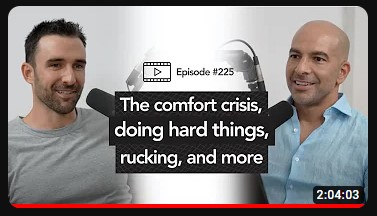
The contemporary human experience, often characterized by unprecedented levels of material comfort and technological convenience, is increasingly under scrutiny for its profound impact on physical and mental well-being. This phenomenon, provocatively termed "The Comfort Crisis" by author Michael Easter, suggests that society’s relentless pursuit of ease may paradoxically be undermining human resilience, fostering widespread dissatisfaction, and contributing to a myriad of public health challenges. Easter’s seminal work, gaining significant traction through platforms like Dr. Peter Attia’s widely listened-to podcast, presents a compelling argument that many modern ailments stem not from a lack of resources or opportunities, but from an overabundance of comfort that detaches individuals from their inherent need for struggle and challenge.
The Genesis of an Idea: Michael Easter’s Personal and Professional Journey

The inspiration behind "The Comfort Crisis" is deeply rooted in author Michael Easter’s personal journey and professional observations. A former writer for Men’s Health magazine, Easter witnessed firsthand the societal trends contributing to declining physical and mental fortitude. Crucially, his own battle with alcohol addiction, a struggle that had plagued generations of his family, provided a profound lens through which to examine the seductive yet destructive nature of excessive comfort. His recovery, a testament to overcoming significant personal hardship, endowed him with a unique perspective on the intricate balance between comfort and struggle, and how this dynamic shapes human behavior and well-being. This personal crucible, combined with his journalistic curiosity, propelled him to explore the broader societal implications of our increasingly comfortable lives.
Defining the "Comfort Crisis": A Counter-Narrative to Modern Woes
In an era frequently defined by headlines decrying crises of debt, health, and social discord, Easter posits a radical counter-narrative: that these issues are often symptoms of a deeper "comfort crisis." Far from facing insurmountable hardships, many individuals in developed nations, particularly in the United States, are grappling with the consequences of systemic overindulgence and an almost pathological avoidance of discomfort. This perspective resonates strongly with philosophies like "Mustachianism," which has long advocated for intentional living, questioning consumerist norms, and embracing a simpler, more challenging existence to achieve financial independence and overall life satisfaction. The central tenet is that by deliberately reintroducing elements of hardship and challenge into daily life, individuals can cultivate greater resilience, appreciation, and a profound sense of purpose.

The Problem-Seeking Brain: A Fundamental Human Tendency
One of the book’s most illuminating insights delves into a fundamental aspect of human psychology: the brain’s innate tendency to scan its environment for problems, irrespective of how safe or idyllic that environment may be. Scientific research in cognitive psychology and neurobiology has consistently demonstrated this adaptive mechanism, which, while crucial for survival in ancestral environments, becomes maladaptive in modern, highly comfortable settings. Studies, for example, have shown that as external threats diminish, individuals do not necessarily become more content; instead, their threshold for what constitutes a "problem" lowers. This leads to the phenomenon of "problem inflation," where minor inconveniences are elevated to significant stressors, and trivial issues become sources of profound anxiety and complaint.
This psychological tendency has far-reaching implications. In societal terms, it can manifest as excessive nitpicking in community forums, heightened political polarization over minor "wedge issues," and a general amplification of grievances. Instead of fostering gratitude for an unprecedented era of peace and prosperity, this mechanism can breed perpetual dissatisfaction, driving individuals and communities to invent or exaggerate problems where none truly exist. Conversely, those who face genuine hardship, such as communities in war zones, often exhibit remarkable resilience and a pragmatic acceptance of their circumstances, recalibrating their "problem threshold" to real, existential threats. This adaptive capacity highlights the human potential to thrive under adversity and the detrimental effects of its absence.
Nature’s Prescription: The Restorative Power of the Outdoors
"The Comfort Crisis" also provides compelling arguments for the vital role of nature in human well-being, contrasting it sharply with the debilitating effects of modern, sedentary lifestyles characterized by cubicles and constant driving. The book highlights the scientifically proven benefits of spending time in natural environments, a concept often referred to as "forest bathing" or "ecotherapy." Research in environmental psychology and public health has consistently shown that exposure to nature can significantly reduce stress, lower blood pressure, improve mood, enhance cognitive function, and even accelerate physical healing.
For instance, studies have demonstrated that simply placing a plant in a hospital room can measurably improve patient recovery rates. Extending this principle, prolonged immersion in a vibrant forest environment offers a potent form of "medicine" that resonates with our biological wiring. The complex sensory input – the rustle of leaves, the scent of earth, the dappled sunlight – triggers ancient neural pathways, fostering a sense of calm and rejuvenation. In contrast, the sterile, artificial environments of modern urban life often contribute to chronic stress, mental fatigue, and a host of physical ailments, underscoring the critical need to reintegrate natural experiences into our daily routines.

The Paradox of Exertion: Embracing Physical Challenge for Greater Well-being
Another key tenet of Easter’s work is the exploration of humanity’s peculiar aversion to physical exertion, despite its immense, scientifically validated benefits. The book starkly illustrates this with an observation: a mere 2% of people choose the stairs when an escalator is available. This tendency towards the path of least resistance, while seemingly innocuous, exacts a staggering cost on individual and public health.
Physical activity, far from being a mere aesthetic pursuit, is a fundamental requirement for human physiological and psychological flourishing. Regular movement, particularly incorporating heavy load-bearing and bursts of intense exertion, is a potent preventative measure against a vast array of diseases, from cardiovascular issues and diabetes to mental health disorders like depression and anxiety. These benefits are not speculative; they are extensively documented through decades of medical and exercise science research. The "comfort crisis" fosters a lifestyle of physical inactivity, leading to widespread chronic illness and a dependence on pharmaceutical interventions that often address symptoms rather than root causes. By deliberately choosing the "harder" option – walking, cycling, lifting, or engaging in demanding outdoor activities – individuals can unlock profound improvements in their physical vitality, mental clarity, and overall life satisfaction.

The Effort-Reward Principle: The Deep Satisfaction of Hard-Won Achievements
The psychological principle that the harder one works for something, the happier and more satisfied one will be with the outcome, forms another cornerstone of "The Comfort Crisis." This "effort-reward principle" is deeply ingrained in human psychology. When challenges are overcome through persistent effort, the brain releases neurotransmitters like dopamine, reinforcing the sense of accomplishment and making the reward feel more meaningful. This explains why a meal savored after a day of physical labor tastes incomparably better than one consumed without effort, or why a self-built project brings a unique pride unmatched by a purchased item.
In a society where instant gratification and effortless consumption are often promoted, this principle serves as a crucial reminder of the intrinsic value of struggle. It highlights that true satisfaction is often inversely proportional to the ease with which something is obtained. This perspective challenges the consumerist narrative that happiness can be bought or achieved without personal investment, advocating instead for experiences that demand effort, patience, and perseverance.

Illustrative Application: Embracing Deliberate Discomfort in the Modern Age
The principles outlined in "The Comfort Crisis" are not abstract philosophical musings; they are actionable guidelines for living. Consider the example of a modern individual, accustomed to the conveniences of urban life, embarking on a deliberate journey into purposeful hardship. Imagine them trading their comfortable home for a period of "carpentourism" in a remote mountain region, living minimally, and engaging in physically demanding construction work. Initial challenges, such as navigating difficult terrain, unexpected vehicle issues, or confronting limited amenities like indoor plumbing and a sparse food supply, might initially induce stress.
However, as days turn into a week, a transformative shift occurs. The discomfort ceases to be a source of frustration and instead becomes a catalyst for heightened awareness and a deep sense of vitality. The body adapts to the physical demands, the mind sharpens in response to problem-solving in a challenging environment, and the senses become more attuned to the natural world. Moments of simple pleasure, like a paddleboarding excursion on a remote lake without the distraction of technology, become profoundly serene and memorable. The culmination of such an experience, perhaps a simple meal after a sustained period of healthy hunger, tastes exquisitely, embodying the effort-reward principle. This firsthand embrace of controlled hardship demonstrates how individuals can consciously recalibrate their comfort thresholds, fostering resilience and discovering a richer, more meaningful existence.

Beyond Financial Independence: The Philosophy of Purposeful Hardship
The insights from "The Comfort Crisis" hold particular relevance for communities like the Financial Independence, Retire Early (FIRE) movement. While the FIRE community often excels at intentional saving and mindful consumption, there has been a recent discourse about the potential for "under-spending" or an overly restrictive approach to finances. However, Easter’s work reframes this discussion, emphasizing that "purposeful spending" should not merely entail loosening purse strings for luxury, but rather investing in experiences that challenge and enrich.
The core message is to be discerning: while it is beneficial to invest in "better tools" that enhance capabilities and facilitate productive activity, it is detrimental to acquire "softer chairs" that merely perpetuate a cycle of ease and physical inertia. The aim is to cultivate a life rich in experience and personal growth, which often necessitates embracing discomfort and foregoing superfluous conveniences. This means prioritizing outdoor adventures, skill acquisition, physical challenges, and community engagement over passive consumption and excessive leisure.

Societal Implications and the Path Forward
"The Comfort Crisis" serves as a powerful call to action, urging a reevaluation of our relationship with comfort in a world increasingly defined by its pursuit. The societal implications of widespread overindulgence are profound, contributing to escalating rates of chronic disease, mental health challenges, and a pervasive sense of dissatisfaction despite material abundance. By understanding and actively counteracting our innate biases towards ease, individuals and communities can cultivate greater resilience, foster deeper appreciation for life’s simple pleasures, and build a more robust foundation for physical and mental well-being.
The path forward involves a conscious shift in values and daily practices. It requires prioritizing regular outdoor time, integrating purposeful physical exertion into routines, embracing periods of hunger or mild discomfort, and engaging in activities that demand effort and skill. These are not exotic or niche treatments but fundamental human requirements that have been gradually eroded by modern convenience. While medical advice should always be followed for specific conditions, a proactive adoption of these "uncomfortable" yet essential practices forms the bedrock of a truly healthy and fulfilling life. As Easter’s work and countless personal testimonies suggest, by deliberately choosing the harder path, we often discover the greatest rewards and unlock our full human potential.

