
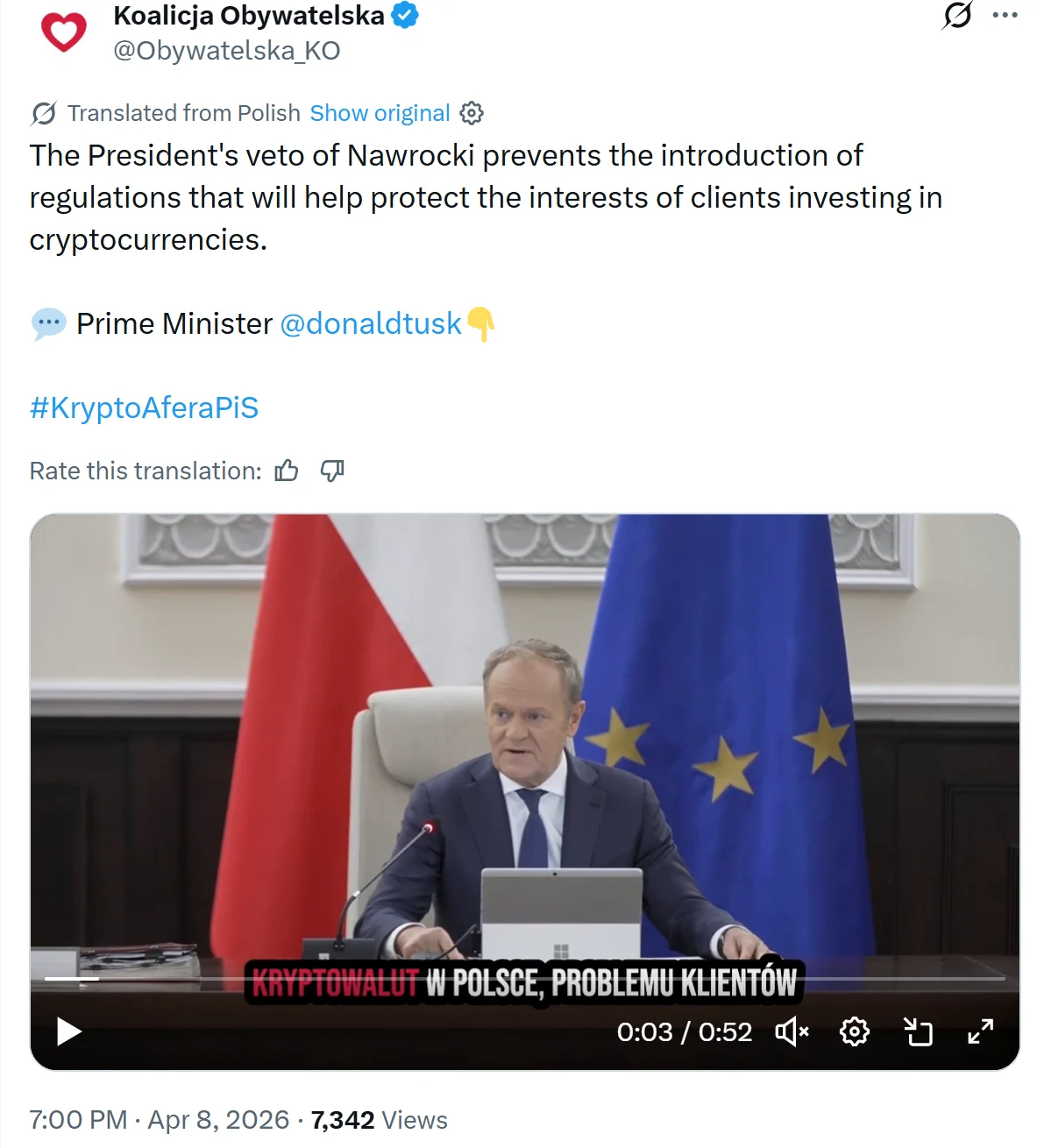
Warsaw, Poland – Poland’s parliament has once again failed to muster the necessary votes to override a presidential veto on a pivotal bill aimed at regulating the cryptocurrency market. This repeated legislative deadlock underscores a deepening political schism over the nation’s approach to digital assets, leaving Poland as the sole European Union member state yet to align its legal framework with the bloc’s comprehensive Markets in Crypto-Assets Regulation (MiCA). The latest vote, held on Friday, saw lawmakers fall short of the 263 votes required to overturn President Karol Nawrocki’s objection, with 243 Members of Parliament (MPs) voting against the veto and 191 in support, as reported by local outlet TVP World.
The proposed legislation, a cornerstone of Prime Minister Donald Tusk’s agenda, seeks to integrate Poland into the EU’s MiCA framework, which officially came into effect in 2024. MiCA is designed to establish a harmonized regulatory environment for crypto-asset service providers across the EU, covering aspects such as the issuance, authorization, and supervision of crypto-related activities. The continued absence of such regulations in Poland has raised significant concerns among government officials and industry observers, who warn of increasing risks to investors and the potential for illicit activities.
President Nawrocki has consistently defended his vetoes by articulating concerns regarding what he perceives as overly stringent regulations, a lack of sufficient transparency, and the potential for undue burdens on small and medium-sized enterprises (SMEs) operating within the nascent crypto sector. In his public statements, the President has emphasized the need for a more balanced approach that fosters innovation while safeguarding against potential pitfalls. However, this stance has been met with strong opposition from the government, which argues that the delay is creating a regulatory vacuum detrimental to market integrity.
Finance Minister Andrzej Domański has been particularly vocal about the implications of this ongoing stalemate. He has reportedly warned that the absence of clear legal guidelines risks transforming the Polish crypto market into a "playground for fraudsters," leaving both consumers and legitimate businesses vulnerable to exploitation and scams. The government’s position is that a regulated environment, while potentially presenting initial challenges, ultimately provides a more secure and predictable landscape for all participants.
This latest parliamentary vote marks the second unsuccessful attempt by the current government to push the crypto regulation bill past the presidential hurdle. A similar rejection occurred in December of the previous year, highlighting the persistent disagreement between the executive and legislative branches on this critical issue. Despite the setback, Polish lawmakers swiftly reintroduced the legislation, presenting a revised draft they claimed was an "improved" version. However, critics at the time suggested that the modifications were largely cosmetic, failing to address the core concerns raised by the President.
The repeated vetoes and subsequent reintroductions of the bill point to a complex political dynamic at play. Prime Minister Tusk’s government has made alignment with EU regulations a priority, viewing it as essential for Poland’s integration into the broader European economic and legal order. The MiCA framework, in particular, is seen as a crucial step towards creating a unified digital asset market within the EU, fostering cross-border innovation and protecting consumers from the risks associated with unregulated crypto activities.
President Nawrocki’s firm stance, however, suggests a divergence in opinion regarding the optimal regulatory approach. His concerns about excessive regulation and its potential impact on smaller businesses resonate with a segment of the market that fears stifling innovation and compliance costs. The President’s assertion that "a wrong law that passed a hundred times still remains a wrong law" underscores his commitment to his principles, even in the face of parliamentary majority support. This philosophical difference has created a significant legislative impasse, leaving Poland in a precarious regulatory position.
A Chronology of the Regulatory Standoff
The journey of the crypto regulation bill in Poland has been marked by a series of legislative attempts and presidential rejections, illustrating the depth of the disagreement.
- December [Previous Year]: The Polish parliament initially passes a bill designed to implement the EU’s MiCA regulation. President Nawrocki issues a veto, citing concerns about the bill’s provisions.
- Days Following December Veto: In response to the presidential veto, Polish lawmakers reintroduce a revised version of the crypto bill, claiming it addresses previous concerns.
- February [Current Year]: President Nawrocki vetoes the re-submitted bill for a second time, reiterating his reservations about its regulatory scope and potential impact. He publicly states his unwillingness to sign a flawed law, regardless of its parliamentary passage.
- Friday [Recent Date]: The Polish parliament holds another vote to override the President’s latest veto. The motion fails to secure the required supermajority, marking the second unsuccessful attempt by the government to push the legislation through.
This recurring pattern of legislative action and executive opposition has prolonged the period of regulatory uncertainty for the Polish crypto market.
The Broader Implications of Regulatory Uncertainty
The persistent failure to enact comprehensive crypto regulations in Poland carries significant implications for various stakeholders, including investors, businesses, and the broader economy.

For Investors: The absence of clear regulatory frameworks leaves retail and institutional investors exposed to a higher degree of risk. Without established consumer protection measures, investor recourse in cases of fraud, market manipulation, or platform insolvency is limited. This can deter both domestic and international investors from engaging with the Polish crypto market, potentially leading to capital flight and missed investment opportunities. The warning from Finance Minister Domański about the market becoming an "El Dorado for fraudsters" highlights this critical vulnerability.
For Businesses: Local cryptocurrency exchanges and service providers operating in Poland face an uncertain legal landscape. They must navigate a complex and evolving environment without the benefit of clear guidelines, potentially leading to increased compliance costs and operational challenges. Many Polish crypto firms have expressed a desire for regulatory clarity, as it provides a foundation for sustainable growth and fosters trust within the market. The fact that Poland remains the only EU member state not to implement MiCA places its domestic crypto businesses at a disadvantage compared to their counterparts in other EU countries, which can operate under a unified and predictable regulatory regime. This may incentivize companies to seek licensing and operational bases in other EU jurisdictions, leading to a potential brain drain and loss of economic activity for Poland.
For the Polish Economy: The delay in crypto regulation can hinder Poland’s ability to fully participate in the burgeoning digital asset economy. The EU’s MiCA framework aims to foster innovation and create a level playing field for crypto businesses across the bloc. By remaining outside this framework, Poland risks being marginalized in a rapidly evolving sector, potentially missing out on the economic benefits associated with the development of blockchain technology and digital assets. Furthermore, the lack of robust regulation could tarnish Poland’s reputation as a business-friendly and technologically advanced nation.
The Zonda Controversy: A Case Study in Regulatory Fallout
The political standoff over crypto regulation has also become entangled with the operations of Zonda, Poland’s largest cryptocurrency exchange. Prime Minister Tusk has publicly accused the platform of alleged links to illicit funding, citing intelligence reports that purportedly connect its origins to Russian criminal networks. This accusation has significantly heightened tensions and drawn Zonda directly into the political arena.
In response to these allegations, Zonda CEO Przemysław Kral vehemently denied the claims, characterizing them as "absurd" and "harmful to the Polish innovation market." He further stated that he is "compelled to take appropriate legal steps to protect my personal rights." The exchange’s leadership has consistently advocated for clear and fair regulation, suggesting that the current impasse is detrimental to the entire industry.
The controversy surrounding Zonda has also brought to light further complexities. Kral recently clarified that he does not control access to a significant crypto wallet, reportedly holding approximately $330 million in Bitcoin. He claims that this wallet’s access remained with the former CEO, Sylwester Suszek, who disappeared in 2022. This revelation adds another layer of intricacy to the ongoing discussions about transparency and accountability within the Polish crypto landscape.
The involvement of a prominent domestic exchange like Zonda in such a high-profile political dispute underscores the sensitive nature of cryptocurrency regulation and its potential to intersect with broader geopolitical and economic concerns. The accusations, while denied by the company, serve to amplify the urgency for a clear regulatory framework that can address such complex issues with established legal processes.
The Path Forward: Navigating the Regulatory Maze
The repeated failure of the Polish parliament to override the presidential veto on the crypto bill presents a significant challenge for the government. The core of the dispute appears to lie in differing philosophies regarding the appropriate balance between regulation and innovation. President Nawrocki’s emphasis on caution and protection for smaller entities contrasts with Prime Minister Tusk’s drive for EU alignment and market integrity.
Moving forward, a potential resolution could involve further dialogue and compromise between the President’s office and the government. This might entail refining the bill’s provisions to address specific concerns raised by the President without significantly diluting its core objectives of MiCA compliance and investor protection. Alternatively, the government may explore alternative legislative strategies or seek to build broader consensus around the necessity of timely regulatory action.
The continued delay risks not only economic disadvantages but also a potential erosion of trust in Poland’s capacity to adapt to the evolving digital landscape. As the global financial system increasingly embraces digital assets, the absence of a robust regulatory framework could leave Poland lagging behind, unable to capitalize on the opportunities and manage the risks inherent in this transformative technology. The coming months will be crucial in determining whether Poland can finally bridge the gap between its political leadership and establish a clear, consistent, and protective regulatory environment for its burgeoning cryptocurrency sector.

