

The landscape of real estate investment is significantly shaped by the regulatory environment in which properties are managed. For landlords and property investors, understanding the nuances of state and local laws is paramount, as these can directly influence profitability, operational efficiency, and overall return on investment. In 2026, a close examination of the U.S. housing market reveals five states that are consistently recognized for their landlord-friendly policies, creating an environment conducive to rental property ownership. These states often feature regulations that simplify property management, reduce operational costs, and provide robust legal frameworks for landlords.
Defining Landlord-Friendliness: More Than Just Reduced Costs
A landlord-friendly state is characterized by a legal and regulatory framework that generally favors property owners, making it easier and often more cost-effective to own and manage rental properties. This does not imply an absence of tenant protections; rather, it suggests a balance where landlord rights and operational considerations are given significant weight. These markets typically exhibit several key characteristics:
-
Low Property Taxes: Property taxes represent a substantial ongoing expense for real estate investors. In 2026, effective property tax rates across the U.S. can range from as low as 0.25% to as high as 2% of a property’s assessed value. While property taxes are often tax-deductible, higher rates in certain states can significantly erode a property’s cash flow and cap rate, impacting overall profitability. States with lower property tax burdens allow landlords to retain more of their rental income, enhancing their investment’s financial performance. For instance, a property with an assessed value of $300,000 in a state with a 0.5% property tax rate would incur $1,500 in annual taxes, compared to $6,000 in a state with a 2% rate. This difference directly affects net operating income.
-
Absence of Rent Control: Rent control policies, designed to maintain housing affordability for tenants by limiting how much landlords can charge for rent and when they can increase it, can present significant challenges for property owners. While intended to protect renters, strict rent control can stifle long-term cash flow and investment growth. When operating costs such as insurance premiums, property taxes, maintenance, and management fees escalate, landlords in rent-controlled areas may be unable to adjust rents accordingly. This can lead to deferred maintenance, reduced property upkeep, and diminished investment value, as revenue growth is capped. For new investors, the absence of rent control offers greater flexibility in pricing and revenue management.
-
Low-Barrier Entry: The process of establishing a rental property business can involve obtaining various licenses, permits, and certifications, depending on the property type, rental strategy (e.g., short-term vs. long-term rentals), and location. Some states impose stringent licensing requirements that can substantially increase upfront setup costs. Landlord-friendly states often streamline these processes, allowing investors to launch their rental property ventures with fewer bureaucratic hurdles and lower initial expenditures. This can include simplified registration processes, fewer mandatory inspections before occupancy, and more accessible business licensing.
-
No Caps on Security Deposits: Security deposits serve as a crucial financial safeguard for landlords, covering potential costs associated with unpaid rent, utility bills, property damage beyond normal wear and tear, lease violations, and professional cleaning required during tenant turnover. When states impose limits on security deposit amounts, it can leave landlords vulnerable. Damages or unpaid rent could potentially exceed the capped deposit amount, leaving the landlord to absorb the deficit. Furthermore, lower security deposits may not offer a clear indication of a tenant’s financial stability. Markets without strict caps on security deposits provide landlords with greater protection, although it is generally expected that landlords will set "reasonable" amounts.
-
Minimal or Short Notice-of-Entry Requirements: The ability to access rental properties with reasonable notice is essential for property maintenance, inspections, repairs, and showing the property to prospective tenants or buyers. Legally mandated long notice periods can complicate scheduling and potentially delay necessary work. Landlord-friendly states typically require shorter notice periods, often 24 to 48 hours, for non-emergency entry. This flexibility allows landlords to address issues promptly, conduct routine maintenance efficiently, and minimize vacancies by facilitating quicker showings.
-
Efficient Eviction Processes: While landlords strive for stable, long-term tenant relationships, eviction is a reality in property management. The eviction process can vary dramatically across the U.S., ranging from as little as three weeks to as long as six months. In states with streamlined eviction procedures, landlords can regain possession of their property more quickly, minimizing financial losses from non-payment of rent and reducing the period during which they are responsible for ongoing property expenses. Lengthy and complex eviction proceedings can be costly, not only in legal fees but also in lost rental income and potential damage to the property by disgruntled tenants. Laws that facilitate a swift and legally sound eviction process are a significant advantage for landlords.
-
Additional Landlord Rights and Protections: Beyond these core characteristics, some states offer further protections, such as no limits on late rent fees, immediate rights to dispose of abandoned property left by tenants, and state preemption laws that prevent local governments from enacting stricter rental regulations than those at the state level.
It is important to note that no single state embodies all these landlord-friendly characteristics perfectly. Often, a state’s overall landlord-friendliness is determined by a balance of these factors, and specific market conditions within a state can vary. For instance, Texas offers a relatively easy eviction process and no rent control, but it may have higher property taxes compared to other landlord-friendly states. Furthermore, the presence of major cities within a state can introduce unique local ordinances that may differ from state-level regulations, requiring investors to conduct thorough due diligence on specific municipalities.

The Top 5 Most Landlord-Friendly States in 2026
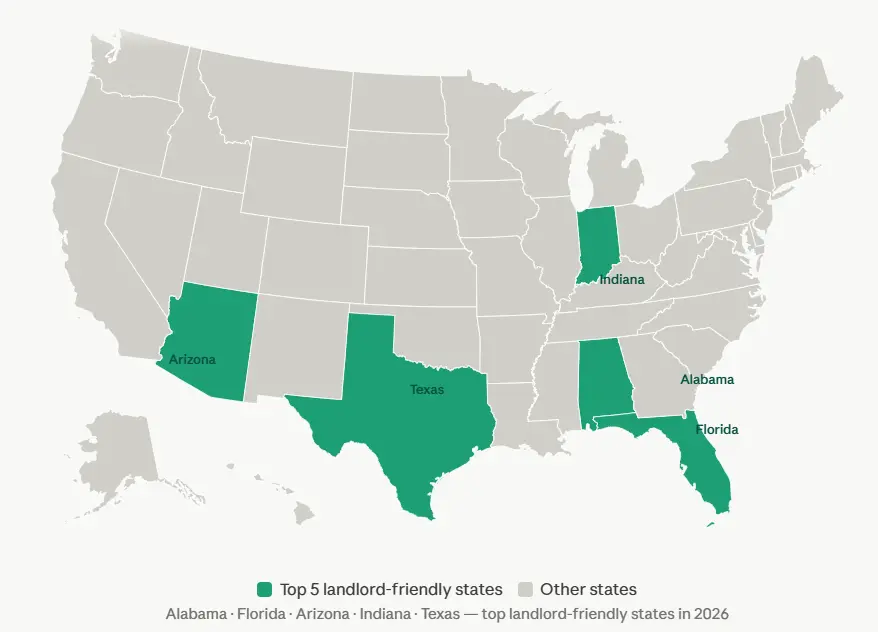
Based on an analysis of regulatory environments, tax structures, and tenant-landlord laws, the following five states stand out as particularly landlord-friendly in 2026:
Alabama
Alabama is frequently cited as one of the most landlord-friendly states due to its minimal regulations and straightforward legal framework for rental property owners.
- Low Property Taxes: Alabama generally boasts low property tax rates, making it an attractive state for investors looking to maximize cash flow.
- No Rent Control: The state does not have statewide rent control laws, allowing landlords to set rents and implement increases based on market conditions.
- Streamlined Eviction Process: Alabama offers a relatively quick and efficient eviction process, typically taking around 30-45 days from notice to lockout, which is significantly faster than many other states.
- Minimal Licensing Requirements: The barriers to entry for becoming a landlord are generally low, with fewer mandatory licenses or permits required compared to other states.
- No Caps on Security Deposits: Landlords are permitted to charge a reasonable security deposit without a state-imposed cap.
- Reasonable Notice-of-Entry Rules: Landlords typically need to provide reasonable notice, often 24 hours, before entering a tenant’s unit for non-emergency reasons.
Top Landlord-Friendly City with High Average Cap Rate: Birmingham, Alabama, often presents strong investment opportunities with competitive property prices and rental demand, leading to attractive average cap rates for rental properties.
Florida
Florida’s business-friendly climate extends to its real estate market, making it a popular choice for landlords.
- Low Property Taxes: While property taxes vary, Florida’s rates are generally considered moderate, especially when compared to some of the highest tax states. The state also offers homestead exemptions that can reduce tax burdens for owner-occupied properties, though this does not directly benefit purely investment properties.
- No Rent Control: Florida law prohibits local governments from enacting rent control ordinances, providing landlords with significant pricing flexibility.
- Efficient Eviction Process: The state has a statutory framework for evictions that, when followed correctly, can be relatively swift. The process typically involves a 3-day notice for non-payment of rent, followed by a court filing.
- No Caps on Security Deposits: Florida law does not place a statutory cap on security deposit amounts, allowing landlords to set deposits commensurate with potential risks.
- Limited Notice-of-Entry Requirements: Landlords are generally required to provide reasonable notice, typically 12 hours for routine inspections or repairs and 24 hours for showing the property, although specific circumstances can influence this.
- State Preemption: Florida has strong state preemption laws that limit the ability of local governments to enact stricter regulations on landlords than those established at the state level.
Top Landlord-Friendly City with High Average Cap Rate: Jacksonville, Florida, is frequently recognized for its robust rental market, affordable housing options, and consistent demand, which can translate into higher average cap rates for investors.
Arizona
Arizona offers a balanced regulatory environment that is generally favorable to landlords.
- Moderate Property Taxes: Arizona’s property tax rates are typically within the mid-range nationally, offering a reasonable cost of ownership.
- No Rent Control: The state prohibits rent control, allowing landlords to adjust rents based on market dynamics.
- Expedited Eviction Process: Arizona has a clear and efficient eviction process, with a 5-day notice to pay rent or quit for non-payment. The legal proceedings can be relatively swift, often concluding within a few weeks.
- No Caps on Security Deposits: Similar to other landlord-friendly states, Arizona does not impose a statutory limit on the amount a landlord can charge for a security deposit.
- Reasonable Notice-of-Entry: Landlords are generally required to provide reasonable notice, often 24 hours, before entering a tenant’s dwelling for non-emergency purposes.
- Strong Landlord Protections: Arizona law provides clear guidelines for landlord responsibilities and tenant obligations, offering a solid legal foundation for property management.
Top Landlord-Friendly City with High Average Cap Rate: Phoenix, Arizona, continues to be a major growth market with strong demand for rental housing, offering investors opportunities for solid returns and competitive cap rates.
Indiana
Indiana is known for its straightforward legal framework and low operational costs, making it an attractive state for landlords.
- Low Property Taxes: Indiana consistently ranks among states with lower property tax rates, which significantly benefits the cash flow of rental properties.
- No Rent Control: The state does not have rent control statutes, granting landlords autonomy in setting rental prices.
- Efficient Eviction Process: Indiana’s eviction process is considered one of the more efficient in the nation. A 10-day notice is typically required for non-payment of rent, and the legal process can be completed relatively quickly.
- No Caps on Security Deposits: Landlords in Indiana are not subject to state-imposed caps on security deposit amounts.
- Standard Notice-of-Entry Rules: Indiana law requires landlords to provide reasonable notice, usually 24 hours, before entering a rental unit for inspections or repairs.
- Limited Licensing Requirements: The initial setup for becoming a landlord in Indiana is generally less complex, with fewer mandatory licenses and permits.
Top Landlord-Friendly City with High Average Cap Rate: Indianapolis, Indiana, offers a robust rental market with diverse property types and consistent tenant demand, contributing to favorable average cap rates for real estate investors.
Texas
Texas is a large and diverse market that offers significant advantages for landlords, despite some trade-offs.
- No Rent Control: Texas law explicitly prohibits rent control, giving landlords the freedom to adjust rents according to market demand and operating costs.
- Streamlined Eviction Process: The eviction process in Texas is known for its relative speed and efficiency. A 3-day notice to vacate is typically required for non-payment of rent, and legal proceedings can often be completed within a few weeks.
- No Caps on Security Deposits: Texas law does not set a maximum limit on the amount landlords can charge for security deposits.
- State Preemption: Texas has strong state preemption laws, preventing cities and local municipalities from enacting regulations that are more restrictive than state landlord-tenant laws.
- Trade-off: Higher Property Taxes: While Texas excels in many landlord-friendly aspects, it is known for having higher property tax rates compared to some other states on this list. Investors must factor this into their financial projections.
- Landlord Rights: Texas law provides landlords with specific rights, including the ability to charge late fees and handle abandoned property in accordance with established procedures.
Top Landlord-Friendly City with High Average Cap Rate: Houston, Texas, presents a dynamic real estate market with substantial population growth and a high demand for rental housing, often resulting in competitive average cap rates for investors.
Beyond the Label: The Importance of Market Fundamentals
While "landlord-friendly" and "tenant-friendly" labels can serve as initial indicators, they should not be the sole determinants of an investment decision. Daryl Fairweather, Chief Economist at Redfin, emphasizes that the underlying economic fundamentals of a market are far more critical. These include home prices, rent levels, job growth, and long-term demand. A landlord-friendly market with weak economic fundamentals might underperform a tenant-friendly market with robust population growth and limited housing supply.
Fairweather cautions that landlord-friendly policies do not automatically equate to low risk. In some instances, a surge in investor activity driven by favorable regulations can inflate property prices, compressing yields. Additionally, risks such as overbuilding or economic volatility can impact any market, regardless of its regulatory stance. Investors are advised to prioritize core economic indicators such as affordability, migration trends, and local employment.
Navigating Tenant-Friendly Markets: Strategies for Success
For investors who encounter excellent opportunities in tenant-friendly markets, understanding how to mitigate potential challenges is key. Rent control, a significant concern in some tenant-leaning areas, requires careful strategic planning.
Fairweather suggests that in rent-controlled markets, the purchase price is a primary determinant of initial cash flow. Investors must acquire properties at a basis that is sustainable given future rent limitations. Beyond the purchase, minimizing turnover and vacancy is crucial. This involves maintaining properties well and fostering positive tenant relationships to reduce churn. Some investors also seek properties where allowable rent adjustments, such as inflation-based increases or capital improvement pass-throughs, can help offset rising costs over time.
For investing in tenant-friendly states generally, Fairweather recommends conservative underwriting and professional operations. This includes rigorous tenant screening, setting appropriate initial rents, and budgeting for potentially longer timelines when resolving issues. A deep understanding of local regulations—including notice periods, eviction timelines, and rent increase rules—is essential to avoid surprises. Engaging with local property managers or legal experts, particularly for first-time investors, is also highly advisable.
The Bottom Line: A Holistic Approach to Real Estate Investment
In the current real estate climate, the simplistic labels of "landlord-friendly" or "tenant-friendly" are becoming less decisive. As Fairweather notes, investors are increasingly prioritizing market fundamentals over regulatory classifications. A market like Milwaukee, for example, might be considered tenant-friendly but can still be attractive if it offers affordable entry points and stable rental demand. Conversely, some historically landlord-friendly markets, such as parts of Florida, have seen cooling due to escalating prices and insurance costs.
Ultimately, the most pertinent question for any real estate investor is: "Does this deal make financial sense given the local market conditions?" Regulations are an important factor, but they are only one piece of a larger puzzle. A thorough analysis of the deal’s numbers, combined with a comprehensive understanding of market dynamics, is the cornerstone of successful real estate investment in any jurisdiction. Utilizing data and analytical tools to underwrite deals effectively remains the most reliable path to identifying profitable opportunities across diverse markets.

