

The landscape of real estate investment is continually shaped by a complex interplay of market forces, economic indicators, and regulatory environments. For property investors, understanding these dynamics is crucial for maximizing returns and mitigating risks. A key consideration in this evaluation is the designation of states as "landlord-friendly" or "tenant-friendly." These labels, while seemingly straightforward, carry significant implications for cash flow, operational efficiency, and overall return on investment. This analysis delves into what constitutes a landlord-friendly state, examines the top five states in 2026 according to prevailing market conditions, and explores the nuanced decision-making process for investors, acknowledging that regulatory environments are just one piece of a larger investment puzzle.
Defining a Landlord-Friendly State: Beyond the Label
A landlord-friendly state is characterized by a legal and regulatory framework that generally favors property owners and simplifies the management of rental properties. This often translates to lower barriers to entry, reduced operating costs, and clearer pathways for addressing tenant-related issues. However, it is imperative to clarify that this designation does not imply a disregard for tenant rights. All states maintain tenant protection laws, and responsible landlords are expected to understand and comply with these regulations. A strong landlord-tenant relationship, built on mutual respect and adherence to legal obligations, remains a cornerstone of successful rental property management.
Instead, landlord-friendly markets typically exhibit a combination of the following characteristics that support rental property businesses and their owners:
Low Property Taxes
Property taxes are a significant recurring expense for real estate investors. In 2026, effective property tax rates across the United States typically range from 0.25% to 2% of a property’s assessed value. While property taxes are often deductible, thereby reducing taxable income, higher rates in certain states directly impact a landlord’s net operating income and capitalizable rate (cap rate). Furthermore, these taxes are subject to annual increases, potentially eroding profitability over time. States with lower property tax burdens allow landlords to retain more of their rental income, thereby enhancing cash flow and improving investment returns. For example, a property with an assessed value of $300,000 in a state with a 0.5% property tax rate would incur annual taxes of $1,500, whereas a property of the same value in a state with a 1.5% rate would face $4,500 in annual taxes. This substantial difference can significantly influence the financial viability of an investment.
Absence of Rent Control
Rent control policies, designed to ensure housing affordability and stability for tenants, limit the amount landlords can charge for rent and dictate the frequency and magnitude of rent increases. While these policies serve a social purpose, they can pose considerable challenges for landlords. When operating costs such as insurance premiums, property taxes, management fees, and maintenance expenses rise, landlords operating under rent control may be unable to adjust rental income proportionally. This can lead to diminished cash flow, reduced profitability, and potentially a reluctance to invest in property upkeep or necessary renovations. In some instances, landlords might defer critical repairs, which can negatively impact the long-term value of their investment. The absence of strict rent control measures allows landlords greater flexibility to adjust rents in response to market conditions and rising expenses, thereby safeguarding their investment and ensuring the property’s continued viability.
Low-Barrier Entry
Establishing a rental property business often necessitates obtaining various licenses and permits, the requirements for which can vary significantly based on property type, rental strategy (e.g., long-term vs. short-term rentals), and location. These requirements can include business licenses, rental permits, zoning compliance, and building permits for renovations. In states with stringent licensing requirements, investors may face substantial upfront costs and bureaucratic hurdles, delaying the commencement of operations and increasing initial investment outlays. Landlord-friendly states typically streamline these processes, making it easier for investors to establish their rental businesses without encountering excessive red tape or prohibitive fees. This reduced friction allows for quicker deployment of capital and a faster path to generating rental income.
No Caps on Security Deposits
Security deposits serve as a crucial financial safeguard for landlords, covering potential damages beyond normal wear and tear, unpaid rent or utilities, and lease violations. In jurisdictions that cap security deposit amounts, landlords may find that the maximum deposit allowed is insufficient to cover significant repair costs or extended periods of unpaid rent. Furthermore, a lower security deposit may offer less insight into a prospective tenant’s financial stability. Markets that do not impose limits on security deposits provide landlords with greater protection against financial losses. While there is no cap, landlords are generally expected to set a "reasonable" amount, ensuring it aligns with market norms and the property’s characteristics. This flexibility allows landlords to better protect their assets and mitigate potential financial risks.
Minimal or Short Notice-of-Entry Requirements
The ability to access a rental property with reasonable notice is essential for various landlord responsibilities, including property inspections, conducting repairs and maintenance, showing the property to prospective tenants, and responding to emergencies. Legally mandated long notice periods can create logistical challenges and delay necessary actions. For instance, a required 72-hour notice for routine maintenance could prolong a repair issue, causing inconvenience to the tenant and potentially increasing costs. Conversely, states with minimal or short notice-of-entry requirements (typically 24 to 48 hours) provide landlords with greater operational agility. This allows for more efficient property management, quicker resolution of issues, and a smoother process for marketing vacant units.
Expedited Eviction Process
While the ideal scenario involves no tenant evictions, the reality of property management in the U.S. indicates that evictions are a possibility for a significant number of landlords. The eviction process, from the initial notice to the final lockout, can vary dramatically across states, ranging from approximately three weeks to as long as six months. In states where the eviction process is protracted, landlords may incur substantial financial losses due to unpaid rent and ongoing property expenses. Moreover, lengthy eviction proceedings can exacerbate tensions with tenants, potentially leading to increased property damage. States with streamlined eviction processes, characterized by shorter notice periods and more efficient legal proceedings, offer landlords a more predictable and less costly recourse when tenant issues arise, thereby protecting their investment.
Additional Landlord Rights
Beyond the core characteristics, some states offer further protections and incentives for landlords. These can include the absence of limitations on late rent fees, enabling landlords to recover additional costs associated with delayed payments. Some states also grant landlords immediate rights to dispose of abandoned property left by a tenant, simplifying the process of preparing a unit for new occupants. Furthermore, state preemption laws can prevent local municipalities from enacting additional rental property regulations that may conflict with or exceed state-level statutes, ensuring a more uniform and predictable regulatory environment across the state.
It is crucial to note that no single state embodies all these landlord-friendly characteristics to an equal degree. The designation of a state as "landlord-friendly" is often based on a balance of these factors relative to its overall legal and regulatory landscape. For example, in the Texas housing market, investors may benefit from no rent control and a relatively efficient eviction process but must contend with higher property taxes compared to some other states.

Moreover, the influence of local ordinances cannot be overstated. While a state may be considered landlord-friendly, individual cities or municipalities within that state may have their own specific regulations regarding rental properties. Therefore, a thorough understanding of local laws is essential, even in a generally favorable state.
The Top 5 Most Landlord-Friendly States in 2026
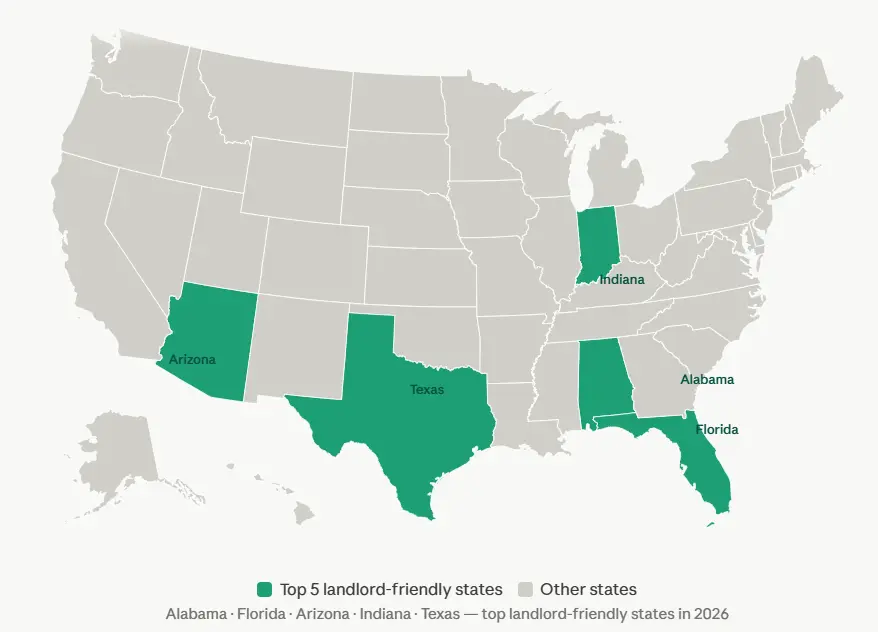
Based on an analysis of prevailing market conditions and regulatory frameworks in 2026, the following five states are identified as being among the most landlord-friendly in the U.S. housing market:
1. Alabama
Alabama stands out in 2026 as a state with notably few regulations specifically targeting individual landlords. This minimalist approach to landlord-tenant law creates a straightforward operating environment. Key advantages include:
- Minimal Licensing Requirements: Alabama generally has low barriers to entry regarding licensing for rental property owners, reducing initial setup costs and administrative burdens.
- No Rent Control: The state does not have statewide rent control laws, allowing landlords to adjust rents in response to market demand and operating expenses.
- Reasonable Eviction Process: While not the absolute fastest, Alabama’s eviction process is considered relatively efficient and less prone to prolonged legal delays compared to some other states.
- No Caps on Security Deposits: Landlords have flexibility in setting security deposit amounts, providing a stronger financial cushion.
- Low Property Taxes: Alabama generally boasts lower property tax rates, contributing to higher net operating income.
Top Landlord-Friendly City with High Average Cap Rate: Birmingham, Alabama, often presents attractive opportunities for real estate investors due to its growing economy, relatively affordable housing stock, and robust rental demand, which can translate into competitive cap rates.
2. Florida
Florida’s robust population growth and a business-friendly environment have historically made it an attractive destination for real estate investors. In 2026, its landlord-friendly attributes continue to draw significant attention:
- No Rent Control: Florida law prohibits local governments from enacting rent control ordinances, providing landlords with significant pricing freedom.
- Streamlined Eviction Process: The state has a relatively swift and predictable eviction process, allowing landlords to regain possession of their property efficiently if necessary.
- No Caps on Security Deposits: Landlords can set security deposits at levels that reflect the property’s value and potential risks, offering enhanced protection.
- Favorable Property Tax Environment: While property taxes exist, they are generally considered manageable, especially when compared to some other high-cost states, and homestead exemptions can benefit owner-occupants.
- Strong Demand for Rentals: Florida’s consistent influx of residents, both for permanent living and seasonal tourism, fuels a strong and sustained demand for rental properties.
Top Landlord-Friendly City with High Average Cap Rate: Orlando, Florida, benefits from a dynamic economy driven by tourism and a growing professional workforce, leading to high rental demand and potentially strong cap rates for investors.
3. Arizona
Arizona’s proactive approach to business development and its growing population centers contribute to its landlord-friendly status in 2026. The state offers a balanced regulatory environment for property owners:
- No Rent Control: Arizona prohibits rent control measures, allowing market forces to dictate rental pricing.
- Efficient Eviction Procedures: The state offers a relatively straightforward and expedited eviction process, minimizing the financial impact of non-paying tenants.
- No Caps on Security Deposits: Landlords are permitted to set security deposits without statutory limitations, providing greater financial security.
- Favorable Property Tax Rates: Arizona’s property taxes are generally competitive, especially in certain areas, contributing positively to cash flow.
- Growth and Investment Appeal: Cities like Phoenix and its surrounding metropolitan areas continue to experience significant growth, attracting new residents and increasing the demand for rental housing.
Top Landlord-Friendly City with High Average Cap Rate: Phoenix, Arizona, is a major economic hub experiencing substantial population and job growth, making it a prime location for rental property investments with the potential for attractive cap rates.
4. Indiana
Indiana offers a compelling combination of affordability and landlord-favorable regulations, making it an attractive state for real estate investors in 2026, particularly those seeking consistent cash flow.
- No Rent Control: Indiana does not have rent control statutes, granting landlords the autonomy to set and adjust rental rates.
- Relatively Simple Eviction Process: The state’s eviction laws are designed to be reasonably efficient, providing landlords with a clear path to address tenant issues.
- No Statutory Caps on Security Deposits: Landlords have discretion in determining the amount of security deposits, offering a buffer against potential tenant-related damages or delinquencies.
- Low Property Taxes: Indiana is known for its generally lower property tax rates, which significantly benefits the net operating income of rental properties.
- Affordable Entry Point: Compared to many coastal states, Indiana offers more affordable real estate prices, allowing investors to acquire properties at a lower cost basis, which can enhance cap rates.
Top Landlord-Friendly City with High Average Cap Rate: Indianapolis, Indiana, as the state capital and largest city, offers a diverse economy and a steady demand for rental housing, often presenting opportunities for solid returns.
5. Texas
Texas, with its booming economy and large population centers, is a significant player in the U.S. housing market. While it presents some trade-offs, its landlord-friendly aspects are considerable:
- No Rent Control: Texas law explicitly prohibits rent control, providing landlords with maximum flexibility in setting rental prices.
- Efficient Eviction Process: The state offers one of the most streamlined eviction processes in the country, enabling landlords to resolve tenant disputes swiftly.
- No Caps on Security Deposits: Landlords in Texas are not subject to limitations on the amount of security deposits they can charge.
- Strong Rental Demand: Major metropolitan areas like Houston, Dallas, Austin, and San Antonio consistently attract new residents and businesses, driving robust demand for rental properties.
- Trade-off Consideration: While Texas excels in rent control absence and eviction efficiency, it is important to note that property taxes in Texas can be higher than in some other landlord-friendly states. Investors must factor this into their financial projections.
Top Landlord-Friendly City with High Average Cap Rate: Austin, Texas, continues to experience rapid growth and a burgeoning tech industry, leading to high rental demand and, despite rising property values, can still offer attractive cap rates, especially in well-selected submarkets.
Navigating the Investor’s Decision: Beyond the Label
While the "landlord-friendly" designation provides a valuable starting point, it is crucial for investors to understand that these labels are not definitive determinants of investment success. As Daryl Fairweather, Chief Economist at Redfin, points out, "Landlord-friendly and tenant-friendly labels can be helpful, but they can be too broad to guide an investment decision on their own. What matters more is the underlying economics (fundamentals) of a market, like home prices, rent levels, job growth, and long-term demand. A landlord-friendly market with weak fundamentals can underperform a tenant-friendly market with strong population growth and tight supply, for example. I would suggest that investors should treat the regulatory environment as just one of many factors."
The allure of a landlord-friendly state can sometimes mask underlying economic weaknesses or lead to market inefficiencies. For instance, a state with very permissive regulations might attract a surge of investor activity, driving up property prices and compressing rental yields. This rapid investor influx can lead to overbuilding or create vulnerability to economic downturns, even in a favorable regulatory climate. Fairweather cautions, "Landlord-friendly doesn’t always mean low risk. Typically in some of these markets, rapid investor activity has already driven up prices, which can compress yields. There’s also the risk of overbuilding or economic volatility. Just because regulations are favorable doesn’t mean the investment will perform well. Always start by paying close attention to fundamentals like affordability, migration trends, and local employment."
Why Investors Might Choose Tenant-Friendly Markets
The notion that investors exclusively seek landlord-friendly environments is a misconception. Many investors strategically choose to invest in tenant-friendly markets due to compelling economic fundamentals. For example, a Q4 2025 Redfin report highlighted a significant increase in investor purchases in the Milwaukee housing market. Despite Milwaukee’s location within a generally landlord-friendly state, recent regulations have introduced more tenant-centric policies, including extended eviction timelines and stricter requirements for security deposits and property inspections.
This scenario underscores Fairweather’s point that market fundamentals often outweigh regulatory labels. A tenant-friendly market with robust population growth, strong job creation, and limited housing supply can offer greater long-term appreciation and stable rental demand, potentially outweighing the benefits of a more permissive regulatory environment in a less dynamic market.
Expert Insights for Investing in Tenant-Friendly Markets
For investors considering or operating within tenant-friendly markets, navigating potential challenges requires strategic planning and diligent execution.
Regarding rent control, Fairweather advises, "In rent-controlled markets, cash flow starts with the purchase price. You need to buy at a basis that makes sense given future rent constraints. After that, focus on minimizing turnover and vacancy, since you might not be able to raise rents between tenants. Keeping units well-maintained and building good tenant relationships can reduce churn. I’ve seen some investors also look for properties where allowable increases like inflation-based adjustments or capital improvement passthroughs can help offset costs over time."
Furthermore, Fairweather offers practical guidance for investing in tenant-friendly states: "In tenant-friendly states, it’s important to underwrite conservatively and operate professionally. That means screening tenants carefully, setting rents appropriately from the start, and budgeting for longer timelines if issues arise. You also want to understand local regulations in detail—notice periods, eviction timelines, and rent increase rules—so there are no surprises. Work with a local property manager or legal expert, especially if you’re a first-time investor."
Conclusion: A Data-Driven Approach to Real Estate Investment
In the evolving real estate market of 2026, the "landlord-friendly" or "tenant-friendly" label should not be the sole determinant of an investment decision. As Redfin’s Fairweather emphasizes, "That’s increasingly true. What we’re seeing now is that investors are prioritizing fundamentals over labels. A market like Milwaukee, for example, may be considered tenant-friendly, but if it offers relatively affordable entry points and stable rental demand, it can still be attractive. Meanwhile, some traditionally landlord-friendly markets—like parts of Florida—have cooled due to rising prices and insurance costs. So today, the more important question is: ‘Does the deal make sense given the local market conditions?’ Regulation matters, but it’s not the whole story.”
Ultimately, a landlord’s success hinges on a thorough analysis of the deal’s financial viability and alignment with local market conditions. This requires a deep dive into the numbers, encompassing property prices, rental income potential, vacancy rates, operational expenses, and long-term market trends. By leveraging comprehensive data and analytical tools, investors can make informed decisions that lead to profitable outcomes, regardless of a state’s regulatory classification.

