

A groundbreaking working paper from the Federal Reserve Bank of Cleveland is challenging conventional wisdom regarding cryptocurrency ownership. Instead of demographic characteristics or differing risk appetites, the research posits that a fundamental divergence in beliefs about the future returns of digital assets is the primary driver of who chooses to invest in cryptocurrencies. This novel perspective offers a compelling explanation for the persistent volatility observed in crypto markets and the cyclical nature of rallies that attract new investors, potentially fueling a feedback loop where rising prices reinforce bullish sentiment and draw in further market participants.
The study, titled "Do You Even Crypto, Bro? Cryptocurrencies in Household Finance," meticulously analyzed data from repeated surveys of up to 25,000 U.S. households across multiple waves. Researchers Michael Weber, Bernardo Candia, Olivier Coibion, and Yuriy Gorodnichenko found that expectations about future cryptocurrency returns explained a significantly greater portion of the variation in ownership than a wide array of demographic factors. This suggests that investors are not simply similar individuals with a penchant for risk, but rather individuals who hold fundamentally different outlooks on the potential of digital assets.
Unpacking the Belief Divide: Expectations Trump Demographics
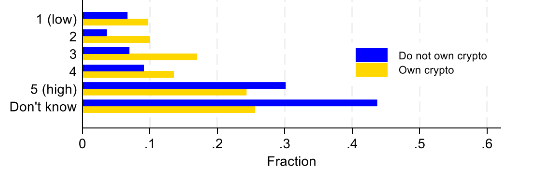
The core finding of the Cleveland Fed paper hinges on the profound impact of anticipated returns. The researchers discovered that for individuals willing to speculate on future performance, the gap in expectations between crypto owners and non-owners was substantial. In 2021, a significant majority of non-crypto owners (87%) reported not knowing what return to expect from digital assets over the subsequent year. Even among existing crypto owners, 54% expressed a similar lack of clarity. However, for those who did venture a prediction, crypto owners anticipated an average annual return of 22%, starkly contrasting with the mere 7% expected by non-owners.
Furthermore, the study revealed that crypto owners tended to perceive digital assets as less risky than their non-owning counterparts. This perception of reduced risk, coupled with elevated return expectations, appears to be a potent combination for driving investment decisions. The quantitative analysis underscored this point: a one-percentage-point increase in an individual’s expected crypto return was associated with a 0.8-percentage-point increase in the probability of owning cryptocurrency. When considered alongside risk expectations, these return-based beliefs explained considerably more variation in crypto ownership than observable characteristics such as age, income, and gender.
This inverse relationship between the explanatory power of expected returns and demographic factors sets cryptocurrencies apart from traditional assets like stocks, bonds, and gold. For these established markets, demographic and financial characteristics typically hold more sway in predicting investment behavior. Cryptocurrencies, however, appear to invert this relationship, with speculative outlooks taking center stage.
The Information Experiment: A Catalyst for Crypto Adoption
Perhaps the most consequential finding for the practical dynamics of crypto markets comes from a randomized information experiment conducted by the researchers. In 2025, households were randomly assigned to receive information about various assets, including Bitcoin (BTC), traditional stocks, GameStop (a meme stock that experienced significant volatility), and inflation. The results were striking: participants exposed to information about Bitcoin’s previous 12-month returns showed a notable increase in their desired cryptocurrency portfolio allocation, rising by approximately 2 percentage points. This represents a substantial 47% increase relative to the 4.3% desired allocation among the control group, which did not receive this specific information. Crucially, actual subsequent crypto purchases also saw a commensurate rise of about 2.5 percentage points.

The authors aptly described this outcome as "providing information about recent Bitcoin returns induces some households to start buying cryptocurrency." This effect was particularly pronounced among individuals who had previously cited a lack of sufficient information as their reason for not owning crypto. Conversely, those who already held a negative view of crypto as an investment did not significantly alter their behavior in response to the information treatment, suggesting that belief systems, once firmly entrenched, are more resistant to change.
This experiment provides tangible evidence for the feedback loop mechanism. Positive past performance, when communicated effectively, can serve as a powerful catalyst, drawing in new investors who may have previously been on the fence due to a perceived lack of understanding or information. Their subsequent purchases then contribute to upward price pressure, potentially reinforcing bullish expectations and attracting even more participants.
Crypto’s Volatility: A Product of Disagreement and Learning
The research from the Federal Reserve Bank of Cleveland offers a compelling explanation for the inherent volatility of cryptocurrencies. Unlike traditional financial assets, which often have established valuation models and a greater degree of consensus among investors, cryptocurrencies remain a relatively nascent and poorly understood asset class for a large segment of the population. This lack of common understanding fosters a breeding ground for sharply divergent beliefs about their future prospects.
The paper highlights that the absence of shared information and beliefs among crypto investors is a key factor contributing to its price instability. When individuals hold vastly different views on an asset’s potential, any new information, particularly about past performance, can significantly sway expectations and, consequently, behavior. This dynamic can lead to rapid shifts in market sentiment and price movements as investors react to evolving beliefs.
Beyond Investment: The Impact on Household Consumption
The study also explored the spillover effects of crypto wealth on household consumption. It found that a doubling in Bitcoin’s price led to a 1.4 percentage point increase in the likelihood of a household whose entire financial portfolio was in crypto purchasing a durable good. This effect is equivalent to roughly a 7% increase relative to the unconditional probability of such a purchase. However, the researchers noted that this boost in consumption did not extend to ordinary, day-to-day spending.
This distinction suggests that crypto gains may be perceived by households more akin to "gambling income" or lottery winnings rather than a permanent increase in wealth. Such windfalls might prompt a one-time significant purchase but do not necessarily translate into sustained changes in spending habits, unlike income derived from more stable sources.
Demographic Snapshot: Persistent but Not Primary
While the research emphasizes the primacy of beliefs over demographics, it does acknowledge that a distinct demographic profile for crypto investors persists. Individuals under 40 were found to be 13 percentage points more likely to own cryptocurrency than those over 60, even after controlling for other factors. Men were also about 4 percentage points more likely than women to own crypto, and higher-income and wealthier households demonstrated a greater propensity to participate in the market.
These demographic trends, while present, are presented as secondary to the overwhelming influence of return expectations. This suggests that while certain groups may be more inclined to explore new asset classes, it is the fundamental belief in the future profitability of cryptocurrencies that ultimately drives the decision to invest.
Implications for the Future of Crypto Markets
The findings of the Cleveland Fed working paper carry significant implications for the future trajectory of cryptocurrency markets. The research points towards a future where price volatility is likely to remain a defining characteristic of digital assets due to the ongoing divergence of investor beliefs and the potent influence of information on market sentiment.
The conclusion drawn by the authors is that the next wave of retail demand for cryptocurrencies may not solely depend on the absolute price of Bitcoin or other digital assets, but rather on how investors are informed about past price movements. This highlights the critical role of information dissemination and narrative building in shaping investor psychology within the crypto space.
The paper’s authors suggest that the continued absence of common information and beliefs among investors will likely perpetuate cryptocurrency’s status as a highly volatile asset class. This presents a somewhat uncomfortable outlook for the market, indicating that speculative dynamics, driven by differing expectations and the impact of perceived past performance, will continue to be a dominant force.
In essence, the research underscores that understanding the psychology of cryptocurrency investors, particularly their deeply held beliefs about future returns, is paramount to comprehending the unique behavior of this evolving asset class. As the digital asset landscape continues to mature, this focus on cognitive factors, rather than solely on traditional financial metrics, will likely become increasingly crucial for investors, regulators, and market participants alike. The quest for understanding crypto’s erratic nature leads back to the fundamental human element: what people believe will happen tomorrow.

