
By Molly Schwartz, cross-asset strategist at Rabobank
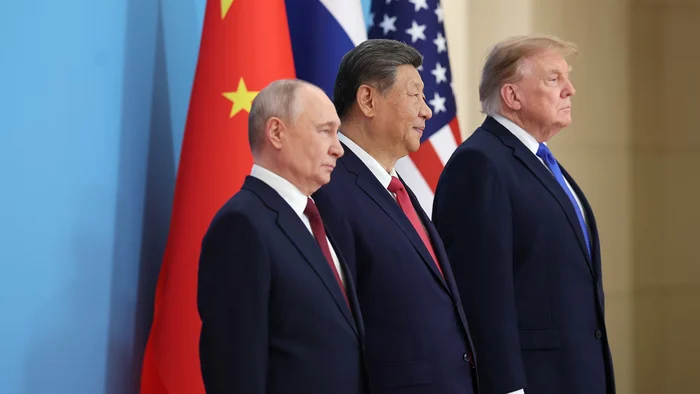
The highly anticipated and unprecedented trilateral talks among U.S. President Donald Trump, Chinese President Xi Jinping, and Russian President Vladimir Putin, held on the sidelines of the Asia-Pacific Economic Cooperation (APEC) summit, have concluded, leaving a significant void of public specifics but an abundance of geopolitical speculation. While the leaders themselves reportedly departed in visibly good spirits, a sense of unease has settled over international observers and market participants, particularly those without a direct stake in these high-level deliberations. The lack of transparent outcomes, juxtaposed with the apparent cordiality, has amplified concerns that a new global order might be quietly taking shape, reminiscent of historical power realignments.
The APEC Summit: A Stage for Unprecedented Dialogue Amidst Global Flux
The APEC forum, traditionally dedicated to fostering economic growth, cooperation, trade, and investment across the Asia-Pacific region, found itself unexpectedly serving as the backdrop for a diplomatic event of immense geopolitical gravity. Established in 1989, APEC comprises 21 member economies, representing approximately 60% of global GDP and nearly half of world trade. Its annual leaders’ meeting is typically focused on multilateral economic agendas, such as trade liberalization, investment facilitation, and regional connectivity. However, the 2026 summit transcended its usual economic mandate, becoming the stage for a trilateral meeting that observers had speculated could either clarify the global pecking order or exacerbate existing geopolitical tensions.
The decision for leaders of the United States, Russia, and China—three nations with often divergent strategic interests and complex bilateral relationships—to engage in direct, unprecedented talks signaled a potential paradigm shift. Each leader arrived with their own set of motivations. President Trump, known for his transactional approach to foreign policy, likely sought to project an image of a decisive global deal-maker, asserting American leadership while simultaneously engaging with traditional rivals. President Xi, steering China towards greater global influence and economic power, would have aimed to secure stability for China’s ambitious Belt and Road Initiative and its broader economic agenda, while reinforcing Beijing’s standing as a co-equal global power. President Putin, for his part, would have seen the meeting as a significant diplomatic coup, elevating Russia’s status on the world stage and potentially gaining leverage in ongoing conflicts and geopolitical contests, particularly in Europe. The sheer act of these three leaders convening sent a powerful message: the world’s most significant power brokers were directly engaged in shaping future global dynamics, potentially to the exclusion of others.
The "Declaration Toward Peace": Ambiguity as a Strategic Tool?
The primary public outcome of these extraordinary talks was a joint statement, cryptically titled the "U.S.–Russia–China Heads of State Declaration toward Peace." While the original report indicated that the leaders agreed to four abbreviated points, the content of these points remained largely undisclosed at the time of writing. This profound lack of transparency regarding the substance of the agreement has been a central point of contention and concern among analysts and international stakeholders.
At face value, commitments shrouded in such generality offer little concrete assurance or direction. Without specific details on proposed actions, timelines, or mechanisms for implementation, a "declaration toward peace" risks being perceived as merely symbolic. This ambiguity, however, could also be a deliberate strategic choice, allowing each party to interpret the agreement in a manner that best serves their national interests, or signaling that more substantive, perhaps contentious, discussions are ongoing behind closed doors. For some, the public goodwill expressed by the leaders, coupled with the absence of tangible outcomes, suggests either a failure to reach concrete agreements on critical issues or, more alarmingly, the establishment of understandings too sensitive for immediate public disclosure. The lack of specificity leaves the global community to grapple with myriad interpretations, fueling uncertainty about the future direction of international relations, security architecture, and economic cooperation.
The Specter of "Yalta 2.0": Reshaping the Global Order
The most potent and frequently invoked analogy emerging from the trilateral summit is "Yalta 2.0." This term immediately conjures images of the 1945 Yalta Conference, where Allied leaders Franklin D. Roosevelt (U.S.), Winston Churchill (U.K.), and Joseph Stalin (USSR) met to discuss the post-World War II reorganization of Europe. That conference effectively divided Europe into spheres of influence, profoundly shaping the geopolitical landscape for decades and contributing to the Cold War’s origins.
The current "Yalta 2.0" narrative suggests a similar, albeit updated, reordering of global power. This time, the key players are the United States, Russia, and China, signaling a shift from a bipolar or unipolar world order to a potentially new multipolar structure. The concerns are manifold: that these three powers might unilaterally redraw geopolitical boundaries, establish new economic spheres, or dictate terms on global issues without broader international consultation. The specific fear articulated in the original analysis is that Europe, or at least Ukraine, could once again find itself "on the chopping block," a pawn in a larger strategic game. This implies that the security and sovereignty of nations might be decided not by international law or multilateral consensus, but by the convenience or strategic interests of the dominant powers.
Such a realignment could have far-reaching geopolitical implications. It might challenge existing alliances like NATO, diminish the role of the United Nations, and accelerate a fragmentation of the international system into competing blocs. Geoeconomically, it could lead to the formation of exclusive trade zones, the weaponization of supply chains, and a heightened competition for critical resources and technological dominance. The very foundations of the liberal international order, built on principles of open markets, democratic values, and multilateral institutions, could face unprecedented strain, ushering in an era of renewed great power competition and potential instability.
European Responses and the Challenge of Unity
The "Yalta 2.0" narrative has predictably generated significant anxiety in European capitals. For many European nations, particularly those bordering Russia or with historical ties to the Soviet bloc, the idea of their security and future being decided by an exclusive club of global powers is deeply unsettling. The ongoing conflict in Ukraine exacerbates these fears, making the prospect of being sidelined from a peace process directly affecting the continent’s security a critical concern.
In a seemingly conciliatory move, Russian President Vladimir Putin reportedly extended an invitation to European leaders to discuss the war in Ukraine in Moscow. While appearing to offer a diplomatic avenue, this gesture was met with skepticism. As noted, an invitation to discuss is not equivalent to a formal seat at the negotiating table, especially when the terms of a potential peace process might already be under discussion by the trilateral powers. European leaders fear that participating under such conditions would legitimize a process that could bypass their core interests and sovereignty, leaving them with little actual influence over the outcomes.
This predicament highlights Europe’s enduring challenge of achieving a unified foreign policy. German Chancellor Merz, reflecting a prominent European viewpoint, reportedly dismissed the APEC trilateral summit as a mere "photo op," expressing little interest in participating. He firmly stated that the "Yalta format cannot bring peace" to Ukraine, underscoring a deep-seated rejection of any agreement that mirrors the historical division of Europe. This sentiment echoes a broader European concern that any peace forged without their full and equal participation would be inherently unstable and illegitimate.
The internal dynamics within the European Union further complicate its response. There are factions that criticize any unilateral initiative to engage with President Putin without prior consensus-building across all member states. This commitment to collective decision-making, while a cornerstone of EU diplomacy, can also lead to inertia, leaving the bloc unable to respond swiftly and decisively to rapidly evolving geopolitical events. In contrast, President Trump’s stated philosophy—that "Too often past leaders avoided talking to nations with whom they had disagreements…No peace was ever forged by declining opportunities for engagement"—underpins his readiness to engage directly, a stark contrast to the EU’s more cautious, consensus-driven approach. This divergence in diplomatic philosophy underscores the adage: "if you’re not at the table, you’re on the menu." Europe’s inability to present a unified and proactive front risks marginalizing its influence in critical global negotiations.
Global Economic Repercussions and Market Volatility
The geopolitical uncertainties emanating from the APEC trilateral talks immediately reverberated through global financial markets, triggering a pronounced risk-off sentiment. Investors, grappling with the opaque nature of the summit’s outcomes and the looming specter of a reshaped global order, sought refuge in traditional safe-haven assets.
The U.S. Dollar (USD) emerged as a primary beneficiary of this flight to safety. The DXY Index, which measures the dollar’s value against a basket of major currencies, climbed back to levels not seen since 2025. This strengthening was driven by a dual dynamic: increased demand for the dollar as a global reserve and safe-haven currency amidst heightened geopolitical risk, and elevated U.S. interest rate hike expectations, which make dollar-denominated assets more attractive.
Conversely, equity markets experienced significant declines. The S&P 500, a broad indicator of U.S. stock market health, fell by more than 147 points, representing a 2.02% decrease. The NASDAQ Composite, heavily weighted towards technology stocks, also dropped by 2.2%. These declines occurred despite what might otherwise have been considered positive news, such as yesterday’s record-breaking Anthropic IPO, which closed 17.1% higher than its initial public offering price. The overarching risk-off mood, fueled by geopolitical uncertainty, overshadowed individual company performance and investor optimism.
The demand for safe assets also impacted the bond market, pulling U.S. Treasury yields lower across the curve. As investors flocked to the perceived safety of government bonds, their prices rose, and yields, which move inversely to prices, consequently fell. This indicated a strong preference for capital preservation over risk-taking.
Emerging market (EM) currencies bore an "extra layer of pain." Geopolitical instability tends to disproportionately affect developing economies, which are often more vulnerable to capital outflows and shifts in global risk appetite. Coupled with the strengthening U.S. dollar and rising U.S. interest rates, the attractiveness of "carry trades" – borrowing in low-interest-rate currencies and investing in higher-yield EM currencies – declined. This reduced demand for EM assets, putting further downward pressure on their currencies and increasing the cost of dollar-denominated debt for these nations. The combined effect of geopolitical uncertainty and tighter global financial conditions presents a formidable challenge for emerging markets, potentially hindering their growth prospects and exacerbating economic vulnerabilities.
Federal Reserve Policy: Navigating Geopolitical Headwinds
The confluence of geopolitical shifts and market volatility presents a complex challenge for central banks, particularly the U.S. Federal Reserve. The Federal Open Market Committee (FOMC) must now factor these external dynamics into its monetary policy decisions, balancing inflation control with financial stability concerns.
The market’s immediate reaction to the APEC summit indicated that investors are already positioning for further aggressive monetary tightening. The Overnight Index Swap (OIS) curve, a key indicator of market expectations for future interest rates, implies that investors are fully positioned for a rate hike in December. Furthermore, close to 70% of a 25-basis-point hike is priced in for the January meeting.
These expectations align with the recent hawkish shift of some FOMC members. Governor Christopher Waller, who has previously been seen as moving from one of the most hawkish to one of the most dovish members, has now returned to a distinctly hawkish stance. His recent comments suggest a strong push for either a 50-basis-point hike at the upcoming December meeting or, at minimum, a 25-basis-point hike accompanied by clear forward guidance that an additional hike will follow in January.
Waller’s assertive stance on forward guidance throws a wrench into the philosophy espoused by other influential figures, such as Kevin Warsh, who advocate for refraining from explicit forward guidance and pulling back on central bank communication to allow for greater flexibility. The differing views within the FOMC highlight the internal debates surrounding the appropriate path for monetary policy in an increasingly uncertain global environment.
However, irrespective of their individual philosophies, Waller, Warsh, and the remaining slew of FOMC Board members will all have their "seat at the table" come December 9. It is at this critical meeting that they will collectively decide the future direction of U.S. monetary policy. Their decisions will not only influence domestic economic conditions but will also send ripples across global financial markets, impacting exchange rates, capital flows, and the economic trajectories of nations grappling with the implications of a potentially new world order. The Fed’s path will be crucial in either stabilizing or further destabilizing the global economic landscape in the wake of these unprecedented geopolitical maneuvers.
In conclusion, the APEC trilateral summit, while publicly lacking in concrete outcomes, has undeniably ignited profound discussions about the future of global power dynamics. The specter of "Yalta 2.0" looms large, raising concerns about the potential marginalization of some nations, particularly in Europe, from critical peace and security deliberations. The immediate market reactions – a strengthening U.S. dollar, declining equities, and distress in emerging markets – underscore the deep financial implications of geopolitical uncertainty. As the world awaits more clarity from the major powers, the imperative for other nations to forge unified strategies and assert their interests has never been more urgent. Meanwhile, central banks like the Federal Reserve must navigate these turbulent waters, with their decisions playing a pivotal role in shaping the economic stability of a rapidly evolving global landscape.

