
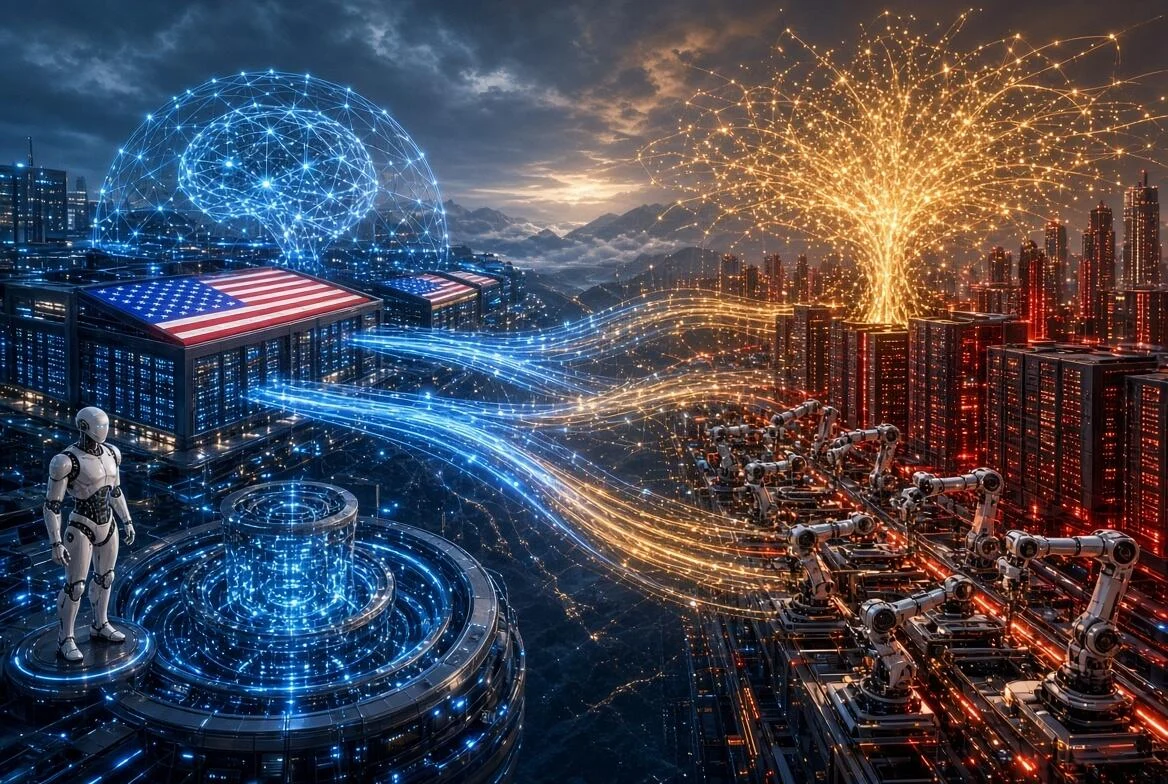
The intensifying artificial intelligence arms race between the United States and China represents a pivotal geopolitical contest, with its outcome poised to redefine global economic and military leadership. Experts universally acknowledge that mastery of AI is not merely a technological advantage but a fundamental determinant of national power in the 21st century. This high-stakes competition compels both nations to pour substantial resources into research, development, and deployment, reflecting a deep understanding of AI’s transformative potential across all sectors.
The Global Stakes: A New Arms Race
The strategic importance of AI cannot be overstated. From enhancing economic productivity and driving innovation to revolutionizing military capabilities and intelligence gathering, AI is a general-purpose technology with far-reaching implications. For Beijing, AI development is a core national priority, central to its ambition to surpass American power and fundamentally reshape the global order. Chinese leader Xi Jinping has personally championed this vision for years, directing significant state investment, mandating AI integration across the economy, and overseeing the rapid buildout of essential infrastructure, including vast data centers and power generation facilities. This top-down, whole-of-government approach allows China to swiftly overcome regulatory hurdles that often slow progress in more decentralized economies. Conversely, Washington is acutely aware of the existential nature of this competition. Treasury Secretary Scott Bessent starkly articulated this concern, stating, "There is no day after tomorrow if China wins at this," highlighting the profound economic and national security ramifications. While most experts temper such apocalyptic predictions, they universally agree that the stakes are extraordinarily high. Monzy Merza, co-founder of the AI-powered cybersecurity platform Crogl and a former security research leader, emphasizes, "If we can all agree that the most advanced capability now in the world is the capability of AI and that capability can be leveraged to achieve economic and political outcomes, well, then we have to have the best of that capability." This imperative becomes even more critical in national security. McDaniel Wicker, Senior Vice President for U.S. Government at Babel Street, a Virginia-based AI intelligence firm, likens the current moment to the dawn of the atomic era, calling AI "the elemental weapon system of the near future, and for decades to come." He warns that a significant imbalance could enable China to make faster decisions and advancements, thereby pressing its advantage globally.
Current Standing: A Mixed Picture of Leadership
Assessing who is "winning" the AI race presents a nuanced picture. A consensus among ten defense and cybersecurity experts consulted by The Epoch Times indicates that the United States currently holds a discernible lead in several critical areas. The U.S. excels in developing cutting-edge, "frontier" AI models, possesses superior computational power (often referred to as "compute"), and leads in the quality and innovation of advanced microchips. Joel Thayer, Senior Adviser for AI and Emerging Technology at the America First Policy Institute, asserts, "By every conceivable metric, the U.S. has a significant upper hand." Noah Kenney, CEO of Digital 520, an AI governance and cybersecurity consultancy, concurs, noting the U.S.’s "stronger AI ecosystem," advanced chip design, extensive cloud infrastructure, and the majority of notable frontier models.

However, China demonstrates formidable strengths that complicate a definitive declaration of U.S. victory. The nation has proven remarkably adept at developing AI models that perform comparably to top Western competitors but at a fraction of the cost and computational load. This efficiency is partly driven by "distillation," a technique where Chinese AI models are trained to mimic the outputs of more powerful American models after extensive querying. Beyond this technical prowess, China boasts a massive manufacturing capacity, a distinct advantage that allows for the rapid deployment and iteration of AI-powered products on an industrial scale. Kenney highlights China’s lead "by far in the supply chain components," acknowledging that while the U.S. designs advanced hardware, its large-scale production relies heavily on China’s supply chain. David Ackerman, an AI and compliance expert at the Stimson Center, underscores this, noting, "You could have the greatest technology on the planet, but if you don’t have the capacity to roll it out, then its use is going to be extremely limited." Efforts by the U.S. to re-shore critical manufacturing, initiated under the Trump administration, have been slow to materialize due to complex regulatory environments, hindering the pace needed to compete effectively in the AI and energy sectors. This frustration with regulatory red tape may even inspire radical proposals, such as Elon Musk’s suggestion to build data centers in space, seeking environments more conducive to rapid innovation.
Strategic Imperatives and Policy Responses
The U.S. government has engaged in bilateral discussions with China, with AI as a core topic, to explore cooperation on preventing powerful AI models from falling into the hands of terrorists and criminal organizations. However, Beijing remains skeptical, viewing such U.S. security initiatives as thinly veiled attempts to assess Chinese technical capabilities and vulnerabilities, making meaningful commitments unlikely. The U.S. has implemented export controls on advanced computer chips, aiming to slow China’s progress. While these controls are deemed necessary, experts like Kenney caution that they are insufficient on their own. "Controls alone don’t secure U.S. leadership. So domestic capacity and innovation really have to do the rest," he advises, emphasizing the need for a robust "offense" strategy that includes making American AI the preferred choice for allies and emerging markets. Su Tzu-yun, Director of the Division of Strategy and Resources at Taiwan’s Institute for National Defense and Security Research, suggests tightening the implementation of these export bans through global cooperation with customs agencies to prevent smuggling.
China’s command economy, while enabling rapid deployment and infrastructure buildout, also presents disadvantages. Some experts note that a state-run system can stifle genuine innovation and lead to wasteful endeavors, contrasting with the more organic, decentralized innovation prevalent in the U.S. ecosystem. However, China’s ability to quickly implement nationwide directives, such as clearing neighborhoods for transmission lines, provides a significant advantage in infrastructure development, particularly for energy.
The Energy Nexus: A Looming Bottleneck
The burgeoning demand for AI computing power is inextricably linked to energy consumption, posing a significant challenge for both nations. Ethan Tu, founder of Taiwan AI Labs, warns, "We might reach a point where progress stalls due to energy bottlenecks." American tech giants are already encountering energy constraints in their race to build massive AI data centers. Scott Ebeling, head of energy strategy at BOX Energy Solutions, highlights that a single "hyperscaler" data center can consume a gigawatt of power, enough for approximately a million households. Despite accelerated energy buildouts, the U.S. grid faces challenges, with critical components like transformers now requiring two years for delivery compared to 14 weeks in 2020.

China, in contrast, has aggressively invested in domestic power generation, encompassing coal, hydro, wind, and solar. This massive investment provides its industrial and tech sectors with an abundant, low-cost electricity supply. Ebeling points out that large-scale Chinese data centers pay roughly half the electricity costs of their American counterparts, attributing this advantage to Beijing’s top-down command structure, which allows for rapid, unencumbered grid expansion.
Beyond Raw Power: China’s Strategic Play
Despite its energy advantages, China is unlikely to surpass the U.S. in "absolute terms" of AI capability, particularly in frontier models, due to insufficient compute resources, according to Thayer. Instead, China has strategically focused on open-weight models—AI models whose numerical parameters are publicly released, allowing users to download and modify them. This approach requires significantly less infrastructure for rapid deployment. Chinese models have shown impressive performance on various benchmarks, often nearly closing the gap with American counterparts. Kenney highlights their particular strength in developing "hyper-efficient models."
However, these achievements come with significant caveats. A joint advisory issued by the FBI, NSA, and CISA alleged that six Chinese AI companies have engaged in "aggressive, malicious, and targeted distillation activities at an industrial scale" against U.S. frontier models since late 2024. Distillation involves extensively querying an AI model and then using its outputs to train a new, less computationally intensive model that mimics the original’s responses. While some experts credit this method for China’s efficiency, others point to broader Chinese innovation. Ethan Tu emphasizes caution with AI benchmarks, noting that Chinese models often appear trained to beat specific tests. He explains that "while Chinese models perform very well on tasks with known standard answers, they often underperform in prospective testing—sometimes referred to as ‘experiential’ or ‘real-world feel’ testing." This suggests an inherent limitation: "The fundamental issue is that China largely models its development on U.S. systems; consequently, while it can approach the achievements of U.S. models, it struggles to actually surpass them." Thayer uses the analogy of a speedboat and water-skiers: "Their speed basically depends on our speed, and if we slow down, they slow down." While China aims to scale its computational capacity to reduce reliance on distillation, this would contradict its core strategy of achieving AI capabilities at the lowest possible cost, potentially negating its competitive advantage.
The Trust Deficit: A Critical Hurdle for China
Even if China cannot achieve absolute AI supremacy, its strategy appears to involve capturing market share by offering lower-priced or free open-weight models, thereby locking users into its ecosystem. Meta and Google have responded by releasing their own free open-weight models, transforming the competition into a "footprint war," as Merza describes it.

However, a significant roadblock for China in establishing global market dominance is the pervasive issue of trust. "Artificial intelligence serves as a critical information platform—akin to 5G infrastructure—so the questions of whether to use it and whether it can be trusted are paramount," Tu states. He adds that while Chinese models are easily replicable and often free, "establishing genuine trust remains a significant challenge." Merza observes that while his European clients may have some mistrust toward American AI models, "I don’t hear anybody saying they’re going to run off and start using Chinese models because that mistrust is even higher." Concerns extend beyond merely handing over sensitive data to include fears that foreign-made models might deliberately provide incomplete, incorrect, or resource-intensive answers to degrade American capabilities. Moreover, the U.S.’s current lead gives it agenda-setting power, allowing it to define acceptable governance, security, and privacy standards, and to highlight instances where Chinese AI might be developed "without guardrails or an appropriate safety net."
The Shadow of AI Dominance: Cyber Warfare and Influence Operations
The repercussions of Chinese AI dominance would span economic and national security domains, which are often intertwined. Tu warns of "digital colonialism," where nations unable to develop their own trustworthy AI platforms become reliant on those of stronger powers, granting immense influence to the platform owners. China’s existing dominance in certain industries could be further amplified by superior AI, leading to increased control over global markets, as Ackerman suggests. Wicker emphasizes China’s "whole-of-government, whole-of-society approach," where economic advantages in AI would be leveraged as a "lever of national power," not just for commercial gain. Merza even speculates about scenarios where China might offer AI capabilities to nations for free, only to weaponize that dependency by cutting off access or providing next-generation AI to adversaries if political disagreements arise.
In terms of direct security threats, AI plays a crucial role in cyber warfare and military applications. The Chinese regime has a well-documented history of state-sponsored hacking, extending beyond traditional intelligence gathering to industrial-scale intellectual property theft. Jake Williams, a former NSA hacker, notes the stark difference in ethical standards, where such activities are "par for the course" in China. Beyond data theft, Su Tzu-yun warns that successful breaches allow attackers to "alter data undetected, causing significant misinformation," potentially plunging a nation into chaos. Critical infrastructure operators, Merza’s clients, are deeply concerned about both direct hacking and the infiltration of AI models or computing infrastructure by Chinese actors. The proven capability of AI to launch cyberattacks and discover system vulnerabilities, demonstrated by companies like Anthropic and OpenAI, underscores the imperative for the U.S. to possess superior defensive AI. Thayer stresses that a parity in AI cyber capabilities could be "a devastating blow to our national security," necessitating an AI advantage to thwart attacks.
Beyond traditional cyberattacks, China is highly skilled at "shaping the battlefield of the mind" through online influence operations, as Wicker describes. AI significantly amplifies this capability, allowing for faster, more efficient, and hyper-personalized crafting of messages for even smaller population segments. Cognitive warfare is already evident in the AI race itself, with China reportedly conducting campaigns to turn U.S. public opinion against data centers. AI enables granular targeting for influence campaigns, even down to specific individuals, leveraging China’s decades-long surveillance state and its ability to process vast amounts of behavioral data. Neil Sahota, AI strategist at ACSI Labs, warns of "cognitive manipulation," where AI-generated "plausible intelligence" and "synthetic evidence" can influence decision-making environments, potentially leading to poor military engagements or retaliatory strategies. AI can also mount "cognitive denial-of-service" attacks, overwhelming analysts or voters with credible-looking information faster than it can be validated. Another alarming possibility is "poisoning economic models" by manipulating data streams like supply chain forecasting, affecting creditworthiness and insurance analyses. Williams points out that merely demonstrating such capabilities, even without deploying them, could sow distrust and chaos, particularly in sensitive areas like election outcomes.
Military Applications: Ethics vs. Efficiency

Both the U.S. and Chinese militaries are actively integrating AI, but their approaches differ significantly. Wicker notes that the U.S. military and national security community are "doing a really good job of embracing and implementing AI," pushing innovation and integrating it into military planning and war gaming for China-based scenarios. However, the U.S. proceeds with caution regarding AI-powered weapons, particularly autonomous lethal systems. "Autonomous systems in the West carry huge ethical considerations and concerns about who actually is carrying out potentially lethal action," Wicker explains, leading to a focus on non-lethal autonomous systems. Kenney confirms a "lot of hesitancy to utilize those tools," driven by discomfort with "quantifying human lives" in lethal decision-making, as Sahota puts it. The U.S. government largely ensures that human operators retain ultimate authority over high-stakes AI deployments, with AI primarily serving to analyze data and flag important information for human review. Wicker stresses, "On the critical decisions… those are never places where we want a machine to make that decision."
In stark contrast, the People’s Liberation Army (PLA) appears far less constrained by ethical considerations regarding autonomous weapons. Experts agree that the communist regime seems much less concerned about the moral implications of AI-driven lethality, reflecting fundamentally different political structures and value systems. This is where China’s manufacturing might becomes a critical factor. "Not only can they build these systems, but they can build them at scale and put them onto the battlefield in large numbers if needed," Wicker observes. In a potential conflict, such as a Chinese invasion of Taiwan involving U.S. military intervention, the battlefield could see drone swarms on both sides. If one side requires human approval for each target while the other allows AI weapons to identify and eliminate targets autonomously, the ethical stance of the U.S. could become a significant tactical disadvantage, slowing down operations. Williams acknowledges, "The side that has to wait for confirmation is going to inflict less damage." However, he cautions that "if your end game is trying to live with the civilian population that’s left over afterwards, I think indiscriminate targeting is probably not a great way to get there."
Charting the Future: Expert Recommendations for U.S. Strategy
Experts offer a range of recommendations for the U.S. government to maintain its competitive edge and mitigate risks. While acknowledging the necessity of export controls on advanced chips, they stress that these are merely defensive measures that slow China down, not a guarantee of U.S. leadership. Kenney emphasizes the need for "domestic capacity and innovation" and an "export strategy that really makes the American AI the preferred choice for allies in emerging markets." Su advocates for tighter enforcement of export bans through global customs cooperation to prevent chip smuggling.
Ackerman highlights the critical need for infrastructure buildup in the U.S., including pipelines, power plants, and increased domestic manufacturing, asserting that "until we do these things, we will always be susceptible." Jason Richards, former FBI IT executive, stresses the importance of securing AI systems through trusted connections and building "resiliency" with "shut-off switches" for sensitive models. He also places responsibility on the public to become "responsible consumers" of media, capable of detecting AI-generated content. Wicker suggests that leaders must become comfortable with both receiving and judiciously rejecting AI recommendations.
Thayer recommends intensifying efforts to prevent China from distilling U.S. AI models and stopping data flows to China, while fostering a competitive domestic market to reduce reliance on cheaper Chinese alternatives. The consensus among experts is that the U.S. government must unequivocally avoid implementing any Chinese AI products, a sentiment echoed by Richards, who believes the government will "never" use them. Kenney notes that the current administration is already pressuring private corporations to avoid Chinese AI. Tu proposes using regulation to push out Chinese AI by establishing model evaluation standards that prioritize "human rights, privacy, public safety, and democratic universal values." He argues that Chinese AI, constrained by the Chinese Communist Party’s censorship requirements, would naturally be rejected when evaluated against these universal values.

The U.S.-China AI race is a dynamic, multifaceted competition that demands continuous vigilance and strategic adaptation. The implications for global power, economic prosperity, and national security are profound, underscoring the urgency for the U.S. to not only innovate but also to proactively shape the ethical and governance frameworks that will define the future of AI.

