

The S&P 500 index has experienced an extraordinary surge over the past several years, delivering significant gains to investors, particularly those with retirement savings nestled in index funds. This robust performance has seen the S&P 500 climb approximately 57 percent in just the last two years, and an astonishing more than double over the past five years. This dramatic appreciation has led many to question the sustainability of current market valuations, prompting discussions around whether this growth is a reflection of genuine economic strength and technological advancement, or the early signs of an impending financial bubble, particularly fueled by the burgeoning excitement surrounding Artificial Intelligence (AI).
For many, this period of unprecedented growth has fundamentally altered personal financial landscapes. Individuals who, as recently as the onset of the COVID-19 pandemic, felt only halfway to their retirement goals may now find themselves unexpectedly crossing the financial finish line. Conversely, those already retired are experiencing a substantial boost to their net worth, potentially leading to considerations of more extravagant purchases or shifts in spending habits. The core question on many investors’ minds is whether these gains are fundamentally "real" or merely a transient financial illusion, susceptible to a significant correction.

Unpacking Market Valuations: The Price-to-Earnings Perspective
To understand the current market dynamics, it’s crucial to delve into the foundational principles of stock valuation, often illustrated through the analogy of a rental property. When an investor purchases a rental house, their primary return comes from the collected rent, or profit, after all expenses are covered. The selling price of such a property is typically tethered to its future income stream. For instance, a house generating $24,000 in annual profit might reasonably sell for $240,000, representing a price-to-earnings (P/E) ratio of 10 (Sale Price / Annual Profit). If the market for rental properties suddenly inflates, pushing the sale price to $480,000 while the rent remains constant, the P/E ratio effectively doubles to 20. While this benefits the seller, the new investor faces a significantly less profitable future, as their percentage return on investment is halved.
Applying this logic to the stock market reveals a similar trend. In 2019, an investment of $100,000 in the S&P 500, with dividends reinvested, would today be worth approximately $256,960—a staggering 157% gain. However, over the same period, the underlying corporate earnings attributable to that $100,000 investment only increased from roughly $5,290 to $7,540, a modest 42% rise. This divergence indicates that the market’s price-to-earnings ratio for the S&P 500 has escalated from around 20 in 2019 to approximately 30 today. This means that investors are paying a significantly higher premium for each dollar of corporate earnings than they were just a few years ago. While owning stocks remains profitable, purchasing them at current elevated P/E ratios inherently suggests a lower expected rate of future returns compared to periods when valuations were more modest. This is not to say that a crash is imminent or guaranteed, but rather that the mathematical reality of valuation dictates a more tempered outlook for future percentage gains.

The Magnificent Seven and the Concentrated Market Rally
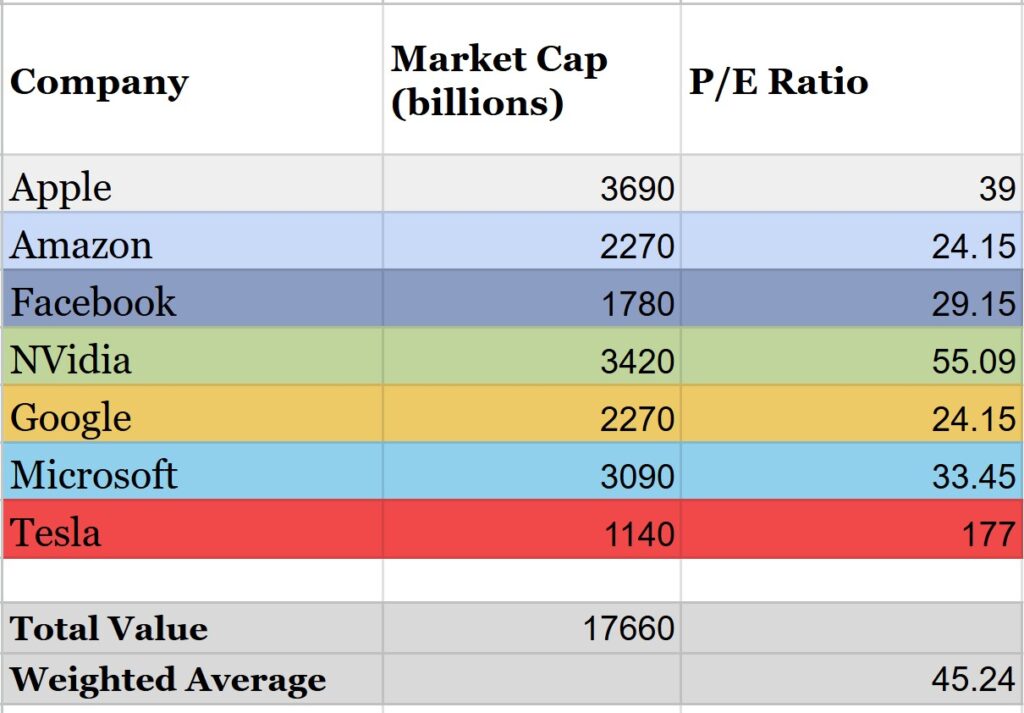
A deeper examination of the S&P 500’s recent ascent reveals a highly concentrated rally. Approximately three-quarters of the market’s recent growth has been driven by just seven colossal technology companies, collectively dubbed the "Magnificent Seven": Apple, Nvidia, Microsoft, Amazon, Google (Alphabet), Meta Platforms (Facebook), and occasionally Tesla. These companies represent an unprecedented concentration of market power, collectively accounting for over 25% of the entire S&P 500’s market capitalization, which now stands at an staggering $17.66 trillion.
The valuations of these tech giants are notably higher than the broader market, with their weighted average P/E ratio hovering around 45. This contrasts sharply with the P/E ratio of the remaining 493 companies in the S&P 500, which stands at a more modest, though still above-average, 20. This disparity highlights investor conviction that these dominant tech players will continue to deliver outsized growth. Companies like Nvidia, a leading designer of graphics processing units (GPUs) essential for AI, have seen their stock prices explode due to surging demand for their hardware, making them a primary beneficiary of the AI infrastructure boom. Tesla, while a prominent tech company, often trades on the anticipation of future earnings and technological breakthroughs rather than its current profitability, contributing to its elevated P/E.

Artificial Intelligence: The Unprecedented Catalyst
The primary force driving this extraordinary concentration of wealth and high valuations within the Magnificent Seven, and indeed the broader market sentiment, is the rapid advancement and transformative potential of Artificial Intelligence. Recent breakthroughs, particularly in generative AI with models like OpenAI’s ChatGPT, have demonstrated capabilities previously thought to be years away. AI software can now exhibit human-like reasoning, analyze complex documents, generate code, assist in medical diagnostics, and even pilot autonomous vehicles.
This technological revolution is manifesting in two critical ways:
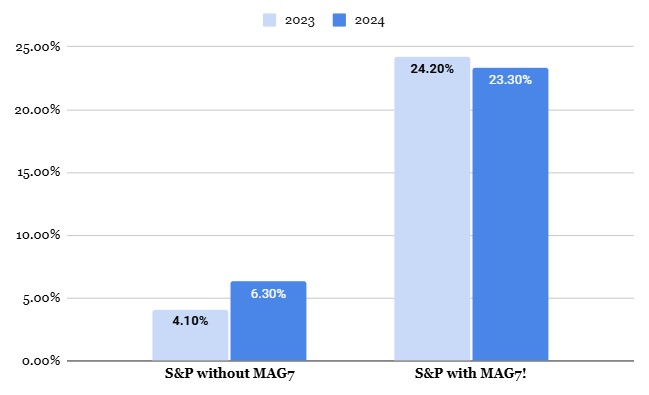
- AI Infrastructure Boom: Six of the Magnificent Seven are investing hundreds of billions of dollars into building vast data centers filled with powerful supercomputers to train and deploy advanced AI models. Microsoft’s significant investment in OpenAI, Amazon and Google’s development of their own AI models and cloud infrastructure, and Meta’s commitment to AI research are prime examples. Nvidia, the seventh, is at the epicenter of this infrastructure build-out, as it manufactures the specialized chips (GPUs) that power these AI systems. The demand for Nvidia’s processors has allowed the company to command premium prices, leading to astronomical growth in its valuation.
- Productivity Revolution: Beyond infrastructure, the widespread integration of AI is expected to usher in a new era of productivity across virtually every industry. The promise is an "infinite workforce" of highly intelligent AI agents working tirelessly, eliminating the traditional constraints of human intelligence and labor. This vision includes AI designing complex medications, identifying intricate legal loopholes, and debugging software with unprecedented efficiency. The anticipation of this profound shift in productivity and profitability is a significant factor in current market enthusiasm.
However, this future, while promising, is not without its uncertainties. The timeline for full AI integration and widespread profitability remains unclear. Potential challenges include massive development costs, intense competition, regulatory hurdles, and unforeseen ethical dilemmas. There’s also the profound societal question of mass unemployment if AI automates a vast swathe of jobs, potentially leading to social upheaval and economic restructuring. The ultimate distribution of the immense wealth generated by AI also remains a critical, unanswered question.
Historical Context and Economic Fundamentals
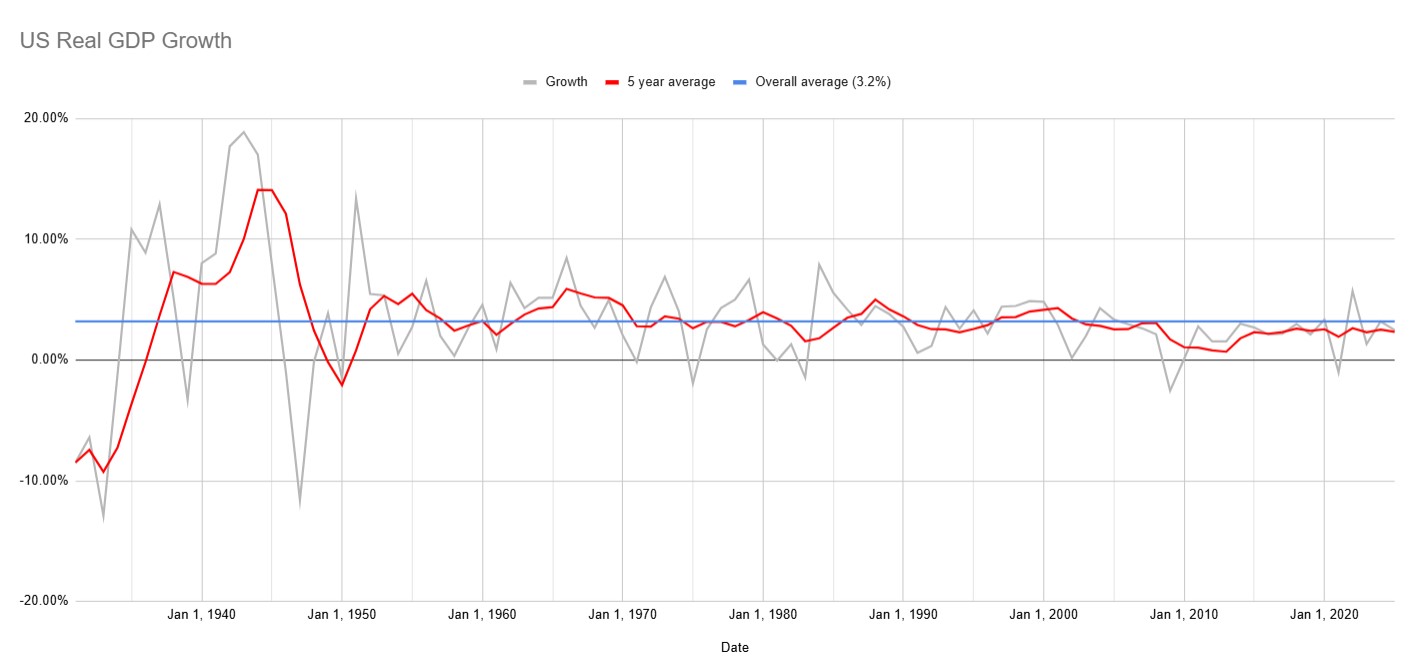
While the current excitement around AI is undeniably potent, it is essential to view market movements through a historical lens. The history of US economic growth, as measured by real GDP, reveals a remarkably consistent average growth rate of approximately 3% after inflation, decade after decade. Interestingly, recent decades have shown a tendency towards slower than average growth, which, without the AI narrative, would suggest even less justification for the current elevated stock market valuations. This implies that the market is not simply pricing in general economic growth, but rather a specific, high-growth future driven by technological transformation.
Past market manias, such as the dot-com bubble of the late 1990s, serve as cautionary tales. During that period, internet-related stocks soared to unsustainable valuations based on speculative future growth, only to crash dramatically when reality failed to meet expectations. While the underlying technological advancements of the current AI boom are arguably more tangible and transformative than some of the dot-com era’s promises, the core principle of valuation — the relationship between price and future earnings — remains constant. The market’s collective belief in an accelerated earnings trajectory due to AI is driving prices, but the actual realization of those earnings will be the ultimate arbiter of these valuations.
Expert Perspectives and Alternative Investment Strategies
Given the current market landscape, various investment experts and strategies offer different perspectives:

Vanguard’s Forward-Looking Projections: Vanguard, a cornerstone of the index fund world, annually publishes its 10-year annualized return forecasts. Their most recent projections suggest a potential shift in investment performance:
- International stocks and even bonds are forecasted to outperform US stocks over the coming decade. This outlook is largely based on current valuations; for example, the Vanguard Total International Stock Index Fund (VXUS) currently has a P/E ratio of approximately 15.9, making international equities appear significantly "on sale" compared to their US counterparts. While Vanguard has made similar predictions in recent years that have yet to fully materialize (partially due to the concentrated US AI boom), the underlying logic of buying assets at lower valuations remains sound.
Warren Buffett’s Cautious Stance: The "Oracle of Omaha," Warren Buffett, through Berkshire Hathaway, is another critical voice in assessing market conditions. His recent actions and shareholder letters signal a cautious approach. Berkshire Hathaway is currently holding an extraordinary $334 billion in uninvested cash, indicating a scarcity of attractive investment opportunities at current prices. Even repurchasing Berkshire’s own shares, which might typically be a strategy when undervalued, is being done sparingly as Buffett considers them slightly overvalued at a P/E ratio averaging around 21 in recent years. This conservative posture from one of history’s most successful value investors underscores the perceived expensiveness of the current market.
Diversification and Robo-Advisors: Strategies emphasizing diversification across different asset classes and geographies, such as those offered by robo-advisors like Betterment, remain relevant. A diversified portfolio, which typically includes a mix of US stocks, international stocks, and bonds, aims to achieve more stable returns with lower volatility by spreading risk. For instance, a typical Betterment core portfolio has a weighted average P/E ratio of about 22, reflecting its broader exposure compared to a purely US large-cap equity portfolio. While a US-only portfolio has outperformed in recent years, the long-term rationale for diversification rests on the cyclical nature of markets and the potential for other regions or asset classes to eventually outperform.
The Role of Debt Management: In an environment of elevated stock valuations and higher interest rates, re-evaluating personal debt, particularly mortgages, becomes a pertinent consideration. Traditionally, holding a mortgage and investing surplus cash into index funds has been a common strategy, especially when mortgage rates were low and expected stock returns were higher. However, with higher mortgage rates (e.g., 7%) and potentially lower future stock returns, the financial trade-off becomes much closer. Paying off a mortgage can be viewed as "buying" a guaranteed return equivalent to the interest rate saved, making it a compelling, low-risk alternative to market investments, especially for those who value the psychological benefit of being debt-free. It provides a guaranteed "return" that can outperform cash held in low-interest savings accounts.
The Enduring Principles of Investing
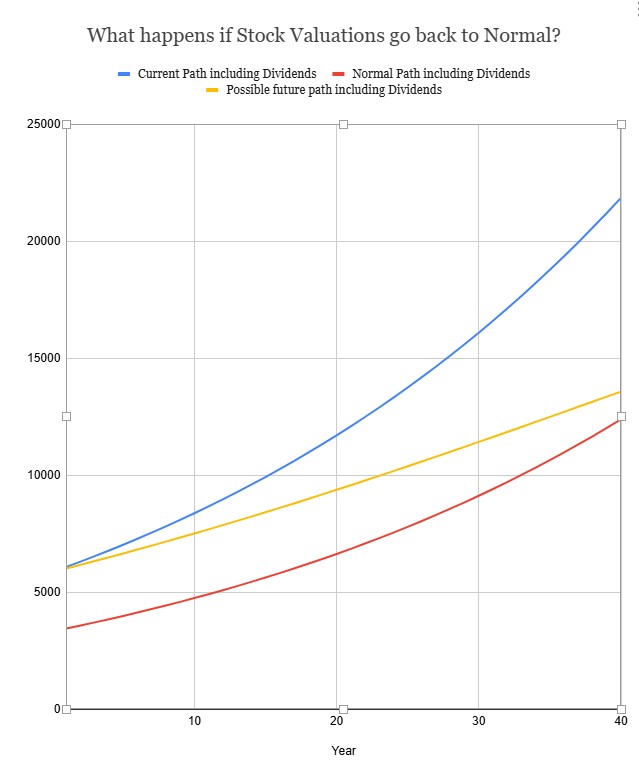
Despite the enthralling narrative of AI and the dizzying market ascent, the fundamental principles of sound investing remain unchanged. While the "blue path" of continued exponential growth (as depicted in some optimistic forecasts) would be desirable, a more realistic "yellow path" of moderated, yet still positive, returns is a perfectly acceptable outcome. The economy will continue to grow, and corporate earnings will generally follow suit, but future investors may simply be less willing to pay such high multiples for those earnings.
Attempting to time the market—selling stocks now in anticipation of a crash to buy them back cheaper later—is a notoriously difficult and often losing endeavor. History is replete with examples of investors missing out on significant gains while waiting on the sidelines. The most reliable approach continues to be consistent, long-term investing in a diversified portfolio, ignoring daily news headlines and market speculation. This strategy allows investors to capture the compounding power of economic growth over decades, irrespective of short-term volatility.
Ultimately, while understanding market dynamics and global economic shifts is valuable, focusing excessive energy on worrying about daily fluctuations can be counterproductive. Reinvesting that mental energy into tangible aspects of life, such as physical activity, community engagement, and personal growth, offers guaranteed, market-beating returns in terms of well-being and fulfillment. For those seeking continuous, informed economic perspective, reputable sources like The Economist provide valuable insights without succumbing to sensationalism. The future, particularly with the advent of AI, is undeniably exciting and unpredictable, but a steadfast, disciplined approach to finance and a balanced perspective on life will always serve investors best.

