
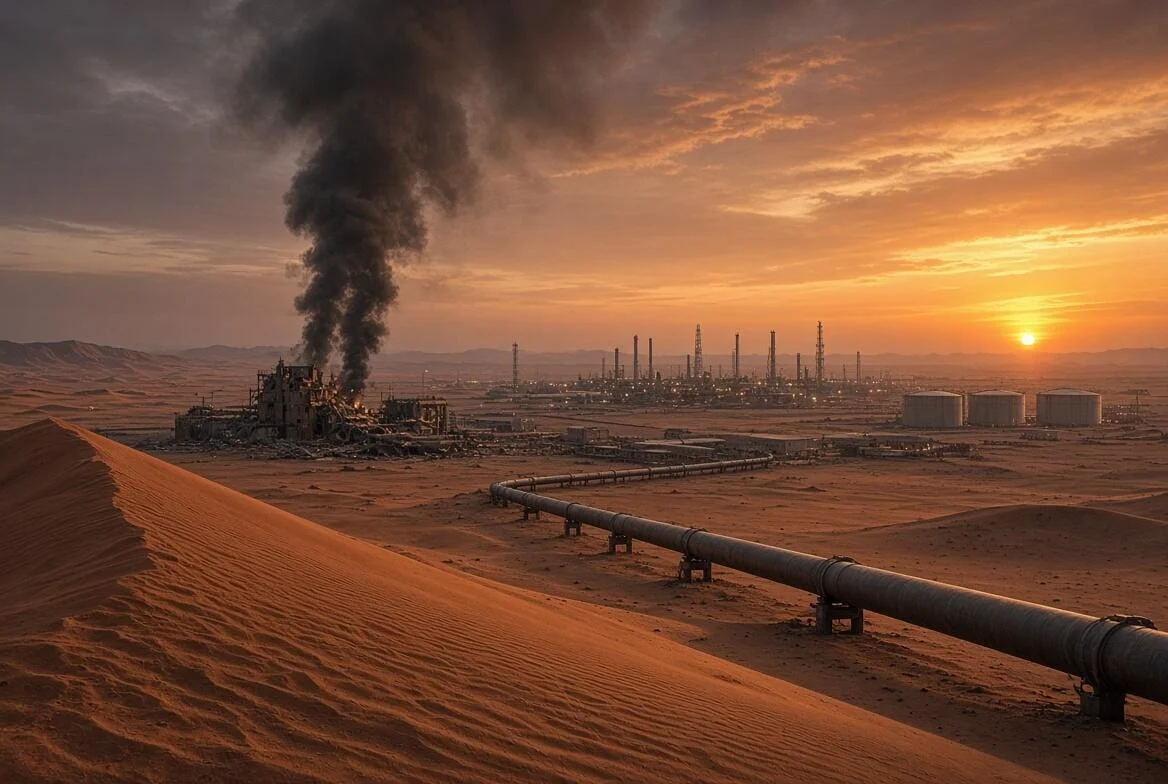
Saudi Arabia, long considered the steadfast shock absorber of the world oil market, is now facing an existential threat to its critical energy infrastructure, profoundly altering its role from a global stabilizer to a significant source of risk. Recent, escalating attacks on key Saudi oil facilities and shipping lanes have not only exposed deep vulnerabilities but have also triggered a stark reassessment of the global energy landscape, projecting a rebuilding timeline spanning years and costs potentially reaching trillions of dollars. This shift implies a prolonged period of global diesel shortages and heightened geopolitical instability, challenging assumptions held by major energy consumers and policymakers worldwide.
Escalating Threats and Strategic Vulnerabilities
For decades, the Kingdom of Saudi Arabia has leveraged its vast oil reserves and robust export capabilities to cushion global supply shocks, particularly through the strategically vital Strait of Hormuz. When this choke point has been threatened, Riyadh could reroute significant crude volumes westward via its East-West pipeline to the Red Sea port of Yanbu, ensuring continued exports. However, this critical bypass is now squarely in the crosshairs of regional adversaries, primarily the Ansar Allah (Houthi) movement from Yemen, alongside alleged Iranian-backed militias in Iraq.
The chronology of these attacks paints a grim picture of escalating capability and intent. In September, drones targeted and largely knocked the East-West pipeline out of service, an attack Riyadh attributed to Iranian-backed groups in Iraq. This was followed on October 4 by a strike on a pumping station at Khurais, east of Riyadh, marking a significant escalation by hitting a major oil field for the first time in the current conflict and causing another pipeline shutdown. Beyond land-based infrastructure, Ansar Allah has asserted control over islands at the mouth of the Red Sea, declared a "maritime ban" on Saudi shipping, and claimed strikes on Saudi airports, effectively creating a multi-front assault on the Kingdom’s ability to produce, transport, and export its most vital commodity. These coordinated attacks signify a calculated strategy to cripple Saudi Arabia’s energy lifeline, targeting both its primary export routes and its secondary bypass mechanisms.
The East-West Pipeline: More Than Just a Pipe
The conventional understanding of a pipeline as a simple conduit for oil falls short in comprehending the complexity and fragility of Saudi Arabia’s East-West system. As energy expert Karl Miller highlights, a modern pipeline is an intricate, interconnected system comprising pumping stations, power supplies, advanced control systems, storage tanks, and loading berths. Its strength is, by definition, determined by its weakest link. The September drone attacks on pumping stations, the October interruption at Khurais, a fire at the Riyadh energy complex, and the disruption of Saudi aviation all represent distinct but interconnected strikes against this delicate system.
While partial restoration of the pipeline has been reported, Miller warns that fundamental equipment losses remain unresolved. The vulnerability of Yanbu, the Red Sea export hub, underscores this point: the port can be effectively shut down without a single bomb hitting its berths if the flow of crude from the East-West pipeline ceases. This systemic fragility means that even seemingly minor attacks can have cascading effects, disrupting the entire chain of supply.
Miller’s analysis further stresses the importance of throughput over individual damaged stations. Using a benchmark of 5.8 million barrels a day through the corridor, a complete interruption for just seven days would jeopardize the movement of 40.6 million barrels, while a 30-day shutdown could impact 174 million barrels. While this represents a stress calculation rather than a definitive claim of full closure, it vividly illustrates the immense volume of oil at risk and the immediate implications for global supply should these disruptions persist or intensify.
A Decade-Long Rebuild and Trillions in Costs
The ramifications of these attacks extend far beyond immediate supply disruptions; they necessitate a massive, long-term reconstruction effort for the entire Gulf energy complex. Karl Miller’s updated assessment extends the rebuilding horizon to between seven and ten years for the most severely damaged and interconnected systems, placing full recovery between October 2033 and October 2036. While some partial output may return sooner, full, reliable operation is not anticipated for nearly a decade.
The primary reason for this extended timeline lies in the specialized nature of the required equipment. Components such as large compressors, high-voltage transformers, complex turbines, specialized pressure vessels, and integrated control systems are not off-the-shelf items. They are custom-built, requiring a meticulous and lengthy process from design to commissioning. Miller outlines a critical path for replacing such a package: a year to define the damage and fund the design, three years for procurement and manufacturing, two years for delivery and installation, and a final year for commissioning and stabilization. This 84-month (7-year) timeline represents an optimistic scenario. Insecure sites, potential financing gaps, existing factory queues for specialized industrial equipment, and the risk of repeated attacks could easily add another three years, pushing the recovery closer to the 2036 mark. The crucial insight here is that while money can secure a manufacturing slot, it cannot compress the inherent stages of highly specialized engineering and fabrication.
The financial implications are equally staggering. Miller models the reconstruction of the wider Gulf energy system, including Saudi Arabia, across three scenarios, emphasizing that these are funding envelopes based on assumptions, not audited damage estimates specific to Saudi Arabia alone.
| Scenario | Controlled | Central | Severe |
|---|---|---|---|
| Base reconstruction capital | $400 bn | $800 bn | $1,400 bn |
| Execution uplift (security, delays, escalation) | $100 bn | $280 bn | $630 bn |
| Finance and startup liquidity | $50 bn | $120 bn | $250 bn |
| Total funding envelope | $550 bn | $1.20 trn | $2.28 trn |
Source: Karl W. Miller, Saudi Arabia: The Breaking Point (12 October 2026). Covers the broader Gulf reconstruction portfolio.
In the central case, an estimated $180 billion would be required within the first two years alone, escalating to $540 billion over years three to five. Over a seven-year period, this averages more than $170 billion annually. This immense capital outlay will not only strain national budgets but also create intense competition among Gulf states for the limited global supply of specialized manufacturers, engineering firms, fabrication yards, and expert crews. A critical transformer slot secured by Kuwait or Qatar, for instance, is one that Saudi Arabia cannot obtain, further exacerbating delays and costs across the region.
Furthermore, delays themselves carry a hefty price tag. Miller’s analysis suggests that a three-year delay on the central reconstruction program could add between $76 billion and $125 billion in cost escalation, plus another $42 billion to $90 billion in financing charges. This does not even account for the cost of replacing the lost fuel supply. Each year that 1 million barrels a day of fuel supply remains offline translates to 365 million barrels that must be replaced, equating to approximately $55 billion at an illustrative price of $150 a barrel. Leaving a full 3 million barrel-a-day gap unrepaired for three more years would imply nearly $500 billion in replacement purchases alone.
Widening Global Diesel and Jet Fuel Deficits
The attacks on Saudi infrastructure threaten to significantly exacerbate an already precarious global fuel situation. Miller’s baseline assessment identifies a minimum global shortfall of 3 million barrels a day of diesel and jet fuel. If disruptions prevent 1 million barrels a day of crude from reaching operational refineries, the resulting loss of refined products, specifically diesel and jet fuel, would be approximately 300,000 to 450,000 barrels a day. An additional net loss of 500,000 barrels a day would push the global deficit to 3.5 million barrels, a one-sixth increase, adding another 15 million barrels of shortfall every month.
While cautioning against double-counting (lost crude, the refinery output it would have produced, and the missed export cargo may all represent the same barrels), the direction of travel is clear and concerning. Saudi Arabia, historically the Gulf’s primary source of relief and swing capacity, is now struggling to maintain its own bypass capabilities. An unreliable Saudi bypass means a growing global deficit in crucial refined products, with far-reaching consequences.
America’s Limited Capacity to Compensate
The notion that the United States or other major producers can easily fill this growing global supply gap is challenged by Miller’s sobering assessment of American capacity. Over a four-week period leading up to October 2, US refineries produced approximately 5.17 million barrels a day of distillate fuels. Of this, 1.56 million barrels were exported, and 3.77 million barrels were consumed domestically. To replace a 3 million barrel-a-day global gap from the United States alone would necessitate a staggering 58% increase in distillate output beyond current American refinery production levels.
The reality is stark: US distillate production is only about 150,000 barrels a day higher than a year ago, while the global gap is nearly 20 times that figure. This highlights a critical distinction: promising more exports does not magically create more fuel. It merely reallocates an existing shortage, moving it from one international buyer to another, and simultaneously drains domestic American inventories, potentially leading to domestic fuel crises. This underscores the systemic nature of the global energy challenge, where incremental increases in production are insufficient to offset large-scale, sustained disruptions.
Broader Economic and Geopolitical Ramifications
The energy crisis is already manifesting in the real economy, with tangible impacts on fundamental sectors. Global cereal prices are reportedly 17.2% higher than a year ago, a direct consequence of rising energy costs impacting agricultural production, transportation, and storage. Farmers require diesel for planting and harvesting before their crops yield revenue, truckers need it to move goods before invoices are settled, and cold chains depend on it to ensure food reaches shelves. Airlines, a sector particularly sensitive to fuel costs, require certified jet fuel at every airport they serve, for which diesel is not a substitute.
Miller’s gravest warning concerns the "weakest buyers"—nations already struggling with foreign exchange reserves and credit. These countries will not merely face higher prices; they risk being priced out of the market entirely, leading to potential humanitarian crises, widespread food insecurity, and further destabilization.
On a geopolitical level, Saudi Arabia’s diminished role as an energy stabilizer has profound implications. The Kingdom’s economy itself reflects this stress: Saudi oil activity fell by a quarter in the second quarter, contributing to a 4.8% contraction in GDP. This fundamental shift from an "insurance policy" for the world to a "source of risk" reconfigures regional power dynamics and international energy security strategies. The protracted and costly rebuilding effort will divert significant resources and attention, potentially impacting Saudi Arabia’s ambitious Vision 2030 diversification plans. The international community, particularly major energy consumers, must confront the reality that this is not a temporary price spike to be weathered, but a systemic, long-term challenge demanding comprehensive strategic responses.
International Response and Policy Challenges
The original article, authored by Larry C. Johnson via Sonar 21, and drawing on Karl Miller’s analysis, suggests a disconnect between the severity of the crisis and public acknowledgments from major powers. While Riyadh has openly blamed Iranian-backed militias, the broader international response, particularly from Washington, has not fully articulated the extent of the damage or the long-term implications. This creates a policy challenge where short-term measures, such as discussions around Russian diesel or export bans, are unlikely to address the fundamental, structural deficit.
Policymakers face the daunting task of explaining to their electorates that the rebuilding of the Gulf’s energy infrastructure will be measured in years and trillions of dollars, and that the world will likely be short of diesel for much of that time. Any promises of falling prices or swift recovery must be viewed through this lens. True recovery, as Miller concludes, will be evidenced not by repair announcements or fluctuating headline prices, but by the tangible delivery of fuel to markets, ensuring the stability of global supply chains and economies. The current situation demands a candid and realistic assessment from all stakeholders to navigate what promises to be one of the most significant energy challenges of the 21st century.

