
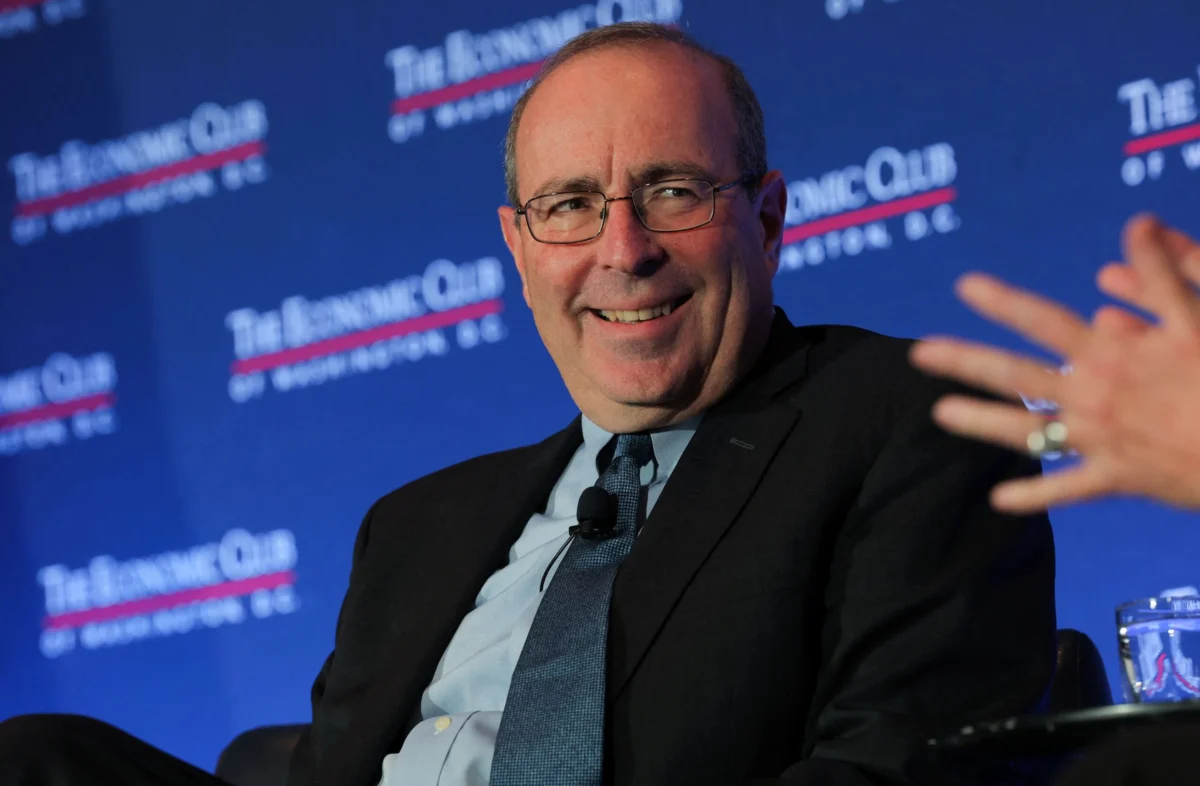
Richmond Federal Reserve President Thomas Barkin indicated Thursday that the central bank would likely need to implement additional interest rate increases to effectively combat persistent inflation, though he maintained an open stance on the precise magnitude and timing of such adjustments. Speaking in a CNBC interview conducted as part of the Richmond Fed’s 2026 CFO Summit, the influential policymaker underscored his deep concern over elevated price pressures and the necessity for further calibration of monetary policy. His remarks offered a crucial glimpse into the ongoing deliberations within the Federal Open Market Committee (FOMC) as it navigates a complex economic landscape characterized by an exceptionally tight labor market and inflation rates far exceeding the Fed’s long-term target.
Barkin articulated a clear, albeit nuanced, path forward for monetary policy, stating, "Unemployment’s near record lows, and inflation is too high. That means the path is pretty straightforward. The question, of course, is pace." This assessment highlights the dual mandate of the Federal Reserve: achieving maximum employment and stable prices. While the employment side of the mandate appeared robust, the inflation component remained a significant challenge, necessitating a restrictive policy stance. He further elaborated on the preferred pace of adjustments, adding, "Gradual makes sense if you think there’s uncertainty in the world, and if you think that there’s information you’re going to get in the period. And I think that’s still a pace that makes sense to me." This emphasis on gradualism suggests a data-dependent approach, allowing the Fed to observe the impact of previous hikes and evolving economic conditions before committing to aggressive moves.
The Rationale Behind Further Tightening
Barkin’s perspective is rooted in a comprehensive analysis of the current economic environment, where several key indicators point to the need for continued monetary tightening. His concerns are largely driven by the persistence of inflation and the underlying strength of the U.S. labor market, which collectively suggest that the economy may still be operating with significant momentum.
Persistent Inflationary Pressures
At the time of Barkin’s comments in mid-to-late November 2022, inflation remained stubbornly high. The Consumer Price Index (CPI) for October 2022, released just days prior to his interview, showed an annual increase of 7.7%. While this marked a modest deceleration from the summer’s peak, it was still significantly above the Federal Reserve’s 2% target. Core CPI, which excludes volatile food and energy prices, also registered a robust 6.3% year-over-year increase, indicating broad-based price pressures across various sectors of the economy. This persistent inflation was eroding purchasing power and creating uncertainty for businesses and consumers alike. Barkin explicitly identified inflation as "the most important risk right now," signaling the Fed’s unwavering commitment to bringing it back under control. He expressed hope that the Fed’s previous actions, including the September rate hike, and any future moves would have a tangible impact on taming these price increases.
The Resilient Labor Market
Complementing the inflation challenge was an exceptionally strong labor market. The unemployment rate for October 2022 stood at 3.7%, remarkably close to the half-century lows seen just prior to the COVID-19 pandemic. This robust employment picture, characterized by high job openings and strong wage growth, contributed to sustained consumer demand, which in turn could fuel further inflationary pressures. While a strong labor market is generally desirable, in an inflationary environment, it can complicate the Fed’s efforts to cool the economy without triggering a sharp downturn. Barkin’s acknowledgment of "unemployment’s near record lows" underscored the challenge of simultaneously achieving price stability while maintaining a healthy jobs market. The tension between these two mandates necessitates a delicate balancing act, with the current priority firmly on curbing inflation.
Navigating the Neutral Rate
A critical component of Barkin’s assessment centered on the concept of the "neutral rate" – the theoretical interest rate at which monetary policy is neither stimulative nor restrictive to economic growth. He suggested that current policy was approaching this neutral level, but perhaps had not yet fully crossed into truly restrictive territory. "If you’re restricting the economy, presumably you’re restricting consumption, which is you know roughly two thirds of the economy, and that’s relatively elevated," he explained. "So that would make the case that we’re a little bit accommodative." This nuanced view implies that even with the significant rate hikes already implemented, the overall stance of monetary policy might not yet be sufficiently tight to decisively cool demand and bring inflation down to target. His comments suggest that the Fed may need to push rates beyond merely neutral to achieve its inflation objectives, embracing a period of genuinely restrictive policy.
Monetary Policy in Motion: A Chronology of Fed Actions
Barkin’s comments were delivered a little over a week after the Federal Open Market Committee (FOMC) concluded its early November 2022 meeting, where it voted to raise the benchmark federal funds rate by 75 basis points, bringing the target range to between 3.75% and 4.00%. This marked the fourth consecutive 75-basis-point hike, reflecting the Fed’s aggressive campaign to rein in inflation that had reached multi-decade highs.
Recent FOMC Decisions and Forward Guidance
The November 2022 rate hike followed a similar 75-basis-point increase in September, which had elevated the rate to 3.00-3.25%. The FOMC’s post-meeting statement in November reiterated its commitment to achieving its 2% inflation target and indicated that ongoing increases in the target range would be appropriate. However, the statement also introduced language suggesting a potential shift in the pace of future hikes, noting that the Committee would take into account the cumulative tightening of monetary policy, the lags with which monetary policy affects economic activity and inflation, and economic and financial developments. This "accumulation of more information" clause provided the flexibility for the Fed to consider smaller rate increases in the future, signaling a move towards a more data-dependent and potentially less aggressive approach after a period of rapid tightening. This nuance aligned with Barkin’s call for a "gradual" pace given ongoing uncertainties.
Market Anticipation and the FedWatch Tool
Financial markets closely track the Federal Reserve’s actions and communications, attempting to anticipate future policy decisions. At the time of Barkin’s interview, the CME Group’s FedWatch Tool, which gauges the probability of future rate changes based on fed funds futures contract pricing, indicated a high likelihood of another rate hike in December 2022. Specifically, markets were pricing in a better than 80% chance of a December hike, with expectations largely centering on a 50-basis-point increase rather than another 75-basis-point move. This market sentiment suggested that investors had largely absorbed the Fed’s commitment to further tightening but were also anticipating a moderation in the pace of increases, consistent with the FOMC’s evolving forward guidance and Barkin’s own remarks. Beyond December, the tool also suggested that markets anticipated at least one more rate adjustment in early 2023, signaling a terminal rate likely above 4.5%.
The Role of Non-Voting Members and Future Influence
It is important to note that while Thomas Barkin is a highly respected voice within the Federal Reserve system, he was not a voting member of the Federal Open Market Committee in 2022. The FOMC consists of 12 voting members: the seven members of the Board of Governors, the president of the Federal Reserve Bank of New York, and the presidents of four other Federal Reserve Banks on a rotating basis. Barkin will, however, assume a voting position on the FOMC in 2027. Despite not having a direct vote, the presidents of the regional Federal Reserve Banks play a crucial role in shaping policy discussions through their participation in FOMC meetings and their public commentary. Their regional economic insights and perspectives contribute significantly to the broader consensus-building process, making Barkin’s views highly influential, even without a current vote. His forward-looking perspective, therefore, offers a valuable indicator of the thinking that will eventually guide future policy decisions.
Broader Economic Context and Emerging Risks
Beyond the immediate concerns of inflation and interest rates, Barkin also touched upon several other significant economic factors and potential risks that could influence the long-term outlook. His insights extended to the evolving role of artificial intelligence and the dynamics of debt markets, particularly concerning large technology companies.
Artificial Intelligence: A Double-Edged Sword for Prices
Barkin identified artificial intelligence (AI) as a source of both short-term price pressures and long-term deflationary potential. In the immediate future, the massive investments required for AI infrastructure, including advanced chips, specialized data centers, and skilled labor, could contribute to increased demand and potentially higher prices in certain sectors. This mirrors the current boom in technology capital expenditure. However, Barkin expressed optimism that, over a longer horizon, AI would ultimately spur significant productivity gains across the economy. By automating tasks, optimizing processes, and enabling new innovations, AI could lead to more efficient production, lower costs, and ultimately help ease inflationary pressures "farther down the road." This perspective highlights the complex and often contradictory impacts of technological advancements on macroeconomic variables.
Scrutinizing Debt Issuance to Hyperscalers
In a related matter, Barkin raised a cautionary flag regarding the substantial debt issuance by "hyperscalers" – a term referring to the largest cloud computing providers and major technology companies (e.g., Amazon Web Services, Microsoft Azure, Google Cloud). With estimated debt issuance for these entities projected at over $500 billion for the year, Barkin emphasized that this trend was "worth watching" for potential credit issues. While acknowledging that these large, cash-generating companies are generally considered "good credits," his concern focused on the less transparent corners of the financial system. "So it’s more who are the intermediaries in this world who are taking on risks that you don’t know about," he mused. "You do wonder where in the intermediary sector is the biggest risk." This suggests a concern about potential hidden leverage or mispriced risk within the broader financial ecosystem, particularly among the banks, investment firms, or other financial institutions that facilitate these large debt transactions. Such systemic risks, if they materialize, could have broader implications for financial stability, even if the primary borrowers themselves remain robust.
The Road Ahead: Implications for Policy and the Economy
Thomas Barkin’s statements underscore the Federal Reserve’s unwavering commitment to price stability and provide a clear indication that the journey to bring inflation back to target is far from over. His emphasis on further rate hikes, even if gradual, suggests that policymakers are prepared to endure a period of restrictive monetary policy to achieve their objectives.
Balancing Growth and Price Stability
The implications for the broader economy are significant. Continued tightening of monetary policy will likely translate into higher borrowing costs for businesses and consumers, potentially dampening investment, hiring, and consumption. While this is the intended mechanism to cool demand and reduce inflation, it also carries the risk of slowing economic growth and potentially tipping the economy into a recession. The challenge for the Fed, as highlighted by Barkin, is to navigate this path carefully, striking a balance between bringing inflation down decisively and avoiding an overly severe economic contraction. The robust labor market provides some cushion, but the effects of higher rates on housing, manufacturing, and other interest-rate-sensitive sectors will be closely monitored.
The Data-Dependent Path Forward
Ultimately, the Federal Reserve’s future actions will remain highly dependent on incoming economic data. Barkin’s preference for a "gradual" approach reflects this data-dependent strategy, allowing policymakers to assess the impact of previous tightening and respond to evolving inflation, employment, and growth figures. Key indicators such as monthly CPI and PCE inflation reports, labor market statistics (unemployment rate, wage growth, job openings), and surveys of business and consumer sentiment will continue to guide the FOMC’s decisions. The Fed’s commitment to transparency, as evidenced by Barkin’s public remarks, aims to provide clarity to markets and the public, even as the exact trajectory of interest rates remains subject to the unfolding economic narrative. The overarching message from Richmond is clear: the fight against inflation requires vigilance and a willingness to act, with the ultimate goal of restoring price stability for a healthy and sustainable economy.

