
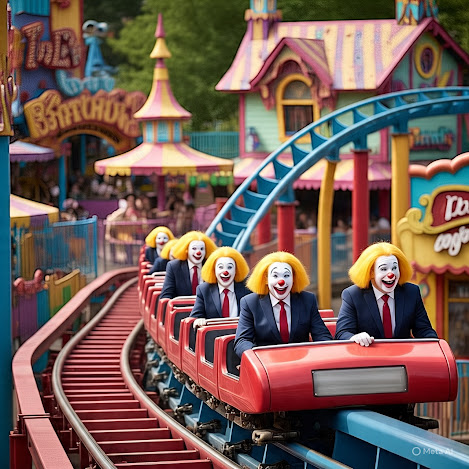
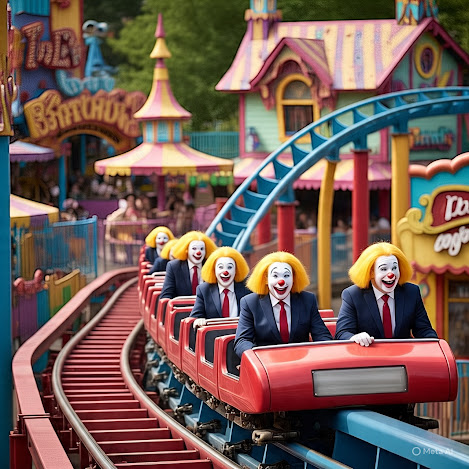
The financial landscape has been gripped by unprecedented volatility since early 2025, culminating in a dramatic rollercoaster ride for global stock markets, a phenomenon largely attributed to the sudden escalation of international trade tariffs. Following a robust multi-year ascent that peaked in February 2025, the market experienced one of its most severe and swift corrections in recent history, shedding a substantial 20% of its value at its nadir. Remarkably, as of June 2025, it has staged an equally rapid recovery, nearly regaining its prior peak. This abrupt swing, characterized by sharp declines and equally rapid rebounds, has left investors, businesses, and policymakers grappling with uncertainty, largely pointing to the unfolding global tariff and trade dispute as the primary instigator.
Market Dynamics and the Tariff Catalyst
The period immediately following February 2025 saw a remarkable divergence from previous market behavior. Historically, significant market corrections are often preceded by clear economic indicators or geopolitical crises. This time, however, the catalyst appeared to be a series of unpredictable policy shifts emanating from the White House concerning trade. As the administration began to levy substantial new tariffs on imported goods from key trading partners, a palpable sense of apprehension spread across capital markets. The Dow Jones Industrial Average, S&P 500, and NASDAQ Composite all registered significant drops, with certain sectors, particularly those heavily reliant on global supply chains like manufacturing and technology, experiencing disproportionate losses. For instance, the S&P 500, a broad measure of U.S. stock market health, saw its steepest single-day percentage decline since the 1930s on April 2nd, 2025, following a particularly aggressive tariff announcement dubbed "Liberation Day" by the administration. This event triggered widespread panic selling, as evidenced by a 40% surge in volatility indices such as the VIX. Yet, subsequent announcements hinting at potential de-escalation or temporary pauses in tariff implementation invariably led to swift market recoveries, underscoring the direct correlation between tariff policy and investor sentiment.
Defining Tariffs and Their Economic Mechanics
At its core, a tariff is a tax imposed by a government on goods and services imported from another country. While often presented as a levy on foreign nations or corporations, the economic reality is that tariffs are ultimately borne by domestic consumers and businesses. When a U.S. importer brings goods from abroad, whether it’s a small business ordering specialized components or a retail giant like Amazon or Walmart importing consumer products, they are responsible for paying this import tax. These increased costs are then, almost invariably, passed on to the end consumer through higher retail prices.
Beyond consumer goods, tariffs ripple through the entire economy. Consider the construction industry: tariffs on imported steel, aluminum, lumber, and other essential building materials directly inflate the cost of new infrastructure projects, commercial developments, and residential housing. For example, a 25% tariff on imported steel directly translates to a 25% increase in the cost of steel for a U.S. manufacturer or builder, making their products or projects more expensive. This broader increase in input costs acts as a de facto national sales tax, reducing purchasing power, slowing economic activity, and potentially dampening overall demand. While tariffs do generate revenue for the government, which could theoretically aid in deficit reduction or funding public services, this benefit is often overshadowed by the distortionary effects on markets and the increased cost of living for citizens.
The Rationale Behind Tariffs: Protectionism vs. Strategy
Governments employ tariffs for various reasons, typically falling into two main categories: protectionism and strategic leverage. Protectionist tariffs aim to shield domestic industries from foreign competition. By making imported goods more expensive, they theoretically give domestically produced alternatives a price advantage. For example, a tariff on imported automobiles like Hondas might make General Motors vehicles more competitive, potentially leading to increased sales for GM, more domestic manufacturing jobs, and higher profits for U.S. automakers. While this might appear beneficial for specific industries and their employees, it often comes at the expense of consumers, who face higher prices and reduced product selection. Moreover, it can stifle innovation within protected industries by reducing competitive pressure.
Strategic tariffs, on the other hand, are often deployed as a bargaining chip in international negotiations. A country might impose tariffs to pressure another nation into altering its trade practices, addressing intellectual property theft, or gaining concessions in other geopolitical arenas. In some critical sectors, such as defense or essential infrastructure, tariffs can be justified on national security grounds to ensure domestic production capabilities. However, the effectiveness of such strategies is hotly debated among economists, with many arguing that they often lead to retaliatory tariffs, escalating trade wars, and a net negative impact on global economic growth.
A contentious example of tariff application highlighted in the discourse around this recent surge is the imposition of taxes on imported solar panel components. Despite the fact that these components contribute to affordable, clean energy and offer long-term economic benefits, both the current administration and its predecessor, Joe Biden, have applied and even raised tariffs on them. This bipartisan "boneheadedness," as some commentators have labeled it, illustrates how tariffs can be driven by political considerations, such as appealing to swing-state voters or protecting specific domestic manufacturing interests, even when the broader economic and environmental costs are significant. Blocking access to cheaper energy sources, critics argue, undermines both consumer welfare and industrial competitiveness.
The Employment Question: Tariffs and Job Creation
The promise of job creation is frequently invoked to justify tariffs. Returning to the hypothetical $5,000 tariff on imported Hondas, the immediate effect might be a surge in demand for GM vehicles. This increased demand could indeed prompt GM to expand production, hire more workers, and potentially invest in new factories and technologies. Such a scenario would lead to job growth within the domestic auto industry and related sectors.
However, this localized gain often masks broader economic costs. The higher price of vehicles due to tariffs means that consumers have less disposable income for other goods and services. Businesses, like Amazon’s delivery fleet, face increased operational costs, which they, in turn, pass on to consumers. This inflationary pressure diminishes overall consumer spending power and corporate profitability across various sectors. The net effect is a reallocation of economic resources, not necessarily an overall increase. Industries that rely on imported components or those that face retaliatory tariffs from other countries may suffer job losses. Furthermore, shielded from robust international competition, domestic industries may become less innovative and efficient over time, hindering long-term growth. Most economists therefore advocate for the very sparing use of tariffs, reserving them for truly critical areas like national defense or food security, where the societal benefits are deemed to outweigh the significant economic costs and inefficiencies they typically introduce. The consensus is that while tariffs can create jobs in specific protected sectors, they generally lead to a net decrease in overall employment and a slowdown in economic growth.
The Unpredictable Nature of Modern Tariff Policy

A significant factor contributing to the current market turmoil is the unpredictable nature of the administration’s tariff policy. President Trump has frequently employed tariffs as a tool of economic statecraft, often announcing high tariffs as threats and then modifying or rescinding them on an almost daily basis. This creates an environment of extreme uncertainty for businesses, which thrive on stability and predictability for planning and investment. The lack of a clear, consistent trade policy makes it exceedingly difficult for companies to manage supply chains, forecast costs, or make long-term capital investments.
This "Bizarro Opposite Universe belief system" regarding economics, as some critics describe it, where tariffs are presented as wealth generators despite economists overwhelmingly viewing them as taxes, has been a source of profound confusion. The market’s reaction—stock prices falling on tariff announcements and rising on their reduction—underscores the disconnect between political rhetoric and economic reality. This volatility suggests that markets understand tariffs as a drag on corporate profits and economic efficiency. The perception that the entire economy is subject to the ad-hoc whims of a single individual raises concerns about governance and the stability of established democratic institutions, particularly the system of checks and balances designed to prevent such unilateral power.
Legal and Constitutional Challenges to Tariff Authority
The sweeping application of tariffs has not gone unchallenged. The U.S. Constitution, with its delineation of powers among the legislative, executive, and judicial branches, provides a framework for trade policy. Historically, Congress has held the primary authority to regulate commerce and levy duties. However, modern presidents have increasingly utilized executive authority, often citing national security provisions under statutes like Section 232 of the Trade Expansion Act of 1962, to impose tariffs without explicit congressional approval.
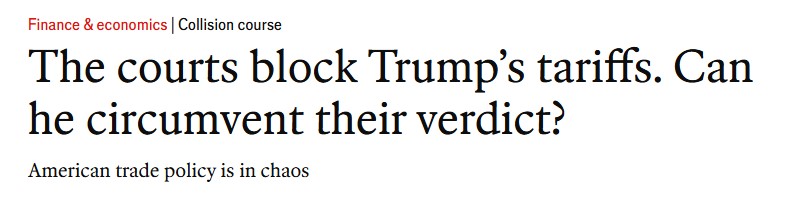
This expansion of executive power has led to a growing number of legal challenges. Businesses and trade associations directly impacted by tariffs have filed lawsuits, arguing that the president has overstepped his constitutional authority. The courts are now becoming a critical battleground in determining the limits of presidential power in trade matters. For instance, recent reports from The Economist highlight several cases where judicial review is being sought to block tariffs, signaling a potential reassertion of the legislative and judicial branches’ roles in rebalancing trade policy authority. The outcome of these legal battles will have profound implications for the future of U.S. trade policy and the distribution of power within the federal government.
Historical Context and Current Tariff Levels
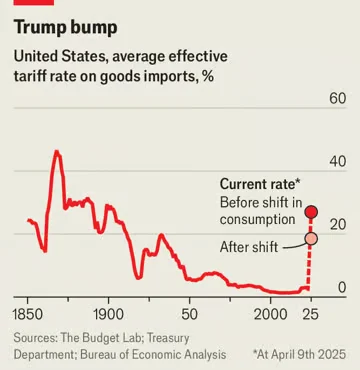
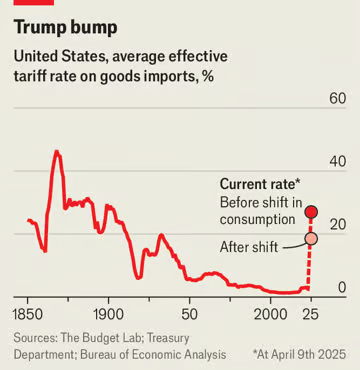
To understand the magnitude of the current situation, it is crucial to place present tariff levels in historical context. For the past 75 years, the U.S. economy has largely operated under a regime of very low tariffs and increasing free trade, a policy widely credited with fostering global economic integration and prosperity. Following World War II, the establishment of institutions like the General Agreement on Tariffs and Trade (GATT) and later the World Trade Organization (WTO) aimed to systematically reduce trade barriers, believing that open markets lead to greater efficiency, innovation, and international cooperation.
However, the current administration’s policies represent a significant departure from this long-standing trajectory. Even discounting the more extreme proposals that circulated, current average tariff rates are estimated to be several times higher than those seen in recent decades. Data from sources like The Economist illustrate this dramatic shift, showing current tariffs spiking upwards on historical charts that otherwise depict a steady decline since the early 20th century. This abrupt reversal of policy has forced businesses to fundamentally reconsider their global supply chain strategies and has injected a level of uncertainty not seen in generations.
Lagging Economic Indicators: Why Price Hikes Aren’t Immediately Visible
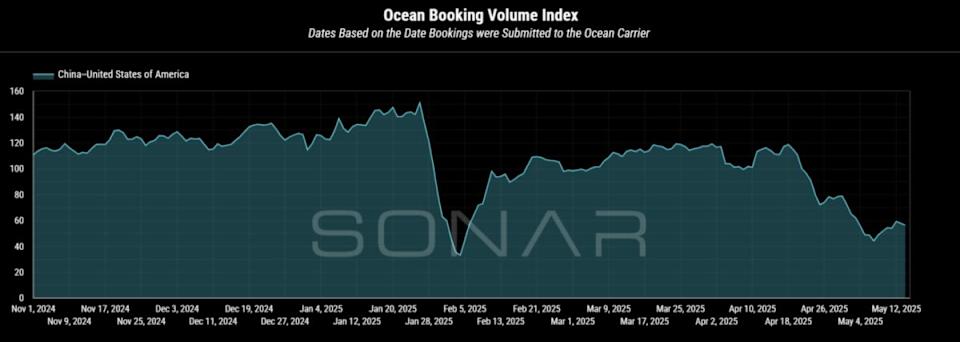
Despite the significant increase in tariffs, many consumers have not yet experienced a dramatic surge in prices at the retail level. This apparent disconnect can be attributed to the inherent inertia of global supply chains and inventory management. The U.S. economy, often likened to a massive cargo ship, takes time to change direction. In normal times, businesses maintain several months’ worth of inventory. Anticipating the imposition of tariffs, many importers strategically accelerated their orders to stockpile goods before the new taxes took effect.
Consequently, the market is currently drawing down these pre-tariff inventories. While imports have demonstrably declined—as indicated by indices like the Freightwaves Ocean Shipping Index (OSI), which shows a significant drop in inbound cargo—the immediate impact on consumer prices is cushioned by existing stock. This buffer, however, is finite. As stockpiled goods are depleted, likely over the summer and fall of 2025, consumers are expected to begin seeing direct price increases and potentially even shortages, particularly for goods heavily reliant on imported components. While the absence of certain "plastic party trinkets" might be a minor inconvenience, the implications for essential tools, machinery, and everyday necessities could be far more disruptive to economic stability.
Future Scenarios: Lingering Tariffs vs. Trade Normalization
The path forward for the global economy hinges on the trajectory of these tariff policies. Two primary scenarios are widely contemplated:
1. Prolonged High Tariffs: This less likely but still plausible scenario envisions a sustained period of elevated tariffs.
- Economic Contraction: Such a reality would likely lead to a significant slowdown in global trade, increasing costs for consumers and businesses, and potentially triggering a global recession.
- Supply Chain Restructuring: Companies would be forced to drastically reconfigure their supply chains, reshoring production or diversifying away from heavily tariffed countries. This process is costly, time-consuming, and would likely result in higher production expenses and less efficient operations.
- Inflationary Pressures: Higher import costs would translate directly into increased inflation, eroding consumer purchasing power and potentially prompting central banks to raise interest rates, further stifling economic growth.
- Reduced Innovation: Protection from foreign competition could reduce the incentive for domestic industries to innovate and improve efficiency, leading to slower technological advancement and reduced overall competitiveness.
- Geopolitical Strain: Prolonged trade disputes would exacerbate international tensions, potentially leading to further retaliatory measures and undermining multilateral trade agreements.
2. Return to Mostly Low Tariffs (Negotiating Tactic): This scenario, favored by many investors, posits that current tariffs are primarily a negotiating tactic, eventually leading to de-escalation and a return to more open trade.
- Market Rebound and Stability: A resolution to the trade disputes would likely be met with a strong positive reaction from financial markets, leading to increased investment and economic stability.
- Resumption of Global Trade Growth: The removal of tariff barriers would facilitate the free flow of goods and services, allowing businesses to optimize supply chains and consumers to benefit from lower prices and greater choice.
- Renewed Investor Confidence: Predictable trade policies are crucial for long-term investment. A return to stability would encourage businesses to plan and invest with greater confidence, fostering economic growth.
- Reinforced Multilateralism: A successful de-escalation could strengthen international trade institutions and reaffirm the benefits of collaborative global economic engagement.
The prevailing wisdom among economists and market analysts is that the most effective way to "win" a tariff game is to avoid playing it altogether. The prosperity of nations, particularly those with large, diverse economies like the U.S., is fundamentally built upon the principles of open borders and the free exchange of goods, services, and even people. When nations treat each other with respect and engage collaboratively, the global economy thrives, and all participants grow richer.
Investor Sentiment and Market Resilience
Despite the turbulent ride, the U.S. stock market’s remarkable bounce-back to near all-time highs by June 2025 is a testament to investor confidence in a future resolution. This resilience, occurring even while current tariff levels remain significantly elevated (reportedly seven times higher than before the "circus opened"), suggests that the market is largely pricing in the expectation of a truce and a resumption of free-ish international trade. Investors, in essence, are betting that the current experiment in tariff-driven economic policy will eventually yield to a more conventional, open-market approach. While this optimism is a positive sign, if these expectations prove unfounded, further market volatility and economic disruption cannot be ruled out.
The Broader Lesson: Navigating Economic Narratives
The recent economic turbulence offers a critical lesson in media literacy and critical thinking. In an era where news headlines are increasingly designed to capture attention through sensationalism, often at the expense of accuracy, discerning factual information from fear-mongering narratives is paramount. Both politically aligned and commercially driven media outlets frequently prioritize generating outrage and fear, as these emotions tend to drive engagement and revenue.

For individuals and investors, this underscores the importance of not forming opinions based solely on fleeting headlines. Instead, a more robust approach involves either disengaging from the constant media cycle to focus on personal well-being or, for areas of genuine interest, becoming a subject matter expert. By delving into original sources, economic reports, and academic analyses, one can gain a deeper, more nuanced understanding of complex issues. It becomes quickly apparent how often mainstream media narratives oversimplify, misrepresent, or outright distort economic realities. Therefore, cultivating a skeptical approach to news and prioritizing foundational knowledge over ephemeral soundbites is crucial for making informed decisions, whether in personal finance or broader civic engagement. Ultimately, economic resilience, both individually and nationally, often stems from an ability to filter noise, understand underlying principles, and maintain a long-term perspective.

