
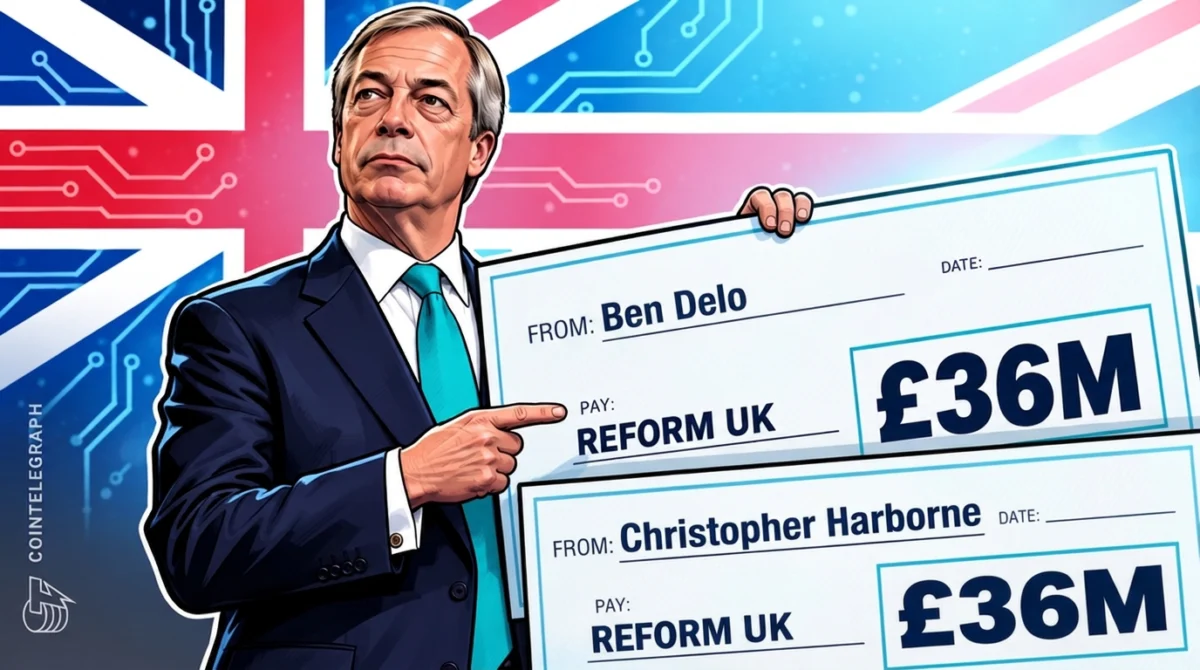
Reform UK, the political party led by Nigel Farage, has secured a monumental £72 million in donations from two prominent figures within the cryptocurrency industry, marking the largest ever financial contribution to a British political party. The substantial sums were revealed to be from Ben Delo, co-founder of the cryptocurrency exchange BitMEX, and Christopher Harborne, a financier and investor with significant ties to the digital asset sector. This unprecedented influx of capital has propelled Reform UK into a new financial stratosphere, but it simultaneously intensifies existing scrutiny surrounding the party’s funding sources and the broader influence of cryptocurrency on British politics.
The latest tranche of funding was confirmed on Saturday, September 12, 2026, with Christopher Harborne announcing a matching donation of £36 million. This followed an equally significant £36 million contribution from Ben Delo, disclosed just a day prior. This dual injection of capital has effectively doubled the party’s financial capacity overnight. Notably, this is not the first time Harborne has supported Reform UK; he previously donated £9 million to the party in August 2025.
In an opinion piece published in The Telegraph, Harborne articulated his motivations, stating that Delo’s substantial contribution had served as a powerful catalyst for his own pledge. He explicitly disavowed any expectation of personal gain, emphasizing his desire to see "just a party that is ready for government." This statement suggests a strategic alignment with Reform UK’s broader political ambitions.
Ben Delo, a figure central to the burgeoning cryptocurrency economy, explained his motivation as a desire to ensure a "fair fight" for Reform UK in the upcoming electoral landscape. His £36 million donation was structured to provide a consistent monthly allocation of £1 million until the anticipated general election in 2029. However, Delo opted for an upfront, lump-sum payment, a strategic decision seemingly aimed at circumventing any potential obstacles or challenges that might arise in disbursing funds over an extended period.
Nigel Farage, the leader of Reform UK, publicly welcomed both donations, asserting that the substantial funding would equip his party to contest the next general election on an equitable footing. This sentiment underscores the party’s long-standing narrative of being under-resourced compared to established political entities.
A Pattern of Crypto Connections and Political Investigations
The sheer magnitude of these donations has amplified existing concerns and investigations into Reform UK’s financial backing. Cointelegraph reported last month that Nigel Farage was already under investigation concerning millions of pounds worth of donations and gifts received from individuals linked to the cryptocurrency sphere, specifically naming Harborne and George Cottrell. Farage has consistently denied any wrongdoing.
This ongoing scrutiny intensified earlier in the year when Farage resigned his position as a Member of Parliament in July 2026 amidst the burgeoning crypto scandal. This resignation triggered a by-election, a contest Farage subsequently won with a commanding 63% of the vote, significantly outperforming his satirical opponent, Count Binface.
The recurrent pattern of substantial contributions from individuals with deep ties to the digital asset industry has ignited robust debate among parliamentarians regarding the potential influence of cryptocurrencies on the integrity and fairness of the British political system. The sheer volume of these donations raises critical questions about the regulatory frameworks governing political finance and the potential for foreign or undisclosed influence.
In response to these developments, Labour MPs were reportedly considering making permanent a moratorium on crypto donations that was initially announced in March 2026, pending further legislative review. This proposed action stems from concerns over the potential for undue influence, particularly in light of what Farage himself characterized as "gifts" from Harborne and Cottrell. The implications of such a permanent ban would be far-reaching, potentially reshaping the landscape of political fundraising for parties with connections to the tech and finance sectors.
Ben Delo: A History of Legal Challenges and Presidential Pardon
The financial backing from Ben Delo is particularly noteworthy given his past legal entanglements. Delo was one of three co-founders of the BitMEX cryptocurrency exchange who pleaded guilty to federal charges in the United States. These charges were related to violations of the Bank Secrecy Act, a crucial piece of legislation designed to prevent money laundering and financial crimes.
While Delo agreed to a substantial $10 million fine in 2022 as part of his plea agreement, he did not face a prison sentence. In a significant development in March 2025, Delo, along with his BitMEX co-founders Arthur Hayes and Samuel Reed, received a presidential pardon from then-U.S. President Donald Trump. This pardon, while a legal reprieve for Delo, adds another layer of complexity to his involvement in funding a British political party, raising questions about the international implications of such financial flows and the individuals involved.
The Broader Implications for UK Politics and Regulatory Oversight
The record-breaking donations to Reform UK from the cryptocurrency sector have far-reaching implications for the British political landscape. Firstly, they dramatically enhance Reform UK’s ability to campaign effectively, potentially leveling the playing field against more established parties with larger existing donor bases. This influx of capital could translate into increased advertising, expanded campaign staff, and greater outreach efforts, all of which are critical components of modern political campaigning.
Secondly, these donations have intensified the debate surrounding the regulation of political finance. The current rules, which have historically been geared towards traditional forms of wealth, may be ill-equipped to handle the rapid accumulation and cross-border flow of wealth generated by the cryptocurrency market. This situation necessitates a review and potential overhaul of existing legislation to ensure transparency, prevent illicit financial activities, and maintain public trust in the democratic process.
The involvement of individuals with past legal issues, even if resolved through fines or pardons, also raises questions about due diligence and the ethical considerations of accepting large donations. Political parties have a responsibility to ensure that their funding sources are legitimate and do not pose a risk to the integrity of their operations or the political system as a whole.
The ongoing investigations and the contemplation of a permanent ban on crypto donations by Labour MPs highlight the sensitivity and urgency of this issue. The government and regulatory bodies will need to carefully consider how to balance the principles of free speech and association, which include the right to donate to political causes, with the imperative to safeguard the democratic process from undue influence and financial impropriety.
As the UK moves closer to a general election, the substantial financial backing received by Reform UK from the cryptocurrency world will undoubtedly remain a focal point of political discourse and public scrutiny. The events of the past year underscore the evolving nature of political finance in the digital age and the critical need for adaptive and robust regulatory frameworks to ensure a fair and transparent electoral system. The long-term impact of these record-breaking donations on Reform UK’s electoral prospects and the broader trajectory of cryptocurrency regulation in the UK remains to be seen, but it is clear that this chapter marks a significant turning point in the intersection of digital finance and democratic politics.

