
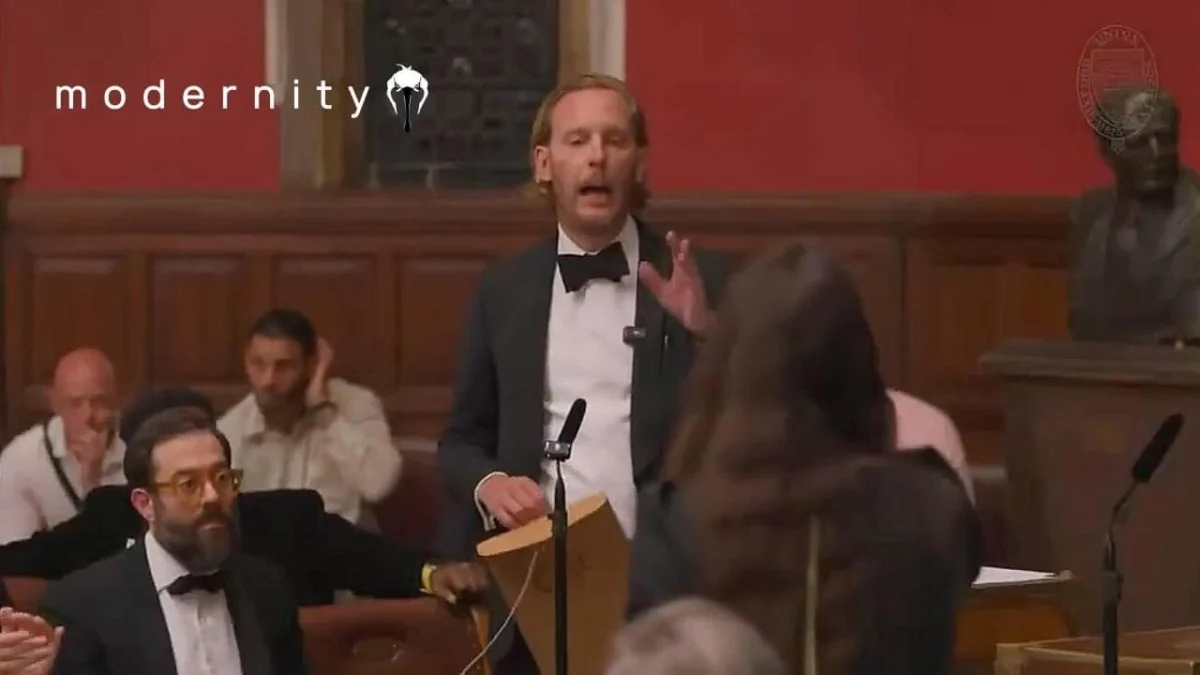
The hallowed halls of the Oxford Union, renowned globally as a crucible of unfettered intellectual discourse, became the epicenter of a profound debate on free speech and religious sensitivity on August 6, 2026. What began as a contentious motion – "This House believes the West is right to be suspicious of Islam" – escalated into a dramatic and widely scrutinized incident when commentator Laurence Fox employed a theatrical ruse, suggesting he was about to display a cartoon of the Prophet Muhammad, only to reveal a satirical image of a prominent British politician. The ensuing panic and attempts to silence him within the chamber, meticulously documented and widely shared, underscored the volatile tensions at the intersection of Western liberal values and deeply held religious convictions.
The Context: A Battleground of Ideas
The Oxford Union, established in 1823, boasts a nearly two-century legacy of hosting influential figures and facilitating robust, often provocative, debates. Its reputation as a bastion where even the most challenging ideas can be aired and contested is central to its identity. The motion under discussion that evening was inherently divisive, drawing lines between cultural identity, national security concerns, and the principles of religious tolerance. Such topics frequently attract passionate advocacy and opposition, both inside and outside the debating chamber.
The atmosphere was palpably charged even before proceedings commenced. External to the Union’s historic building, left-wing protesters had gathered, attempting to block entry and voice their dissent against the debate’s premise and certain invited speakers. Inside, the lineup promised a clash of ideologies: arguing in favour of the motion were actor and free-speech campaigner Laurence Fox, accompanied by figures such as Tommy Robinson, known for his activism critical of Islam, and writer Jonathan Sacerdoti. Opposing the motion were the Oxford Union President, Arwa Elrayess – a 20-year-old Muslim of Palestinian heritage from Gaza – alongside prominent British politician Jacob Rees-Mogg, a former Union librarian, and other speakers. This diverse panel, coupled with the provocative nature of the motion, set the stage for a memorable and, as it transpired, explosive evening.
The Incident Unfolds: A Calculated Provocation
As the debate progressed, Laurence Fox took the floor to present his argument for the motion. His central thesis revolved around the imperative of free speech in Western societies and what he presented as an inherent conflict with certain interpretations of Islamic doctrine, particularly concerning blasphemy and the depiction of religious figures. To bolster his point, Fox cited polling data, asserting that a significant majority—78 percent—of British Muslims believe no publication should print pictures of Muhammad, a figure that he claimed rose even higher within specific demographic groups. He contrasted this with Britain’s own historical trajectory, noting the long-abandoned blasphemy laws that once governed speech in the UK, implying a double standard or an erosion of once-defended liberties.
It was at this juncture that Fox introduced his dramatic prop: a plain brown paper envelope. He held it aloft, indicating to the assembled audience and his fellow debaters that it contained a cartoon of the Prophet Muhammad. The immediate reaction was a visceral jolt throughout the chamber. The mere suggestion of the image’s presence, let alone its potential display, triggered an instantaneous wave of alarm and frantic attempts to prevent its unveiling.
Reactions and Interjections: The Scramble to Censor
The response to Fox’s gesture was swift and multifaceted. Several individuals within the chamber, including those officially involved in the debate, moved to intervene. Rules of the Union were suddenly invoked, with desperate appeals to procedure. Questions of "relevance" and "necessity" were hurled at Fox, as if the potential offense of the image outweighed its argumentative utility. A pervasive demand for "respect" filled the air, reflecting the deep-seated cultural and religious sensitivities at play.
The most notable interjection came from the Oxford Union President, Arwa Elrayess, herself a Muslim. She had, in her initial remarks, positioned herself as a staunch defender of open debate, stating, "Free speech and debate is not something I do despite being a Muslim, it is something I do because of it." Yet, confronted with the perceived threat of the Muhammad cartoon, her stance appeared to shift. She interjected, implying that her very presence and leadership within the Union should have been sufficient evidence that Muslims believe in free speech, thus making Fox’s intended display unnecessary and potentially inflammatory.
Jacob Rees-Mogg, speaking against the motion, also contributed to the efforts to halt Fox. Drawing upon his past experience as a Union librarian, he attempted to invoke procedural technicalities, recalling a belief that props were against the Union’s rules. This scramble for any possible mechanism to prevent the image from being shown highlighted the deep discomfort and perceived risk associated with its potential display. Despite these concerted efforts, the chair presiding over the debate ultimately ruled that props were, in fact, permitted, allowing Fox to proceed.
Fox, undeterred by the mounting pressure, delivered a powerful personal statement before opening the envelope. "My wife asked me not to show this for fear of repercussions for my family," he revealed, adding a layer of personal risk to his act of defiance. "But I told her that if I did not, I would have submitted to Islam." He then reiterated his broader point, asserting that the West should resist Islam "in the strongest terms on free-speech grounds alone."
The Reveal and Its Immediate Aftermath: The Argument Made
With tension at its peak, Fox finally opened the envelope. The image he revealed was not a depiction of the Prophet Muhammad, but rather a caricature of Jacob Rees-Mogg. The effect was immediate and profound. A wave of laughter and applause swept through the chamber, a collective release of the palpable fear that had gripped the room moments before. The anxiety, the procedural challenges, and the demands for respect evaporated instantly, replaced by a sense of relief and amusement.
In that singular moment, Fox’s argument, in the eyes of many, was settled more effectively than any oratorical flourish could have achieved. The swift and intense reaction to the mere idea of a Muhammad cartoon, followed by the immediate decompression upon seeing a benign political caricature, starkly illuminated his central point: that a distinct and powerful taboo surrounding depictions of the Prophet Muhammad exists, one that visibly impacts the practical application of free speech even within an institution dedicated to its highest ideals.
Jonathan Sacerdoti, who had spoken alongside Fox, later recounted the episode in The Spectator, observing that the opposition and their guests "squirmed in discomfort, terrified at the very suggestion a drawing of Mohamed might soon be unveiled." He concluded that the incident had "found the limit of free speech they had all denied existed. That limit was Islam."
Broader Context: Free Speech, Blasphemy, and Global Tensions
The incident at the Oxford Union is not an isolated event but rather a microcosm of a larger, ongoing global debate concerning free speech, religious sensitivities, and the concept of blasphemy. For centuries, Western societies have gradually moved towards greater freedom of expression, often challenging religious dogma and evolving legal frameworks. The United Kingdom, for instance, formally abolished its common law offense of blasphemy in 2008, reflecting a societal shift away from protecting religious sensibilities through legal means.
However, the global landscape presents a more complex picture. Many Muslim-majority countries still uphold blasphemy laws, often carrying severe penalties. Moreover, the issue of depicting Prophet Muhammad carries immense significance within Islam, with many interpretations forbidding such imagery out of reverence and to prevent idolatry. This theological tenet, when confronted with the Western ideal of unrestricted expression, has repeatedly led to flashpoints.
Historical precedents underscore the gravity of these tensions. The 2005 Jyllands-Posten Muhammad cartoons controversy in Denmark sparked widespread protests, boycotts, and even violence across the Muslim world. The 2015 Charlie Hebdo massacre in Paris saw 12 people killed by Islamist terrorists in retaliation for the satirical magazine’s depictions of Muhammad. More recently, in 2020, the beheading of French teacher Samuel Paty by an Islamist extremist, after Paty showed Muhammad cartoons in a class on freedom of expression, sent shockwaves across Europe. These incidents, far from abstract philosophical disputes, represent real-world threats and severe consequences for individuals and publications perceived to have violated the religious taboo.
Against this backdrop, Fox’s demonstration highlighted a critical question: Can free speech truly be considered "free" if it operates under an implicit condition of silence or self-censorship regarding certain religious sensitivities, particularly when the threat of real-world repercussions is present? The "fear," as Fox articulated, and the "taboo," as Sacerdoti observed, are demonstrably real, influencing behavior even within the supposedly most robust bastions of debate.
The Oxford Union’s Dilemma and Institutional Implications
The Oxford Union, in this episode, found itself in a precarious position. As an institution dedicated to the unfettered exchange of ideas, it implicitly champions free speech. Its President, Arwa Elrayess, had explicitly articulated this commitment. Yet, when faced with the practical test of a potentially offensive religious image, the institutional machinery—from procedural challenges to direct appeals—moved to restrict its display. This created a perceived dissonance between the stated principle of absolute free speech and its observed application.
The incident raises uncomfortable questions for elite institutions across the West. If a premier debating society, with its historical claim to be a "last redoubt of free speech," visibly flinches at the mere suggestion of an image, what does this signify for broader societal discourse? Does it suggest a tacit acceptance of a "managed privilege" of speech, where certain topics or expressions are permissible only if they do not risk offending particular religious sensitivities?
Fox’s ultimate declaration, "So it is in that spirit that I will not submit. I show you this as an Englishman who believes in free speech. I will not submit. I will not bow down," resonated with those who view the incident as a capitulation to external pressures on fundamental Western liberties. The fact that the image which produced genuine terror was the one everyone understood could not be shown, rather than the one actually revealed, became the core of his argument.
Conclusion: An Unsettled Debate
Despite the motion "This House believes the West is right to be suspicious of Islam" being defeated in the chamber that night, the larger argument, as the article concludes, was not. The Oxford Union incident served as a potent, real-time illustration of the profound challenges facing free speech in an increasingly diverse and interconnected world. It demonstrated that the ideal of unbridled expression often collides with deeply held religious beliefs, sometimes with severe consequences.
The panic triggered by a simple, empty envelope at one of the world’s most prestigious debating societies underscored a critical tension. True free speech, by definition, must encompass the right to offend, to provoke, and to challenge, within legal boundaries. If this freedom collapses the moment it risks offending a particular religious sensitivity, it ceases to be a universal principle and becomes a conditional privilege. The dramatic events at the Oxford Union serve as a stark reminder for Western institutions to critically examine whether they are truly upholding their foundational commitment to free expression, or if they are inadvertently contributing to a culture of self-censorship driven by fear and external pressures. The debate over the limits and responsibilities of free speech, particularly in relation to religious belief, remains profoundly unsettled.

