

The quest for enhanced organization and heightened productivity is a perennial challenge for individuals across all walks of life. In an increasingly complex and demanding world, effective time management and task prioritization are no longer mere conveniences but essential tools for success. For many, the solution lies in the structured yet adaptable framework of a bullet journal, specifically through the strategic implementation of well-designed planner pages. These pages serve as the backbone of a system designed to manage schedules, track to-do lists, and facilitate the achievement of personal and professional goals. This exploration delves into seven fundamental planner bullet journal pages that empower users to gain control over their commitments and optimize their daily operations.

The Foundational Elements: Bullet Journal Key and Index
At the core of any effective bullet journaling system lies a clear and consistent methodology for denoting different types of entries. This is where the Bullet Journal Key Page, often referred to as the system’s legend, plays a crucial role. This page serves as a personalized glossary, defining the symbols used to categorize tasks, events, notes, and their respective statuses. While the original bullet journal system, developed by Ryder Carroll, proposed a simple set of symbols (e.g., a dot for tasks, a circle for events, a dash for notes), users are encouraged to adapt these to their unique needs. Common additions include symbols for migrated tasks, completed tasks, prioritized items, or even inspiration. The key is to establish a system that is intuitive and easily memorized, ensuring that information can be quickly processed and understood at a glance. Strategically placing the key page immediately after the journal’s cover page ensures it remains readily accessible for constant reference, preventing misinterpretation and fostering efficient information retrieval.
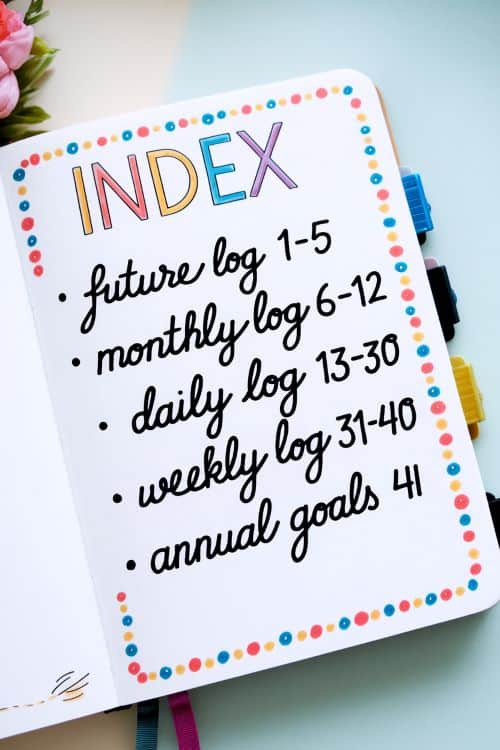
Complementing the key page is the Index. This vital component acts as a comprehensive table of contents for the entire bullet journal. By dedicating the initial pages of the journal to the index, users create a navigable roadmap of their entries. As new collections, logs, or specific pages are created, their corresponding page numbers and titles are meticulously recorded in the index. This practice liberates users from the constraint of pre-planning page layouts, allowing them to utilize blank pages as needed without sacrificing the ability to locate information later. For instance, a series of project-related notes spread across several pages can be consolidated under a single index entry, such as "Project Alpha: Pages 34-36, 38, 42." This indexing system transforms the bullet journal from a static notebook into a dynamic, easily searchable database of personal information, essential for reviewing past progress and planning future endeavors.

Projecting Forward: The Future Log
The Future Log is an indispensable tool for foresight and long-term planning within the bullet journal framework. This section is dedicated to capturing significant events, deadlines, birthdays, appointments, and other commitments that fall outside the immediate monthly or weekly view. Typically spanning several pages, the future log allows users to visualize their upcoming schedule at a glance, often covering a period of three to six months, or even a full year. This proactive approach to planning is crucial for avoiding scheduling conflicts, identifying potential busy periods, and strategically allocating time for important personal and professional milestones. By noting these future events, individuals can anticipate periods of high demand, plan for necessary preparations, and ensure that no critical date is overlooked. The future log serves as a high-level overview, providing a strategic vantage point from which to plan the more granular details of monthly and daily activities. Its consistent use fosters a sense of control over one’s schedule and reduces the likelihood of being caught off guard by upcoming obligations.
Monthly and Daily Rhythms: The Monthly and Daily Logs
The Monthly Log is the cornerstone of short-term planning within the bullet journal. This spread typically occupies two facing pages, with one side dedicated to a calendar view of the month and the other reserved for a monthly task list, goals, or important events. The calendar portion is designed to be a record of what has happened, encouraging users to fill it in retrospectively. This practice promotes a more accurate and reflective account of the month’s activities, moving beyond mere scheduling to capture the lived experience. The opposite page serves as a dynamic action plan, outlining key objectives, appointments, and tasks for the month ahead. This dual-purpose layout ensures that the monthly log functions both as a historical record and a forward-looking guide, providing a comprehensive snapshot of the month’s commitments and achievements.

The Daily Log, in contrast, is the most granular and flexible component of the bullet journal. This section is dedicated to the day-to-day management of tasks, events, and spontaneous thoughts. Unlike the more structured monthly or weekly spreads, the daily log is a fluid space where entries are made as they arise. Users can opt for a minimalist approach, employing bulleted lists to denote tasks, appointments, and notes, or they can embellish their daily logs with doodles, quotes, or personal reflections. The primary function of the daily log is to serve as a catch-all for immediate needs and ideas, ensuring that no important detail or fleeting thought is lost. Its adaptability makes it an ideal tool for capturing the unpredictable nature of daily life, allowing for real-time organization and idea generation. By consistently using the daily log, individuals can maintain a clear focus on immediate priorities while simultaneously creating a rich tapestry of their daily experiences.
Bridging the Gap: The Weekly Log
The Weekly Log serves as a crucial bridge between the monthly overview and the daily minutiae. This spread offers a consolidated view of the week’s schedule, providing a practical framework for managing daily priorities, appointments, and ongoing tasks. A well-structured weekly log allows users to anticipate the demands of the upcoming week, identify potential time constraints, and allocate their resources effectively. Many individuals opt for a two-page spread for their weekly log. One page might be dedicated to a day-by-day breakdown of tasks and appointments, while the other could be reserved for broader weekly goals, habit tracking, or reflective notes. Alternatively, a single-page spread can be utilized, with reflections integrated into the daily logs. The weekly log’s strength lies in its ability to provide a mid-range perspective, enabling users to plan with more detail than a monthly spread but with less intensity than a daily one. This balanced approach is invaluable for maintaining momentum and ensuring that week-long projects or commitments are effectively managed.
Aspiring to More: The Annual Goals Tracker
The Annual Goals Tracker is a powerful tool for long-term aspiration and personal development. This dedicated section within the bullet journal is designed for outlining and monitoring overarching goals for the entire year. By breaking down these aspirations into distinct categories such as career development, health and fitness, personal growth, or financial objectives, users can create a clear roadmap for achievement. The tracker often includes space to mark progress, celebrate milestones, and record key actions taken towards each goal. The act of physically writing down goals has been scientifically linked to an increased likelihood of their accomplishment, as it solidifies intent and provides a tangible record of aspirations. Regularly referencing the annual goals tracker serves as a powerful motivator, keeping individuals focused on their most important long-term objectives and reinforcing their commitment to personal progress. This page transforms the abstract desire for self-improvement into a concrete, actionable plan.
The Broader Impact of Strategic Bullet Journaling
The strategic implementation of these seven core bullet journal pages offers a multifaceted approach to organization and productivity. Beyond simply managing tasks, this system fosters a heightened sense of self-awareness and intentionality. By providing a dedicated space for reflection and planning, bullet journaling encourages users to critically assess their priorities, identify areas for improvement, and make conscious decisions about how they allocate their time and energy. Studies in behavioral psychology consistently highlight the efficacy of structured planning and regular review in achieving goals. For instance, research published in the Journal of Applied Psychology has shown that individuals who set specific, measurable, achievable, relevant, and time-bound (SMART) goals, and then regularly track their progress, are significantly more likely to succeed. The bullet journal provides an ideal platform for implementing such goal-setting strategies.

Furthermore, the inherent flexibility of the bullet journal system allows it to adapt to the evolving needs of its user. As an individual’s life circumstances change, their bullet journal can be modified to reflect new priorities, challenges, and objectives. This adaptability is a key differentiator from rigid, pre-formatted planners, which can become obsolete if they do not align with the user’s current trajectory. The bullet journal empowers individuals to curate a system that is uniquely their own, thereby increasing engagement and adherence.
In conclusion, the integration of these seven essential planner bullet journal pages—the Key, Index, Future Log, Monthly Log, Daily Log, Weekly Log, and Annual Goals Tracker—provides a robust and adaptable framework for achieving peak organization and productivity. By embracing this system, individuals can transform their notebooks into powerful tools for managing their lives, reducing mental clutter, and confidently pursuing their aspirations. The consistent and thoughtful application of these pages can lead to a more streamlined, focused, and ultimately more fulfilling existence.

