
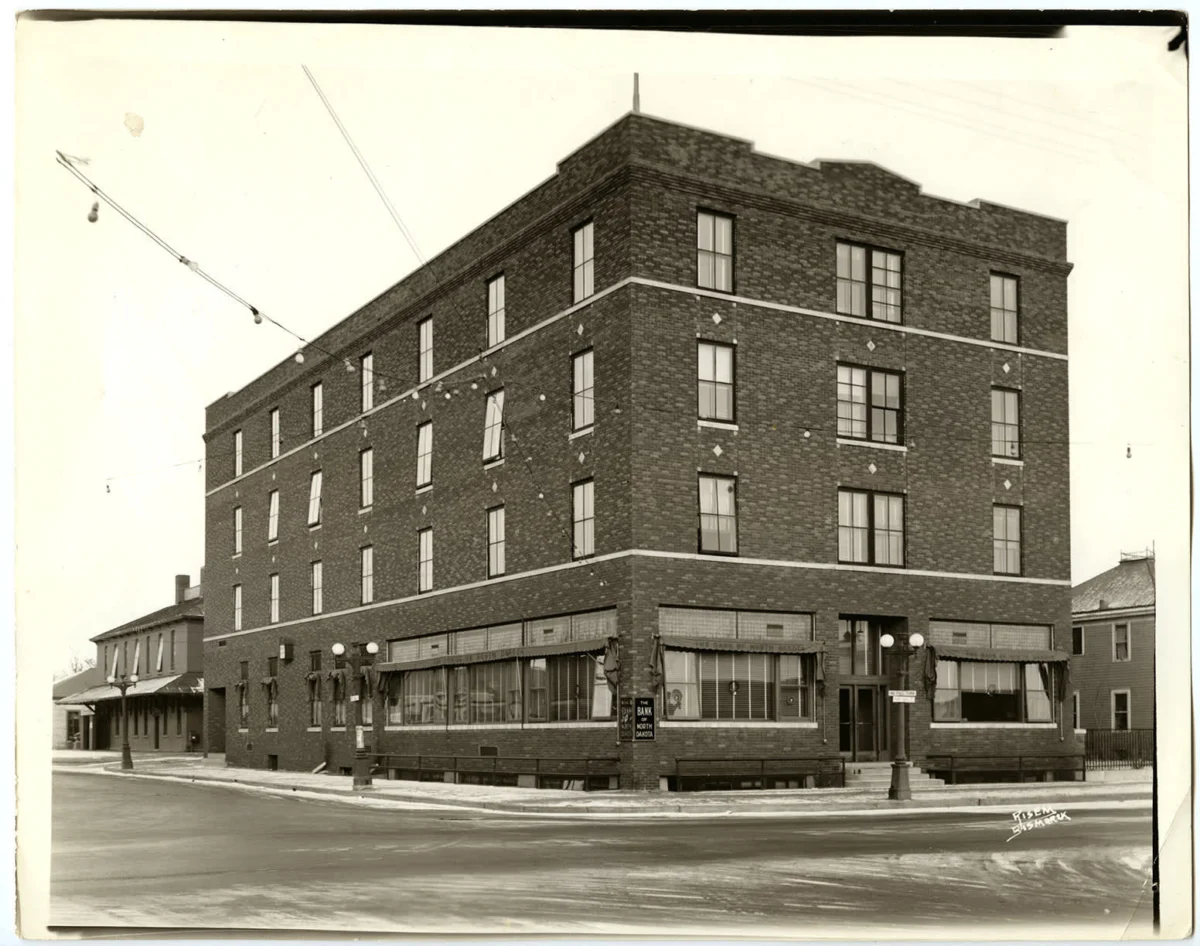
BISMARCK, N.D. — Over a century after its controversial founding by a progressive farmer-labor movement, the Bank of North Dakota (BND) stands as a unique and robust anomaly in the American financial landscape. Established in 1919, it remains the nation’s sole state-owned and -operated bank, managing approximately $11 billion in assets and enjoying widespread bipartisan support, even in one of the country’s most conservative states. This enduring institution, born from a populist revolt against industrial titans and distant bankers, is now attracting renewed attention from a new generation of public banking advocates across the United States.
A Foundation Forged in Populist Fury
The genesis of the Bank of North Dakota dates back to 1918, a period marked by significant economic unrest and social change in the Great Plains. The Nonpartisan League (NPL), an influential offshoot of the progressive farmer-labor movement, swept into power in North Dakota on a wave of popular discontent. Farmers, the backbone of the state’s economy, felt exploited by powerful financial institutions and industry barons centered in Minneapolis and Chicago. They faced exorbitant interest rates on loans, predatory practices from private grain elevators that controlled commodity prices, and unfair freight rates imposed by railroad monopolies.
Arthur C. Townley, a former Socialist Party member and a failed flax farmer, became the charismatic figurehead of the NPL. Barnstorming the state in a borrowed Ford Model T, Townley articulated a vision of public ownership for key industries, including banks, mills, and factories. His message resonated deeply with a populace yearning for self-determination and economic justice. The NPL’s platform promised to dismantle the exploitative systems that kept farmers in debt and at the mercy of distant corporations. By 1919, the NPL-controlled state legislature moved decisively, authorizing the creation of a state-owned and -operated bank, along with a state-owned mill and elevator, laying the groundwork for what would become the Bank of North Dakota. This ambitious legislative agenda was a direct response to a profound sense of economic grievance, a radical experiment born out of necessity rather than ideology in the eyes of its proponents.
From Socialist Experiment to Conservative Cornerstone
Remarkably, the Bank of North Dakota has not only survived but thrived, adapting to dramatic shifts in Great Plains politics from its prairie progressivism roots to today’s deep-red conservatism. Its continued existence and success are often cited as a testament to its pragmatic utility. North Dakota Governor Kelly Armstrong, a Republican, openly expressed his surprise at its longevity: "I think it’s weird, right? We’re one of the most conservative states in the union, and we have this state-run bank that was started by first-generation Norwegian immigrants. I don’t think we could set one up now, but I’m sure glad we have it."
This sentiment is echoed by other prominent Republican leaders in the state, including U.S. Senators Kevin Cramer and John Hoeven, the latter having served as a former president of the bank. Even former North Dakota Governor and current Interior Secretary Doug Burgum, a Republican, has been a vocal supporter. Their backing highlights the bank’s ability to transcend ideological divides, earning approval based on its tangible contributions to the state’s economy, even within a party where "socialist" is often a pejorative. The bank’s governance structure, helmed by the state’s Industrial Commission — comprising the governor, attorney general, and agriculture commissioner — ensures its alignment with state priorities while maintaining operational independence from day-to-day political pressures.
A Unique Model: The "Bankers’ Bank"
At its core, the Bank of North Dakota operates as a conventional financial institution, holding the state’s deposits and providing various types of loans. However, its unique mandate allows it to strategically meld political and financial objectives to advance North Dakota’s industrial and economic goals. Don Morgan, the Bank of North Dakota’s president and CEO, underscores this duality: "It’s one that if you use it wrong, it could be a little bit dangerous. But if you use it right, it can be a really powerful financial tool."
Unlike commercial banks, the BND does not primarily compete for individual customer deposits, actively discouraging them to avoid direct competition with the state’s private financial institutions. Instead, its core deposit base derives from the state’s general fund, a mix of tax revenues and fees. This model allows the BND to function as a "bankers’ bank," partnering with the state’s 91 community banks. It participates in loans that local banks might be too small to finance independently, thereby expanding access to credit across the state. This collaborative approach has been crucial to its enduring acceptance within North Dakota’s financial community. Rick Clayburgh, president and CEO of the North Dakota Bankers Association, describes the BND as a "wonderful tool for institutions" that allows community banks to "punch above their weight class."
Beyond traditional commercial real estate and agricultural loans, the BND engages in areas where private banks typically do not, or cannot, offer competitive terms. For instance, it provides direct student loans at remarkably low interest rates for North Dakotans pursuing higher education, a critical investment in human capital. The bank also acts as a vital economic stabilizer during times of crisis. During the Great Depression, it ensured teachers were paid in full and famously sold foreclosed farmland back to families at below-market prices after the devastating Dust Bowl. More recently, in 2026, it injected $500 million in loan support to farmers grappling with the impacts of trade tariffs, low commodity prices, and escalating input costs. These counter-cyclical interventions demonstrate the bank’s flexibility and responsiveness to the state’s economic needs, offering a financial safety net that private institutions often cannot or will not provide.
Inspiring a New Wave of Public Banking Advocates
The Bank of North Dakota’s century-long success story is now resonating far beyond its borders, serving as a powerful example for a burgeoning movement advocating for public banking across the United States. This resurgence of interest aligns with a new wave of progressive populism, driven by contemporary economic anxieties such as the housing crisis, student debt, crumbling infrastructure, and the immense financing needs for climate change mitigation.

Roughly a dozen states have experimented with state-run banks in the past, but most failed by 1900 due to turbulent economic conditions or the rise of laws favoring private banking. The BND’s survival makes it a compelling case study. Many public banking proponents are Democrats and democratic socialists who have gained increasing political traction. New York City Mayor Zohran Mamdani, who co-sponsored legislation to allow municipalities to establish public banks during his time as a New York State Assembly member (2021-2025), is a notable figure. Francesca Hong, a Wisconsin gubernatorial candidate, included a call for a state bank modeled after the BND in her platform. At the federal level, Representatives Alexandria Ocasio-Cortez (D-N.Y.) and Rashida Tlaib (D-Mich.) have championed legislation to facilitate the creation of state-owned banks.
The arguments for public banking are manifold. Washington state Senator Bob Hasegawa, who has been pushing for a state bank since the 2008 financial crisis, argues that "the people deserve to be in control of their own tax dollars that they’re putting forward." He contends that allowing Wall Street banks to leverage public funds for their shareholders while states borrow back their own money for infrastructure projects is inefficient and inequitable. Harvard Law Professor Christine Desan, an expert on the political economy of capitalism, views public banking as a logical extension of the monetary system’s design. "Why doesn’t the public use the same power of banking that private institutions use?" she asks, noting that a public bank, by joining the existing financial network, would gain the same lending advantages. States like Massachusetts, New Mexico, and California are actively pursuing proposals to establish their own public banks, reflecting a growing national conversation about alternative financial models.
Skepticism and Safeguards: Navigating the Risks
Despite the growing enthusiasm, the concept of public banking faces considerable skepticism, particularly from major players in the commercial banking industry. The American Bankers Association (ABA) has consistently opposed such initiatives, labeling them "a solution in search of a problem" that presents "significant risks to taxpayers." ABA spokesman Josh Britton asserts that America’s existing banks are "highly regulated and well-capitalized and reliably serve communities, businesses, and state and local governments," and that "misguided political interference would only harm consumers and the economy."
A primary concern is the potential for political interference, where a public bank could theoretically favor certain industries or projects based on the political leanings of elected officials, creating an uneven playing field. Don Morgan of the BND acknowledges these risks, emphasizing that strict prohibitions on competing with local financial institutions and a sound governance structure are paramount. "Our founding documents stating that we’re never to compete with [North Dakota financial institutions] is a very powerful statement, because I’ve always said the minute we start competing with them, then our model falls apart," Morgan explains. He stresses the importance of running the BND as a financial institution first, adhering to principles of safety and soundness, even while serving the state’s strategic objectives. This financial discipline, he argues, acts as a crucial "backstop" against political overreach.
The Coal Creek Station: A Pragmatic Investment
The BND’s unique role is exemplified by its involvement in the Coal Creek Station in McLean County. In 2020, Great River Energy, the plant’s then-owner, announced plans to retire the 1,151-megawatt lignite coal-fired power plant by the end of 2022, citing financial losses and a shift towards renewable energy. This decision threatened hundreds of jobs and posed a significant economic blow to the region. Then-Governor Burgum, along with Senators Cramer and Hoeven, launched an "all-of-government" effort to find a buyer, a challenging task given the national trend away from coal.
The Bank of North Dakota proved indispensable in "quarterbacking" the complex sale. It facilitated a financing package that enabled Rainbow Energy Center to acquire the plant and its affiliated company, Nexus Line, to purchase the transmission line. Crucially, the BND purchased $150 million in bonds issued by the North Dakota Transmission Authority through its Match Program, providing a vital loan to Nexus Line. Stacy Tschider, CEO of Rainbow Energy Center, unequivocally states that the deal would not have materialized without the BND’s intervention, particularly in an environment where private banks were hesitant to finance coal projects due to environmental concerns and changing market dynamics.
Following the BND’s investment, Rainbow Energy has embarked on expanding the plant’s utility, envisioning it as a futuristic "energy park." Beyond traditional electricity generation, the plant now redirects excess power to mine Bitcoin during periods of low grid demand, offsetting lost profits. Tschider also revealed ongoing discussions with artificial intelligence hyperscalers to construct a data center directly adjacent to the plant, promising additional revenue and economic diversification, despite some local opposition to such facilities. This investment highlights the BND’s pragmatic, state-centric approach, supporting existing industries and fostering new economic opportunities, even if these choices might diverge from the environmental priorities often championed by public banking advocates in other states.
Modernizing with the "Roughrider Coin" and Roosevelt’s Legacy
The Bank of North Dakota continues to innovate, demonstrated by the recent launch of its first stablecoin, dubbed the "Roughrider Coin," at the Theodore Roosevelt Presidential Library in Medora. This digital currency is designed to enable North Dakota’s network of community banks to execute near real-time bank-to-bank transfers, modernizing the state’s financial infrastructure. The library itself benefited from the BND’s support, receiving a $70 million line of credit to commence construction while awaiting private financing, ensuring its timely opening for the nation’s 250th anniversary.
The library’s location in the badlands, a place where a young Theodore Roosevelt sought solace and found inspiration, underscores the deep connection between the state’s identity and its progressive heritage. Roosevelt, often revered by both sides of the modern political spectrum for his populist, progressive appeal, trust-busting efforts, and staunch nationalism, represents the spirit of self-determination that many in North Dakota associate with the BND. Robbie Lauf, the library’s interim CEO, describes the bank as having "very deep roots in the state of North Dakota; [it’s] very much tied to the prairie populist movement" that emerged after the Progressive Era.
Lauf, who previously worked in both Governor Burgum’s office and with former Federal Reserve Chair Jerome Powell, rejects the notion that the BND clashes with free-market ideals. He posits that populism, in its true sense, aims to achieve "self-determination as a region" and that the bank represents "anything but an embrace of any type of state ownership of means; it’s a partnership with private enterprise." He concludes, "This institution does not work without private enterprises and private banks… For me, that’s deeply free market." This perspective encapsulates the delicate balance the Bank of North Dakota has maintained for over a century, proving that a publicly owned institution can operate effectively within a market economy, adapting its original "socialist" mandate to serve the evolving needs of a dynamic and proudly independent state. As Don Morgan succinctly puts it, "There’s good ideas on all sides of the political spectrum. We get so hung up in the debate or the letter by your name or the title assigned to you. There are good ideas."

