
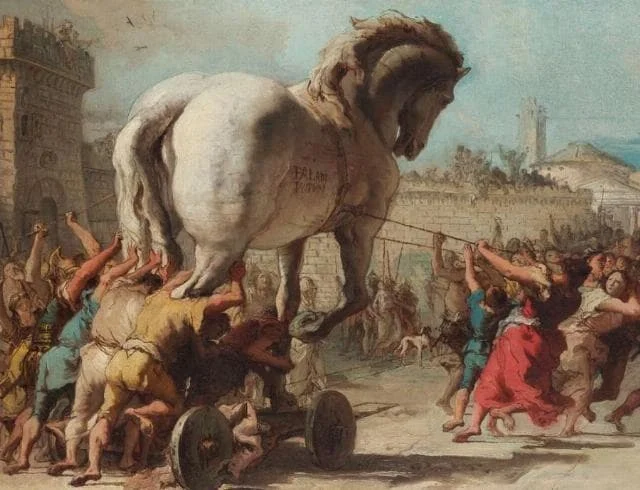
The landscape of modern conflict has profoundly shifted, moving beyond traditional physical battlefields to encompass the intricate realm of information. In an era where digital connectivity permeates every aspect of daily life, the strategic deployment of information, or its manipulation, has become a potent tool capable of influencing public opinion, shaping narratives, and even destabilizing societies. This phenomenon, often termed information warfare, draws parallels to historical stratagems, with some observers likening its deceptive nature to the legendary Trojan Horse – a seemingly innocuous offering concealing a disruptive force. The essence of this modern "Trojan Horse" lies in its ability to infiltrate the collective consciousness through persuasive, yet often superficial, messages, undermining societal cohesion before the true nature of the attack is widely recognized.
The Evolving Landscape of Information Warfare
Information warfare, broadly defined, involves the use and management of information and communication technologies to achieve strategic objectives over an adversary. Historically, this has included propaganda during wartime or political campaigns. However, the advent of the internet, social media, and always-on digital devices has dramatically amplified its reach and sophistication. Today, individuals are barraged by a constant stream of soundbites, headlines, and trending topics across myriad platforms – from smartphones and tablets to computers and televisions. These succinct messages, often stripped of context and nuance, can rapidly propagate globally, leading to widespread adoption of specific phrases or ideas, sometimes without a deep understanding of their origins or underlying implications. This pervasive environment has transformed public discourse into a fertile ground for influence operations, where ideas can be disseminated with unprecedented speed and scale.
The Power of Simplistic Narratives and Public Perception
A key characteristic of effective information campaigns is the deployment of messages that, on the surface, appear self-evidently true or morally upright. Phrases such as "Believe all women," "Black lives matter," and "Build back better" serve as prime examples. These slogans are crafted for maximum resonance and minimal immediate challenge, leveraging widely accepted principles of justice, equality, or progress. For instance, few would openly argue against the concept of believing women, asserting that Black lives are inconsequential, or advocating for a regression in societal development. This inherent positivity or moral weight makes these messages highly attractive and easily adoptable. Public sentiment surveys often indicate a general inclination towards statements that align with perceived virtues, making such soundbites powerful instruments for shaping public opinion. People readily internalize and echo these phrases, display them as symbols of alignment, and sometimes treat them as fundamental truths without deeper interrogation. The simplicity, in this context, becomes an aid to their persuasive power, allowing them to bypass critical scrutiny.
The effectiveness of such communication lies in its ability to implant ideas without necessarily prompting reflection or critical analysis from the recipient. Like the mythical wooden horse, these messages are often "hollow" in the sense that their true strategic purpose is not immediately apparent. They are designed to be appealing enough to be welcomed into the public discourse but sufficiently benign in appearance to avoid immediate, rigorous examination. This subtle infiltration is a hallmark of sophisticated propaganda, which often seeks to seduce rather than coerce. It aims to charm its way into unsuspecting minds, patiently awaiting the opportune moment to exert its full influence.
The Imperative of Critical Thinking: Defending Against Deception
Despite their initial potency, such narratives are inherently fragile when subjected to critical thought. The act of questioning serves as a potent antidote, capable of breaking the spell cast by simplistic slogans. When an individual pauses to ask, "Don’t some women lie, and shouldn’t accusations be supported by evidence?" the complexity of justice and due process reasserts itself, reminding society that evidentiary proof often holds more weight than unverified claims. Similarly, when the assertion "All lives matter" is met with attempts to silence or discredit, it can expose a potential divergence between the stated goals of "diversity" and "equity" and the broader principles of universal equality and justice. Furthermore, inquiring into the specifics of "What are we building, and why?" in the context of phrases like "Build back better" can reveal underlying agendas, such as those articulated by organizations like the World Economic Forum, which have discussed concepts like a "new world order" or a "Great Reset" of global systems.
In essence, critical thinking acts as a formidable bulwark against information warfare. Those who engage in the strategic manipulation of information often view independent thought as an obstacle to be neutralized. Reasoned debate and rational inquiry are crucial defenses, enabling individuals to construct mental "forts" that protect society from deceptive narratives. These intellectual fortifications are adorned with the principle: "Come, let us reason together." Far from being a source of fear, reasoned debate is the pathway to enlightenment and collective understanding. Consequently, directives that demand unquestioning compliance, such as "The science is settled" or "Trust the experts," are viewed by critics as attempts to disarm the public’s capacity for reason and spiritual growth. The historical record suggests that blind obedience, or "just following orders," rarely leads to positive outcomes. Good choices, and by extension a good life, are predicated on thoughtful contemplation and moral discernment. From this perspective, any assault on free speech is seen as an attack on the fundamental essence of human autonomy and spiritual potential.
Censorship, Dissent, and the Erosion of Free Speech
When propagandistic forces are perceived to be attacking societal values from multiple directions, discerning the perpetrators and their motives can be challenging. However, certain indicators are often cited as telltale signs. When groups or governmental entities attempt to "cancel" individuals for their personal beliefs, it is argued that they are engaging in a form of warfare against individual conscience. This can manifest in overt acts, such as politically motivated violence, or more subtle forms of information warfare.
Recent years have seen various incidents that critics point to as examples of governmental or institutional overreach in regulating speech. For instance, in the United Kingdom, discussions around "hate speech" legislation have raised concerns among some about the criminalization of certain religious or conservative viewpoints. One case cited involves Finnish politician Päivi Räsänen, who faced legal proceedings in Finland for expressing her biblically informed views on sexuality, and was reportedly banned from flying through London’s Heathrow Airport due to these beliefs being classified as "hate speech" in both countries. Similarly, in Poland, a pregnant mother, Oliwia Olejniczak, was reportedly convicted and fined for "inciting hatred" after speaking at a public rally against mass immigration. Critics of these actions argue that the punishments meted out for expressing opinions, particularly those rooted in religious conviction or concerns about social policy, can sometimes be disproportionately severe compared to penalties for other offenses, raising questions about the fairness and balance of justice systems.

When governments are perceived to be misusing their criminal justice systems to persecute citizens for their beliefs – especially religious adherents or those voicing concerns about family safety – it signals, to some observers, a government at war with its own people. Such actions, including the "canceling" of citizens, are seen as identifying the independent thinkers most feared by those in power. Drawing inspiration from religious texts like Matthew 5:10, "Blessed are those who are persecuted because of righteousness, for theirs is the Kingdom of Heaven," proponents of free speech encourage vigilance when individuals stand firm on moral truths in the face of governmental hostility. These individuals, it is argued, are building intellectual forts for society, and their steadfastness offers a refuge for others seeking to resist propaganda and expand the space for open discourse.
The COVID-19 Pandemic: A Case Study in Information Management and Public Trust
The COVID-19 pandemic provided a stark global illustration of the complexities of information management during a crisis, becoming a significant case study for those concerned about government propaganda and overreach.
Chronology of the Pandemic Response:
- Early 2020: The rapid global spread of COVID-19 triggered widespread panic and unprecedented public health responses. Governments worldwide implemented lockdowns, travel restrictions, and social distancing measures.
- Mid-2020: Public health authorities and scientific bodies became central figures, issuing guidelines and pronouncements. The phrase "trust the science" became a common refrain in official communications.
- Late 2020 – Early 2021: The development and rollout of novel mRNA vaccines marked a new phase. Governments launched massive vaccination campaigns, often accompanied by strong messaging encouraging compliance, such as "Now is the time to do what you’re told."
- 2021-2022: Debates intensified over vaccine mandates, mask requirements, and the efficacy of various non-pharmaceutical interventions. Concerns about "misinformation" and "disinformation" led to increased efforts by governments and social media platforms to curate content and suppress dissenting viewpoints.
Governmental Messaging and Public Compliance:
During the pandemic, public health agencies and governments frequently emphasized the importance of scientific consensus and adherence to expert advice. This approach was widely justified as essential for saving lives, preventing healthcare system collapse, and accelerating the end of the pandemic. Official communications often highlighted the urgency of the situation and the collective responsibility of citizens to comply with measures for the greater good.
Controversies and Allegations of Overreach:
However, these measures and the associated communication strategies also sparked significant controversy. Critics argued that Western governments, in the name of "science," committed actions that were later deemed questionable or even "unforgivable."
- Lockdowns and Mandates: While proponents cited public health benefits, critics pointed to the severe economic and social costs of lockdowns, the erosion of individual liberties, and the potential for long-term psychological impacts.
- "Quarantine Camps": Concerns were particularly heightened by reports from countries like Australia, which implemented strict quarantine facilities for travelers and close contacts. In the United States, internal documents from agencies like the CDC, suggesting plans for similar facilities, fueled fears among those who saw echoes of historical injustices.
- Historical Parallels: For many Americans, the idea of government-mandated internment evoked the forced relocation and imprisonment of Japanese-Americans during WWII – an event widely condemned as a grave violation of constitutional rights. The prospect of such measures being considered for "unvaccinated" individuals or those expressing "unapproved speech" during COVID-19 raised alarms about a potential repeat of history.
- Public Opinion and Division: Polling data from early 2022 revealed deep societal divisions. Majorities of Democrats, for example, reportedly supported measures such as fining the unvaccinated, restricting their movement, or sending them to quarantine camps. A significant minority even supported removing children from homes with unvaccinated parents. This stark polarization indicated how profoundly the information environment and public health crisis had fractured social cohesion, leading to unprecedented levels of animosity among citizens.
These developments were seen by some as an all-out information war waged by health bureaucrats and government authorities against their own populations, disseminating narratives that fostered irrational fear and internal division, thereby threatening the foundational principles of democratic societies and constitutional rights. The ability of the populace to see through what was perceived as propaganda and resist submission to what they considered tyranny was credited by some with preventing a more profound societal collapse.
The Role of Oligarchies and the Peril of Unchecked Power
A recurring concern among critics of modern information management is the historical pattern of centralized power structures, or oligarchies, controlling information. Throughout history, regimes characterized by censorship and the rigging of public debate – including communists, fascists, Nazis, and military dictatorships – have consistently demonstrated a propensity for suppressing dissent. Today, concerns are voiced that "globalists, socialists, collectivists, and other Big Government parasites" have infiltrated national governments, advocating similar approaches to censorship and the criminalization of alternative viewpoints.
The argument posits that information, whether factual or contested, should not be the exclusive domain of any single group. Oligarchies, it is contended, are composed of fallible human beings, not infallible angels, and thus their control over information presents a significant risk to individual autonomy and democratic principles. The experiences of the COVID-19 lockdowns, where government bureaucrats and "experts" were accused of demanding unquestioning obedience and committing "unforgivable crimes" against citizens in the name of "science," are frequently cited as recent evidence of the dangers inherent in unchecked governmental authority and concentrated power.
Broader Implications: Social Cohesion and Democratic Resilience
The long-term implications of sustained information warfare are profound, impacting social cohesion, public trust in institutions, and the very resilience of democratic systems. When citizens lose faith in the integrity of information channels and the honesty of their leaders, the social fabric begins to fray. The ability to engage in open, rational debate – essential for resolving societal challenges – is undermined when dissenting views are silenced or labeled as "disinformation."
The challenge lies in navigating a complex information environment where distinguishing truth from manipulation is increasingly difficult. An informed and critically engaged citizenry is often cited as the most robust defense against such threats. This requires fostering environments that encourage intellectual fortitude, diverse perspectives, and a commitment to rigorous inquiry rather than passive acceptance. Safeguarding discourse in a contested landscape necessitates a continuous effort to uphold free expression, promote media literacy, and cultivate a public sphere where ideas can be freely exchanged and rigorously debated without fear of reprisal or demonization. The future health of democratic societies hinges on their collective ability to discern, question, and ultimately reject the modern "Trojan Horses" of propaganda.

