
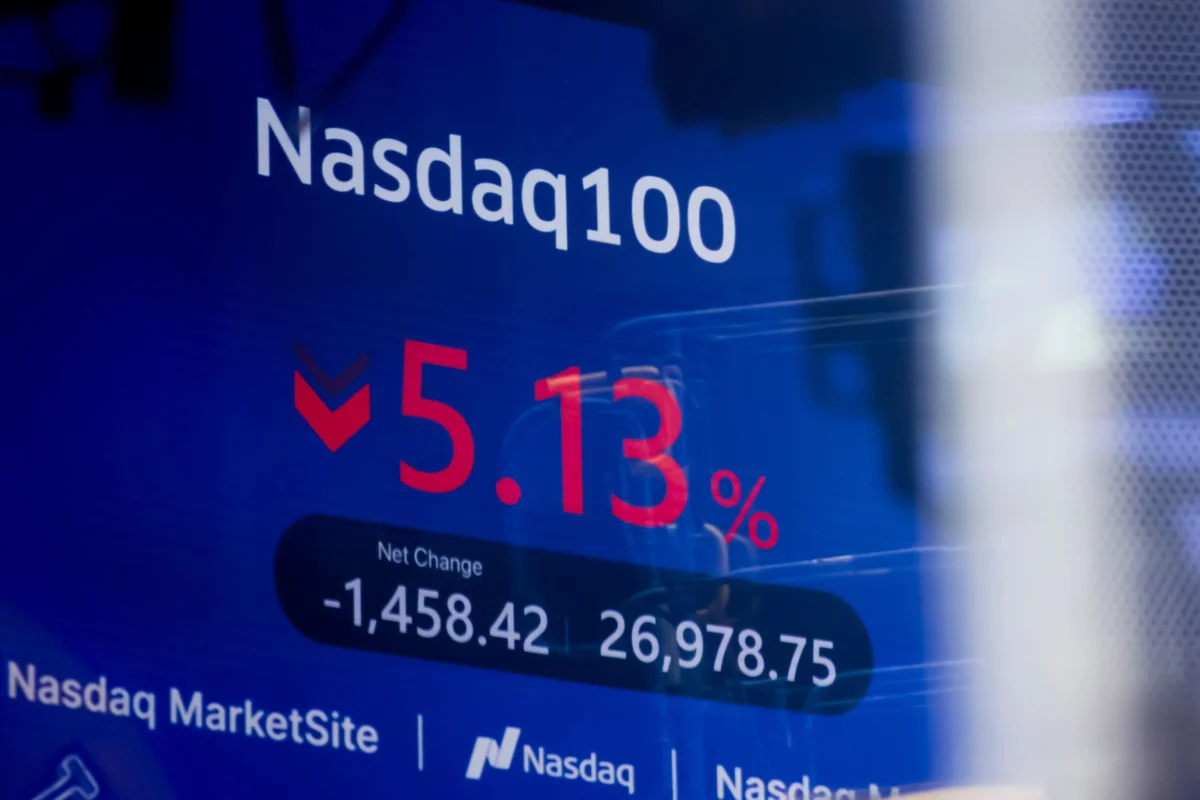
The Nasdaq Composite, a bellwether for the technology sector and growth stocks, officially plunged into correction territory on Thursday, experiencing a sharp decline that saw the index close more than 11% below its record high achieved just last month. This significant market movement, which saw the tech-heavy index slide more than 5% in a single day, marks a critical juncture for investors, prompting widespread reevaluation of market dynamics, particularly within the burgeoning artificial intelligence (AI) sector. Historically, such corrections can signal further near-term volatility, though a subsequent recovery often materializes within a few months, offering a glimmer of hope amidst the current downturn.
Defining a Market Correction and Its Immediate Impact
In the parlance of Wall Street, a market correction is formally recognized when an index experiences a decline of 10% or more from its most recent peak. Should the decline deepen to 20% or more, it then qualifies as a bear market, signifying a more severe and prolonged period of investor pessimism. The Nasdaq Composite’s recent performance, falling definitively past the 10% threshold, places it squarely in correction territory, a phenomenon not uncommon but always impactful given the index’s concentration of high-growth technology and innovation companies. The immediate reverberations were felt across the market, particularly in sectors highly leveraged to technological advancements and future growth projections, triggering widespread sell-offs and heightened investor anxiety. This abrupt shift comes after a period of robust growth, fueled by optimism surrounding technological innovation, particularly in AI, making the current pullback a stark reminder of market sensitivities.
Historical Precedents and Recovery Patterns
An analysis of the Nasdaq Composite’s performance over the last decade reveals a pattern of resilience following corrections, albeit with varying degrees of immediate severity and recovery timelines. Across ten previous correction episodes, including notable selloffs in 2025, 2022, 2020, and 2018, the initial downturn was frequently followed by additional rough selling over the subsequent month. This pattern suggests that the current market might endure further declines before finding a definitive bottom.
However, the historical data also offers a silver lining for long-term investors. In most of these instances, the Nasdaq demonstrated a robust capacity for recovery, returning to rally mode within six months. Specifically, the index gained an average of 9.41% from its correction bottom over the following three months and an even more substantial 17.03% over a six-month period. This historical tendency for a rebound underscores the underlying strength and innovative capacity of the companies that comprise the Nasdaq, which often attract renewed investor confidence once initial jitters subside.
A critical exception to this pattern, however, was the January 2022 correction. This particular downturn proved to be far more protracted and severe, resulting in the Nasdaq losing an additional 18.3% over the subsequent six months and remaining down by 24.3% a year later. This outlier serves as a cautionary tale, highlighting that while historical averages point to recovery, specific market conditions and catalysts can lead to more challenging and prolonged periods of decline. Understanding the unique factors driving the current correction is therefore paramount in assessing its potential trajectory.
The Catalyst: Midterm Election Outcomes and Regulatory Shadows
The immediate catalyst for the current market correction is widely attributed to the recent midterm elections, which saw Democrats achieve significant gains, including sweeping victories in both the House and Senate. While shifts in political control often introduce market uncertainty, a specific outcome from these elections has particularly rattled the tech sector: the victory of Gina Hinojosa in the race for Texas governor. Hinojosa campaigned on a platform that included an immediate moratorium on data center development within the state, a policy stance that has sent ripples of concern throughout the technology industry.
Texas, known for its business-friendly environment and vast land availability, has emerged as a crucial hub for data center construction, attracting massive investments from tech giants seeking to power their expanding operations, particularly those related to artificial intelligence. The prospect of state-level restrictions on such vital infrastructure is now forcing investors to grapple with the potential for slowed data center construction. This directly impacts companies deeply entrenched in the artificial intelligence trade, which relies heavily on robust, scalable, and rapidly expanding data center capacity to process vast amounts of data, train complex AI models, and deliver AI-powered services. The fear is that if Texas, a pivotal state for tech infrastructure, implements such a moratorium, other states might follow suit, creating a patchwork of regulations that could significantly impede the growth trajectory of the AI industry across the nation.
The AI Trade Under Scrutiny: From Enthusiasm to Apprehension
The artificial intelligence trade has been a significant driver of market enthusiasm and growth over the past few years. Companies developing AI hardware, software, and services have seen their valuations soar, often based on future growth potential rather than immediate profitability. The promise of AI to revolutionize industries, enhance productivity, and create new market opportunities has captivated investors. However, this intense focus on future growth also makes these stocks particularly vulnerable to any perceived threats to their expansion.
The proposed data center moratorium in Texas, therefore, strikes at the very heart of the AI growth narrative. Data centers are the physical backbone of AI, providing the computational power, storage, and networking capabilities essential for running AI algorithms. Any impediment to their development translates directly into potential bottlenecks for AI innovation and deployment. This concern was immediately reflected in the performance of chip stocks, which are integral to AI hardware. The iShares Semiconductor ETF (SOXX), a key indicator for the chip sector, tumbled by an alarming 12% on Thursday, marking its worst single-day performance since the initial market shock of the Covid-19 outbreak in March 2020. This drastic decline underscores the market’s immediate reaction to the potential for regulatory headwinds impacting the supply chain and infrastructure critical for AI.

Companies like NVIDIA, AMD, Broadcom, and Intel, which supply the high-performance GPUs and other specialized hardware essential for AI computations, are particularly exposed. A slowdown in data center build-outs would directly translate into reduced demand for their products, impacting their revenue and growth projections. Beyond chipmakers, cloud service providers such as Amazon Web Services, Microsoft Azure, and Google Cloud, all heavily invested in AI infrastructure, also face significant challenges. Their ability to expand and offer cutting-edge AI services is intrinsically linked to the continuous expansion of their data center footprint. The regulatory uncertainty thus casts a long shadow over the entire AI ecosystem, prompting analysts to re-evaluate earnings forecasts and growth trajectories for these previously high-flying stocks.
Expert Insights and the Path Ahead
Market strategists and chart analysts are closely scrutinizing historical patterns to gauge the likely trajectory of the current correction. Frank Cappelleri, founder of CappThesis, pointed to past midterm election cycles for guidance, noting that they often precede periods of increased market volatility in the near term. His research indicates that while the path can be bumpy, the Nasdaq has historically been higher 12 months after the election in all but one of 13 midterm cycles since 1974.
Cappelleri cited the 2018 midterm elections as a relevant precedent. Following the Democratic victory in the House that year, the Nasdaq initially rallied the day after the election. However, this initial optimism was quickly followed by a sharp sell-off in December. Despite this short-term turbulence, the index ultimately rebounded, finishing approximately 15% higher a year after the election. This historical context suggests that while immediate volatility is likely, a longer-term recovery remains a plausible outcome, assuming the underlying economic fundamentals and innovation trends remain robust.
However, the specific nature of the current catalyst—regulatory intervention impacting critical infrastructure—adds a layer of complexity not always present in past midterm-induced corrections. The potential for state-level policies to directly influence the operational environment for tech companies, particularly in the strategically vital data center sector, represents a novel risk factor that investors must now integrate into their models. This risk extends beyond Texas, as other states, grappling with environmental concerns, energy demands, or local community impacts, might consider similar measures, potentially fragmenting the regulatory landscape for data center development across the United States.
Broader Economic and Industry Implications
The implications of this correction extend far beyond the immediate dip in stock prices. A sustained slowdown in data center construction due to regulatory hurdles could have broader economic consequences. The construction and operation of data centers create numerous jobs, from skilled labor to highly specialized IT professionals. Investment in these facilities often stimulates local economies through property taxes, utility usage, and ancillary service demands. A moratorium could thus lead to job losses, reduced capital expenditure by tech companies, and a cooling effect on local economic development in regions that have historically welcomed such investments.
Furthermore, the uncertainty around data center development could impact the United States’ competitive edge in the global AI race. If domestic expansion is hampered, tech companies might seek to build their infrastructure in more permissive regulatory environments abroad, potentially shifting innovation and job creation overseas. This scenario could have long-term strategic implications for national technological leadership and economic competitiveness.
From an industry perspective, the correction serves as a wake-up call for the tech sector to engage more proactively with policymakers at the state and local levels. The rapid growth of AI and its foundational infrastructure has, in some instances, outpaced public discourse and regulatory foresight. The industry may need to articulate more clearly the benefits of data centers, address local concerns regarding energy consumption and environmental impact, and propose solutions that balance innovation with sustainable development.
Looking Ahead: Investor Sentiment and Future Outlook
As the market navigates this period of uncertainty, investor sentiment will remain a critical factor. While historical data suggests a recovery is likely, the path will undoubtedly be volatile. The degree to which state-level restrictions on data centers materialize and propagate will be closely watched. Any clarification or moderation of policies, or conversely, further adoption of restrictive measures, will significantly influence the market’s trajectory.
Companies in the AI trade will likely face increased scrutiny regarding their geographic diversification of infrastructure and their strategies for navigating regulatory landscapes. Investors may begin to favor companies with more robust risk mitigation plans or those less reliant on large-scale, centralized data center expansion. The current correction, while painful in the short term, could also spur greater innovation in energy-efficient data center technologies or distributed computing models that are less resource-intensive and more resilient to localized regulatory pressures.
Ultimately, the Nasdaq Composite’s plunge into correction territory is a complex event driven by a confluence of market dynamics and emerging political and regulatory challenges. While the tech sector has demonstrated remarkable resilience in the past, the unique nature of the current catalyst—the intersection of political outcomes and critical infrastructure development—demands careful observation and strategic adaptation from investors, industry leaders, and policymakers alike. The coming months will be crucial in determining whether this correction follows the historical pattern of a temporary setback or marks a more significant re-evaluation of the AI-driven growth paradigm.

