
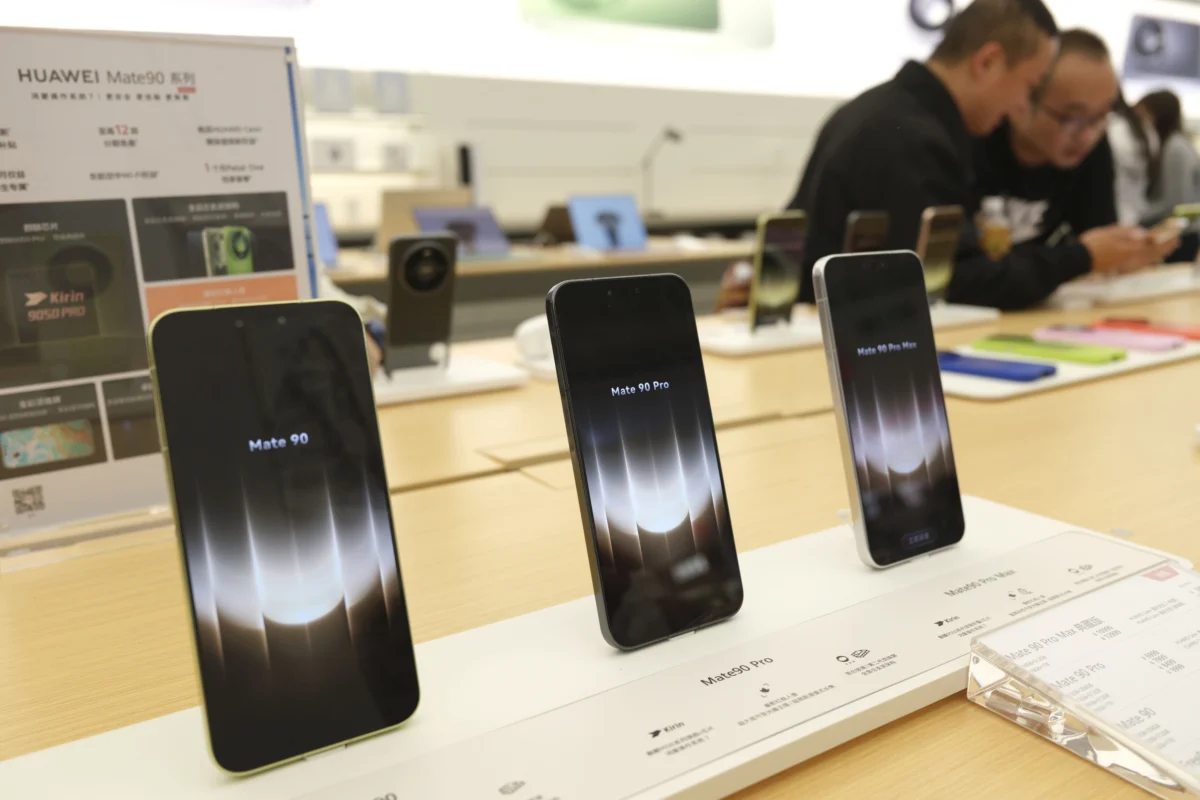
BEIJING – In a strategic pivot to counter persistent market slowdowns in both the smartphone and automotive sectors, Chinese tech behemoth Huawei is doubling down on its consumer business, particularly by championing devices powered by its proprietary, domestically developed chips. This ambitious direction was underscored by the recent launch of its Mate 90 series smartphones, which debuted on October 1, 2026 – China’s National Day – featuring Huawei’s self-engineered "LogicFolding" chip. The move represents a significant milestone in the company’s quest for technological self-sufficiency, a journey intensified by years of stringent U.S. trade restrictions.
The unveiling of the Mate 90 series, showcased prominently in cities like Hai’an, Jiangsu Province, marks not just a product launch but a powerful statement of resilience. The "LogicFolding" chip, whose development has been a closely guarded secret, is seen as Huawei’s answer to the supply chain disruptions that crippled its access to advanced semiconductors from international manufacturers like TSMC following sanctions imposed in 2019. This strategic shift is crucial for Huawei as it grapples with a challenging global economic landscape and a fiercely competitive domestic market.
The Enduring Shadow of Sanctions and Huawei’s Resilience
The U.S. restrictions, enacted in 2019, fundamentally altered Huawei’s trajectory, effectively cutting off its access to vital American technology, including Google’s Android operating system and advanced chip manufacturing capabilities. Prior to these sanctions, Huawei was on an aggressive ascent, briefly securing the top spot in global smartphone shipments in the second quarter of 2020. At its peak, the company aimed to ship 300 million smartphones globally in 2019, having already shipped over 240 million units in China and overseas. The swift and severe impact of the sanctions, however, saw its global market share plummet, severely curtailing its international aspirations.
Richard Yu, Huawei’s Executive Director and Chairman of its consumer business, recently addressed foreign press for the first time since 2019, signaling the company’s renewed intent to re-engage with the global market. Speaking ahead of the Mate 90 series launch, Yu candidly acknowledged the dramatic decline in Huawei’s overseas smartphone sales, now reduced to "several million" units annually. Despite this stark reality, Yu articulated an ambitious vision: to recover international market share, driven by a combination of its self-developed hardware and the global expansion of its HarmonyOS operating system within the next one to three years. He also expressed hope that China’s burgeoning chip manufacturing capacity would eventually enable large-scale overseas sales of devices with Huawei’s self-developed chips, circumventing the existing technological blockades.
The financial repercussions of the sanctions were profound. Huawei’s consumer business, once its largest revenue contributor, saw its income halved from 2020 to approximately $34 billion in 2021. However, demonstrating remarkable resilience and strategic adaptation, the segment has since rebounded, growing to an estimated $51 billion in 2025, representing about 39% of Huawei’s total revenue, according to CNBC calculations. This recovery underscores the company’s ability to innovate and find new avenues for growth despite formidable external pressures.
"LogicFolding": A New Era of Self-Sufficiency
The "LogicFolding" chip is more than just a component; it symbolizes China’s broader ambition for technological independence. For Huawei, it represents years of intense research and development, an "overtime" effort as described by company insiders, to overcome critical supply chain vulnerabilities. The choice of October 1st, National Day, for the Mate 90 launch was highly symbolic, aligning Huawei’s technological breakthrough with a narrative of national pride and self-reliance. Industry analysts suggest that the performance and scalability of the "LogicFolding" chip will be closely watched, not only by competitors but also by governments and tech communities worldwide, as a litmus test for China’s indigenous chip manufacturing capabilities.
The Mate 90 series, featuring this groundbreaking chip, aims to differentiate itself in a crowded market by offering a unique ecosystem experience powered by HarmonyOS. While Huawei has made significant strides in cultivating its domestic developer community for HarmonyOS, expanding its reach into overseas markets will present a new set of challenges, including competition from established ecosystems like Android and iOS, and the need to rebuild trust and brand recognition among international consumers.
Navigating a Sluggish Smartphone Market
Huawei’s aggressive push into the smartphone market with its new chip comes at a challenging time for the industry, particularly in China. Counterpoint Research data indicates a significant slump in Chinese smartphone sales, with double-digit year-on-year declines recorded in August and September of the current year. This broader market contraction means Huawei is not just fighting to regain lost ground due to sanctions but also to carve out market share in a shrinking pie.
Despite these headwinds, Huawei’s strong brand loyalty in China, coupled with the nationalistic sentiment surrounding its self-sufficiency efforts, could provide a crucial advantage. The company’s ability to innovate with features, camera technology, and seamless integration within its HarmonyOS ecosystem will be key to captivating consumers in a market that is increasingly demanding value and differentiation. The Mate 90 series, therefore, carries the dual burden of technological demonstration and commercial success in a highly competitive and contracting market.
Huawei’s Strategic Foray into Electric Vehicles
Beyond smartphones, Huawei has strategically diversified into the electric vehicle (EV) sector, positioning itself not as a car manufacturer, but as a critical technology provider. Through partnerships with several Chinese automakers, the company has developed a business unit focused on providing software interfaces, advanced driver-assist systems, and intelligent cockpits. This unit generated at least $6.7 billion in revenue in 2025, according to Huawei’s annual report, showcasing its rapid growth and potential. Huawei-powered vehicles, such as the Stelato G9 (introduced by Yu Chengdong in Chengdu on August 20, 2026), embody this collaborative model, focusing on smart technology integration rather than vehicle assembly.
However, much like the smartphone market, China’s automotive sector is also facing significant headwinds. China Passenger Car Association data as of September 27 indicates that the auto market is on track for its worst year since 2021, with sales down by over 20% across roughly the first three quarters of the year. The new energy vehicle segment, encompassing battery electric and hybrid-powered cars, has not been immune, experiencing a 13% tumble in sales during the same period. This domestic slowdown contrasts sharply with the rapid export growth seen by many other Chinese EV brands, as Huawei-powered vehicles have largely concentrated on the domestic market.
Challenges in the EV Arena
Huawei’s Harmony Intelligent Mobility Alliance (HIMA), its auto tech software system, which includes collaborations with manufacturers like Chery and Seres, has also felt the pinch of the market downturn. In September, HIMA-powered vehicle deliveries dropped for the third consecutive month, down by 29% from a year ago, according to CNBC calculations of publicly available figures. This performance starkly contrasts with market leader BYD, which has consistently posted double-digit gains, selling well over 400,000 units a month. Similarly, Leapmotor has maintained rapid growth, with deliveries exceeding 100,000 cars a month since July. In comparison, HIMA delivered just under 37,500 vehicles in September, bringing its total sales since the launch of the first Huawei-powered car (the Aito M5 in December 2021) to over 1.56 million units.
The partnership with Seres Group, which manufactures the Aito EV line, highlights both the opportunities and risks in Huawei’s EV strategy. Seres Group’s Shanghai-listed shares have plummeted by over 60% so far this year, reflecting broader market anxieties and intense competition. Despite these challenges, Huawei reaffirmed its commitment to the partnership on October 1st, announcing a five-year cooperation extension with Seres, including the joint establishment of an Aito business team. This demonstrates Huawei’s long-term commitment to its EV strategy, even amidst short-term market volatility. The decision to deepen this alliance suggests a belief in the eventual recovery and growth of the NEV market, and Huawei’s unique value proposition within it.
Broader Implications and The Road Ahead
Huawei’s dual strategy of prioritizing homegrown chips for smartphones and providing advanced technology for electric vehicles underscores a profound shift in its business model, driven by necessity and ambition. The "LogicFolding" chip represents a significant step towards decoupling from foreign technology dependencies, positioning Huawei and potentially China as a whole, for greater self-reliance in critical tech sectors. This move has global implications, potentially reshaping supply chains and fostering increased competition in semiconductor innovation.
However, the path ahead is fraught with challenges. Recovering significant overseas smartphone market share will require not only technological prowess but also overcoming lingering geopolitical tensions and rebuilding a robust international distribution and marketing network. In the EV sector, Huawei must contend with a rapidly maturing and intensely competitive market, where differentiation and scale are paramount. The slowdowns in both the smartphone and automotive markets, particularly in its crucial domestic base, add another layer of complexity to Huawei’s strategic execution.
Richard Yu’s renewed engagement with the foreign press, the symbolic launch of the Mate 90 series, and the steadfast commitment to its EV partnerships paint a picture of a company determined to navigate its challenges through relentless innovation and strategic adaptation. As mainland China markets reopen after the National Day holiday, global observers will be keenly watching Huawei’s performance, as its journey reflects not only its corporate destiny but also the broader trajectory of China’s technological aspirations on the world stage. The success of its homegrown chips and its EV ecosystem will be critical indicators of its ability to thrive in a new era of global tech competition and self-reliance.

