
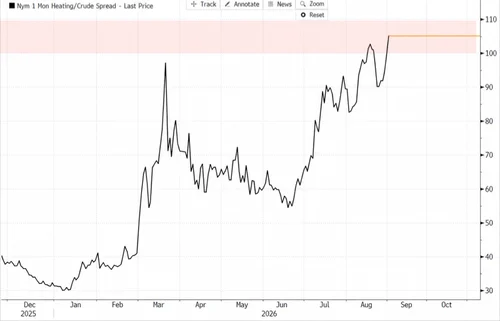
The global energy landscape faced a significant tremor early Tuesday as Bloomberg’s NYMEX one-month heating-oil/crude spread, widely tracked on the Terminal as the HOCL1 Index, surged dramatically, breaching the critical $100 per barrel mark before escalating further to nearly $106 by late morning. This historic blowout serves as a stark and urgent warning to international markets, underscoring a deepening crisis primarily concentrated in finished fuels rather than in the raw availability of crude oil. The unprecedented divergence between crude and refined product prices highlights severe structural vulnerabilities within the global refining and distribution network, exacerbated by a complex interplay of geopolitical tensions, operational disruptions, and strategic policy decisions by key global players.
Understanding the Crack Spread: A Vital Market Barometer
To fully grasp the gravity of the HOCL1 Index’s recent performance, it is essential to understand the "crack spread." In the energy sector, the crack spread represents the theoretical profit margin that an oil refinery makes by "cracking" (refining) a barrel of crude oil into refined petroleum products like gasoline, diesel, and heating oil. It is calculated by subtracting the price of crude oil from the combined prices of the products derived from it. A widening crack spread typically indicates strong demand for refined products relative to crude oil, suggesting either high demand for fuels, insufficient refining capacity, or disruptions in the supply chain for finished products. Conversely, a narrowing spread points to oversupply in refined products or weak demand. The NYMEX heating-oil/crude spread specifically measures the difference between the price of heating oil futures and crude oil futures, making it a direct indicator of the profitability of converting crude into heating oil and, by extension, other middle distillates like diesel.
Historically, crack spreads fluctuate, influenced by seasonal demand, refinery maintenance schedules, and economic cycles. However, a spread breaching $100 per barrel is exceedingly rare, signaling extreme stress in the refined products market. For context, typical crack spreads might range from $10-$30 per barrel in normal market conditions. Even during periods of high demand or geopolitical tension, sustained levels above $50 have been considered exceptional. The current surge past $100, and its rapid escalation towards $106, catapults the market into uncharted territory, surpassing previous peaks observed during major supply shocks or periods of intense demand, such as the post-financial crisis recovery or the initial disruptions following the Russia-Ukraine conflict. This extraordinary jump serves as a critical distress signal, indicating that the fundamental mechanisms for supplying refined fuels are under immense and unsustainable pressure.
A Confluence of Global Disruptions: The Root Causes Unveiled
The current, unprecedented blowout in the heating-oil/crude spread is not attributable to a single factor but rather a perfect storm of interconnected global disruptions. These issues have systematically eroded the capacity of the global energy system to convert crude oil into the vital fuels that power economies and heat homes.
1. Russian Refinery Outages and Export Restrictions: The ongoing geopolitical conflict in Eastern Europe has profoundly impacted Russia’s energy sector, a major global supplier of both crude oil and refined products. A series of strategic drone attacks by Ukraine have targeted Russian refineries, causing significant operational disruptions and capacity reductions. While exact figures are often difficult to verify independently, industry estimates suggest that these attacks, combined with technical failures and maintenance backlogs exacerbated by Western sanctions limiting access to crucial equipment and technology, have taken a substantial portion of Russia’s refining capacity offline. Analysts at institutions like Goldman Sachs have repeatedly issued warnings about a looming "global diesel crisis," directly linking it to these Russian outages. Furthermore, Moscow’s strategic decision to restrict exports of industrial fuels, potentially to stabilize domestic markets or as a geopolitical leverage tool, has tightened global supplies even further, particularly for distillates like diesel and heating oil which are critical for industrial operations, transportation, and agriculture worldwide. The combined effect of physical damage and strategic export controls has effectively removed a significant volume of refined products from the international market, creating a vacuum that other producers are struggling to fill.
2. Persistent Disruptions Through the Strait of Hormuz: The Strait of Hormuz, a narrow waterway between Iran and Oman, remains the world’s most critical oil transit chokepoint. Approximately one-fifth of the world’s total petroleum consumption, and a substantial portion of its refined products, passes through this strait daily. Recent years have seen escalating geopolitical tensions in the region, including piracy, military incidents, and threats to shipping lanes, particularly from Houthi rebels in Yemen and broader regional rivalries. These disruptions, even if sporadic, introduce immense uncertainty and risk premiums for shipping. Marine insurers increase premiums for vessels transiting the area, and shipping companies face longer transit times by rerouting or heightened security costs. This directly impacts the timely and cost-effective delivery of refined fuels, particularly from major refining hubs in the Middle East and Asia to global markets. The "continued disruptions" mentioned in the original report likely refer to an accumulation of these factors, making the transit of finished fuels through this vital artery increasingly precarious and expensive, thereby contributing to supply tightness and price surges in destination markets.
3. Global Refining Landscape and Underinvestment: Beyond immediate crises, the global refining sector has been grappling with structural challenges for years. The COVID-19 pandemic led to significant refinery rationalization, with many older, less efficient plants being permanently shut down due to plummeting demand. Coupled with this, underinvestment in new refining capacity, driven by uncertain long-term demand outlooks amid the energy transition and stringent environmental regulations, has left the world with limited spare capacity to absorb shocks. When existing refineries face unexpected outages – whether due to maintenance, accidents, or geopolitical targeting – there is little global buffer to compensate. This inherent inelasticity in refining capacity means that even relatively minor disruptions can have outsized impacts on refined product availability and pricing, making the system highly vulnerable to the kinds of concentrated pressures currently at play.
Expert Analysis: China’s Pivotal, Yet Reluctant, Role
Amidst this global energy crunch, eyes have turned to China, a nation possessing one of the world’s largest and most advanced refining infrastructures. Kelly Chen, a senior economist at DNB Carnegie specializing in China, emerging markets, and energy markets, provided crucial insights into Beijing’s potential role—or lack thereof—in alleviating the global refined products squeeze. Her analysis, shared on Tuesday morning, highlighted China’s unique position but tempered expectations for its intervention.
Chen’s central observation is that China stands out as "one of the few countries with enough spare refining capacity to provide meaningful relief to the increasingly strained global market." With its vast network of state-owned and private refineries, China has consistently built out its processing capabilities, often exceeding its domestic demand for certain products. This inherent overcapacity, driven by strategic industrial planning and a desire for energy self-sufficiency, theoretically positions China as a potential global swing producer for refined fuels, particularly at a time when other major refining centers are constrained. As Chen elaborated, "As product exports through the Strait of Hormuz remain heavily disrupted and Ukrainian attacks have constrained Russian refining, China is one of the few regions with room to materially raise refinery throughput and exports quickly."
However, Chen’s analysis swiftly pivoted to the strategic realities that temper China’s willingness to act as a global savior for Western fuel markets. She pointed out that "Beijing appears to have little economic or strategic incentive to rescue Western fuel markets." This assessment delves into several layers of China’s national interest:
-
Economic Disincentives and Energy Security: Chen elaborated that if external pressures, such as those from the United States, force China to reduce or halt its purchases of Iranian oil—a significant source for Beijing due to favorable pricing and less stringent adherence to international sanctions—China would face a difficult choice. It would either have to "compete more aggressively for scarce crude oil barrels" on the open market, potentially driving up its own import costs, or "draw further on its own strategic inventories." Both options, Chen argues, "would weaken China’s own energy security to ease a shortage elsewhere." China has already demonstrated a willingness to tap its strategic buffers to absorb disruptions to its crude oil supply, and Beijing likely has limited "appetite to do much more" to benefit others at its own expense.

-
Geopolitical Leverage and Industrial Strategy: A more subtle but equally powerful incentive for Beijing’s reluctance lies in the potential geopolitical and economic benefits derived from high global fuel prices. Chen noted that "high road-fuel prices could boost global demand for Chinese electric vehicles/energy technologies." China has heavily invested in becoming a global leader in electric vehicles, battery technology, and renewable energy infrastructure. A sustained period of high conventional fuel prices in Western markets could accelerate the shift towards these alternative technologies, thereby creating a larger market for Chinese exports and solidifying its leadership in the green energy transition. This aligns perfectly with Beijing’s long-term industrial and strategic goals, making intervention to lower global fuel prices counterproductive to its own strategic interests.
-
Selective Export Policies: While China did increase its refined product export quotas in July, Chen highlighted that these quotas "remain well below 2025 levels." This indicates a calculated approach by Beijing, balancing domestic demand, refinery utilization, and strategic reserves without fully opening the floodgates to global markets. The "question is whether the authorities have an incentive to raise product exports further," a question Chen’s analysis definitively answers in the negative for the immediate future. Until "crude oil supplies become less disrupted," Chen concludes, "we suspect Chinese authorities have little reason to significantly raise product exports." This suggests that China prioritizes its own energy stability and strategic objectives over alleviating external market pressures, especially those primarily impacting Western economies.
Broader Economic and Geopolitical Implications
The relentless ascent of the heating-oil/crude spread carries profound implications, rippling through global economies and reshaping geopolitical dynamics.
1. Inflationary Pressures and Cost-of-Living Crisis: The most immediate and tangible impact is on inflation. Heating oil and diesel are fundamental to global commerce. Elevated prices for these middle distillates translate directly into higher operating costs for transportation sectors (trucking, shipping, rail, aviation), manufacturing, and agriculture. Businesses face increased expenses for moving goods, powering factories, and operating farm machinery, which are inevitably passed on to consumers in the form of higher prices for virtually all goods and services. For households, particularly in regions reliant on heating oil for warmth, the surge represents a direct hit to disposable income, exacerbating existing cost-of-living crises. Governments may face intense pressure to implement subsidies or tax cuts, further straining public finances.
2. Energy Security and Supply Chain Resilience: The crisis in refined fuels underscores a critical vulnerability in global energy security. Nations are realizing that having access to crude oil is only half the battle; the capacity to refine it and ensure its distribution is equally, if not more, vital. This realization is likely to spur renewed discussions on diversifying refining capacity, strengthening strategic petroleum product reserves (beyond just crude), and enhancing the resilience of energy supply chains against geopolitical shocks and natural disasters. Countries heavily reliant on imported refined products, particularly those with limited domestic refining capabilities, will find their energy independence and economic stability increasingly at risk.
3. Geopolitical Realignments and Leverage: The refined fuels crunch could also trigger significant geopolitical realignments. Countries with spare refining capacity, like China, gain considerable leverage in international relations. Their decisions to export or withhold products will have disproportionate impacts on global markets, potentially influencing diplomatic negotiations, trade agreements, and strategic alliances. Western nations, already grappling with complex relations with Russia and China, may find their energy security increasingly intertwined with the policy choices of non-allied powers. The crisis could also intensify competition for scarce refined products, leading to new trade routes, bilateral deals, and potentially, increased friction between nations vying for essential fuel supplies.

4. Winter Outlook and Humanitarian Concerns: As the Northern Hemisphere approaches winter, the spike in heating oil prices takes on a humanitarian dimension. Colder temperatures will inevitably increase demand for heating, placing further upward pressure on prices. Vulnerable populations, particularly in Europe and parts of North America, could face exorbitant heating bills, leading to energy poverty and potential public health crises if access to affordable heating is compromised. This looming threat will undoubtedly factor into policy decisions and emergency preparedness efforts by governments.
Potential Outlook and Future Scenarios
The immediate outlook for the heating-oil/crude spread suggests continued volatility and the potential for further price spikes, especially if geopolitical tensions escalate or refinery issues persist. Resolving the current crisis is a multi-faceted challenge, dependent on several unpredictable variables.
In the short term, markets will closely monitor developments in Russia regarding refinery operations and export policies, as well as the stability of shipping lanes through the Strait of Hormuz. Any de-escalation of conflict or improvement in refinery throughput could provide some relief, but a rapid return to historical norms seems unlikely given the structural nature of the challenges.
Medium-term prospects hinge on global economic activity, the pace of the energy transition, and strategic investments. A significant global economic slowdown could dampen demand for fuels, naturally easing price pressures. However, if economic activity remains robust, the underlying supply constraints will continue to drive up prices. The lack of significant new refining capacity coming online in the near future means that structural tightness will likely persist for some time.
Policy responses will be critical. Governments may explore a range of interventions, from coordinated releases from strategic product reserves (if available) to direct consumer subsidies, or diplomatic efforts to de-escalate tensions in critical energy regions. The crisis may also accelerate the push towards renewable energy sources and electric vehicles, as high fossil fuel prices make alternatives more economically attractive. However, this transition requires substantial investment and time, offering little immediate relief.
Conclusion: A Critical Juncture for Global Energy
The historic breach of the $100 mark by the NYMEX heating-oil/crude spread is more than just a financial metric; it is a profound indicator of a global energy system under immense strain. It signals a critical juncture where geopolitical conflicts, infrastructural vulnerabilities, and strategic national interests have converged to create an unprecedented crisis in refined fuel markets. This is not merely a pricing issue but a fundamental challenge to global economic stability, energy security, and social welfare. As the world grapples with this complex interplay of factors, the imperative for international cooperation, strategic foresight, and resilient energy policies has never been more urgent. The decisions made by major energy players and governments in the coming months will dictate not only the trajectory of fuel prices but also the broader landscape of global energy security for years to come.

