
Global Crypto Tax Reporting Framework Faces Significant Onchain Activity Gap
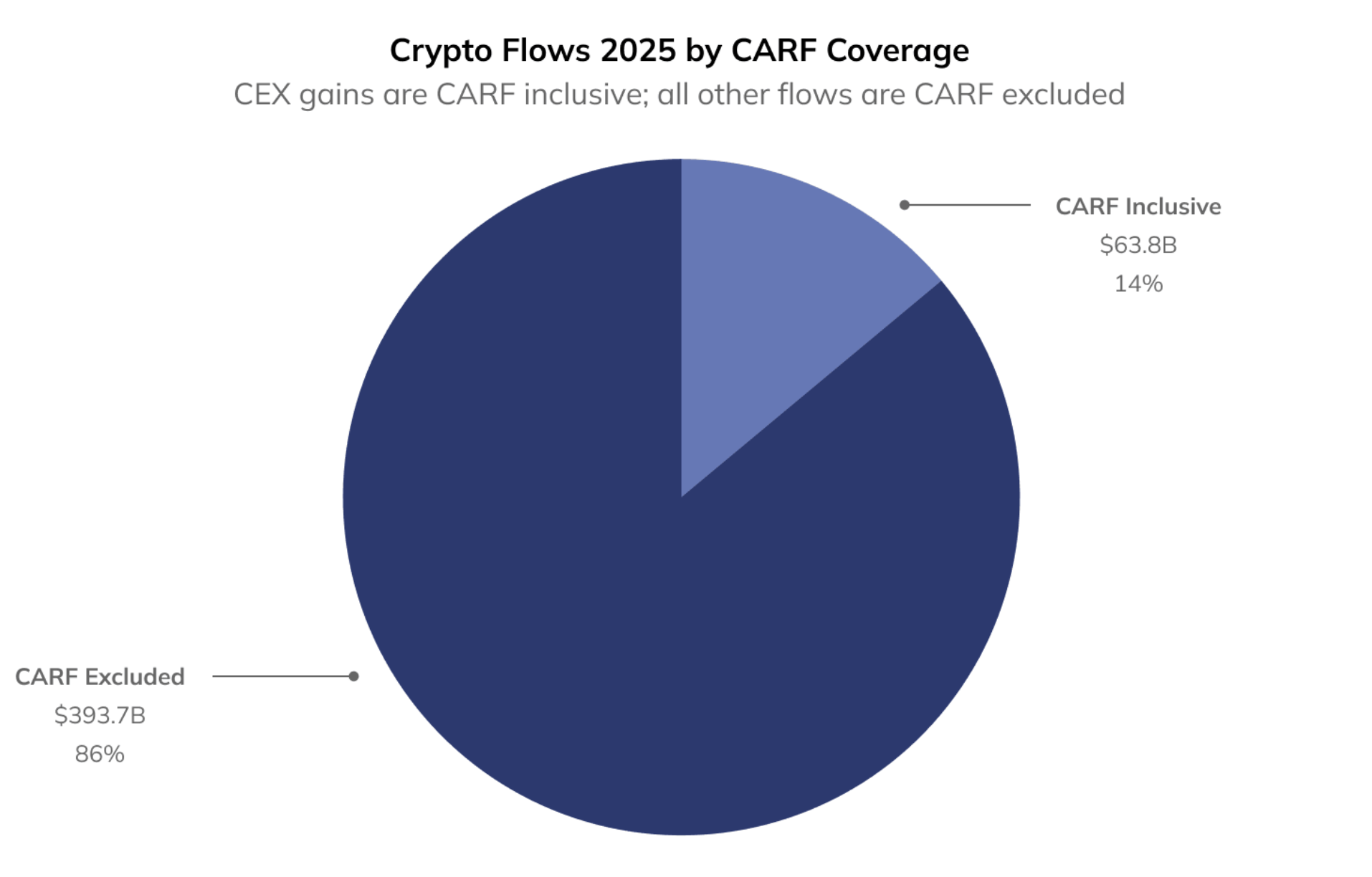
Potentially taxable onchain crypto activity reached at least $457 billion globally in 2025, according to a new Chainalysis report. This substantial figure highlights a significant challenge for international tax authorities, as current reporting rules, notably the Organisation for Economic Co-operation and Development’s (OECD) Crypto-Asset Reporting Framework (CARF), may only capture a fraction of this activity. Chainalysis’s comprehensive analysis indicates that the transactions covered by CARF account for a mere 14% of the onchain taxable activity identified, leaving a substantial 86% of potential tax revenue unaccounted for by the framework.
The United States accounted for an estimated $112.6 billion of the total onchain taxable crypto activity in 2025. Regionally, North America led the globe with $134.6 billion in such activity, followed closely by the European Union, which registered $125.1 billion. These estimates encompass a wide array of onchain transactions, including realized capital gains from trading, income generated through activities like cryptocurrency mining, staking, and lending, and payments made using cryptocurrencies. Crucially, these figures exclude transactions conducted entirely within centralized cryptocurrency exchanges, focusing instead on activity that occurs directly on blockchains.
The CARF, developed by the OECD and finalized in 2022, aims to standardize the reporting of crypto-asset transactions across jurisdictions. It requires covered crypto service providers to collect and report customer transaction data to their respective tax authorities. This data is then intended to be shared internationally, fostering greater transparency and enabling tax compliance. The framework’s implementation began on January 1, 2026, in 48 participating jurisdictions, including key economic blocs like the United Kingdom and the European Union. Under CARF, in-scope crypto providers are mandated to gather detailed customer information, including their tax residency status, and transmit this data to domestic tax authorities.
However, the Chainalysis report underscores a fundamental limitation in CARF’s current design: its reliance on intermediaries. Colby Mangels, a former OECD advisor who played a role in developing CARF, previously explained to Cointelegraph that the framework was intentionally designed around intermediaries that facilitate crypto transactions as a business. This approach, while effective for traditional financial services, encounters significant hurdles in the rapidly evolving world of decentralized finance (DeFi).
The CARF Framework: Scope and Limitations
The CARF framework’s primary objective is to create a global standard for reporting crypto-asset transactions to combat tax evasion and ensure fair taxation. It targets entities that act as intermediaries in crypto transactions, such as exchanges, wallet providers, and brokers. These intermediaries are required to collect specific information about their customers, including names, addresses, dates of birth, and tax identification numbers, as well as details about their crypto transactions, such as the type of crypto-asset, the quantity, the date of the transaction, and its value.
The framework’s design implicitly assumes the existence of identifiable and accountable entities responsible for holding or facilitating these transactions. This is where the challenge with onchain activity, particularly in the DeFi space, emerges. In decentralized exchanges (DEXs), peer-to-peer (P2P) transfer networks, and decentralized applications (dApps), transactions often occur directly between users without a central intermediary. In such scenarios, there may be no single entity that can be held responsible for reporting obligations, or the nature of the interaction might not fit the traditional definition of a custodial or service relationship.

Chainalysis’s analysis highlights that the 86% of onchain taxable activity not covered by CARF includes a significant portion of these decentralized activities. This encompasses:
- Decentralized Exchanges (DEXs): While DEXs facilitate trading, they often operate without a central entity to collect user data. Transactions occur directly from user wallets to liquidity pools, making it difficult to assign reporting responsibility.
- Peer-to-Peer (P2P) Transfers: Direct transfers between individuals, whether for goods, services, or simply as gifts, are a core feature of blockchain technology. These transfers, especially when not facilitated by a regulated platform, fall outside CARF’s purview.
- Onchain Income Streams: Activities like earning yield through DeFi protocols, participating in liquidity mining, or receiving airdrops directly into a wallet represent taxable income. However, if these streams are generated through smart contracts without a clear intermediary, reporting becomes problematic.
- Crypto-Denominated Payments: Using cryptocurrencies for everyday purchases or as a medium of exchange for services, especially when conducted directly from a wallet, presents a similar challenge.
Regional Breakdown of Taxable Onchain Activity (2025 Estimates)
The global estimate of $457 billion in potentially taxable onchain crypto activity is distributed across various regions, with North America and Europe leading the charge.
- North America: $134.6 billion
- United States: $112.6 billion
- Other North American nations contribute the remaining $22 billion.
- European Union: $125.1 billion
- This figure represents the collective taxable onchain activity across all EU member states.
- Other Regions: The remaining $197.3 billion is distributed across the rest of the world, indicating a global phenomenon.
These figures are based on Chainalysis’s proprietary data and methodologies, which analyze blockchain transactions to identify and categorize activities that are likely subject to taxation. The exclusion of centralized exchange activity is a deliberate choice, as these platforms are typically subject to their own regulatory requirements and are expected to provide transaction data to users and, in some cases, directly to tax authorities. The focus on onchain activity is crucial because it represents the inherent, permissionless nature of blockchain technology, which often operates outside traditional financial gatekeepers.
Timeline and Regulatory Developments
The landscape of crypto taxation has been evolving rapidly. The OECD began its work on crypto-asset taxation initiatives several years ago, recognizing the growing importance and potential tax implications of digital assets.
- 2022: The OECD finalized the Crypto-Asset Reporting Framework (CARF) and amendments to the Common Reporting Standard (CRS) for automatic exchange of information on crypto-assets. This marked a significant step towards international cooperation on crypto tax matters.
- January 1, 2026: CARF data collection commenced in 48 jurisdictions. This date signifies the official start of the reporting obligations for covered crypto service providers in these countries.
- Ongoing: Tax authorities worldwide are continuously developing their understanding of crypto assets and refining their approaches to taxation. This includes exploring ways to adapt existing tax laws and regulations to the unique characteristics of digital assets and distributed ledger technology.
The introduction of CARF is a response to the increasing use of cryptocurrencies for investment, payments, and other financial activities. As the value and volume of crypto transactions have grown, so too has the potential for tax evasion and avoidance. International bodies like the OECD have recognized the need for a coordinated approach to ensure that individuals and entities engaged in crypto activities contribute their fair share of taxes.
Analysis of Implications: The Tax Gap and Future Outlook
The stark discrepancy identified by Chainalysis between total onchain taxable activity and the portion captured by CARF has several significant implications:
- Revenue Shortfall: Governments may be missing out on substantial tax revenue due to the inability to effectively track and tax a large segment of crypto activity. This could impact public finances and the ability of governments to fund essential services.
- Compliance Burden: For taxpayers who are aware of their obligations, the lack of clear reporting mechanisms for certain onchain activities can create confusion and a de facto barrier to compliance.
- Regulatory Evolution: The report’s findings are likely to prompt further discussion and action from regulatory bodies. There is a growing recognition that current frameworks may need to be expanded or adapted to address the complexities of DeFi and other onchain activities.
- Technological Arms Race: Tax authorities may need to invest in advanced blockchain analytics tools and expertise to effectively monitor and audit onchain transactions. This could lead to a technological arms race between sophisticated crypto users and the tax agencies seeking to enforce compliance.
Colby Mangels’ previous comments to Cointelegraph suggest a potential pathway forward. Tax authorities are closely observing developments in anti-money laundering (AML) regulations, particularly efforts to define when DeFi platforms or their operators should be considered regulated crypto service providers. This indicates a potential shift towards extending reporting obligations to entities that, while not traditional intermediaries, play a crucial role in the DeFi ecosystem.
The implications of this tax gap extend beyond just revenue collection. A perceived lack of oversight or enforcement in certain areas of the crypto market could potentially foster environments where illicit activities are more likely to occur, although the report itself does not delve into this aspect. Ensuring a level playing field for all taxpayers, regardless of whether their financial activities are onchain or offchain, is a fundamental principle of tax fairness.
Broader Impact and Future Considerations
The Chainalysis report serves as a crucial wake-up call for policymakers and tax authorities globally. The sheer volume of onchain crypto activity that falls outside the current CARF reporting regime underscores the need for a more comprehensive and adaptable approach to crypto taxation.
One area of consideration for future regulatory efforts could be the development of decentralized identifiers (DIDs) or other identity solutions that could be integrated into DeFi protocols, allowing for pseudonymized reporting while still maintaining user privacy. Another avenue might involve exploring different models of responsibility for transaction reporting within decentralized networks, perhaps by focusing on protocol developers or those who deploy smart contracts.
The report’s findings also highlight the importance of ongoing education and outreach to crypto users. As regulations evolve, clear guidance on tax obligations and reporting procedures will be essential to foster a culture of compliance within the crypto community.
In conclusion, while the CARF represents a significant step forward in global crypto tax reporting, the Chainalysis report clearly demonstrates that it is not a complete solution. The vast majority of onchain crypto activity currently operates beyond its reach. Addressing this gap will require continued innovation in regulatory frameworks, technological solutions, and international cooperation to ensure that the burgeoning digital economy is subject to fair and effective taxation. The $457 billion figure is not just a statistic; it represents a significant area where tax compliance and governmental revenue collection are currently challenged, necessitating a proactive and adaptive response from all stakeholders.

