
Amidst a flurry of significant events in the cryptocurrency sphere, including the highly publicized Binance hack and the crucial US midterm elections, a long-anticipated development within the Bitcoin ecosystem has quietly come to fruition. On October 29, the eCash network, a distinct hard fork of Bitcoin spearheaded by Paul Sztorc and his company LayerTwo Labs, officially went live. Sztorc, a prominent figure in the Bitcoin development community and the primary architect behind the innovative Drivechain proposals (BIP300 and BIP301), has launched this new network with the explicit aim of injecting renewed dynamism into Bitcoin’s foundational code, focusing on enhancing payment capabilities, privacy features, and the development of novel applications.
Sztorc articulated his motivations behind the eCash launch, stating, "We need to actively sabotage the ‘degrowth’ policies killing Bitcoin. We want to find the true Bitcoin builders and give them the tools to actually innovate. We just need the open-minded, risk-taking contrarians to come and build." This forceful statement underscores Sztorc’s belief that Bitcoin’s current trajectory has been hampered by what he perceives as stagnation and resistance to significant advancements.
The eCash hard fork presents an intriguing opportunity for eligible Bitcoin holders, granting them an equivalent balance of the new network’s native token, ECX, for every BTC they controlled at the time of the fork. This direct distribution offers holders an immediate stake in the new ecosystem, raising questions about the potential benefits for developers and the practical utility for Bitcoin investors who now possess these newly minted coins.
Understanding the eCash Network and its Core Innovations
eCash, developed by LayerTwo Labs, emerges as a separate hard fork from Bitcoin, a decision stemming from Sztorc’s stated frustration with what he describes as "complacency narratives" and "cult-like toxicity" that he believes have impeded Bitcoin’s progress. The network’s cornerstone innovation is the implementation of Drivechains. This sophisticated system is designed to empower developers by allowing them to construct independent sidechains, each equipped with a unique set of features and functionalities, without necessitating any alterations to the core eCash blockchain protocol.
This architectural approach liberates developers from the constraints of Bitcoin’s often rigid base-layer development, enabling them to pursue a broader spectrum of applications. The eCash platform is envisioned as a fertile ground for experimentation in areas such as advanced payment systems, enhanced privacy solutions, the creation of diverse digital assets, and the development of prediction markets. Concurrently, the Drivechain mechanism is engineered to benefit miners by providing them with avenues to increase their revenue streams through the collection of additional transaction fees generated on these sidechains.
The launch of eCash’s mainnet was accompanied by the simultaneous debut of five distinct sidechains: BitNames, BitAssets, Thunder, Truthcoin, and zSide. Furthermore, two additional sidechains, Photon – designed with quantum resistance in mind – and CoinShift, a decentralized exchange, are slated for future integration. This multi-pronged approach suggests a strategic effort to build a robust and diverse ecosystem around the eCash network from its inception.
Sztorc has been a vocal proponent of Drivechains for over a decade, consistently arguing that Bitcoin’s traditionally conservative development methodology has stifled its inherent potential. He asserts, "Anything that isn’t maximizing network usage is simply a distraction. Users, the ones who actually pay transaction fees to miners, will win in the long run." This perspective highlights a fundamental belief in user-centric development and the prioritization of network utility as key drivers of long-term value.
Accessing and Managing New ECX Holdings
The eCash hard fork occurred at Bitcoin block height 973,728. Individuals who maintained control over their private keys at the precise moment of this snapshot are entitled to an equivalent amount of ECX tokens in their wallets. LayerTwo Labs has clarified, "If you held the keys to your BTC at that exact block, you now own the exact same amount of ECX. It is that simple, and you can access them right now."
However, the process of claiming and managing these new ECX holdings requires a degree of technical understanding and caution. Bitcoin holders who self-custody their assets will need to utilize a wallet that specifically supports the eCash network and meticulously follow the provided procedures to segregate their ECX from their original BTC holdings. This separation is critical due to the shared transaction history between the two chains. Without proper precautions, a transaction initiated on one network could inadvertently be "replayed" on the other, potentially leading to unintended consequences.
LayerTwo Labs offers a crucial warning: "Never move your BTC first, as an ordinary, unprotected BTC spend can easily be replayed on the ECX network." While the eCash protocol incorporates built-in replay protection mechanisms, the company strongly advises users to initiate any transactions with ECX first before attempting to spend their BTC. This sequence is designed to mitigate the risk of accidental transaction replay.
For individuals who held their Bitcoin on centralized cryptocurrency exchanges at the time of the fork, the distribution of ECX tokens is contingent upon the exchange’s decision to support the fork. Holders in this category are advised to verify whether their respective exchanges have announced support for the eCash fork or plans for ECX distribution. Their access to the new tokens is, to a degree, dependent on the policies and actions of these intermediaries.

Trading and Market Dynamics of ECX
The ability to acquire ECX is distinct from the ease with which these tokens can be traded on the open market. As of the initial launch period, ECX was not yet widely listed on major cryptocurrency exchanges, presenting a challenge for immediate liquidity and price discovery. Furthermore, depending on the user’s jurisdiction, the acquisition of new coins through a hard fork can carry tax implications, necessitating due diligence and consultation with tax professionals before filing tax returns.
Early market access was provided by NeoxEX, which announced native ECX deposits, withdrawals, and trading pairs (ECX/USDT, ECX/USDC, and ECX/BTC) on October 29. CoinW also indicated plans to distribute ECX to eligible Bitcoin holders, with further announcements regarding deposit, withdrawal, and trading availability expected at a later date.
An alternative trading avenue has emerged on Solana through the decentralized exchange Orca. Here, users can swap USDC for wrapped ECX (wECX) via a liquidity pool. While this offers a method for gaining exposure to ECX, it involves a wrapped token on a different blockchain rather than direct trading of native ECX on the eCash network.
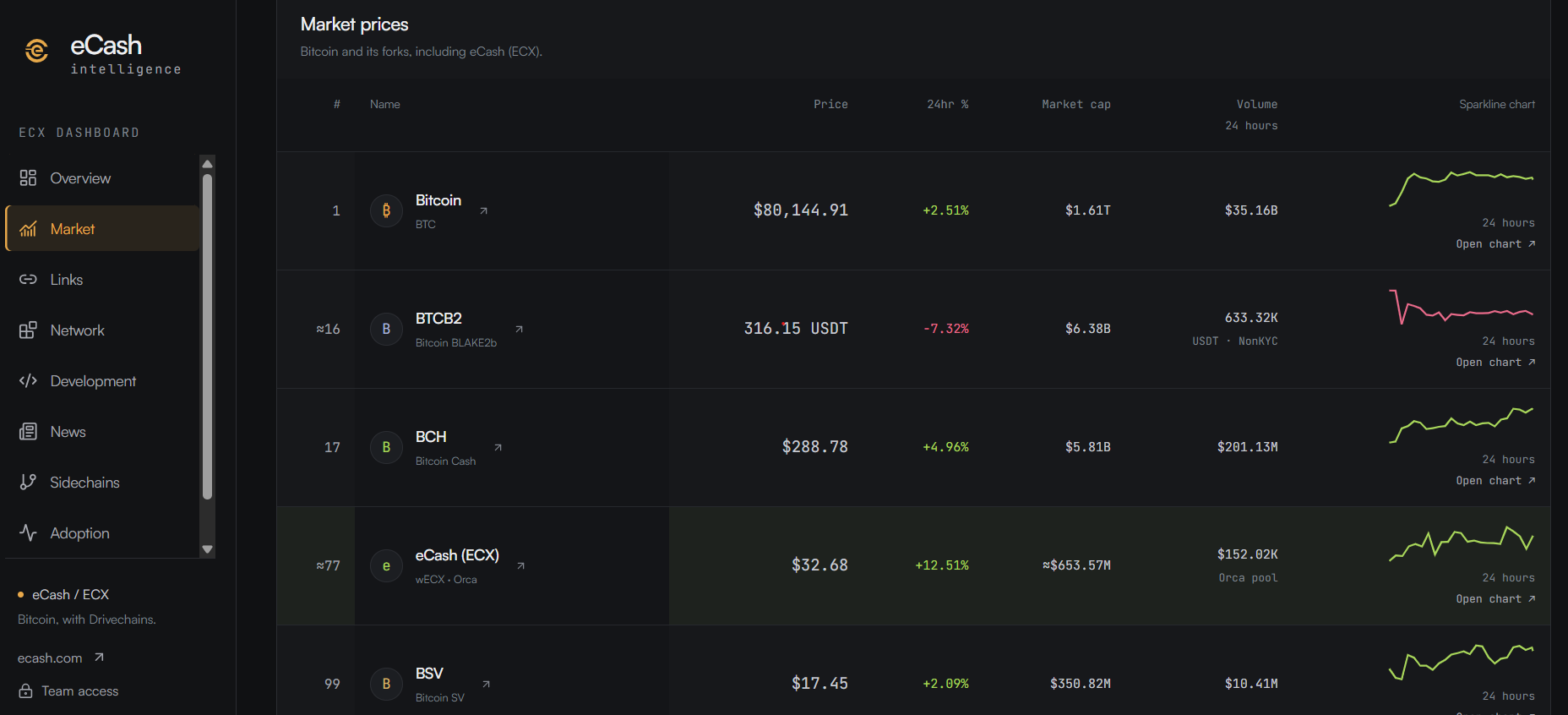
Market data for ECX has shown some variability. CoinMarketCap reported ECX at approximately $32.63 with a 24-hour trading volume of around $355,000 as of November 5. In contrast, CoinGecko listed ECX as a preview token, with no immediate price data or tracked exchange markets available. Crypto market data provider Kaiko indicated that it does not track ECX, further limiting the availability of independent market analysis.
LayerTwo Labs has reported that early trading activity saw ECX prices fluctuate between $40 and $50. However, they have not provided detailed order book depth or trading volume figures, instead pointing to the total value locked in the Orca liquidity pool as an indicator of available liquidity.
Sztorc expressed optimism regarding the potential for ECX’s liquidity, drawing parallels to the initial performance of Bitcoin Cash (BCH) post-fork. He stated, "If our fork replicates even a fraction of [Bitcoin Cash] BCH’s initial performance, the liquidity will be staggering." He also reassured potential holders concerned about current liquidity levels, suggesting that they can retain their coins and make decisions later, noting that "We are actively adding new exchanges and trading pairs, so the user experience will only improve. Otherwise, you’re welcome to take your free money and leave."
A Divergent Vision for Bitcoin’s Future
The long-term success of eCash, according to Sztorc, hinges on its ability to foster the development of valuable applications and attract users willing to transact and pay for these services. The project’s primary metrics for success in its inaugural year are anticipated to be customer acquisition and the generation of transaction fee revenue.
Sztorc remains unfazed by criticisms leveled against the security model of Drivechains, particularly concerns regarding the potential for miners to collude and illicitly access funds held on sidechains. He dismisses these apprehensions as "superstition," arguing, "If you genuinely believe miners will torch their own billion-dollar operations for a short-term theft on an L2, then you shouldn’t trust Bitcoin’s L1 either." This stance suggests a fundamental faith in the economic incentives and security assumptions underpinning the broader blockchain ecosystem.
In essence, eCash offers Bitcoin holders a new digital asset and provides developers with an expanded platform for innovation. The ultimate significance and market impact of ECX will be determined by its adoption and utility, contingent on whether developers can build compelling applications and whether users find sufficient value in utilizing the eCash network. The launch represents a bold experiment in blockchain evolution, driven by a desire to unlock what its proponents believe is the untapped potential of Bitcoin’s foundational technology.

