
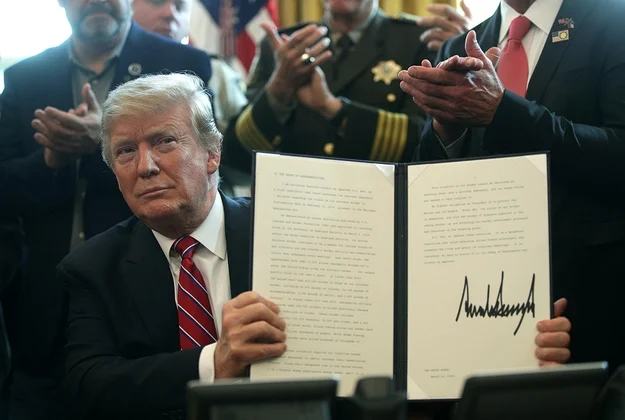
The Associated Press has confirmed a significant shift in the American political landscape, calling the Congressional races in favor of the Democratic Party. This decisive outcome grants Democrats control of both the House of Representatives and the Senate, fundamentally altering the balance of power when the new Congress convenes at the start of 2027. However, this "blue wave" will immediately confront a formidable challenge: the continued presence of President Trump in the White House, armed with the constitutional powers of veto and executive order, ensuring a period of deeply divided government in the United States. This configuration portends a challenging legislative environment, likely characterized by political stalemate and an increased reliance on presidential unilateralism, with profound implications across domestic and foreign policy, as well as financial markets.
The Shifting Tides: A Blue Wave in Congress
The midterm elections, held prior to the start of 2027, delivered a clear mandate to the Democratic Party, which successfully flipped numerous seats to secure majorities in both legislative chambers. While specific seat counts were not immediately available, the Associated Press’s call indicates a robust performance that exceeded expectations in many key districts and states. This outcome marks a significant rebuke to the incumbent presidential administration, typically seen as a referendum on the president’s performance and the direction of the country. Historically, such widespread gains by the opposition party in midterm elections are not uncommon, often leading to periods of legislative friction. For instance, former President Bill Clinton faced a Republican-controlled Congress after the 1994 midterms, and President Barack Obama similarly contended with a Republican House majority after 2010, both leading to intensified partisan battles and legislative gridlock. The current scenario places President Trump in a similar, if not more pronounced, position of direct confrontation with a newly empowered opposition.
The Democrats’ victory means they will control the legislative agenda, committees, and the confirmation process for presidential appointments. This newfound power allows them to initiate legislation, investigate the executive branch, and attempt to steer national policy in a direction divergent from the President’s priorities. However, the constitutional framework of the U.S. government, designed with checks and balances, ensures that the President retains significant authority, particularly when it comes to preventing legislation from becoming law.
The President’s Arsenal: Veto Power and Executive Orders
At the heart of the impending legislative standoff lies President Trump’s constitutional authority. His power to veto legislation passed by Congress is a formidable tool that can effectively halt any bill he opposes, unless Congress can muster a supermajority to override it. Historically, overriding a presidential veto is an exceedingly difficult feat. It requires a two-thirds majority vote in both the House of Representatives and the Senate. In a House of 435 members, this translates to 290 votes, and in the Senate of 100 members, 67 votes. Given the typically narrow margins of party control, even with a "blue wave," it is highly improbable that the Democrats will command such an overwhelming majority in either chamber.
President Trump himself explicitly articulated his intent to leverage this power. In an interview preceding the election results, he stated, "I have the ultimate power – it’s called veto," adding, "if we didn’t win, I veto everything. I’ll be vetoing, vetoing." This declaration signals a firm resolve to use his veto pen extensively, suggesting that many, if not most, Democratic policy proposals emerging from the new Congress may not advance beyond the President’s desk. This sets the stage for a period where legislative initiatives will likely be dead on arrival, leading to significant frustration within the Democratic-controlled Congress.
Beyond the veto, the President possesses another potent instrument: the executive order. These directives, issued by the President, carry the force of law without requiring Congressional approval. While executive orders cannot create new laws or appropriate funds, they can direct federal agencies on how to implement existing laws, manage federal government operations, and shape policy in areas where the President has inherent authority, such as foreign policy, trade, and immigration. With an unsupportive Congress, President Trump is expected to rely heavily on executive orders to advance his policy agenda, circumventing legislative obstacles. This approach, while efficient for the executive branch, often leads to accusations of overreach and can result in policies that are less stable, as they can be overturned by subsequent administrations or challenged in courts.
Legislative Gridlock: The Foreseeable Future
Rabobank’s Senior Macro Strategist, Bas van Geffen, highlights the significant probability of "legislative gridlock" as the most likely outcome of this divided government. This assessment is rooted in the deep ideological chasm separating the two major parties, particularly during President Trump’s tenure. Compromise, which is essential for legislative progress in a divided government, appears increasingly difficult given the polarized political environment. The absence of common ground suggests that efforts to find bipartisan solutions to pressing national issues will face immense challenges.
This gridlock has several critical implications, particularly for fiscal policy. A divided government typically limits the passage of major new spending initiatives or significant tax reforms, as each party can block the other’s proposals. While this might prevent large-scale fiscal expansion, it also drastically reduces the likelihood of any serious, bipartisan effort to address the nation’s burgeoning public debt and shore up public finances. The Congressional Budget Office (CBO) consistently warns about the unsustainable trajectory of U.S. debt, projected to reach unprecedented levels as a share of GDP in the coming decades. Without a unified government capable of enacting comprehensive fiscal reforms, the national debt is likely to continue its upward climb, potentially exerting upward pressure on long-term interest rates.
Economic Ramifications: Fiscal Uncertainty and Market Volatility
The prospect of legislative gridlock and a confrontational executive-legislative relationship introduces considerable economic uncertainty. One immediate concern highlighted by analysts is the approaching deadline for a government shutdown, currently slated for December 11. Without a budget agreement between Congress and the President, federal agencies face a cessation of non-essential operations, leading to disruptions in public services and a negative impact on economic activity. Historically, government shutdowns, though temporary, have shaved points off GDP growth and eroded consumer confidence.
Furthermore, the debt limit is expected to resurface as a major point of contention in 2027. The debt ceiling is a statutory cap on the total amount of money the U.S. government is authorized to borrow to meet its existing legal obligations. Reaching this limit without Congressional action can lead to a default on U.S. debt, an event that economists widely agree would have catastrophic consequences for the global financial system. The political brinkmanship surrounding the debt limit has become a recurring feature of divided governments, creating periods of intense market anxiety.
The implications for financial markets are multifaceted. The lack of a meaningful fiscal impulse, due to legislative stalemate, could weigh on U.S. equities. Without new government spending or tax cuts to stimulate demand, corporate earnings growth might be constrained. Moreover, the ongoing fiscal uncertainty, coupled with the potential for recurrent debt ceiling standoffs, is likely to keep the "term premium" elevated. The term premium is the extra compensation investors demand for holding longer-term bonds compared to rolling over shorter-term ones. Higher term premiums translate to higher long-term interest rates, which can impact borrowing costs for businesses and consumers, potentially dampening investment and economic growth.
Foreign Policy and Geopolitical Tensions: The Commander-in-Chief’s Domain
In the realm of foreign policy, trade policy, and immigration, the President’s powers are often less constrained by Congress. As Commander-in-Chief, the President has significant latitude in deploying military forces, negotiating treaties (though Senate ratification is required), and conducting international diplomacy. This becomes particularly relevant in volatile regions like the Middle East.
The ongoing situation with Iran serves as a stark example. The decision to escalate military action or pursue diplomatic engagement rests primarily with the President. While Congress has the power to declare war, presidents have historically initiated military actions without such a declaration, relying on their constitutional authority. President Trump’s recent comments regarding Iran, indicating a shift towards diplomacy while retaining the option of military force ("We’re locked and loaded if we need to [strike Iran again], but there may be no reason for it"), underscore the executive’s dominant role in this domain.
Oil markets reacted significantly to these pronouncements. Earlier in the week, oil futures fell sharply on Trump’s indication of renewed diplomatic efforts, suggesting a market perception of reduced geopolitical risk. However, the subsequent rise in 2027 pricing for oil futures suggests that markets may be adjusting expectations towards a scenario of tight supply and elevated transport costs in the coming year, perhaps anticipating that diplomatic efforts might ultimately falter or that other supply-side risks persist. Rabobank analysts remain skeptical of a breakthrough deal between the White House and Tehran, suggesting that "escalation in the coming weeks is likelier than not." This highlights the inherent volatility and unpredictability of foreign policy, especially when driven largely by executive decisions in a divided government. Trade policy, too, can largely be shaped through executive actions, such as imposing tariffs or negotiating trade agreements, without direct Congressional approval for every step. Similarly, immigration policy, while subject to existing laws, offers the President considerable room for maneuver through executive orders affecting enforcement, border security, and asylum procedures.
Monetary Policy and Federal Reserve Appointments
The Democratic victory in the Senate carries another critical implication: the ability to block presidential appointments. This power extends to key positions within the federal government, including the judiciary and, crucially, the Federal Reserve. The Senate’s "advice and consent" role means that presidential nominees for positions like Fed Governors must be confirmed by a simple majority vote.
The article specifically mentions potential replacements for Fed Governors Cook, if she were forced out, and Chairman Powell, if he decided to resign from the central bank’s board. The composition of the Federal Reserve Board of Governors has profound implications for monetary policy, influencing interest rates, inflation targets, and the overall stability of the financial system. A President seeking to appoint nominees whose views align more closely with his own economic agenda might find stiff resistance from a Democratic-controlled Senate, particularly if those nominees are perceived as lacking independence or being overly political.
This dynamic could lead to prolonged vacancies on the Fed board or the appointment of less preferred candidates, potentially affecting the central bank’s ability to operate smoothly or its perceived independence. While the Fed is designed to be an independent institution, insulated from short-term political pressures, the appointment process is inherently political. A confrontational Senate could use its power to scrutinize nominees more intensely, potentially forcing the President to choose more moderate or consensus-driven candidates, or face gridlock in filling critical positions. This could introduce an additional layer of uncertainty for markets, as the future direction of monetary policy could become a point of partisan struggle.
Conclusion: A Path Forward Amidst Division
The incoming era of divided government, characterized by a Democratic-controlled Congress and a veto-wielding President Trump, promises to be a period of intense political struggle and legislative stalemate. While the "blue wave" signals a clear desire for policy change from a segment of the electorate, the constitutional checks and balances, coupled with deep partisan divisions, will likely limit the extent to which Congress can enact its agenda.
The immediate challenges include navigating potential government shutdowns, confronting the debt ceiling, and grappling with a foreign policy largely dictated by executive action. For businesses and investors, this translates to heightened uncertainty regarding fiscal policy, a potential dampening of economic stimulus, and continued exposure to geopolitical risks. The term premium is expected to remain elevated, and U.S. equities may face headwinds from a lack of significant fiscal impulse.
The ability of either party to achieve its policy goals will largely depend on whether any common ground can be found, or if political brinkmanship dominates. President Trump’s stated intention to "veto everything" suggests a confrontational approach, which could exacerbate gridlock. The role of executive orders will become paramount for the President to advance his agenda, while the Senate’s power over appointments will be a critical check on the executive branch. Ultimately, this new configuration of power will test the resilience of American democratic institutions and the capacity of its leaders to govern effectively in an increasingly polarized nation.

