
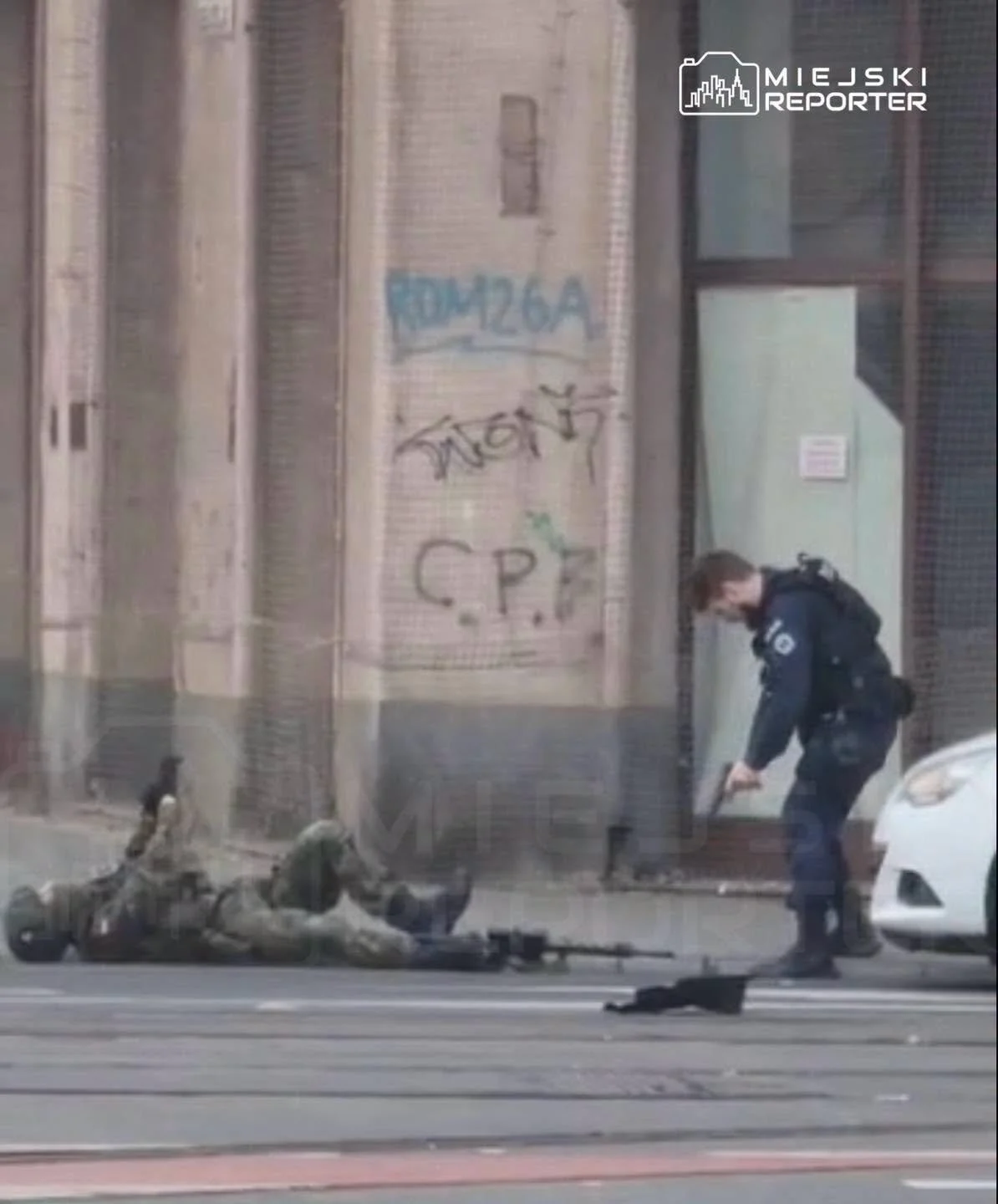
Krakow, Poland – A shocking act of violence unfolded in the heart of Krakow’s historic Main Market Square on [Insert Date if known, otherwise state "a recent afternoon"], when a gunman dressed in military fatigues opened fire, killing at least five individuals and injuring a dozen others. The incident, which occurred amidst a large anti-government protest, has sent shockwaves across Poland and drawn international attention to the nation’s political climate and public safety. Police swiftly responded, neutralizing the suspect at the scene, but the motives behind the brazen daylight attack remain under intense investigation.
The Unfolding Tragedy in Krakow’s Heart
The tranquility of Krakow’s iconic Main Market Square, a UNESCO World Heritage site and a vibrant hub for tourists and locals alike, was shattered around 3 p.m. local time. According to initial reports from BBC News and confirmed by local authorities, a man driving a black Subaru sedan suddenly drove into the bustling square. Eyewitnesses and police accounts indicate that the assailant, clad in full military fatigues, a tactical vest, and a helmet, began shooting "at random" from his vehicle, targeting unsuspecting pedestrians and demonstrators.
The scene quickly devolved into chaos as the sound of gunfire echoed through the historic cobblestone square. Panicked crowds, many of whom were participating in or observing an anti-government demonstration, scattered in desperate attempts to find cover. The attack left a trail of devastation, with emergency services confirming at least five fatalities and over a dozen individuals sustaining injuries, some of whom are in critical condition. The immediate response from law enforcement was decisive; officers confronted the gunman, ultimately shooting and neutralizing him on site, preventing further casualties.
Social media platforms, particularly X (formerly Twitter), became a rapid conduit for initial reports and harrowing eyewitness accounts. User Europa posted, "A mass shooting has taken place in the center of Kraków during an anti-government protest. A black Subaru drove through the center, firing a weapon out the window. Multiple casualties are reported. A perpetrator was reportedly shot dead by police." Another account, Visegrad 24, highlighted the nature of the attack, reporting, "New video shows the suspected terrorist attack at the Old Town Square in Krakow, Poland. 5 people killed and more than 13 wounded by a man in tactical gear." These early, albeit unverified, reports painted a grim picture of the unfolding crisis, emphasizing the tactical appearance of the assailant and the severity of the casualties.
Chronology of a Day Marred by Violence
The events of the day can be pieced together through a preliminary timeline, highlighting the rapid escalation from peaceful demonstration to violent tragedy:
- Morning/Early Afternoon: Hundreds of anti-government protesters began gathering in and around Krakow’s Main Market Square. These demonstrations were organized in response to what opposition figures and critics described as Prime Minister Donald Tusk’s administration’s "attempted coup against the high court," signaling deep political divisions within the country. The atmosphere, while politically charged, was largely peaceful, as is typical for public demonstrations in Poland.
- Circa 2:30 PM – 3:00 PM Local Time: The assailant, driving a black Subaru, approached and entered the Main Market Square. It remains unclear at this stage whether his entry into the pedestrianized area was a deliberate breach or if there were prior security lapses.
- Approx. 3:00 PM Local Time: The gunman, identified by witnesses as wearing military fatigues, a vest, and a helmet, opened fire from his vehicle. The shooting appeared indiscriminate, targeting individuals randomly across the square.
- Minutes Immediately Following the Attack: The square plunged into pandemonium. Individuals ran for cover, while others attempted to aid the wounded. Police officers, likely already present due to the ongoing protest, responded within moments to the sound of gunfire.
- Swift Police Intervention: Within a very short timeframe, law enforcement engaged the suspect. The confrontation resulted in the neutralization of the gunman, effectively ending the active threat. The swiftness of the police response has been credited with preventing potentially more widespread casualties.
- Post-Incident Response: A massive emergency response was immediately initiated. The Main Market Square and surrounding areas were cordoned off, transforming the vibrant public space into a crime scene. Paramedics, fire services, and multiple law enforcement agencies converged on the scene to provide medical aid, secure the area, and begin the painstaking process of investigation. Hospitals across Krakow activated emergency protocols to receive and treat the influx of injured victims.
Background Context: A Nation on Edge
The incident did not occur in a vacuum. Poland has been navigating a period of heightened political tension, particularly concerning the rule of law and judicial independence. The anti-government protest that coincided with the shooting was specifically aimed at Prime Minister Donald Tusk’s administration, which came to power in late 2023 with a mandate to reverse many of the judicial reforms enacted by the previous Law and Justice (PiS) government.
The "attempted coup against the high court" referenced by protesters points to a contentious battle over the judiciary. For years, Poland’s judicial system was at the center of a bitter dispute with the European Union, which accused the former PiS government of undermining democratic checks and balances by politicizing the courts. Tusk’s coalition vowed to restore judicial independence, leading to a series of legislative and administrative actions aimed at reforming the Supreme Court, the Constitutional Tribunal, and other judicial bodies. However, these actions, while lauded by some as necessary to restore the rule of law, have been vehemently criticized by the opposition as an overreach of executive power, a violation of constitutional principles, and indeed, an attempt to seize control of the judiciary – thus the "coup" accusation. This deeply polarized political environment, characterized by intense rhetoric and public demonstrations, forms a critical backdrop to the violent events in Krakow.
Furthermore, Poland is a country with very strict gun control laws. Civilian ownership of firearms is heavily regulated, requiring extensive background checks, psychological evaluations, and demonstrable need (e.g., for sport shooting or hunting) to obtain a license. Incidents of mass shootings are exceedingly rare, making this attack particularly jarring and unprecedented in recent Polish history. The fact that the assailant was dressed in military fatigues and carried out such a sophisticated attack in a highly public space raises immediate questions about his background, training, and access to such equipment.
Official Responses and Investigative Efforts
In the immediate aftermath, Polish authorities moved swiftly to secure the scene and initiate a comprehensive investigation. The national police force, in conjunction with internal security agencies, launched an inquiry to determine the identity of the assailant, his motives, and whether he acted alone or as part of a larger conspiracy.
- Law Enforcement: Police spokespersons confirmed the neutralization of the suspect and appealed to the public for calm and any relevant information, including eyewitness accounts or footage. They emphasized the priority of securing the area, ensuring the safety of citizens, and providing support to victims. Initial statements indicated that investigators were meticulously examining the crime scene for ballistics, forensic evidence, and any personal effects that could shed light on the attacker’s identity and intentions.
- Emergency Services: Medical teams worked tirelessly at the scene, triaging the wounded and transporting them to various hospitals across Krakow. Hospital officials reported being on high alert, with surgical teams prepared to handle critical injuries. The coordination between paramedics, police, and hospitals was crucial in managing the immediate medical crisis.
- Government Officials: Prime Minister Donald Tusk issued a statement condemning the horrific attack, expressing profound condolences to the families of the victims and wishing a swift recovery to the injured. He assured the public that the government would spare no effort in bringing clarity to the situation and ensuring justice. The Mayor of Krakow also released a statement, expressing shock and grief, and pledging full support to the victims and their families, while also calling for unity in the face of such a tragedy. Security officials indicated that an immediate review of security protocols for large public gatherings, particularly those with political sensitivities, would be undertaken.
- International Reactions: Given Krakow’s status as a major European tourist destination, the incident quickly garnered international attention. Foreign embassies in Warsaw likely issued advisories to their citizens, while leaders from neighboring countries and the European Union expressed solidarity with Poland and condemned the violence. The attack serves as a stark reminder of the vulnerability of public spaces to acts of extreme violence, regardless of a nation’s typical security profile.
Broader Impact and Implications
The tragic events in Krakow carry significant implications for Poland, both domestically and internationally.
- Public Safety and Security: The most immediate impact will be on public safety and security measures. The attack in a highly visible and typically safe public space will inevitably lead to increased scrutiny of security protocols, particularly during large public gatherings and protests. There may be calls for enhanced surveillance, more visible police presence, and stricter access controls to sensitive urban areas.
- Political Discourse: The timing of the attack, coinciding with a heated anti-government protest, will undoubtedly inject a new, unsettling dimension into Poland’s already polarized political landscape. While authorities will caution against premature speculation, questions will inevitably arise about the attacker’s motives and whether they were politically driven. This could either further inflame political tensions or, conversely, lead to calls for national unity and a de-escalation of rhetoric. The opposition may face pressure to temper their language, while the government might be challenged on its ability to ensure public order amidst such deep divisions.
- Tourism and Economy: Krakow relies heavily on tourism, drawing millions of visitors annually to its historic sites. While the city has a reputation for safety, such a high-profile act of violence could temporarily deter tourists, impacting local businesses and the broader economy. Authorities will be keen to reassure both domestic and international visitors that Krakow remains a safe destination.
- National Psyche: For a country that has largely been spared from the kind of mass public shootings seen in other parts of the world, this incident will be deeply unsettling. It challenges the perception of safety and security that many Poles hold, potentially fostering anxiety and a sense of vulnerability in public spaces.
- Investigation into Motive: The central question for investigators will be the assailant’s motive. Was this a politically motivated act linked to the protest, a random act of a disturbed individual, or something else entirely? The attacker’s military attire suggests a level of premeditation and perhaps even a symbolic message, but without concrete evidence, any conclusions would be speculative. The findings of this investigation will be crucial in understanding the nature of the threat and informing future prevention strategies.
As Poland grapples with the aftermath of this shocking attack, the focus remains on supporting the victims, ensuring a thorough investigation, and reinforcing the sense of security and resilience within the nation. The incident serves as a grim reminder of the challenges societies face in protecting their citizens from acts of extreme violence, even in the most peaceful and historic settings. The coming days and weeks will be critical in uncovering the full story behind the tragedy in Krakow’s Main Market Square and in shaping the national response to such an unprecedented event.

