

The escalating global regulatory landscape for digital assets is marked by increasingly stern pronouncements from national security apparatuses, as evidenced by China’s Ministry of State Security (MSS) recently characterizing cryptocurrencies as "accomplices" in espionage and illicit financial activities. This hardline stance underscores Beijing’s persistent efforts to control and monitor digital currency flows within its borders and beyond, particularly in the context of perceived national security threats.
China: Cryptocurrencies Under Fire as Espionage Tools
The MSS, China’s primary civilian intelligence agency, has amplified its rhetoric surrounding the risks associated with cryptocurrencies. In a recent social media post, the ministry detailed how digital currencies are allegedly exploited to facilitate money laundering, fund cyberattacks, and, more alarmingly, serve as covert channels for espionage. This assertion directly challenges the common perception of cryptocurrencies as offering a high degree of anonymity, with the MSS emphasizing that transactions are, in fact, traceable by sophisticated state actors.
According to reports from the South China Morning Post, the MSS explicitly stated that cryptocurrencies are frequently utilized by "overseas anti-China hostile forces" aiming to destabilize China’s financial order and undermine national security. The ministry’s warning about the supposed lack of anonymity in crypto transactions appears to be a pointed message, possibly aimed at foreign intelligence agencies attempting to recruit individuals within China. The MSS suggested that these agencies might be falsely assuring potential assets that cryptocurrency transactions are untraceable, thereby encouraging their use for clandestine operations.
The underlying message from the MSS is a clear declaration of their surveillance capabilities: "We’re watching the blockchain." While this assertion holds considerable weight for many prominent cryptocurrencies like Bitcoin and Ethereum, known for their transparent public ledgers, the MSS’s statement may overlook the nuances of privacy-focused coins such as Monero and Zcash, which, when used correctly, offer a significantly higher degree of transactional privacy.
China’s history with cryptocurrencies is characterized by a series of restrictive measures. The nation has implemented multiple bans over the years, culminating in a comprehensive prohibition of cryptocurrency exchanges in 2017 and a subsequent ban on mining operations in 2021. Furthermore, all cryptocurrency-related businesses have been declared illegal, reflecting a deep-seated distrust and a desire for absolute control over financial flows. The MSS’s recent pronouncements can be viewed as an extension of this long-standing policy, framing cryptocurrencies not merely as economic instruments but as potential vectors for foreign interference.
Singapore: A Haven for Crypto Amidst Regional Contraction
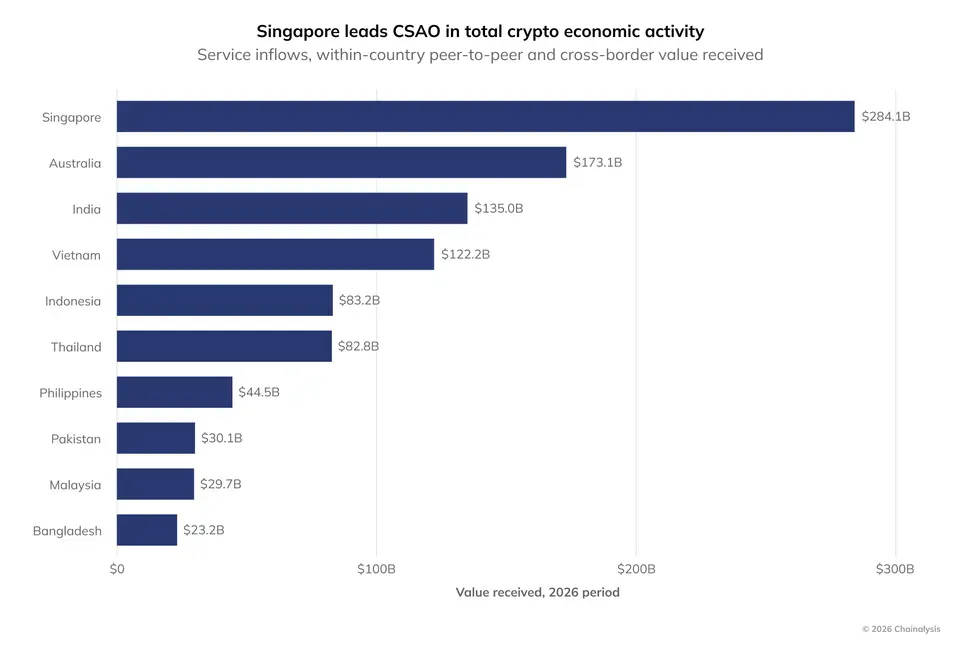
In stark contrast to China’s restrictive approach, Singapore continues to solidify its position as a burgeoning hub for digital asset activity in the Central and Southeast Asia and Oceania (CSAO) region. According to data compiled by Chainalysis, Singapore’s cryptocurrency economy experienced a remarkable surge of 55.4% over the year ending June 2026, reaching a valuation of $284 billion. This impressive growth stands in sharp relief against a broader regional contraction of 6.8% within the CSAO crypto economy during the same period.

The primary driver behind Singapore’s stellar performance was a significant uptick in institutional platform activity, which soared by 94% to $60 billion. This growth was largely concentrated among a select group of market makers, over-the-counter (OTC) trading firms, and institutional brokerages. Chainalysis noted that this institutional expansion in Singapore was characterized by high-volume transactions facilitated by existing platforms rather than the emergence of numerous new services. This suggests a maturation of the institutional crypto ecosystem in Singapore, with established players scaling their operations.
This trend positions Singapore as a critical financial nexus for digital assets in the CSAO, attracting significant institutional capital even as neighboring economies grapple with a downturn. The city-state’s regulatory framework, which has strived to balance innovation with robust oversight, appears to be a key factor in its success. While specific policy details are not elaborated upon in the original reporting, the sustained growth indicates an environment conducive to institutional participation, even amidst evolving global regulatory pressures.
South Korea: Weighing Market-Making Systems Amidst Volatility
South Korea’s Financial Services Commission (FSC) is reportedly considering the introduction of a market-making system for digital assets. This contemplation comes in the wake of a notable incident where a stablecoin pegged to the Japanese yen, JPYC, traded at a price four times its intended value on a major South Korean crypto exchange, Upbit. The event, which occurred on September 17th, highlighted potential liquidity challenges within the nation’s burgeoning crypto market.
The JPYC, a stablecoin designed to maintain a 1:1 peg with the Japanese yen, opened trading on Upbit at 12 Korean won per JPYC. Within an hour, its price surged to a peak of 37.6 Korean won, significantly exceeding its intended value. This price distortion was attributed to limited liquidity on the exchange, illustrating the impact of insufficient market depth on asset price stability.
In response to such volatility, Yoo Young-joon, director of digital finance policy at the FSC, stated that the commission would "also review the need to introduce systems such as market-making activities to increase the efficiency and stability of the digital asset landscape." Market makers play a crucial role in cryptocurrency markets by providing liquidity, ensuring that there are always buyers and sellers available, thereby reducing price volatility and facilitating smoother trading.
Currently, South Korea’s Virtual Asset User Protection Act does not offer exemptions for market-making activities from its anti-market manipulation provisions. This legal framework has effectively prevented market makers from operating freely and contributing to liquidity in the domestic crypto markets. The FSC’s reconsideration of this stance could signal a shift towards fostering a more mature and stable digital asset ecosystem.
Adding to the evolving digital asset landscape in South Korea, U.S.-based payments and infrastructure firm MoonPay has launched a South Korean subsidiary. The company intends to collaborate with local financial institutions on services including remittances, payments, settlements, and digital asset distribution. However, MoonPay is still awaiting the necessary regulatory approvals to fully commence its operations in the country. This move by MoonPay, coupled with the FSC’s potential embrace of market-making, suggests a growing interest in integrating digital assets into the mainstream financial system in South Korea.
Japan: Enhancing Crypto Usability with Binance Pay Integration
Japan is taking steps to integrate cryptocurrencies into everyday commerce through a new partnership involving Binance Pay and PayPay, a widely adopted cashless payment service in the country. Eligible overseas users visiting Japan will now be able to spend over 100 different cryptocurrencies at the vast majority of merchants that support PayPay. This initiative, launched on Wednesday, aims to enhance the convenience and utility of digital assets for tourists and international visitors.
The service operates through HIVEX, a payment interoperability framework that bridges overseas QR payment services with PayPay-compatible merchants. Binance Pay utilizes Tether USDt (USDT) as its backend settlement layer. HIVEX then facilitates settlement with PayPay, which in turn settles with merchants in Japanese yen. Binance has highlighted this as the first crypto payment service to gain access to PayPay merchants via HIVEX, emphasizing that merchants do not require separate opt-in procedures.
PayPay boasts an extensive network of acceptance points across Japan, encompassing major retail chains, smaller businesses, vending machines, taxis, and public transportation. The platform currently supports nine other overseas payment services through HIVEX, predominantly from China, Hong Kong, and Taiwan. This expansion by Binance Pay into the Japanese market, leveraging existing payment infrastructure, represents a significant stride towards making cryptocurrency a more practical payment option for a broader audience. The move is expected to boost crypto adoption among travelers and potentially spur further innovation in crypto payment solutions within Japan.
Hong Kong: Strengthening Regulatory Oversight and Introducing a New Stablecoin
Hong Kong’s financial regulators are enhancing their oversight of the digital asset sector by expanding financial reporting and audit cooperation with licensed crypto firms. The Securities and Futures Commission (SFC) and the Accounting and Financial Reporting Council (AFRC) have entered into a formal agreement to collaborate more closely on audit and assurance work. This memorandum of understanding (MOU) establishes a framework for information sharing, case referrals, mutual assistance, and coordinated inspections and investigations pertaining to licensed crypto firms. This move signifies Hong Kong’s commitment to maintaining high standards of financial integrity and investor protection within its rapidly evolving crypto market.
In parallel with these regulatory developments, HSBC is preparing for the phased rollout of its new Hong Kong dollar-backed stablecoin, named RedCoin. The initial phase of RedCoin’s deployment will focus on person-to-person (P2P) and merchant payments. Subsequently, the stablecoin is slated to expand its use cases into corporate and institutional applications. To mitigate risks and prevent potential scams, HSBC is also launching a comprehensive education campaign aimed at informing the public about the safe use of digital currencies and the potential pitfalls of fraudulent schemes. The introduction of RedCoin by a major global financial institution like HSBC underscores the growing institutional interest in stablecoins and their potential to bridge traditional finance with the digital asset economy. This initiative, coupled with the enhanced regulatory framework, positions Hong Kong as a significant player in the development of regulated digital currency ecosystems.
The developments across these key Asian financial centers highlight a diverse and dynamic global regulatory environment for cryptocurrencies. While China maintains a stringent, security-focused approach, Singapore continues to foster growth, South Korea grapples with stability, Japan seeks to integrate crypto into daily life, and Hong Kong strengthens its regulatory foundations while welcoming institutional innovation. These varying strategies will undoubtedly shape the future trajectory of digital asset adoption and regulation across the continent and beyond.

