
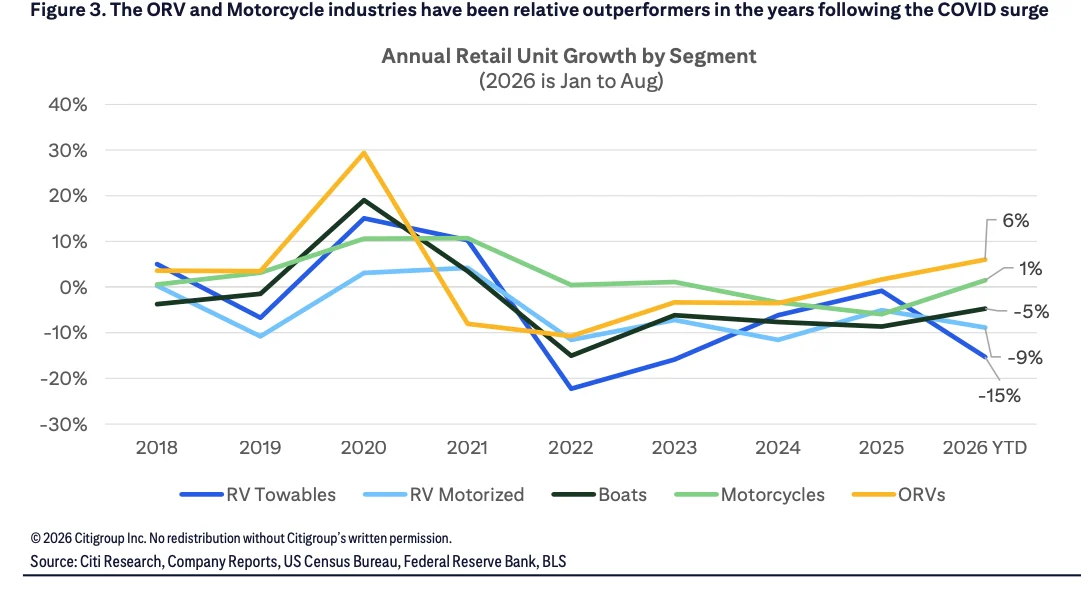
A comprehensive analysis by Citi has illuminated a significant divergence in the affordability landscape across the outdoor leisure vehicle market, challenging conventional investor wisdom that often groups recreational vehicles (RVs), boats, motorcycles, and off-road vehicles (ORVs) under a single macroeconomic umbrella. The detailed report reveals that while high prices and elevated financing costs continue to exert substantial pressure on the towable RV and boat sectors, motorcycles, off-road vehicles, and motorized RVs have, against the odds, become more accessible relative to consumer incomes.
The Shifting Sands of Discretionary Spending
For years, the recreational vehicle and marine industries have been closely watched indicators of consumer discretionary spending, often seen as bellwethers for the broader economic health of middle to upper-income households. The prevailing belief among investors has been that these segments would react uniformly to macroeconomic factors such as inflation, interest rate fluctuations, and income growth. However, Citi leisure analyst James Hardiman, in a recent note, meticulously dissected these categories, concluding that "these categories face very different affordability backdrops," a finding that necessitates a re-evaluation of market strategies and investment perspectives.
Hardiman’s research underscores a critical insight: affordability, rather than a generalized pullback in discretionary spending, is the primary force segmenting the winners from the losers in the outdoor leisure market. This nuanced perspective suggests that a blanket approach to understanding the health of this diverse sector is no longer sufficient.

Towable RVs and Boats: An Enduring Affordability Crisis
At the epicenter of the current affordability crisis are towable RVs and boats. These segments have witnessed a dramatic surge in monthly payments since 2019, far outstripping any corresponding growth in buyer income. According to Citi’s estimates, the monthly payment for a comparable new towable RV has skyrocketed by an astounding 67% above 2019 levels. Similarly, boat payments have seen a substantial increase of 54% over the same period.
This exponential rise in costs translates directly into a heavier burden on household budgets. A typical buyer household’s income now sees approximately 4.4% allocated to a new towable RV payment, a notable increase from roughly 3.5% in 2019. For boats, the situation is even more pronounced, with payments consuming 5.7% of buyer income, up from 4.9% in 2019.
The impact becomes even starker when considering discretionary income – the portion of income remaining after essential expenses. For towable RVs, the payment now consumes 26% more of a buyer’s discretionary income than it did in 2019, even after a slight improvement from a peak of 38% above 2019 earlier in 2024. Boats face a similar, albeit slightly less severe, challenge, with their payment burden standing 16% above 2019 levels relative to discretionary income, having peaked at approximately 25% above 2019 in 2024.
This significant increase in the cost of ownership has compelled a shift in consumer behavior. Buyers, faced with unaffordable price points and punitive financing rates, have resorted to "trading down." This means opting for smaller, less expensive, and lower-content units in an attempt to mitigate the financial strain. However, Hardiman’s analysis clearly indicates that this mix shift, while a natural response to market conditions, "has not solved the underlying affordability problem." The fundamental issue of high costs relative to income persists, suggesting a deeper structural challenge for these segments.

Chronology of Affordability Shifts (2019-Present)
The journey to the current market dynamics is rooted in a series of economic events:
- Pre-2019 Baseline: The period before 2019 serves as the affordability benchmark, characterized by stable interest rates and a relatively predictable growth in leisure spending.
- The Pandemic Boom (2020-2021): The onset of the COVID-19 pandemic spurred an unprecedented surge in demand for outdoor recreational activities and associated equipment. With travel restrictions in place and a newfound emphasis on socially distanced leisure, RVs, boats, and powersports vehicles experienced booming sales. This period saw increased pricing power for manufacturers and dealers.
- Inflationary Pressures and Supply Chain Disruptions (2021-2023): Post-pandemic, robust demand, coupled with global supply chain disruptions and rising raw material costs, fueled significant inflation. This pushed up the sticker prices of new vehicles.
- Rising Interest Rates (2022-Present): Central banks, in a bid to combat rampant inflation, aggressively hiked interest rates. For large, financed purchases like RVs and boats, which often involve longer loan terms, these higher rates translated directly into significantly larger monthly payments, exacerbating the affordability issue.
- Income Growth vs. Cost Increases (2019-Present): While incomes have generally risen since 2019, the rate of increase has been uneven across different consumer segments and, critically, has failed to keep pace with the dramatic increases in prices and financing costs for towable RVs and boats. Conversely, for motorcycles and ORVs, income growth has proven more robust relative to their payment increases.
Motorcycles and Off-Road Vehicles: A Surprising Tale of Enhanced Affordability
In stark contrast to the struggles of the RV and boat markets, the outlook for motorcycles and off-road vehicles (ORVs), such as Polaris RZRs, presents a much brighter picture. Hardiman’s analysis reveals that these categories have actually become more affordable relative to incomes, defying the general perception of a universal squeeze on discretionary spending.
While monthly payments for motorcycles and ORVs have indeed increased since 2019 – by 17% and 21% respectively – this growth has been more than offset by a corresponding, or even greater, increase in buyer income. This crucial differential has allowed these categories to maintain, and even improve, their affordability ratios.

Specifically, motorcycle payments now consume 4.0% of a typical buyer’s income, a reduction from 4.6% in 2019. Similarly, ORV payments have decreased their share of buyer income to 3.4% from 3.7% in 2019. When measured against discretionary income, motorcycles are now approximately 13% more affordable than in 2019, and ORVs are about 10% more affordable. This improved accessibility helps to explain the relative retail outperformance observed in these categories.
Motorized RVs also exhibit a degree of stability, with their affordability roughly unchanged from 2019 levels. This suggests that the higher price point and often more specialized buyer base for motorized RVs may make them less susceptible to the same affordability pressures affecting their towable counterparts.
Economic Underpinnings: Interest Rates, Inflation, and Income
The divergent affordability trends are rooted in the interplay of several key economic factors:
- Elevated Financing Costs: The Federal Reserve’s aggressive interest rate hikes, aimed at taming inflation, have significantly impacted the cost of borrowing. For large-ticket items like RVs and boats, which typically involve substantial loans over extended periods, even a few percentage points increase in interest rates can add hundreds of dollars to a monthly payment. This effect is somewhat mitigated for powersports vehicles, which generally have shorter loan terms, making them less sensitive to rate fluctuations.
- Inflationary Pressures: While headline inflation has shown signs of cooling, the cumulative effect of rising manufacturing costs, labor, and transportation expenses over the past few years has pushed up the base prices of all recreational vehicles. For towable RVs and boats, this baseline price increase, combined with higher financing costs, creates a double whammy for consumers.
- Uneven Income Growth: The critical differentiator identified by Citi is the disparity between income growth and the pace of price/financing increases across categories. While overall incomes have grown, the segments of the population purchasing motorcycles and ORVs appear to have experienced income growth that has either kept pace with or outstripped the rising costs of these specific vehicles. This suggests a potentially different demographic or income elasticity at play for these categories.
Industry Reactions and Consumer Adaptations (Inferred)

Based on Citi’s findings, several reactions and adaptations can be logically inferred across the industry:
- Towable RV and Boat Manufacturers: Companies heavily invested in these segments are likely facing continued pressure on sales volumes and profit margins. We might expect to see a focus on cost-cutting, increased incentives, and a greater emphasis on entry-level or value-oriented models. Innovation might shift towards more affordable technologies or modular designs to reduce overall unit costs. Supply chain management will be crucial to control input costs.
- Powersports Manufacturers (Motorcycles, ORVs): Manufacturers like Polaris (a prominent player in ORVs) and motorcycle brands are likely experiencing more stable or even growing demand. They might focus on maintaining competitive pricing, expanding their product lines, and leveraging their relative affordability advantage through targeted marketing campaigns. Their financial performance may show greater resilience compared to other leisure segments.
- Dealers and Retailers: Dealerships specializing in towable RVs and boats are probably navigating a challenging sales environment, potentially dealing with higher inventory levels and reduced foot traffic for new, larger units. Conversely, powersports dealers might be enjoying more robust sales and a healthier inventory turnover.
- Consumers: The report highlights a rational response from consumers in the towable RV and boat markets: trading down. This suggests a persistent desire for outdoor leisure, but a practical constraint on what they can afford. For motorcycles and ORVs, the improved affordability may attract new buyers or encourage upgrades, leading to sustained demand.
The 2027 Outlook: A Continued Affordability Squeeze
Looking ahead, Citi analyst Hardiman’s 2027 outlook on financing rates for outdoor leisure items offers little solace for those hoping for a significant easing of affordability pressures, particularly for towable RVs and boats.
Based on forward market expectations, prime borrowing rates are projected to potentially rise another 44 to 51 basis points by late 2027. Simultaneously, Hardiman assumes a general price increase of 2.5% across all categories.
Combined, these factors are expected to drive monthly payments 3% to 4% higher. Crucially, the impact of rising rates will be more pronounced for RVs and boats, contributing 2.5% to 3.0% of their payment increase, largely due to their longer loan terms. Powersports vehicles, with their shorter loan durations, are expected to see only about a 1% increase from rates.

While buyer income is assumed to grow by approximately 3.75% and the share of income available for discretionary spending is expected to remain near current levels, this projected income growth is unlikely to bridge the existing affordability gap. Hardiman concludes that affordability should remain "roughly flat overall, preserving rather than closing the current gap." This means towable RVs and boats will likely remain financially stretched for buyers, while motorcycles and ORVs are projected to retain their relative affordability advantage.
Broader Impact and Implications
The persistent affordability squeeze on towable RVs and boats is poised to continue impacting demand well into next year, potentially exerting downward pressure on the shares of manufacturers heavily concentrated in these segments. The market differentiation highlighted by Citi’s report carries significant implications for various stakeholders:
- Investment Decisions: Investors will need to apply a more granular approach when evaluating companies in the outdoor leisure sector, moving beyond generalized macroeconomic assumptions to assess specific segment exposure and affordability dynamics. Companies with a strong presence in powersports or motorized RVs may offer more resilience and growth potential.
- Industry Strategy: Manufacturers and retailers must adapt their strategies. For towable RVs and boats, this could mean focusing on innovative financing solutions, emphasizing the used market, or developing more accessible entry-level models. For powersports, the focus might be on leveraging existing affordability to expand market share and cater to a growing demographic of buyers.
- Consumer Trends: The ongoing affordability challenges could solidify a long-term shift in consumer preferences towards more accessible forms of outdoor recreation or towards smaller, more versatile leisure vehicles. It may also lead to a longer replacement cycle for larger, more expensive assets as consumers hold onto existing vehicles longer.
- Economic Indicators: The performance of these distinct leisure segments could serve as a more refined indicator of economic health, distinguishing between the resilience of different consumer income brackets and their capacity for various types of discretionary spending.
In conclusion, Citi’s analysis offers a critical and timely re-evaluation of the outdoor leisure market. It dismantles the long-held notion of a uniform response to macro factors, instead presenting a nuanced picture where affordability, driven by the intricate interplay of prices, financing costs, and income growth, dictates the fortunes of individual segments. As the market moves forward, this differential will likely shape investment strategies, manufacturing priorities, and consumer choices for the foreseeable future.

