

The traditional financial ecosystem is currently navigating a period of profound transition as the boundaries between daily banking and long-term wealth management continue to dissolve. For decades, community banks and credit unions have served as the bedrock of local economies, commanding high levels of consumer trust in core services such as savings accounts, mortgages, and personal loans. However, a persistent "leakage" has emerged in the customer lifecycle: when these same loyal members seek to transition from saving to investing, they frequently migrate their capital to external brokerage firms and digital-first fintech platforms. This trend has historically deprived smaller financial institutions of significant assets under management (AUM) and weakened the overall "stickiness" of their digital ecosystems.
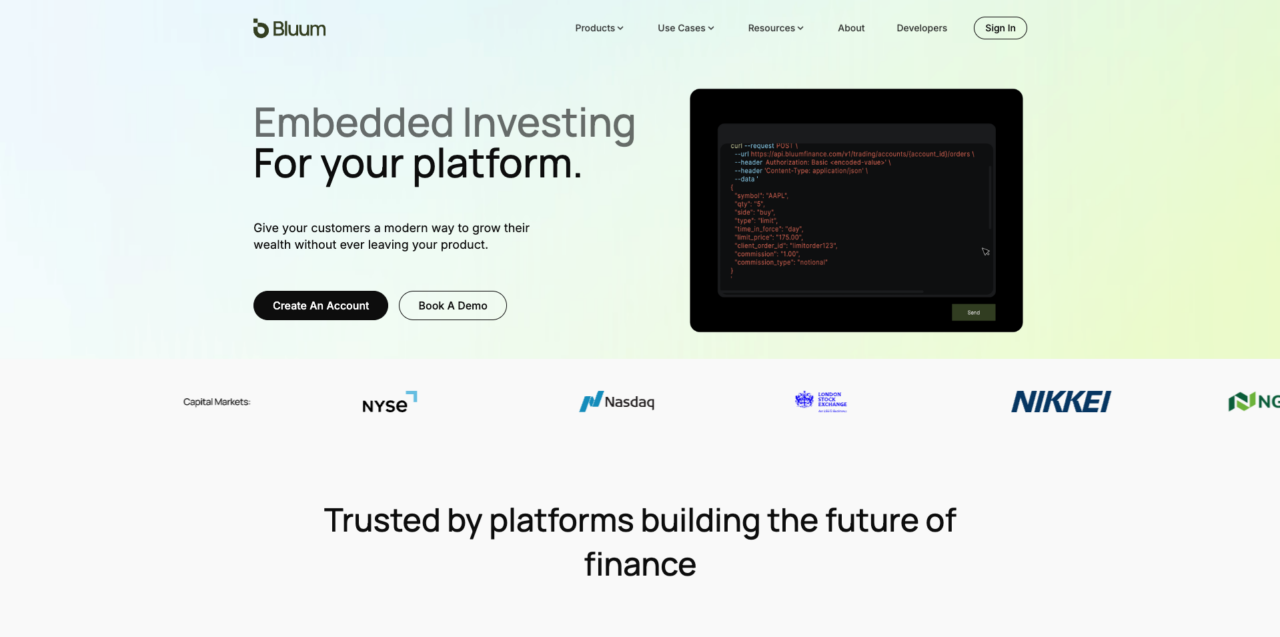
Recognizing this systemic gap, Los Angeles-based Bluum Finance has introduced a comprehensive solution designed to allow these institutions to reclaim their role as the primary financial hub for their members. Founded in 2025, Bluum Finance operates as an embedded wealth management and investing platform, providing the necessary infrastructure for banks and credit unions to offer sophisticated brokerage services directly within their existing mobile and web applications. By utilizing a unified API-driven approach, Bluum Finance aims to democratize access to wealth-building tools while ensuring that community-focused institutions remain competitive in an increasingly crowded digital landscape.
The Strategic Emergence of Bluum Finance
The inception of Bluum Finance comes at a time when the "Great Wealth Transfer" is beginning to reshape the financial industry. Estimates suggest that over $68 trillion will pass from older generations to Millennials and Gen Z over the next two decades. These younger cohorts demonstrate a marked preference for integrated, all-in-one financial experiences. For a community bank or credit union to survive this generational shift, the ability to offer more than just a checking account is no longer a luxury—it is a requirement for survival.
Bluum Finance was co-founded by CEO Ope Sonusi and COO Ariel Leachman, two industry veterans who identified a recurring roadblock for smaller institutions. While many banks desired to offer investment products, the technical, regulatory, and operational hurdles of establishing a brokerage arm were often insurmountable. Sonusi brought a wealth of experience in building fintech platforms for both domestic and international markets, while Leachman’s background in investment banking and private equity provided the necessary capital markets expertise. Together, they developed a platform that abstracts the complexity of brokerage operations, allowing their partners to launch investment services with minimal friction.
FinovateSpring 2026: A Catalyst for Growth
The company’s trajectory gained significant momentum following its debut at FinovateSpring 2026 in San Diego. Finovate is widely regarded as the premier showcase for financial technology innovation, attracting thousands of executives, venture capitalists, and industry analysts. For Bluum Finance, the event served as a critical platform to demonstrate the capabilities of its AI-powered advisory infrastructure.
During the conference, the Bluum leadership team emphasized that their value proposition extends beyond mere trade execution. While several "embedded finance" players exist in the market, many are limited to simple stock trading. Bluum distinguishes itself by offering a holistic suite of services, including multi-asset and multi-market brokerage, custody services, and automated reporting. The inclusion of AI-powered advisory tools allows even the smallest credit unions to provide the kind of personalized portfolio guidance that was previously reserved for high-net-worth individuals at major private banks.
Industry reactions following the Finovate demo highlighted a growing appetite for "Fintech 2.0"—a phase where the focus shifts from standalone apps to the deep integration of complex financial services into trusted, existing brands. Analysts noted that Bluum’s ability to handle the "back-office" heavy lifting—compliance, clearing, and settlement—is what makes the platform particularly attractive to risk-averse community bankers.
Technical Infrastructure and the Power of Unified APIs
At the core of Bluum Finance’s offering is a sophisticated API that connects traditional banking cores to the global capital markets. This "wealth-management-as-a-service" model allows a bank to flip a digital switch and offer its members access to equities, exchange-traded funds (ETFs), and eventually, alternative assets.
The technical architecture is built to be "provider-agnostic," meaning it can integrate with various core banking systems (such as those provided by Fiserv, Jack Henry, or FIS) without requiring a total overhaul of the bank’s existing digital infrastructure. This is a critical factor for community financial institutions, which often operate on legacy systems and have limited IT budgets. By providing a single integration point for brokerage, custody, and reporting, Bluum reduces the "operational lift" that has historically kept small players out of the wealth management game.

Furthermore, the platform’s AI-driven advisory engine utilizes machine learning to analyze a user’s spending patterns, risk tolerance, and long-term goals. This allows the financial institution to offer proactive investment suggestions. For example, if a credit union member reaches a certain savings threshold, the platform can automatically suggest moving a portion of those funds into a diversified ETF portfolio managed through the Bluum infrastructure.
Addressing the Cross-Border Investing Challenge
One of the most ambitious aspects of the Bluum Finance roadmap is the simplification of cross-border investing. Ariel Leachman has frequently drawn parallels between the current state of global investing and the historical state of global payments. A decade ago, sending money across borders was a slow, expensive, and opaque process. Today, thanks to innovations in fintech, cross-border payments are nearly instantaneous and highly transparent.
Investing, however, remains siloed by national borders and complex regulatory frameworks. For a retail investor in an emerging market to buy US-listed stocks, or for a US investor to access frontier market opportunities, the barriers remain high. Bluum Finance is positioning itself to bridge this gap by coordinating international brokers, local custody providers, and varying regulatory requirements through its centralized platform. The goal is to make purchasing a fractional share of a company in a foreign market as seamless as making a local digital payment.
This focus on frontier and emerging markets is not merely a philanthropic endeavor; it is a calculated business strategy. As global wealth becomes more decentralized, the demand for access to stable, high-growth markets is increasing. By facilitating these connections, Bluum is opening up new revenue streams for its partner institutions through foreign exchange fees and international trade commissions.
Strategic Implications for Community Financial Institutions
The primary beneficiaries of Bluum’s technology are the 4,600+ credit unions and thousands of community banks across the United States. These institutions often boast higher customer satisfaction ratings than "Big Four" banks, yet they struggle with "silent churn"—the process where a customer keeps their account open but moves their most profitable activity (investing, wealth management, insurance) elsewhere.

By integrating Bluum’s wealth management suite, these institutions can:
- Increase Deposits and AUM: Keeping investment capital within the institution’s ecosystem allows for better liquidity management and higher overall assets.
- Diversify Revenue: Transaction fees and management fees from investment products provide a non-interest income stream that is crucial in varying interest rate environments.
- Enhance Member Retention: The more financial needs an institution meets, the less likely a member is to switch to a competitor.
- Level the Playing Field: Small institutions can now offer a digital experience that rivals that of Robinhood, Charles Schwab, or JPMorgan Chase.
Future Outlook: 2026 and Beyond
As Bluum Finance moves through the remainder of 2026 and into 2027, the company has signaled an aggressive expansion of its asset classes. While stocks and ETFs remain the foundation, there is significant internal development focused on private markets and digital assets. Private equity and venture capital, once the exclusive domain of institutional investors, are increasingly being "tokenized" or broken into smaller units for retail consumption. Bluum intends to be the gateway for credit union members to access these sophisticated alternative investments.
The company is also doubling down on its partnership model. Rather than competing for the end consumer, Bluum remains committed to its B2B2C (business-to-business-to-consumer) strategy. This approach leverages the existing trust and distribution networks of established financial institutions, allowing Bluum to scale rapidly without the massive customer acquisition costs that have plagued many direct-to-consumer fintechs.
In a broader economic context, the rise of platforms like Bluum Finance represents a shift toward the democratization of sophisticated financial tools. By removing the barriers of cost and complexity, Bluum is enabling a future where a resident in a rural community, banking with a local credit union, has the same access to global wealth-building opportunities as an investor in a major financial hub. As the industry watches the ongoing rollout of these embedded services, Bluum Finance stands as a prominent example of how technology can be used to fortify, rather than replace, the traditional community banking model.

