

The financial technology sector has entered a mature phase where the mere development of a novel digital tool is no longer sufficient to guarantee market success or regulatory approval. As the industry prepares for FinovateSpring 2026 in San Diego, the focus has shifted from "what" is being built to "how" it is being scaled, governed, and secured. The upcoming conference highlights a critical reality in modern banking: the success of a product launch is increasingly dependent on the infrastructure surrounding it, including compliance frameworks, consumer testing methodologies, and automated security remediation.
While the initial development phase often garners the most internal excitement, the operationalization of financial products remains the primary hurdle for traditional institutions and nimble fintechs alike. Launching a product in the current regulatory environment requires a multifaceted approach that encompasses governance, marketing, social engagement, vulnerability management, and iterative consumer feedback loops. At the San Diego event, five specific companies—PentEdge, Intention.ly, PwC, Rezliant, and Kato—will demonstrate how they are addressing these "Day 2" challenges, providing the essential bridge between a live codebase and a sustainable, compliant market presence.
The Evolution of the Fintech Product Lifecycle
The narrative of fintech has evolved significantly over the past decade. If the early 2020s were defined by rapid digital transformation and the "unbundling" of the bank, the mid-2020s are defined by the "rebundling" of governance and the industrialization of product launches. Financial institutions are no longer just competing on features; they are competing on the speed of trust and the efficiency of their back-office operations.

The 2026 FinovateSpring event arrives at a time when regulatory bodies, including the Office of the Comptroller of the Currency (OCC) and the Federal Deposit Insurance Corporation (FDIC), have intensified their scrutiny of third-party risk and artificial intelligence (AI) implementation. Consequently, the tools showcased this year reflect a broader industry trend toward "RegTech-integrated development," where compliance is not an afterthought but a core component of the product’s DNA.
PentEdge: Addressing the AI Governance Gap for Community Institutions
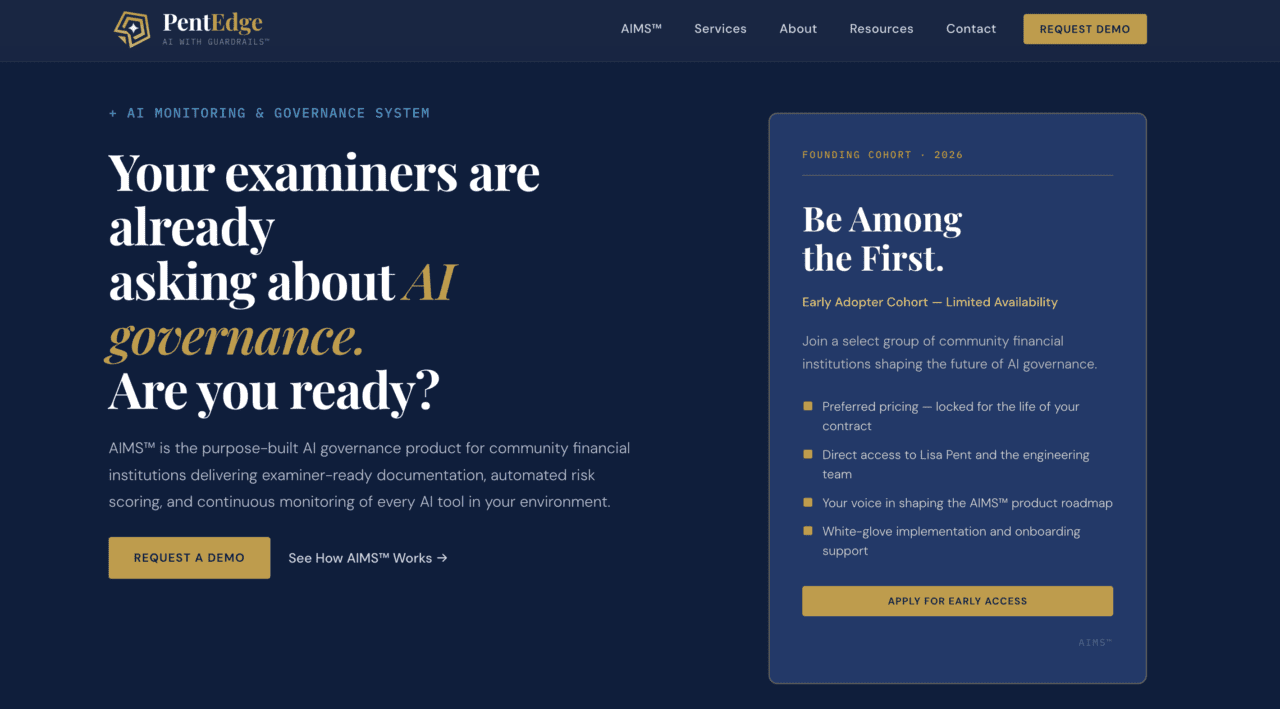
Founded in 2025 and headquartered in North Creek, New York, PentEdge has positioned itself as a critical ally for community banks and credit unions. These institutions, typically managing assets between $500 million and $100 billion, often lack the massive internal compliance departments found at global Tier-1 banks but are subject to the same rigorous federal AI risk guidance.
The company’s flagship platform, AIMS (AI Management and Scoring), provides an examiner-ready governance framework. In an era where AI exposure is a top-tier concern for auditors, PentEdge offers a real-time scoring dashboard that visualizes AI risk across an entire portfolio. By providing pre-built vendor AI risk profiles and generating audit-ready PDF reports, PentEdge allows smaller institutions to adopt innovative AI tools without the fear of regulatory backlash. This capability is essential for maintaining the competitive edge of community banks against larger rivals who have more resources to dedicate to manual compliance checks.
Intention.ly: Accelerating Brand Differentiation in a Crowded Market
In the wealth management and advisory space, the challenge is often less about the technology and more about the articulation of value. Intention.ly, established in 2021 in King of Prussia, Pennsylvania, addresses the "marketing execution gap" with its Advisor Brand Builder (ABB). The platform enables firms to construct a differentiated brand identity, a functional website, and a content engine within days rather than months.
As the advisory market becomes increasingly saturated, the ability to attract ideal clients through targeted, professional branding has become a survival necessity. Intention.ly’s model—offering everything from diagnostic assessments to fractional CMO and COO services—reflects the growing demand for "Marketing-as-a-Service" (MaaS) in fintech. This allows firms to scale their outreach efforts without the overhead of a full-time, in-house marketing department, ensuring that the product’s market entry is as polished as its technical specifications.
PwC: Leveraging Synthetic Customers for Risk-Free Testing
PwC, a global leader in professional services since 1898, continues to innovate with its "Customer Link" platform. One of the most significant risks in product launching is the "cold start" problem—the inability to predict how real customers will react to new pricing or features before they are live. Customer Link solves this by offering a suite of "synthetic customers."
These AI-driven personas allow banks to simulate product interactions, test pricing elasticity, and refine user experiences in a controlled environment. By converting survey data and crosstabs into actionable growth strategies, PwC provides banks with quantitative data that was previously only available through expensive and time-consuming focus groups. This use of synthetic data is particularly relevant as privacy regulations make it increasingly difficult to use actual consumer data for testing purposes.
Rezliant: Automating Security in the Age of Constant Threats
Security remains the most significant existential threat to any fintech product. Rezliant, founded in 2023 in Mesa, Arizona, focuses on the technical hygiene of product launches. Its Maestro Pulse tool is designed to help payment providers and small financial institutions automatically identify and fix vulnerabilities within their codebases, API integrations, and Personally Identifiable Information (PII) data flows.

Maestro Pulse distinguishes itself by providing contextualized triage. Rather than merely flagging thousands of potential issues, the platform prioritizes critical flaws and offers "two-click fixes" directly from email notifications. In the high-stakes world of fintech, where a single API vulnerability can lead to catastrophic data breaches, Rezliant’s focus on automated remediation allows developers to focus on building features rather than constantly playing "whack-a-mole" with security patches.
Kato: Optimizing Post-Launch Servicing and Recovery
Finally, the San Francisco-based startup Kato, founded in 2024, addresses the operational tail of the product lifecycle: loan servicing and recovery. For lenders, the cost of servicing can quickly erode the margins of a new product. Kato utilizes compliance-first automation to reduce servicing costs by up to 80% while simultaneously increasing recovery rates by approximately 1%.
By automating routine interactions and compliance checks, Kato frees human agents to focus on high-value, complex tasks. This shift not only improves the bottom line for lenders but also enhances the customer experience by providing faster, more consistent responses. In the context of a product launch, Kato ensures that the "follow-up" phase is as efficient as the initial acquisition phase.
Chronology of the 2026 San Diego Event
The FinovateSpring 2026 conference is structured to follow the logical progression of a product’s lifecycle. The event kicks off with a series of high-intensity demo days where the aforementioned companies will present their solutions to a room of venture capitalists, bank executives, and industry analysts.

- Day 1: The Innovation Showcase. Focuses on the "Build" phase, highlighting new tools and AI-driven features.
- Day 2: The Governance and Security Summit. This is where PentEdge and Rezliant will lead discussions on navigating the regulatory landscape of 2026.
- Day 3: Market Scaling and Consumer Insights. Featuring Intention.ly and PwC, this day focuses on the "Go-to-Market" strategy and the use of data to drive adoption.
- Day 4: Operational Excellence. Kato and other servicing-focused firms demonstrate how to maintain and optimize products post-launch.
Supporting Data: The High Cost of Failed Execution
The emphasis on execution-support platforms is backed by sobering industry data. According to a 2025 study on financial innovation, approximately 70% of new digital banking products fail to meet their first-year ROI targets. The primary reasons cited are not lack of technical functionality, but rather "regulatory delays" (34%), "poor market fit" (28%), and "security concerns" (22%).
Furthermore, the cost of a data breach for a financial institution in 2025 averaged $6.2 million, a figure that highlights the ROI of tools like Rezliant’s Maestro Pulse. In the community banking sector, the time spent on manual compliance reporting has increased by 45% over the last three years, making the automation provided by PentEdge a matter of operational necessity rather than a luxury.
Industry Implications and Future Outlook
The shift toward specialized support platforms indicates a maturing ecosystem. Financial institutions are moving away from "monolithic" vendors in favor of a "best-of-breed" stack that allows them to plug in specific solutions for governance, marketing, and security.
Industry analysts suggest that this trend will lead to a more resilient financial sector. "We are seeing the end of the era of ‘move fast and break things’ in banking," says one senior analyst expected to attend FinovateSpring. "The new mantra is ‘move fast and govern well.’ The companies presenting in San Diego are the ones providing the guardrails that make that speed possible."

The broader impact of these technologies is the democratization of advanced banking capabilities. By lowering the cost of compliance and security, these platforms enable mid-sized and community banks to offer products that were previously the exclusive domain of global giants. This increased competition is expected to benefit consumers through better pricing, more robust security, and more personalized financial tools.
As FinovateSpring 2026 approaches, the message to the industry is clear: the hard work of innovation only begins after the code is written. Success in the next era of fintech will be defined by those who can master the complexities of the launch, the rigors of the audit, and the nuances of the customer experience. The five companies highlighted in San Diego are not just building tools; they are building the infrastructure of 21st-century finance.

