
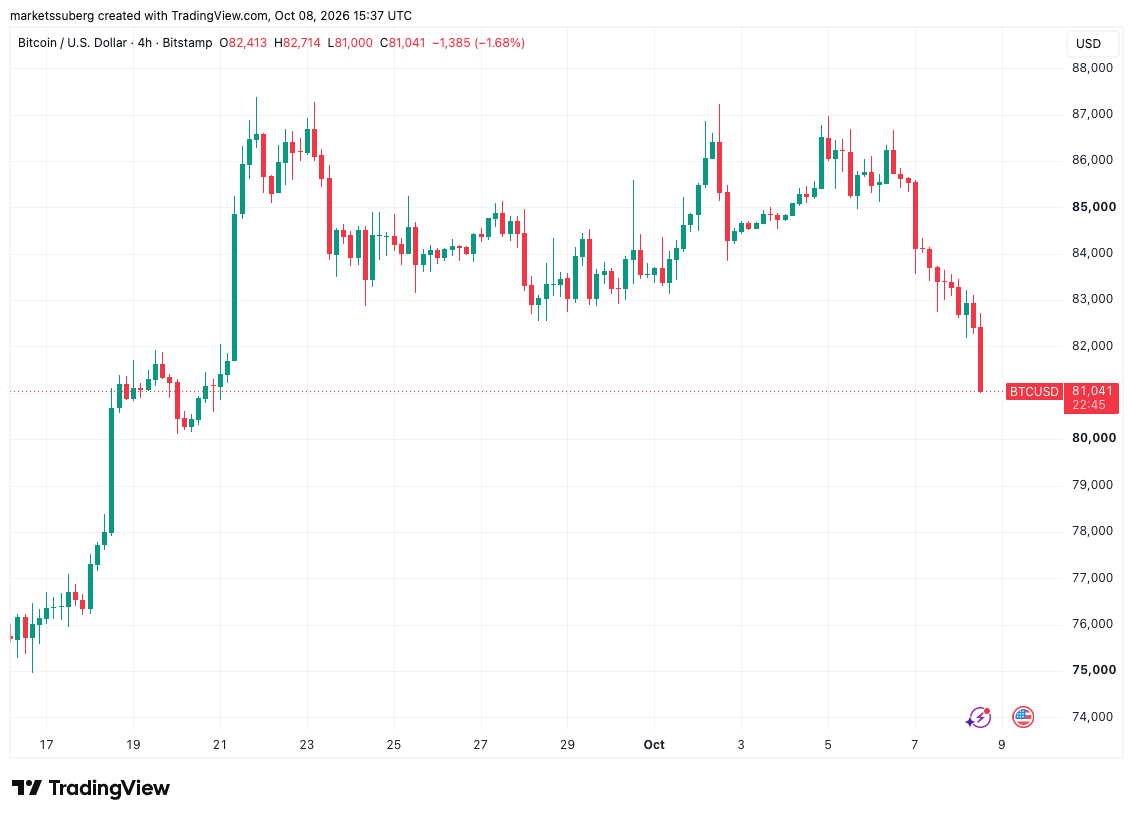
The global financial markets experienced significant volatility on Thursday, with Bitcoin (BTC) facing a critical test at its $82,500 support level following the opening of Wall Street. This downturn coincided with a sharp ascent in oil prices, fueled by growing concerns over potential new military actions between the United States and Iran. Data from TradingView revealed that Bitcoin’s trading pair against the US dollar (BTC/USD) plummeted to $81,000 on the Bitstamp exchange, marking its lowest point since September 21st.
Oil Prices Spike on Renewed US-Iran Military Concerns
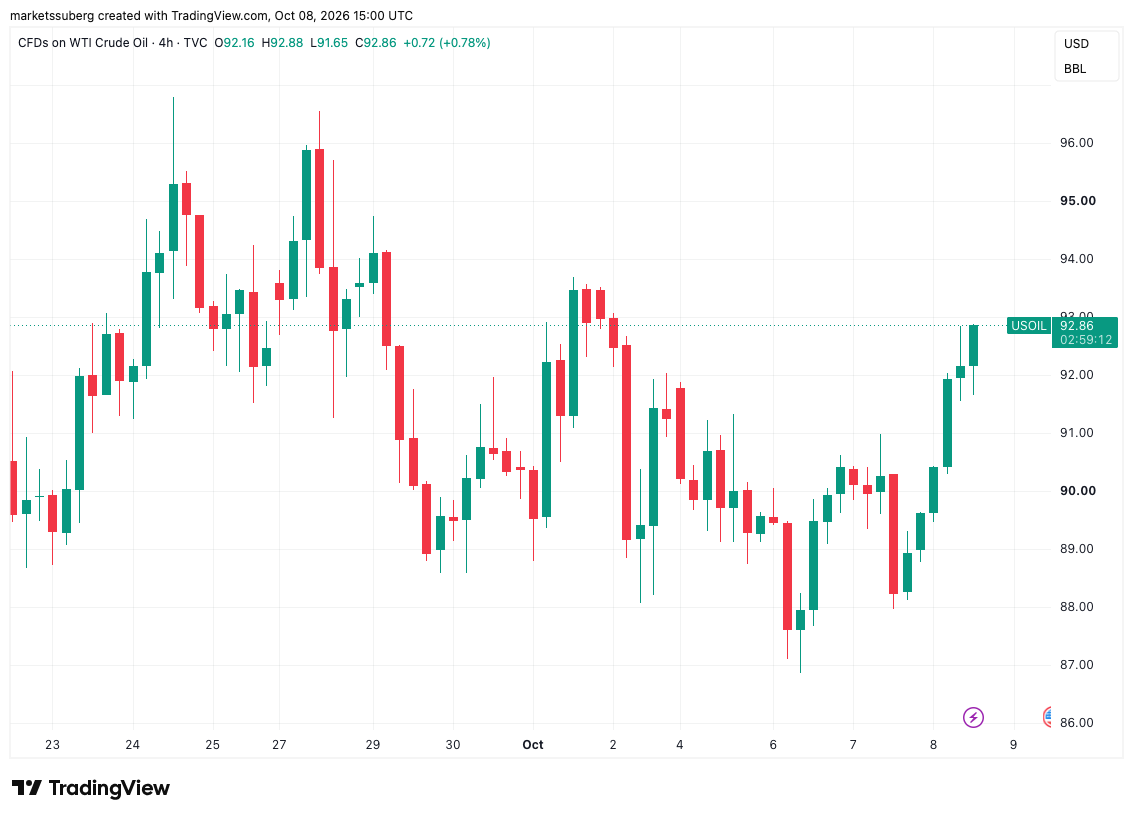
The geopolitical landscape took a dramatic turn as reports emerged suggesting the United States was preparing for potential new military strikes against Iran. Citing a Pentagon official and a source with direct knowledge of the matter, NBC News reported on these developing plans. This news sent shockwaves through the energy markets, propelling crude oil prices to new highs. West Texas Intermediate (WTI) crude oil surged to $93.20 per barrel, its highest level since October 2nd, while Brent crude reached an impressive $105.88 per barrel. These price increases underscore the significant impact that regional instability in the Middle East has on global energy supplies.
The tension between the US and Iran has been a recurring theme in international relations, with periods of heightened rhetoric and potential military engagement. The current situation appears to be exacerbated by the upcoming midterm elections in the United States, a factor that often influences foreign policy decisions and military posturing. Historically, periods of geopolitical uncertainty, particularly in oil-producing regions, have led to significant price volatility in energy commodities, which in turn can ripple through the global economy, impacting inflation and investment sentiment.
Presidential Statements and Market Nerves
Adding a layer of complexity to the situation, U.S. President Donald Trump, speaking at a rally in San Antonio, Texas, made remarks regarding potential progress with Iran on a peace deal. He acknowledged that Middle East envoy Steve Witkoff was engaged in discussions, while also expressing a degree of personal detachment from a diplomatic resolution. "I think the deal isn’t really something that I want to do, but they’re willing to offer us anything to stop," President Trump was quoted as saying by The Independent, suggesting an expectation of an imminent end to the conflict.
These statements, however, did not immediately quell market anxieties. Instead, they contributed to a broader sense of uncertainty, as the market grappled with conflicting signals of potential military escalation and diplomatic overtures. The delicate balance between these opposing forces created an environment of heightened nervousness among investors.
Bond Yields React to Inflationary Pressures and Fed Policy
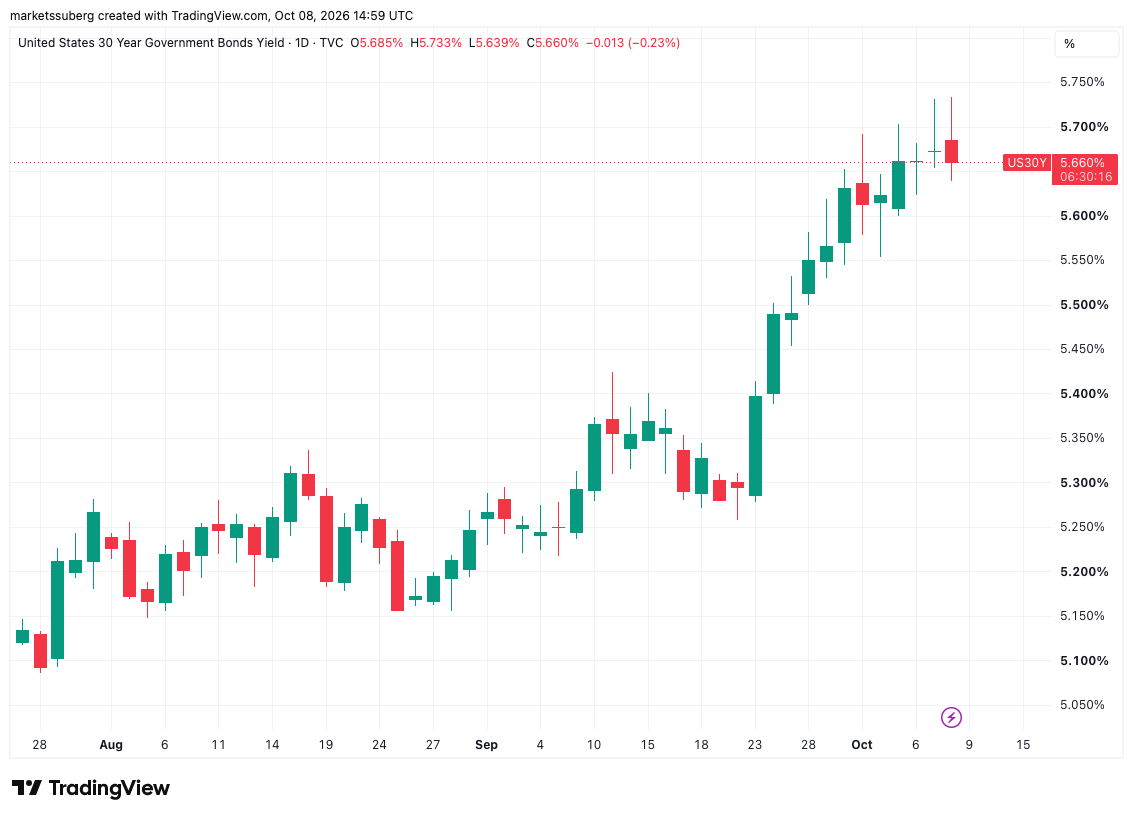
The financial markets also saw significant movement in the bond market. The yield on the U.S. 30-year bond reached a new 24-year high of 5.73% during the trading session, before slightly retreating to 5.65%. This surge in bond yields was driven by persistent concerns about the impact of the escalating geopolitical tensions on fuel prices and, consequently, on inflation. Higher oil prices typically translate into increased transportation costs and broader inflationary pressures, prompting investors to demand higher yields on long-term debt instruments to compensate for the erosion of purchasing power.
Adding to the pressure on bond yields were comments from Federal Reserve Governor Christopher Waller. Speaking at a Central Bank of Turkey forum in Istanbul, Waller indicated that further interest-rate hikes might be necessary to effectively combat inflation and steer it back towards the Federal Reserve’s 2 percent target. "If the economic data continue to come in as expected, I anticipate additional hikes to support a timelier return of inflation to our 2 percent goal. But there is some flexibility about when those hikes will occur," Waller stated. He further elaborated that these hikes "do not need to come at consecutive meetings, but they should be in place in an acceptable period of time."
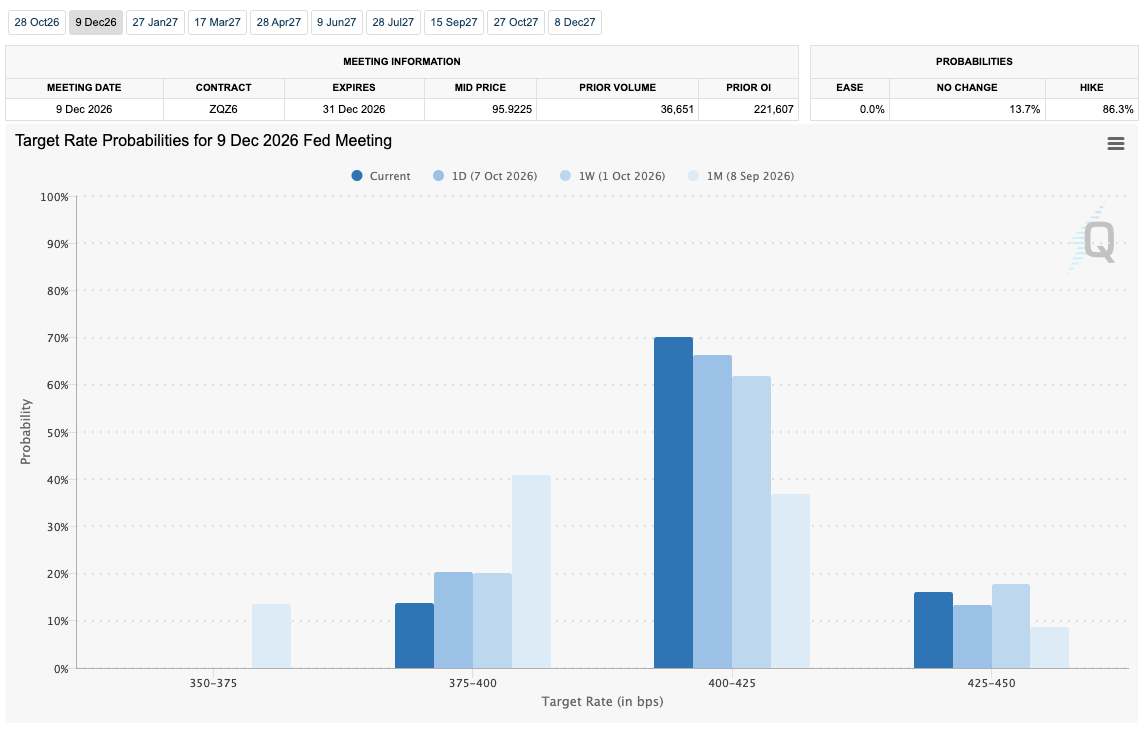
These remarks from a key Fed official significantly influenced market expectations regarding future monetary policy. The CME Group’s FedWatch Tool, which tracks market probabilities for Federal Reserve interest rate changes, showed an increasing likelihood of a 0.25% rate hike at the Fed’s December meeting. By Thursday, the odds of such an increase had surpassed 70%. Meanwhile, consensus for the October meeting continued to favor a pause in rate hikes, maintaining the current range of 3.75% to 4%. The prospect of further rate increases, especially in an environment of already elevated inflation and geopolitical uncertainty, tends to dampen investor appetite for riskier assets like cryptocurrencies.
Bitcoin’s Critical Support Level Under Threat
Against this backdrop of geopolitical and macroeconomic pressures, Bitcoin’s price action became a focal point for traders and analysts. The cryptocurrency was teetering on the edge of its crucial $82,500 support level, a price point that has demonstrated significant importance in its recent market trajectory. Previously, this level had been instrumental in Bitcoin’s broader rebound from multi-year lows observed near $57,000. The significance of the $82,500 mark was further highlighted by its resemblance to key price action observed at the conclusion of the 2022 bear market.
Trader and analyst Rekt Capital, in an updated analysis shared on X (formerly Twitter), emphasized the critical nature of this support level. "Bitcoin is still in a transitional phase and at a critical technical juncture. ~$82,500 is the deciding price point when it comes to where Bitcoin builds out its next market structure," Rekt Capital wrote, underscoring the potential for a decisive shift in Bitcoin’s price trend depending on its ability to hold this level.
The breach of the $82,000 mark by Bitcoin not only impacted its own price but also exacerbated cross-crypto long liquidations. Data from CoinGlass indicated that these liquidations were approximately $430 million at the time of writing, reflecting a wave of leveraged positions being forcibly closed as the price declined. Liquidations occur when a trader’s margin runs out, forcing their position to be sold off to cover potential losses. A sharp price drop often triggers a cascade of liquidations, further accelerating the downward price movement in a feedback loop.
Broader Market Implications and Investor Sentiment
The interplay between geopolitical events, energy markets, central bank policy, and cryptocurrency prices highlights the interconnectedness of global financial systems. The escalating tensions in the Middle East, coupled with the persistent threat of inflation and the Federal Reserve’s tightening monetary policy, create a complex and uncertain environment for investors.
For Bitcoin, the $82,500 support level represents more than just a technical indicator; it is a psychological threshold that, if decisively broken, could signal a deeper correction. The cryptocurrency’s performance in the coming days will likely be heavily influenced by developments in the US-Iran situation and any further signals from the Federal Reserve. Investors will be closely watching for any signs of de-escalation in the Middle East or a more dovish stance from the Fed to gauge the potential for a recovery.
Conversely, a sustained increase in oil prices due to prolonged conflict could further fuel inflation, potentially leading to more aggressive interest rate hikes by the Federal Reserve. This scenario would likely exert additional downward pressure on risk assets, including Bitcoin, as investors shift towards safer havens.
The market’s reaction to President Trump’s statements also demonstrates the sensitivity of financial assets to political rhetoric, especially concerning major geopolitical flashpoints. The lack of immediate clarity or definitive action following his remarks suggests that markets are prioritizing tangible developments and concrete policy decisions over pronouncements.
The current market dynamics underscore a period of elevated risk aversion. Investors are being forced to navigate a landscape fraught with uncertainty, where traditional safe-haven assets like U.S. Treasury bonds are themselves experiencing volatility due to inflation concerns. In such an environment, cryptocurrencies, often perceived as riskier assets, face significant headwinds. The ability of Bitcoin to hold its key support levels will be a crucial indicator of investor confidence and the broader market’s resilience in the face of these multifaceted challenges.
This article is produced in accordance with Cointelegraph’s Editorial Policy and is intended for informational purposes only. It does not constitute investment advice or recommendations. All investments and trades carry risk; readers are encouraged to conduct independent research.

