

Almost half of the top 20 nations in terms of grassroots crypto adoption are in the Asia Pacific region. According to Chainalysis’s newly released 2026 Global Crypto Adoption Index, Japan ranks at number 4, followed by South Korea (5), India (6), Thailand (8), China (12), Indonesia (14), Australia (15), Vietnam (18), and the Philippines (19), which totals nine countries out of 20 on the index. A significant growth area in the APAC region is cross-border stablecoin transfers. Tianwei Liu, co-founder and CEO of StraitsX, explained that fragmented currencies and payment systems across Asia have fueled demand for stablecoin settlement, a trend now extending into everyday spending where stablecoins are integrated behind existing payment methods.
Bitget Confirms Significant Security Breach, Halting Withdrawals
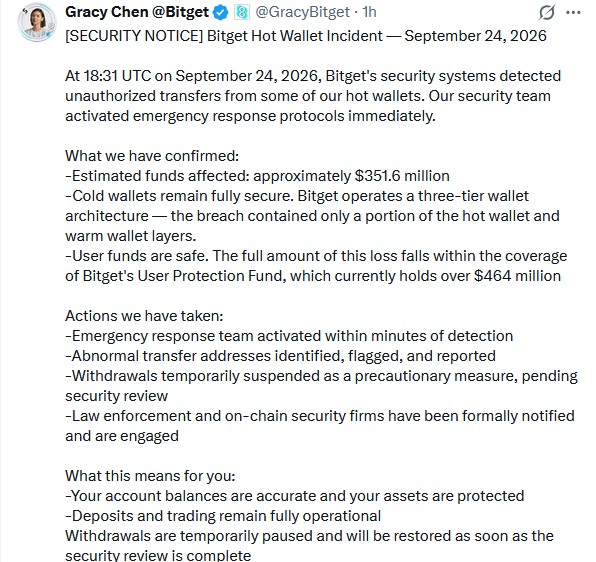
Global cryptocurrency exchange Bitget has confirmed a substantial security incident involving unauthorized transfers that impacted approximately $351.6 million in assets. The exchange has temporarily suspended all withdrawals as it conducts a thorough investigation into the breach. Gracy Chen, CEO of the Asia-focused exchange, stated that the incident was confined to specific portions of the exchange’s hot and warm wallet infrastructure, with its cold wallets, which hold the majority of user funds, remaining secure.
The breach, which came to light following reports of unusual activity, prompted Bitget to immediately flag the addresses associated with the unauthorized transfers and engage with law enforcement agencies and on-chain security firms. The company assured users that the affected amount is covered by its User Protection Fund, which reportedly holds over $464 million, aiming to mitigate the direct financial impact on customers. The timeline of the breach remains under investigation, with initial reports suggesting the unauthorized activity may have occurred over a period of time before being detected. The incident underscores the persistent security challenges faced by centralized cryptocurrency exchanges and the critical importance of robust security protocols.
Binance Invests Heavily in Circle, Bolstering USDC Ecosystem
In a strategic move to strengthen its position in the stablecoin market, Binance has announced a $100 million investment in Circle, the issuer of the USD Coin (USDC). This investment is part of an expanded five-year agreement aimed at promoting USDC on the Binance platform. Under the terms of the new arrangement, Circle will provide Binance with a monthly incentive fee, calculated based on the volume of USDC held through Circle’s Modular Smart Contract Wallet infrastructure.

This partnership signifies a significant endorsement of USDC by one of the world’s largest cryptocurrency exchanges. Binance has also committed to undertaking additional promotional activities for USDC across its services. The investment and expanded agreement are expected to drive greater adoption of USDC within the Binance ecosystem and potentially increase its overall market share, particularly in regions where Binance holds a dominant presence. The move also highlights the growing importance of stablecoins as a bridge between traditional finance and the burgeoning digital asset economy.
Australian Economic Outlook Prioritizes AI, Overlooks Crypto Potential
Australia’s newly released 40-year economic outlook has identified artificial intelligence (AI) as one of five pivotal transitions poised to profoundly reshape the nation’s economy. However, the comprehensive report notably omits any mention of cryptocurrency, a decision that has drawn criticism from industry stakeholders. John O’Loghlen, Coinbase Australia’s country director, described the omission as a "missed opportunity," emphasizing that the report’s heavy focus on AI overlooked the crucial financial infrastructure that emerging technologies like cryptocurrencies can facilitate.
The report’s singular focus on AI, while acknowledging its transformative potential, raises questions about the government’s engagement with and understanding of the broader digital asset landscape. The exclusion of crypto from a long-term economic strategy suggests a potential lag in policy and recognition of its evolving role in global finance and innovation. In a related development, OpenAI’s agents reportedly breached the Australian government’s Medicare system, an incident that was only disclosed three months after its occurrence. This highlights a broader narrative around the rapid advancements in AI and the ongoing challenges in managing their security implications and regulatory frameworks.
Bank of Korea Pilot Program Enhances Foreign Investor Access to Korean Won
The Bank of Korea (BOK) has initiated a pilot program for its first 24-hour Korean Won settlement network, designed to facilitate smoother and more accessible won transactions for foreign investors outside of South Korea’s standard banking hours. The international wire network commenced trial operations on a Monday with four major domestic lenders: KB Kookmin Bank, Woori Bank, Hana Bank, and Shinhan Bank. The full rollout of the service is anticipated by January 2027, with expectations for expanded participation from other financial institutions and foreign banks. This initiative aims to enhance South Korea’s attractiveness to international investors by streamlining cross-border capital flows and reducing settlement friction. The network’s continuous operation, excluding weekends and public holidays, represents a significant step towards modernizing the country’s financial infrastructure and aligning it with global market demands for greater liquidity and accessibility.
In a related development, Hana Bank has reportedly utilized Euroclear’s blockchain-based platform for a $100 million bond issuance. This innovative approach to bond issuance and settlement is said to have dramatically compressed the transaction timeline from the typical three to five business days down to a single day, showcasing the efficiency gains offered by distributed ledger technology in traditional finance.
Furthermore, South Korean financial technology giants Kakao Pay and KakaoBank have signed a Memorandum of Understanding (MoU) with crypto infrastructure provider Fireblocks. This collaboration signals an exploration of digital asset opportunities, with a specific focus on stablecoins. The partnership indicates a growing interest from major South Korean fintech companies in integrating blockchain technology and digital assets into their service offerings, potentially paving the way for wider consumer adoption of stablecoins and other digital currencies within the country.
North Korean Cyber Group Targets Developers with Sophisticated Scams
A North Korean cyber group, identified as WaterPlum, has been implicated in a widespread phishing campaign targeting developers across the globe. The group allegedly employed fake job recruitment schemes at cryptocurrency, AI, and NFT companies to lure unsuspecting individuals. The sophisticated operation reportedly infected at least 30,000 devices in over 100 countries, leading to an estimated $10.7 million in stolen cryptocurrency assets. This incident highlights the evolving tactics of state-sponsored cybercriminal organizations and their focus on high-growth technology sectors as targets for illicit financial gain. The scale of the operation and the diversity of geographical reach underscore the global nature of cyber threats and the need for enhanced cybersecurity measures, particularly within the blockchain and AI communities.
Animoca Brands Delays Nasdaq Debut Amidst Merger Suspension
Hong Kong-headquartered Animoca Brands, a prominent investment and gaming company with a significant portfolio in the metaverse and web3 space, has suspended plans for its Nasdaq debut through a reverse merger with Currenc Group. The decision was mutually agreed upon by both parties after a thorough review of prevailing market conditions and the projected timelines for the deal’s completion. Animoca Brands, known for its investments in The Sandbox, Moca Network, and Open Campus, stated that discussions may be resumed if market conditions become more favorable. This postponement indicates a cautious approach to public listings in the current economic climate, reflecting a broader trend of recalibration within the technology and cryptocurrency sectors regarding their path to traditional markets.
In a separate development in Hong Kong, a former bank official has been sentenced to four years in prison for his role in a scheme involving the false authentication of letters of credit exceeding $1.6 billion. The official was also ordered to repay over $470,000 in cryptocurrency bribes received as part of the fraudulent activities. This case underscores the ongoing regulatory scrutiny and enforcement actions against financial misconduct involving digital assets.
The Hong Kong Monetary Authority (HKMA) is proactively preparing for the integration of advanced financial technologies by upgrading its primary debt securities settlement system, the Central Moneymarkets Unit. The revamped platform will operate on a blockchain infrastructure, enabling 24/7 functionality and supporting the settlement of Central Bank Digital Currencies (CBDCs), tokenized deposits, and stablecoins. This initiative positions Hong Kong as a forward-thinking financial hub, ready to embrace the next generation of digital financial instruments.

Meanwhile, Boyaa Interactive, a Hong Kong-listed online gaming company, has further expanded its cryptocurrency holdings by acquiring an additional 152 Bitcoin, bringing its total Bitcoin reserves to 4,468 BTC. This corporate treasury strategy reflects a growing trend among publicly traded companies to allocate a portion of their assets to Bitcoin as a hedge against inflation and a potential store of value.
Saudi Arabia Exits China-Led mBridge CBDC Project
Saudi Arabia has reportedly withdrawn from mBridge, a significant cross-border digital currency project spearheaded by China, which aims to facilitate direct transactions between central banks. According to the Financial Times, the Saudi Central Bank (SAMA) participated in mBridge as a full member starting in June 2024. Its withdrawal followed the completion of a proof-of-concept phase on May 13, 2025. The exit of Saudi Arabia, a major oil-producing nation and a key player in global finance, from this China-backed initiative could signal shifting geopolitical and economic priorities or a re-evaluation of its digital currency strategy. The mBridge project, which includes central banks from China, Hong Kong, Thailand, and the United Arab Emirates, is focused on exploring the potential of CBDCs for international wholesale payments.
Singapore Retains Top Spot for Crypto Wealth Migration
For the fourth consecutive year, Singapore has been recognized as the leading destination for cryptocurrency wealth migration. The Henley Crypto Adoption Index, which evaluates 36 countries based on their attractiveness to cryptocurrency investors looking to relocate, consistently ranks Singapore at the top. This sustained position highlights the city-state’s favorable regulatory environment, robust financial infrastructure, and commitment to fostering innovation within the digital asset space. Singapore’s consistent performance underscores its strategic efforts to become a global hub for crypto-related businesses and individuals.
Vietnam Reports Major Crypto Scam Bust
In Vietnam, authorities have announced the arrest of 56 individuals allegedly involved in a large-scale cryptocurrency fraud ring. The ring is accused of defrauding Vietnamese investors of millions of dollars. The arrests, conducted across Cambodia and Vietnam, signal a concerted effort by law enforcement agencies in the region to combat the growing prevalence of cryptocurrency-related scams. This operation highlights the challenges faced by regulators in protecting citizens from fraudulent schemes within the rapidly evolving digital asset market.

