
Cupertino, CA – Apple Inc. on Wednesday afternoon unveiled its highly anticipated new lineup of iPhones, featuring the groundbreaking foldable iPhone Duo and the refreshed iPhone 18 Pro and Pro Max models. The "Surprise and Shine" event, marking the first major product launch under new CEO John Ternus, showcased a strategic push towards premiumization and a significant leap into the burgeoning foldable smartphone market. While initial reactions from Wall Street analysts were largely positive regarding the innovative specifications and projected demand, enthusiasm was quickly tempered by mounting concerns that restrained price hikes across the portfolio, coupled with rising component costs, could exert considerable pressure on hardware margins.
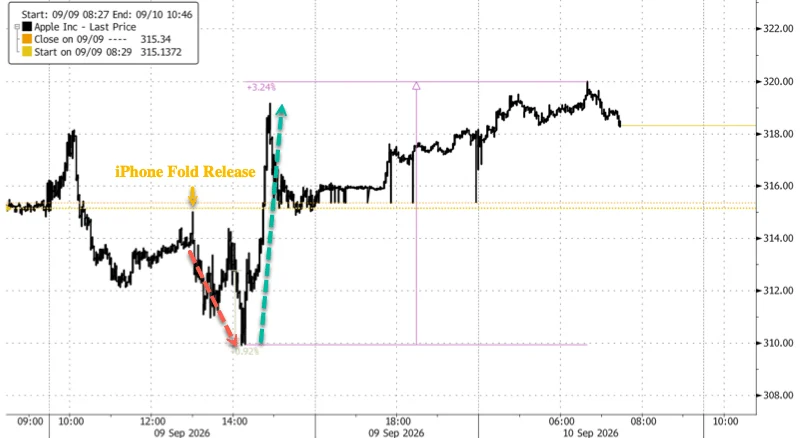
Apple shares experienced a rollercoaster ride during and immediately after the announcement. After an initial dip as the event commenced around 1 p.m. ET, the stock swiftly reversed course, rallying 3% from its session low, and eventually closing up 1.6% since the unveiling. This volatile trading underscored the market’s mixed feelings: excitement over the new products juxtaposed with apprehension over their financial implications.
The iPhone Duo: Apple’s Bold Entry into the Foldable Market
The centerpiece of Apple’s presentation was the iPhone Duo, the company’s inaugural foldable smartphone. This device, featuring a expansive 7.6-inch inner display, promises an "iPad-like multi-tasking experience," positioning it as potentially the most significant new hardware category introduced by Apple since the Apple Watch and AirPods. The iPhone Duo will start at a premium price point of $1,999 for the base model, escalating to a hefty $3,199 for the 2TB premium configuration.
Analysts like Citi’s Atif Malik noted the Duo’s potential to disrupt the market. Malik described the Duo as the "biggest new hardware category since Apple Watch/Airpods," emphasizing its large inner display and enhanced multi-tasking capabilities. Bernstein’s Mark Newman echoed this sentiment, highlighting that unlike many Android competitors, the Duo opens to an aspect ratio familiar to iPad users, which should make it more intuitive for media consumption and side-by-side window usage. Newman also posited that the Duo’s pricing, while substantial, could be competitive if it effectively replaces both a high-end iPhone and an iPad, potentially saving consumers hundreds or even thousands of dollars compared to purchasing both devices separately.
However, the launch was not without its immediate controversies. Social media quickly buzzed with accusations that Apple’s marketing materials for the iPhone Duo depicted "freakishly long" fingers to make the massive foldable device appear easier to hold one-handed. This type of scrutiny highlights the immense pressure Apple faces in presenting a new form factor that challenges conventional ergonomics. Furthermore, Vital Knowledge analysts raised a critical question: "Duo is a very ‘cool’ device, with a competitive price point, but it remains to be seen whether Apple can manufacture enough of them to meet demand." This concern about production scalability for a novel device is a common challenge for new technology introductions.
The decision to price the Duo starting around $2,000 inevitably draws comparisons to the Vision Pro, Apple’s mixed-reality headset launched earlier, which debuted at $3,500 and faced a challenging market reception. The question circulating among analysts is whether Apple has learned from the Vision Pro’s "failed launch" in terms of balancing innovation, pricing, and market readiness. While the Vision Pro represented an entirely new computing paradigm, the Duo is an evolution within the familiar smartphone category, potentially offering a clearer value proposition despite its high cost.
For consumers eager to get their hands on the Duo, pre-orders will begin on Friday, October 16th, with general availability slated for Friday, October 23rd. This staggered release, coming later than the iPhone 18 Pro models, hints at the complexity of manufacturing this new foldable form factor.
The iPhone 18 Pro Lineup: Incremental Innovation with Strategic Pricing
Alongside the foldable revelation, Apple also unveiled the iPhone 18 Pro and iPhone 18 Pro Max, notably foregoing a standard iPhone 18 model at this initial launch. These premium devices boast significant performance enhancements, including the new 2-nanometer A20 processor, which promises up to 40% higher sustained performance. Other notable improvements include a 48 MP main camera with variable aperture and substantially improved battery life with faster charging capabilities.
The pricing strategy for the iPhone 18 Pro and Pro Max models was a key point of discussion among analysts. Entry-level models saw a modest $100 price increase, or about 7-8%, which Bernstein’s Mark Newman described as "less severe than feared and less than what we’ve seen from Android competitors." However, price increases for higher storage tiers were more substantial, with the 18 Pro Max 2TB model seeing a $500 hike compared to its 17 Pro Max equivalent, reaching $2,499.
Goldman analyst Michael Ng highlighted that Apple’s decision to "bifurcate the iPhone 18 model launches with lower-end models expected (by us) in Spring 2027" is a strategic move designed to "support continued iPhone ASP growth amidst ongoing device premiumization." This approach allows Apple to focus its immediate efforts and marketing on its highest-margin, most advanced devices, leveraging the demand for premium features.
Pre-orders for the iPhone 18 Pro and Pro Max models will begin earlier, on Saturday, September 12th, across over 63 countries and regions, with availability starting Friday, September 18th.
Apple’s Evolving Pricing Strategy: A Double-Edged Sword
A particularly intriguing aspect of this launch was Apple’s unconventional approach to pricing older models. Contrary to its historical trend of discounting previous generations by approximately $100, Apple instead increased the prices of the older iPhone 16 and iPhone 17 portfolios by roughly $100. This effectively represents a $200 price swing compared to previous cycles. This move, according to Bernstein, is believed to "offset higher memory component prices" and "should reduce gross margin impact from rising memory costs."

This aggressive pricing strategy underscores Apple’s commitment to maintaining its average selling prices (ASPs) and pushing its product mix towards premium devices. Citi’s Atif Malik noted that the "starting price of $1,999 on Duo shows Apple’s iPhone line up is heavily skewed towards premium devices this fall." This premiumization, coupled with the price increases on older models, is intended to buoy revenue.
To mitigate the impact of these price increases on consumer affordability, Apple announced an updated Apple Upgrade program and highlighted "attractive carrier promotions," such as "Free/$99 iPhone 18 Pro/Pro Max with eligible trade-in and plan." These programs are crucial in making the premium devices accessible to a broader segment of the market, potentially fueling demand despite higher sticker prices.
The Margin Conundrum: Volume, Profitability, and Rising Costs
Despite the innovative products and strategic pricing, a persistent concern echoed across multiple Wall Street desks was the potential pressure on hardware gross margins. The question floating around overnight and into Thursday morning was how much of the new lineup’s demand would "translate into profit."
Jefferies analysts, who maintain an "underperform" rating and a $263.66 12-month price target, explicitly stated that "Apple appears focused on boosting volumes at the expense of margins." They warned that "unchanged pricing for the iPhone 17 and Air could support demand while pressuring profitability." TD Cowen, which rates Apple a "Buy" with a $400 price target, similarly "warned that modest price increases could create hardware gross-margin headwinds." The analysts highlighted that while "price increases were modest, which aids affordability, hardware GM could face more headwinds in the coming year."
Bernstein’s Mark Newman provided a detailed analysis, asking clients directly, "What about gross margins?" His team’s analysis indicated that "like for like 18 Pro / Pro Max models will have significantly worse gross margins than comparable 17 Pro / Pro Max models." Specifically, entry models could see "over 1000bps of gross margin dilution, and on average 14% lower gross profit $/unit." This substantial projected hit to profitability for Apple’s flagship devices is a significant concern for investors.
The primary culprit behind these margin pressures is "elevated memory prices," a volatile component cost that has been a recurring challenge for hardware manufacturers. However, Bernstein also pointed to several mitigating factors that could reduce the overall gross margin impact: the introduction of the high-priced iPhone Duo, the unprecedented increase in prices of older models, and the staggered launch of the lineup.
Goldman analyst Michael Ng offered a slightly more optimistic outlook, stating, "We view this favorable price/mix from premium products as supportive of upside to revenue, which should partially mitigate margin headwinds." Ng’s perspective suggests that the sheer volume and higher ASPs generated by the premium strategy could help offset some of the cost pressures, even if individual unit margins are squeezed.
Apple’s AI Ambitions: Monetization and Ecosystem Integration
Beyond hardware, Apple made significant strides in its artificial intelligence strategy, unveiling new Siri AI features integrated into iOS 27 and introducing "Apple Intelligence." This new AI framework is designed to run on-device whenever possible, leveraging the powerful A20 chip, while more computationally demanding requests are handled through "Private Cloud Compute," emphasizing Apple’s commitment to user privacy.
Crucially, the announcement revealed the "first signs of AI monetization." Some advanced AI capabilities that rely on server models will have usage limits, with "increased access available through iCloud+ plans." This strategy signals Apple’s intent to integrate AI as a value-added service within its ecosystem, potentially driving subscriptions and bolstering its already lucrative services revenue segment. This move aligns with broader industry trends where AI features are becoming a differentiator, and companies are exploring various models to monetize them.
Market Share, Competition, and the Road Ahead for Ternus
For new CEO John Ternus, the launch of the foldable iPhone, with its roughly $2,000 to $3,200 price tag, represents a major test of Apple’s pricing power, its ability to innovate in a maturing market, and its capacity to scale production for a complex new form factor. The success of the iPhone Duo will not only depend on consumer adoption but also on Apple’s manufacturing prowess to meet anticipated demand.
In the broader smartphone market, particularly the nascent foldable segment, Apple is a relatively late entrant compared to Android rivals like Samsung, Huawei, and others. However, Apple’s strategy has often been to refine existing technologies and enter markets with a polished, user-centric product, rather than being first. Bernstein’s analysis suggests that the "lower price increases on entry models should help Apple continue to gain market share over Android rivals," indicating a competitive pricing stance for its traditional flagships despite margin concerns.
The investment community remains watchful. While many analysts maintain "Buy" or "Outperform" ratings with robust price targets (Citi at $365, Bernstein at $370, TD Cowen at $400), there is an underlying current of caution. Bernstein’s Mark Newman articulated this sentiment, stating that while they "like the new product releases and believe gross margin hit may not be as bad as feared, there continues to be much uncertainty on new level of gross margins with today’s elevated memory prices." Newman warned that "the stock may not work until December quarter guide is behind us (in late October)," indicating that definitive clarity on profitability will be crucial for sustained investor confidence.
In conclusion, Apple’s latest product unveiling is a strategic gamble, balancing groundbreaking innovation with shrewd, albeit risky, pricing strategies. The iPhone Duo marks a significant technological leap, while the iPhone 18 Pro lineup reinforces Apple’s commitment to premium performance. The success of this generation will hinge on Apple’s ability to navigate the complex interplay of consumer demand, supply chain capabilities, and the ever-present pressure on hardware margins, all under the watchful eye of its new CEO. The path ahead for Apple appears to be one of calculated risks, aiming to solidify its dominance in the premium segment while cautiously expanding into new frontiers.

