
Building robust real estate data infrastructure is a logical imperative for any burgeoning PropTech platform. However, the reality of collecting and maintaining comprehensive, nationwide property data is a protracted and engineering-intensive endeavor, often spanning many months. This directly conflicts with the market’s demand for rapid deployment of reliable, data-driven solutions in an intensely competitive landscape. In this environment, a strategic partnership offering a real estate data API emerges as a more agile and efficient alternative, enabling businesses to access pre-existing property analytics and investment insights without the significant investment in building an internal data team. This exploration will delve into the critical build versus buy decision for data infrastructure, the practicalities of accessing accurate and current real estate data, and how scalable API solutions can significantly accelerate business growth.
The Inherent Challenges of Building In-House Real Estate Data Infrastructure
While the prospect of complete control and customization over an internal data system might seem appealing, the practical implementation of reliable real estate datasets is fraught with complexity and substantial cost. What begins as a feature development quickly escalates into a continuous operational responsibility. This involves a significant drain on engineering resources, intricate data licensing negotiations, and the perpetual task of data maintenance and updates.
For teams weighing their options, several recurring issues plague the development of in-house data infrastructure:
The Substantial Financial and Resource Drain of a Dedicated Data Team
The creation of sophisticated real estate data analytics capabilities necessitates specialized expertise and a long-term financial commitment. This includes developing complex data pipelines for the collection, normalization, and validation of vast datasets, all while ensuring consistency across diverse markets. This process is inherently time-consuming, directly impeding product development timelines and measurable progress. Consequently, the build versus buy decision for data infrastructure transcends mere control; it fundamentally becomes a question of speed and long-term sustainability.
Comparative Analysis: Building vs. Partnering for Real Estate Data
| Factor | Building Internally | Partnering via API |
|---|---|---|
| Time to Launch | 6-12+ months | Couple of weeks |
| Upfront Cost | High hiring & infrastructure cost | Predictable, usage-based |
| Data Maintenance | Internal responsibility | Managed by API provider |
| Coverage Expansion | Slow & manual | Immediate scalability |
| Engineering Focus | Data pipelines | Product innovation |
Navigating the Labyrinth of Data Licensing, Compliance, and Maintenance
The United States real estate market is notoriously fragmented, with numerous Multiple Listing Service (MLS) data sources operating under disparate licensing agreements and update cycles. Managing API data licensing, permissions, and ensuring compliance across multiple jurisdictions is a formidable challenge. The complexity intensifies when incorporating rental analytics, requiring continuous updates and normalization across thousands of geographic locations. Without dedicated expertise, data accuracy can become inconsistent, eroding user trust. This mirrors the challenges faced when seeking to provide data akin to an Airbnb data API or an Airbnb historical performance API, where timely and accurate information is paramount.
The Critical 12-Month Time-to-Market Hurdle
A significant risk associated with protracted development cycles is the loss of market momentum. Implementation timelines stretching to a year or more can delay product launches, hinder customer acquisition, and erode a competitive edge in the fast-paced PropTech sector. This is precisely why platforms prioritizing rapid results actively seek ways to access critical real estate data without the burden of building an in-house data operation. Instead, they strategically integrate existing solutions, freeing up valuable engineering resources to focus on features that truly differentiate their offerings. This trend towards strategic partnerships naturally leads to the question: What does a collaboration with a specialized real estate data provider entail in practice?
The Mashvisor API Partnership: A Seamless Integration for Accelerated Growth
Recognizing the inherent complexities of developing in-house data infrastructure, businesses are increasingly turning towards faster and more reliable alternatives. A real estate data API partnership offers precisely this solution, enabling companies to integrate readily available, meticulously structured datasets directly into their products. In this model, data transforms from a technical hurdle into a potent enabler of business capabilities.
Effortless Plug-and-Play Real Estate API Integration
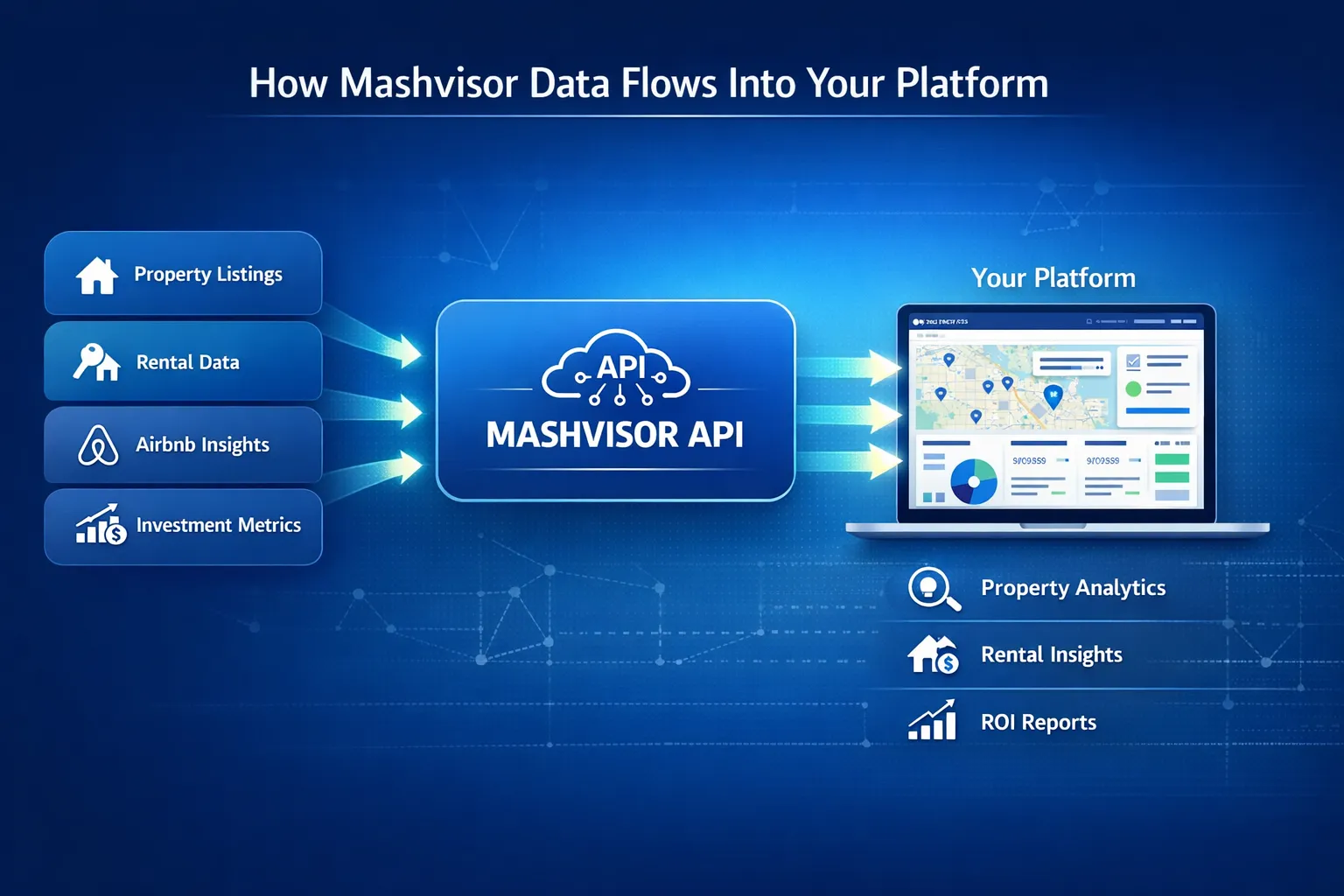
The Mashvisor API is engineered for straightforward integration, granting access to crucial property insights, rental analytics, and investment metrics without the need for building extensive data pipelines. Platforms can leverage standardized endpoints that consistently deliver analytics-ready information. With the underlying infrastructure already in place, integration efforts can concentrate on connecting these endpoints to existing product workflows, rather than grappling with the complexities of data aggregation. This significantly reduces development overhead and accelerates the journey from planning to deployment.
Developers can explore the comprehensive Mashvisor API documentation to understand available endpoints, datasets, and integration capabilities.
Unified Access to Property, Rental, and Short-Term Rental Analytics
A key advantage of partnering with an established real estate data provider is the consolidated access to a comprehensive suite of datasets. Mashvisor amalgamates traditional property data with vital rental performance insights and short-term rental analytics, empowering platforms to deliver deeper market intelligence through a single, unified real estate data API.
The Mashvisor API encompasses a rich array of data points, including:
- Property Details: Comprehensive information on individual properties, including size, features, and ownership history.
- Investment Metrics: Key performance indicators such as cash-on-cash return, capitalization rate, and occupancy rates.
- Rental Income Potential: Estimated monthly rental income based on local market comparables.
- Short-Term Rental (STR) Performance: Data on daily rates, occupancy, and revenue potential for platforms like Airbnb.
- Market Trends and Comparables: Insights into local market dynamics, property value trends, and comparable sales.
- Property Taxes and HOA Fees: Essential cost data for accurate investment analysis.
By consolidating multiple data layers into a single system, businesses can circumvent the need to manage disparate vendors or reconcile inconsistent datasets, thereby delivering superior and integrated analytics to their users.
Tailored for PropTech Platforms and Property Marketplaces
A data API partnership with Mashvisor is specifically designed for businesses aiming to enhance their core product offerings rather than becoming data management specialists. Mashvisor functions as a foundational infrastructure layer, allowing partners to retain complete control over branding, user experience, and product direction while benefiting from continuously updated and scalable datasets. This positioning makes Mashvisor a leading real estate data API solution for entities seeking reliable data integration without protracted development cycles. Beyond streamlining integration, these partnerships fundamentally alter the timeline for launching and scaling new features.

Time-to-Market Advantages: Launching Features in Weeks, Not Months
In the real estate data sector, speed is as critical as functionality. Markets are dynamic, user expectations are constantly evolving, and competitors are perpetually introducing new features. Integrating a real estate investment data API allows for a significantly faster transition from concept to market launch.
Expedited Product Development Cycles
By gaining immediate access to pre-compiled datasets, teams can bypass the months typically spent on sourcing, cleaning, and validating data. Instead, engineers can redirect their efforts towards developing user-centric tools powered by accurate property analytics. This acceleration dramatically shortens the time-to-market for real estate platforms, enabling companies to test innovative ideas, deploy analytics tools, and iterate based on user feedback, unhindered by infrastructure limitations.
Comparative Timeline: Building vs. Partnering for Data Access
| State | Internal Build | Mashvisor API Integration |
|---|---|---|
| Data Sourcing | Months | Immediate access |
| Infrastructure Setup | Extensive | Minimal |
| Testing | Long cycles | Faster iteration |
| Feature Launch | Delayed | Fast |
Scalable Growth Without Infrastructure Overhaul
Business expansion, such as entering new geographical markets, presents considerable challenges for platforms reliant on internally built infrastructure. Conversely, solutions that scale seamlessly with business needs enable instant coverage expansion. As Mashvisor provides nationwide real estate data coverage, platforms can grow their geographic reach without introducing additional operational complexity. Mashvisor’s usage-based pricing model ensures that costs scale in tandem with actual data utilization, offering financial flexibility.
Prioritizing Core Product Value with Focused Engineering Resources
When data infrastructure is managed by a third-party provider, internal teams can reallocate their engineering efforts towards activities that drive differentiation. This allows for a greater focus on user experience enhancements, innovative analytics development, and optimizing the customer journey – all critical for strategic growth. This operational efficiency is a primary driver for businesses opting for API data partnerships for their real estate platforms. While rapid deployment is a significant advantage, ensuring data accuracy, compliance, and long-term scalability remains paramount.
Compliance, Coverage, and Scale: Eliminating Operational Headaches
Launching a product swiftly is only one part of the equation. Real estate platforms must maintain consistent data quality, ensure reliable updates, and adhere to compliant data usage policies to retain customer trust. Managing these standards internally can become increasingly complex and resource-intensive.
Comprehensive Nationwide Real Estate Data Coverage
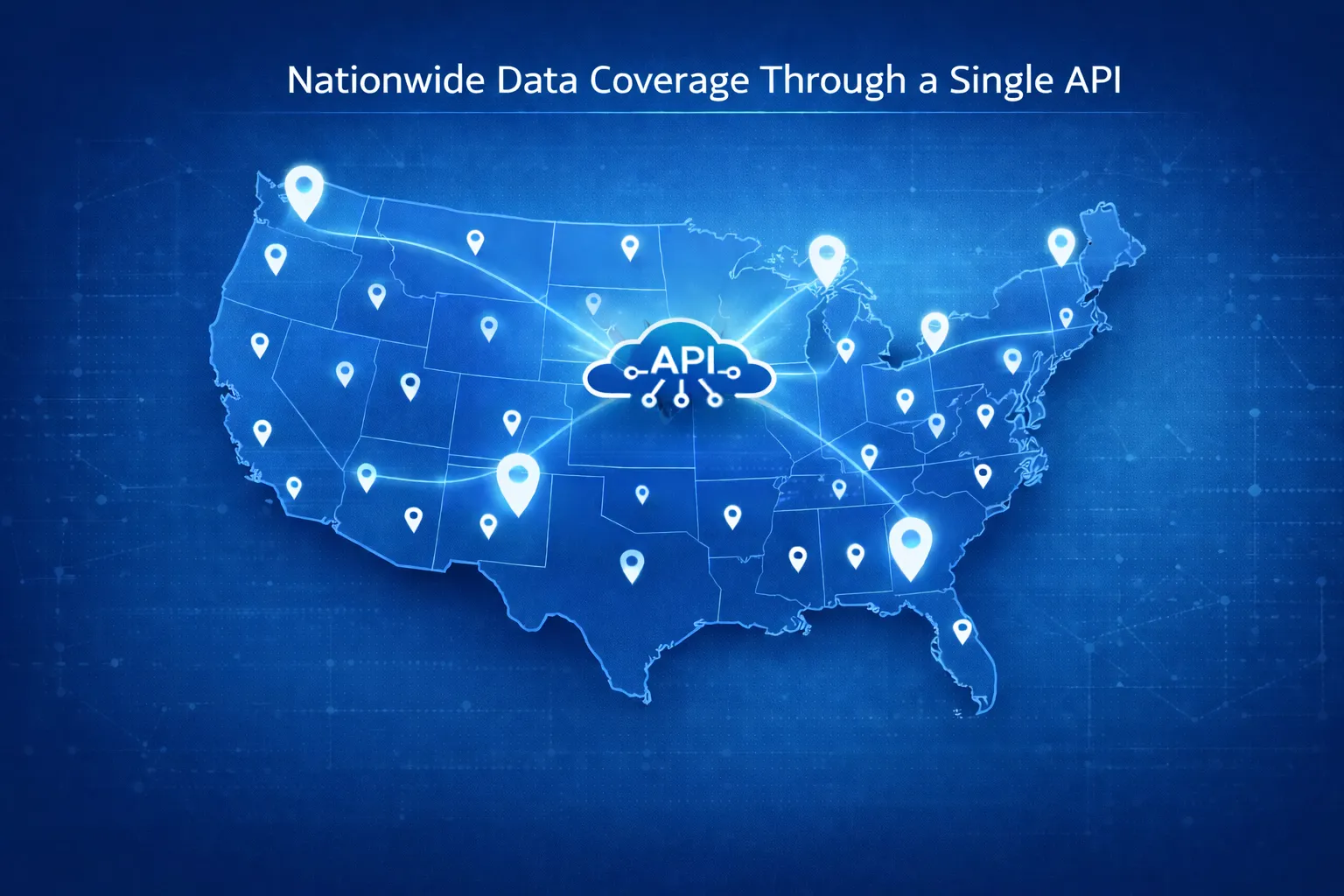
A data partnership with Mashvisor eliminates the arduous task of assembling datasets market by market. Mashvisor offers comprehensive nationwide coverage, allowing businesses to provide consistent insights across all locations without the burden of managing multiple vendors or complex integrations.
This unified data structure ensures that analytics remain comparable across different markets, a crucial requirement for data-driven tools serving a broad user base at scale.
Continuous Data Updates and Maintenance
Real estate data is in a constant state of flux. Listings are updated, rental performance metrics fluctuate, and market conditions evolve on a weekly basis. Maintaining accurate datasets internally demands continuous monitoring, validation, and data cleansing. Through a real estate data API partnership with Mashvisor, aggregation, normalization, and updates are managed proactively. Businesses receive structured datasets ready for immediate analysis, significantly reducing their operational burden. This consistency empowers teams to deliver dependable long-term rental and Airbnb data analytics without diverting essential resources.
Simplified Compliance and API Data Licensing
Data compliance is often an afterthought during the initial development phases but becomes critically important as a business scales. Managing API data licensing, permissions, and usage requirements across numerous sources can introduce significant legal and operational risks. By leveraging a data integration solution, these concerns are substantially mitigated. Businesses can rely on an infrastructure designed to manage licensing considerations and data standardization, allowing their teams to concentrate on core business objectives. With reliability, coverage, and compliance concerns addressed, the next logical consideration is: Which types of companies stand to benefit the most from such a partnership?
Key Beneficiaries of a Mashvisor Data Partnership
While a broad spectrum of real estate industry players can benefit from the Mashvisor API, PropTech data partnerships are particularly transformative.
PropTech Startups: Rapid MVP Launch and Validation
Startups operate under immense pressure to validate their concepts and achieve product-market fit swiftly. Building in-house datasets can decelerate early development and consume scarce engineering capital. Utilizing PropTech API solutions, without the overhead of a dedicated data team, allows startups to launch minimum viable products (MVPs) faster while still offering professional-grade insights.
Mini Case Study: Launching in 48 Hours Instead of Six Months
A PropTech startup successfully launched a short-term rental (STR) deal validation engine in under 48 hours by leveraging Mashvisor’s API. Instead of dedicating months to building data pipelines, sourcing nationwide listings, and normalizing rental performance data, their team focused exclusively on product development and user experience. This enabled them to quickly test market demand, onboard early adopters, and iterate based on real-world usage, all without the expense of hiring a data team or negotiating multiple data licenses.
Real Estate Marketplaces: Enhancing Value Beyond Listings
Property marketplaces and listing platforms increasingly compete on the depth of insights they offer, not just their inventory. Incorporating analytics powered by a trusted real estate API provider adds significant value beyond basic listings, such as presenting investment potential, projecting rental income, and providing market comparisons.
Investment Platforms and SaaS Tools: Delivering Advanced Analytics
Platforms catering to investors, brokers, or property managers require sophisticated property analytics across multiple markets. Utilizing an API allows them to deliver crucial metrics like return on investment (ROI), rental projections, and market performance insights through a single, seamless integration. This supports scalable product growth while maintaining unwavering data quality.
AI and Analytics Platforms: Integrating Property Intelligence
Rather than building entirely new data pipelines from scratch, AI-driven platforms are increasingly adopting API data partnerships to integrate structured datasets into their models and dashboards. Mashvisor provides standardized outputs and extensive market coverage, enabling companies to incorporate real estate insights into recommendation engines, forecasting tools, and analytics applications with minimal additional infrastructure investment.
Who Utilizes the Mashvisor API?
| Platform Type | Primary Benefit |
|---|---|
| PropTech Startups | Accelerated MVP launch |
| Property Marketplaces | Enhanced analytics layer |
| SaaS Tools | Comprehensive investment insights |
| AI Platforms | Structured and scalable real estate data |
The advantages of a Mashvisor partnership are clear: accelerated launches, reliable data, and robust scalability.
Who May Not Benefit from a Mashvisor Data Partnership
A real estate data API partnership with Mashvisor may not be the optimal solution for entities that:
- Possess a deeply entrenched, large-scale internal data engineering team already handling all aspects of data acquisition, processing, and maintenance.
- Require highly granular, custom data fields not currently available through standard API offerings, necessitating bespoke data collection methods.
- Are focused solely on hyper-local data within a very small, specific geographic area that may not be comprehensively covered by broad market data.
- Have stringent, niche regulatory compliance requirements that necessitate direct control over every facet of data handling and processing, beyond standard API provisions.
Mashvisor is strategically designed for teams building production-grade tools, platforms, and workflows that depend on reliable, continuously updated data.
Bottom Line: Strategic Data Integration for PropTech Success
A real estate data API partnership with Mashvisor offers a direct pathway to bypass the formidable challenges associated with building and maintaining proprietary data infrastructure. By integrating production-ready datasets, businesses gain access to scalable analytics, nationwide market coverage, and dependable property intelligence without the operational overhead of managing complex data operations. Furthermore, Mashvisor’s usage-based pricing model ensures that clients pay only for the data they actively utilize, providing cost-efficiency and predictability.
By opting for a strategic partnership, engineering teams can redirect their focus towards core product growth and innovation, confident in the knowledge that a trusted data provider is handling the intricacies of data aggregation, updates, and infrastructure at scale.
Considering the Build vs. Buy dilemma for your real estate data stack? Scheduling a brief consultation with the Mashvisor data team can help align your product roadmap with the most effective integration approach, whether an API partnership is the right fit now or for future expansion. This consultation offers a practical discussion about your data strategy and launch timeline, free from high-pressure sales tactics.
Frequently Asked Questions
What Constitutes a Real Estate Data API Partnership?
A real estate data API partnership, such as with Mashvisor, allows platforms to integrate market and property datasets directly into their existing products, bypassing the need to develop and maintain their own data infrastructure. This facilitates faster access to analytics while significantly reducing engineering and operational complexities.
Why Should I Partner with Mashvisor Instead of Building My Own Real Estate Data Team?
Developing internal data systems demands substantial time investment, recruitment of specialized personnel, and ongoing maintenance. Partnering with a specialized real estate data provider like Mashvisor delivers ready-to-use datasets and accelerates product launches with significantly lower overhead and operational costs.
How Long Does Real Estate API Integration Typically Take?
Most API integrations are generally completed within a couple of weeks, though the precise timeline can vary based on the complexity of the specific product. In contrast, developing internal data pipelines from scratch typically spans several months.
What Specific Data Does the Mashvisor API Provide?
The Mashvisor API offers comprehensive property data, detailed rental income estimates, key investment metrics, and specialized insights for short-term rentals. It covers both current data and historical information extending back 36 months.
Who Are the Primary Users of a Real Estate Analytics API?
PropTech startups, real estate marketplaces, investment-focused SaaS platforms, and advanced analytics tools are among the entities that benefit most from the Mashvisor real estate analytics API.
Are Real Estate Data API Partnerships Affordable for Startups?
Mashvisor’s usage-based access model allows startups to scale their data costs in accordance with their actual data consumption. This pricing structure makes the real estate data API an accessible and cost-effective solution, even for early-stage platforms.

