

The annual county fair in Vermont serves as more than a community celebration of agriculture and local heritage; it has become a primary laboratory for experiential financial education. For families navigating the complexities of modern consumerism, such events provide a high-density environment of "wants" versus "needs," offering a practical stage for children to exercise fiscal autonomy. Recent observations from a local household, involving children aged five and seven, highlight a structured approach to childhood financial literacy that mirrors professional economic principles, including labor-for-capital exchange, debt management, and discretionary spending analysis.
The Landscape of Youth Financial Literacy in the United States
The implementation of household-level financial education comes at a critical time for American youth. According to the 2023 TIAA Institute-GFLEC Personal Finance Index, functional financial literacy among U.S. adults remains at approximately 48%, a figure that has seen little improvement over the last seven years. Experts in developmental psychology and economics suggest that the foundation for financial health is laid long before adulthood. The Council for Economic Education notes that only 25 states currently require high school students to take a course in personal finance, leaving a significant gap that parents and guardians are increasingly expected to fill.
In rural settings, such as the Vermont agricultural community, these lessons are often integrated into the daily rhythm of farm and household maintenance. By utilizing events like the county fair—a "panorama of consumerism"—educators and parents are finding opportunities to demystify the mechanics of money, moving beyond abstract concepts to tangible, real-world consequences.

The Family Money Philosophy: A Categorical Framework
To manage the influx of marketing directed at children, the household in this study utilizes a "Family Money Philosophy." This framework establishes a clear boundary between parental obligations and child-led discretionary spending. The objective is to provide a safety net while allowing for the "friction" of financial decision-making.
Under this system, the parental units remain responsible for all "essential" expenditures. These include:
- Fundamental Needs: Shelter, healthcare, and nutrition.
- Educational Materials: Books, library access, and foundational toys.
- Developmental Experiences: Admission fees to museums, fairs, and community events.
- Apparel: Seasonal and functional clothing.
Conversely, the children are responsible for "discretionary" items. This category includes special snacks or desserts outside of provided meals, souvenirs from gift shops, and supplemental books from commercial vendors like the Scholastic Book Fair. By drawing this line, the parents shift the burden of choice to the children, forcing them to evaluate whether a "want" justifies the depletion of their personal capital.
The Labor-Capital Exchange: Chore Systems and Market Value
The acquisition of capital within this household is strictly tied to labor, specifically tasks that benefit the collective family unit rather than the individual. This mimics a professional employment structure and introduces the concept of "fair market value" for services rendered.

The chore system is divided into two distinct categories:
1. Daily Unpaid Responsibilities (Personal Maintenance)
These tasks are considered part of the "social contract" of the household and do not command a wage. They include:
- Self-directed laundry management.
- Maintenance of personal living spaces (bedroom cleaning).
- Table clearing and basic sanitation of personal items.
- Routine agricultural assistance, such as collecting eggs or managing compost.
2. Paid Contractual Labor (Family Service)
These tasks are eligible for financial compensation because they provide a service that would otherwise require parental time or external hiring. Examples include:
- Organizing shared kitchen infrastructure (cabinets and drawers).
- Managing household waste (emptying all interior trash cans).
- Assisting with the laundry of other family members.
- Seasonal yard work and specialized cleaning projects.
The compensation for these tasks is often negotiated. In one instance, the seven-year-old child negotiated a $10 lump sum for a comprehensive organization of the kitchen. This introduces the concept of "project-based" pay and negotiation skills. However, the "quality control" aspect remains rigorous; payment is only issued upon the successful and complete execution of the task. Failure to meet the established standards—such as spilling waste during trash removal—requires remedial action before funds are disbursed.
Case Study in Debt: The Inflatable Unicorn Incident
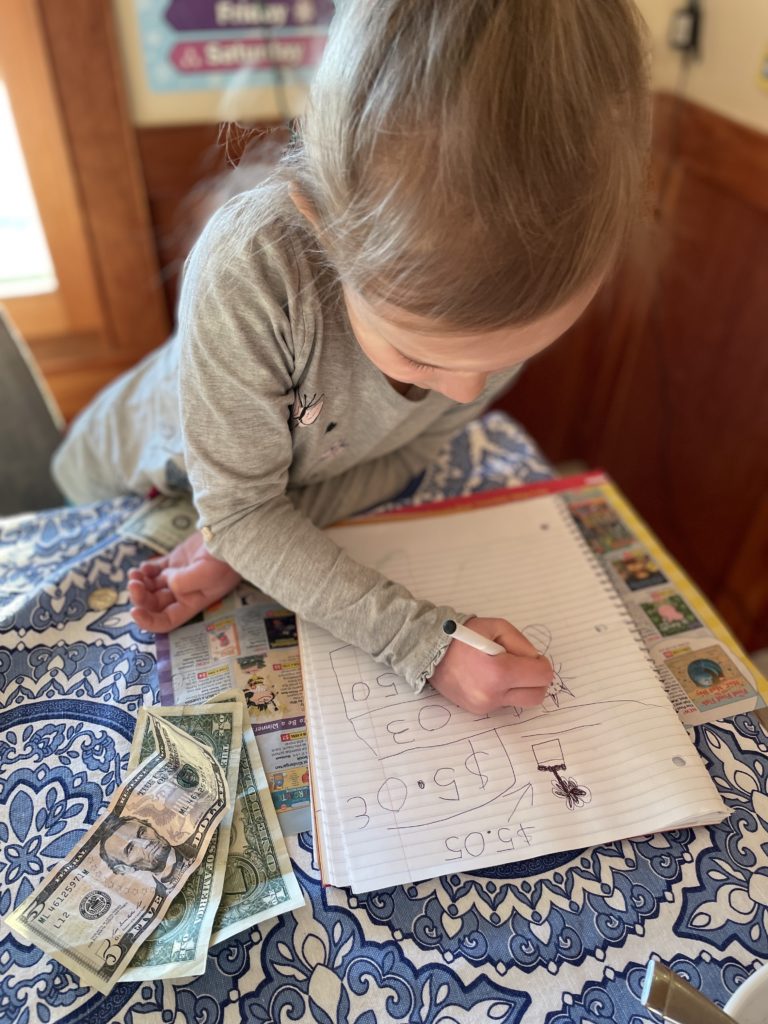
One of the most profound lessons in the study’s chronology occurred at a previous year’s county fair. The seven-year-old child (then six) desired an inflatable turquoise unicorn priced at $13. At the time, her liquid assets totaled only $9. To facilitate a lesson in credit and debt, the parents provided a $4 loan to cover the deficit.
The aftermath of this transaction provided a visceral understanding of debt service. Upon returning home, the child was required to perform labor to repay the $4. The realization that she was working without receiving new capital—because the "value" of that labor had already been consumed—led to a significant shift in her financial perspective. The child noted that it was "not fun" to work for something already in her possession.
This experience aligns with behavioral economic theories regarding the "pain of paying." By allowing the child to experience the psychological weight of debt in a low-stakes environment, the parents successfully instilled a debt-aversion mindset. Since this incident, neither child in the household has opted to spend beyond their current means, demonstrating the efficacy of experiential learning over theoretical instruction.
Logistical Competence and Asset Management
Beyond the philosophy of spending, the household emphasizes the physical management of assets. Each child is responsible for their own wallet and the security of their funds. This introduces the concepts of responsibility and risk.
During a visit to a science museum, the elder child misplaced her wallet containing her earned savings. The ensuing distress and the subsequent process of recovering the item from the museum’s "lost and found" served as a critical lesson in asset security. The parents used this moment to explain the reality of permanent loss; in many real-world scenarios, lost currency is not recovered.
Furthermore, the children are encouraged to handle their own transactions. At local events, they are required to approach vendors, inquire about prices, and count out the necessary currency. This builds "transactional confidence" and ensures they understand the denominations of currency and the mechanics of change-making.
Collaborative Spending and the "Dessert Economy"
The household also fosters collaborative financial planning. During "pizza nights" at a local farm, where parents provided the main meal but declined to purchase dessert, the children began to pool their resources.
This "dessert economy" introduced several complex mathematical and social concepts:

- Cost Sharing: The children realized that splitting the $7 cost of a treat was more efficient than one person bearing the full burden.
- Divisibility of Currency: When a $7 expense could not be evenly divided into whole dollar amounts, the children had to engage with coin denominations (quarters, dimes, and nickels) to ensure an equitable split of $3.50 each.
- Resource Planning: The children began to anticipate these outings, performing extra chores in the days leading up to the event to ensure they had the necessary "discretionary fund" available.
Broader Impact and Future Educational Scaffolding
The ultimate goal of this pedagogical approach is to position money as a "tool" rather than a measure of self-worth or an emotional lubricant. By removing the mystery and anxiety surrounding financial transactions, the parents are equipping the children with a rational framework for future decision-making.
The next phase of this educational timeline involves the introduction of "The Bank of Parental Units." This initiative will introduce the concept of interest rates and long-term savings. By offering a high-yield interest rate on funds kept in "savings" rather than spent immediately, the parents hope to teach the benefits of delayed gratification and the power of compound growth.
Conclusion: The Importance of Early Intervention
The Woods family’s approach highlights a growing trend among proactive parents to treat financial literacy as a core life skill, comparable to literacy or basic mathematics. In an era of digital payments and "invisible" money, returning to the tactile reality of cash, chores, and debt repayment provides a necessary foundation.
As these children grow, the complexity of the lessons will likely increase to include stock market basics, inflation, and charitable giving. However, the fundamental principles established at the Vermont county fair—that money is earned through value creation and that spending requires a choice between competing desires—will remain the bedrock of their financial lives. The success of such programs suggests that when children are given the responsibility to manage their own small-scale economies, they develop a level of fiscal maturity that can protect them from the predatory lending and consumer traps of adulthood.

