
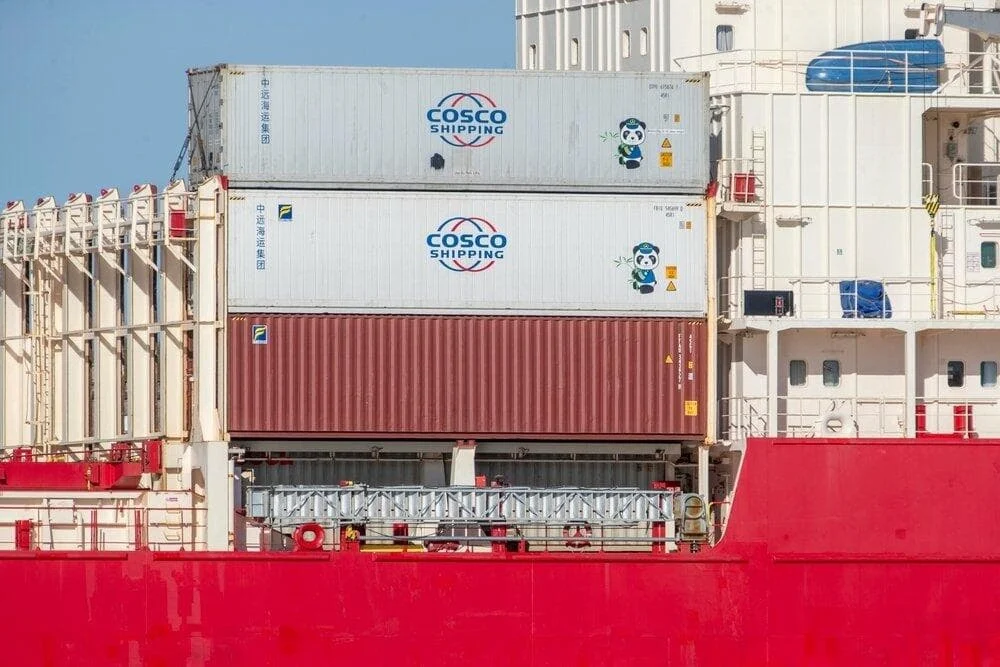
China Ocean Shipping (Group) Company (COSCO), the state-owned shipping giant and one of the world’s largest maritime carriers, has vehemently rejected a report published last week that alleged the company had concealed advanced surveillance equipment aboard its vast fleet of cargo ships. These sophisticated devices, according to the report, were purportedly used to monitor U.S. military communications near the coastlines of target nations, including the United States itself, signaling a potential expansion of Beijing’s intelligence-gathering capabilities through commercial channels.
The Allegations Unveiled: A Report from Anonymous U.S. Officials
The initial report, which surfaced last week and was subsequently referenced by Reuters on Tuesday, cited anonymous U.S. officials who detailed the alleged clandestine operations. These officials, speaking on condition of anonymity to discuss the sensitive U.S. assessment of the Chinese program, asserted that COSCO maintains a decades-long intelligence-collection partnership with the Chinese government. This long-standing arrangement, they claimed, enables Beijing to systematically collect communication signals from various vessels and aircraft operating across strategically vital regions including Europe, North America, and Asia.
The core of the accusation revolved around the nature and purpose of the equipment allegedly installed on COSCO’s vessels. According to one of the unnamed officials, the advanced technology aboard these ships was specifically intended to allow China to gather critical information regarding "military communications technologies and encryption developments." Such intelligence, if successfully collected, could provide Beijing with invaluable insights into the operational capabilities, vulnerabilities, and strategic communications protocols of foreign militaries, particularly that of the United States. This revelation painted a picture of a sophisticated, pervasive intelligence-gathering network embedded within the seemingly innocuous global commercial shipping infrastructure.
COSCO’s Resolute Denial and Defense of Commercial Practices
In response to these grave accusations, COSCO issued a robust denial, characterizing the allegations as "totally unfounded" and unequivocally false. Reuters quoted the Chinese shipping behemoth on Friday, reporting their official statement which sought to dispel the mounting concerns. The company asserted its unwavering commitment to international norms and business ethics, stating, "COSCO SHIPPING has always adhered to market-oriented operations and compliance practices across all our global businesses." This statement aimed to position the company as a legitimate commercial entity operating within the bounds of global trade regulations, rather than an instrument of state intelligence.
Furthermore, COSCO provided an explicit explanation for the equipment installed on its vessels. It affirmed that "All communication, navigation, safety and operational equipment installed on our vessels is used solely for legitimate commercial purposes, including navigation safety, ship-to-shore communications and emergency response." This detailed rebuttal aimed to differentiate standard maritime communication and navigation systems, which are essential for safe and efficient shipping, from any alleged covert surveillance apparatus. The company emphasized that its operations are transparent and conform to international maritime laws and standards, suggesting that any inference of illicit activity was baseless.
COSCO: A Global Maritime Powerhouse and State-Owned Nexus
To understand the scope of these allegations, it is crucial to appreciate COSCO’s immense global footprint. China Ocean Shipping (Group) Company, founded in 1961, is one of the largest conglomerates in the world, with its primary business being shipping and logistics. It is the fourth-largest container shipping company globally, operating a vast fleet that includes container ships, dry bulk vessels, oil tankers, and specialized carriers. Its network spans over 160 countries and regions, calling at more than 1,500 ports worldwide. COSCO’s extensive reach is not limited to vessel operations; it also holds significant investments in port terminals across the globe, including strategic locations in Europe, Africa, and North America. For instance, its ownership stakes in facilities like the Port of Piraeus in Greece or its operational presence in major U.S. ports underscore its integral role in global supply chains.
The fact that COSCO is a state-owned enterprise (SOE) is central to the U.S. allegations. In China’s economic model, SOEs often operate with a dual mandate: commercial success and advancement of state objectives. This structure inherently raises concerns among Western intelligence agencies, who view such entities as potential conduits or instruments for state-sponsored activities, including intelligence gathering, economic coercion, or strategic influence. The scale of COSCO’s operations means that its vessels traverse critical maritime chokepoints and operate in close proximity to sensitive military installations and naval bases worldwide, making them potentially ideal platforms for signals intelligence (SIGINT) collection if equipped for such purposes.
The Broader Landscape of U.S.-China Espionage Concerns
These allegations against COSCO are not isolated incidents but fit into a much broader and escalating pattern of U.S. concerns regarding Chinese state-backed espionage and strategic competition. For years, U.S. intelligence and security agencies have highlighted Beijing’s concerted efforts to acquire sensitive technology, intellectual property, and strategic intelligence through various means, including cyber espionage, human intelligence, and leveraging commercial entities.

The concept of "dual-use" technologies is particularly pertinent here. Many technologies developed for civilian applications – from telecommunications equipment to shipping logistics systems – can also have military or intelligence applications. This blurring of lines makes it challenging to distinguish legitimate commercial activities from potential state-sponsored espionage. Previous high-profile cases, such as U.S. restrictions on Huawei due to national security concerns over its 5G equipment and the ongoing scrutiny of social media platforms like TikTok, illustrate this deep-seated anxiety about Chinese companies potentially acting as extensions of the Chinese state’s intelligence apparatus. The U.S. government has consistently expressed fears that data collected by Chinese companies could be accessed by Beijing, potentially compromising national security.
China’s "Gray-Zone" Strategy: Leveraging Civilian Infrastructure
If substantiated, the alleged use of COSCO’s vessels for signals intelligence operations would align perfectly with what analysts describe as China’s "gray-zone" activity. This strategy involves leveraging commercial infrastructure and civilian technologies to advance state objectives without crossing the threshold of overt military aggression, thereby complicating attribution and response. It represents a subtle, persistent form of competition that seeks to gain strategic advantages through non-traditional means.
Dr. Ryan Clarke of the CCP BioThreats Initiative, for instance, articulated in a book last year that Beijing’s evolving strategy increasingly combines next-generation weapons with irregular and non-kinetic tools. He characterized a multi-faceted approach that extends beyond conventional military power to include instruments such as synthetic narcotics (like fentanyl and cannabinoids), biological weapons (as he characterized COVID-19), psychological influence through platforms like TikTok, and other forms of unconventional warfare. Within this framework, embedding advanced intelligence collection capabilities within a global commercial shipping fleet would represent a sophisticated application of the "gray-zone" doctrine, allowing for pervasive, low-signature data collection in sensitive areas. Such a strategy allows China to project influence and gather intelligence globally under the guise of legitimate commercial activity, making it difficult for target nations to formulate a proportionate response.
Geopolitical Ramifications and the Impending Xi-Trump Summit
The timing of these allegations could not be more sensitive. They surface just weeks before Chinese President Xi Jinping’s expected Sept. 24 visit to Washington for high-stakes talks with President Trump. The U.S.-China relationship is already characterized by significant tension, encompassing trade disputes, technological competition, human rights concerns, and geopolitical rivalry in regions like the South China Sea. Allegations of covert espionage, especially involving a major state-owned entity, threaten to further exacerbate these strains.
While it is unlikely that such sensitive intelligence matters would be openly discussed in public statements during the summit, these accusations will undoubtedly loom large over the private negotiations. They could harden the U.S. negotiating position, particularly on issues related to technology transfer, market access for U.S. companies in China, and cybersecurity protocols. The U.S. administration might leverage these claims to press for greater transparency and assurances from Beijing regarding the independence of its state-owned enterprises and their adherence to international norms. Conversely, China will likely view these allegations as yet another attempt by the U.S. to undermine its commercial interests and global standing, potentially leading to a more entrenched defensive posture. The summit, initially hoped to de-escalate trade tensions, now faces the added complexity of profound national security distrust.
Implications for Global Shipping and Supply Chain Security
Beyond the immediate diplomatic fallout, these allegations carry significant implications for the global shipping industry and the security of international supply chains. If the claims against COSCO gain traction, they could lead to:
- Increased Scrutiny: Other nations, particularly those with strategic military assets or critical infrastructure near shipping lanes, might implement heightened scrutiny and surveillance of Chinese-flagged or state-owned vessels entering their territorial waters or ports. This could involve more frequent inspections, stricter data reporting requirements, or even restrictions on port access.
- Erosion of Trust: The foundation of international shipping relies on trust and adherence to common maritime laws. Allegations of covert intelligence operations could erode this trust, leading to a more fractured and suspicious global maritime environment.
- Supply Chain Disruptions: Increased scrutiny and potential restrictions could lead to delays in cargo movement, increased operational costs for shipping companies, and ultimately, disruptions to global supply chains that are heavily reliant on Chinese carriers like COSCO. Given COSCO’s integral role, any significant restrictions could have ripple effects across various industries.
- Calls for Transparency: There may be renewed calls from international bodies and national governments for greater transparency from state-owned shipping companies regarding their operational equipment and data practices.
The challenge lies in balancing national security concerns with the need to maintain a free and efficient global trading system. Overly aggressive responses could inadvertently harm global commerce, while insufficient action could leave nations vulnerable to intelligence gathering.
The Challenge of Attribution and Verification
A critical aspect of such intelligence disputes is the inherent difficulty in public attribution and verification. Intelligence assessments, by their nature, are often based on classified sources and methods, making it challenging for governments to present irrefutable public evidence without compromising their intelligence capabilities. Conversely, state-owned companies like COSCO can easily issue blanket denials, as they have done, making it hard for the public to ascertain the full truth. This "he said, she said" dynamic often leaves a lingering cloud of suspicion, regardless of the veracity of the claims. The opacity surrounding intelligence operations and state-owned enterprises further complicates efforts to achieve clarity, leaving governments to weigh the risks and implications based on their own assessments.
In conclusion, the allegations against COSCO represent a significant flashpoint in the ongoing geopolitical competition between the United States and China. They underscore deep-seated U.S. concerns about Beijing’s expanding influence and its alleged willingness to leverage commercial entities for strategic intelligence gathering. While COSCO has vehemently denied the claims, the episode will undoubtedly cast a long shadow over the impending Xi-Trump summit and contribute to the growing distrust that defines the complex relationship between the world’s two largest economies, with far-reaching implications for global security, trade, and the future of international cooperation.

