
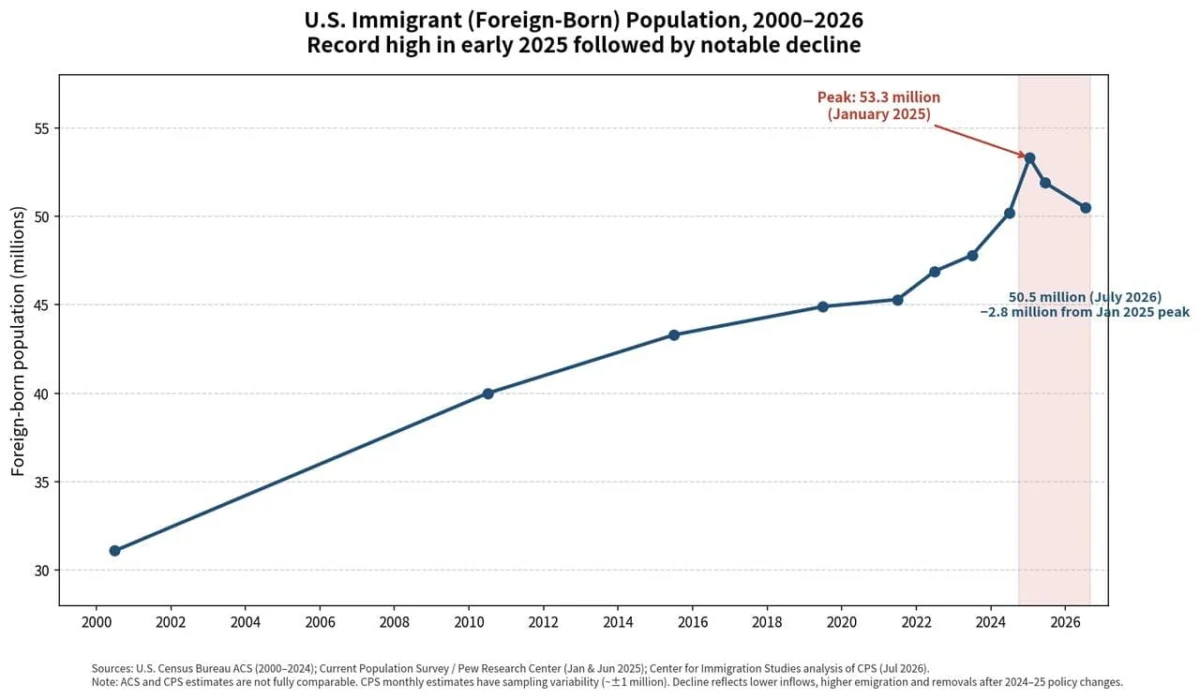
A groundbreaking analysis by the Center for Immigration Studies (CIS) reveals an unprecedented decline in the United States’ immigrant population, marking the first sustained reversal of this trend in nearly a century. The report, based on an examination of the Census Bureau’s Current Population Survey (CPS) data, indicates that the total foreign-born population has fallen by approximately 2.9 million since President Donald Trump began his second term in January 2025. This significant shift includes a reduction of about 2.3 million in the illegal immigrant population and an additional 600,000 legal immigrants who have departed the country.
Key Findings and Data Analysis
The CIS analysis, conducted by research director Steven A. Camarota and demographer Karen Zeigler, tracked government monthly household survey data from January 2025 through July 2026. During this 18-month period, the foreign-born total—which encompasses naturalized citizens, lawful permanent residents, long-term temporary visitors, and illegal immigrants—decreased from an estimated 53.3 million to 50.5 million. This represents a profound demographic shift, contrasting sharply with previous trends.
Specifically, Camarota’s preliminary estimates place the illegal immigrant population at roughly 13.5 million in July 2026, down from 15.8 million at the start of President Trump’s second administration. This 2.3 million reduction in the unauthorized population is a central component of the overall decline. The data indicates that the drop is predominantly among Latin American non-citizens who arrived in 1980 or later, a demographic group that significantly overlaps with the illegal immigrant population. Interestingly, the number of naturalized citizens saw a slight increase of approximately 680,000 over the same period, suggesting that the decrease is concentrated among non-citizens and particularly those without legal standing.
CIS emphasizes that its methodology measures net change, accounting for new arrivals, deportations, voluntary departures, legalizations, and deaths. This comprehensive approach provides a clearer picture of the resident immigrant population compared to gross departure figures. For instance, while the Department of Homeland Security (DHS) reported nearly 3 million departures of illegal immigrants by the one-year mark of Trump’s second term (including 675,000 formal removals and 2.2 million self-deportations), the CIS data reflects the overall change in the population remaining within the country after new entries are factored in.
Speaking to The Washington Times, Camarota described the findings as unprecedented. "We’ve never seen anything quite like this before," he stated. "This is big and sustained, as best as we can tell… It is a fundamental change, and it’s profound."
Historical Context: The Preceding Surge
The dramatic reversal observed under the current administration stands in stark contrast to the preceding four years. From January 2021 to January 2025, during the Biden administration, the United States experienced an unprecedented surge in its foreign-born population, which jumped by 8.3 million. This period marked the largest four-year increase in American history, leading to significant strain on border resources, public services, and housing markets across the nation.
Critics attributed this rapid expansion to a combination of policies and practices, including "catch-and-release" protocols, widespread use of mass parole, perceived asylum abuse, and what many characterized as an effectively open southern border. These policies, they argued, incentivized illegal immigration and created a perception of diminished enforcement, leading to a substantial influx of individuals. The current survey data, therefore, indicates a direct reversal of these trends, demonstrating a rapid unwinding of the demographic shifts that occurred in the previous presidential term.
The Census Bureau had already hinted at a changing dynamic, flagging a "historic" drop in net international migration when it reported that overall population growth slowed to 0.5 percent from mid-2024 to mid-2025. This period only captured the initial months of the new enforcement regime, suggesting that the full impact was yet to be measured. Camarota now posits that the country’s total population is likely heading towards an unprecedented decline, directly linked to the cessation of what he termed the "8.3 million artificial surge" previously pumped through the border.

Policy Shifts Under the New Administration
The observed decline is not attributed to chance but rather to a deliberate and comprehensive shift in immigration policy and enforcement strategies implemented since January 2025. The current administration has moved to significantly tighten border controls and enhance interior enforcement, a marked departure from the previous approach.
One key area of change has been the reevaluation and termination of Temporary Protected Status (TPS) designations. The administration has treated TPS not as a "backdoor amnesty" but strictly as a temporary shelter, adhering more closely to its original statutory intent. A late Biden-era internal memo, exposed in July 2026, reportedly outlined plans to expand TPS in the final days of that presidency, potentially granting de facto protection to over 3 million foreign nationals and setting the stage for prolonged litigation. The current administration has actively worked to dismantle such initiatives. The Supreme Court, for instance, has cleared the path to end TPS for Haitians and Syrians, allowing extensions that were never intended to be permanent to be terminated where legally permissible.
The termination of TPS for Haitians, in particular, triggered a significant increase in deportation flights. Internal documents reported by The New York Times detailed a ramp-up in Immigration and Customs Enforcement (ICE) operations, moving from approximately one deportation flight per month to a weekly schedule to Cap-Haïtien. These flights have included individuals with criminal records, including those convicted of sex crimes involving children, as publicly highlighted by DHS.
Beyond TPS, the administration has also focused on third-country removals for individuals whose home governments are unwilling to accept them back, or who have withholding orders preventing return to a specific country but not removal from the United States entirely. In a ten-day period in late August, internal documents obtained by CBS News revealed three ICE flights carrying over 100 deportees to eight African countries: Burundi, Cameroon, the Central African Republic, Equatorial Guinea, Eswatini, Liberia, Rwanda, and Sierra Leone. Notably, these flights included nationals from Afghanistan, Cuba, Nicaragua, Iran, Nepal, Turkey, and Venezuela, illustrating a broader strategy beyond simply returning African nationals to their home countries. Liberia and Equatorial Guinea have publicly agreed to accept a substantial number of such third-country deportees.
These enforcement actions demonstrate a clear policy framework: first, stopping the inflow of illegal immigration at the border, and then systematically removing those already present in the interior. This two-pronged approach—sealing the border, ending parole pipelines, revoking TPS expansions, and increasing interior enforcement—is credited with the observed population decline.
Expert Commentary and Official Responses
Steven A. Camarota of CIS underscored the effectiveness of the new policies, stating in the CIS release, "The best data we have shows an enormous decrease in the total foreign-born population, with most of the falloff among illegal immigrants." He added, "Regaining control of the border and robust interior enforcement has partly undone the huge increase in the illegal immigration that took place during the border surge."
The Department of Homeland Security, when asked for comment on the Times piece, referred to an earlier release highlighting collapsed border crossings. This aligns with the administration’s narrative that stringent border enforcement is a prerequisite for managing the overall immigrant population.
The drastic shift has naturally elicited varied reactions. Proponents of stricter immigration enforcement view the data as vindication of their long-held arguments. Jim Jordan, for example, previously characterized the prior era as a "systematic plan to open the border, park millions in sanctuary jurisdictions, and then starve the agency that removes them." The current data, from this perspective, represents a direct response to voters who opposed those policies.
Conversely, groups that advocate for more lenient immigration policies, often referred to as the "open-borders crowd," had previously dismissed the possibility of such a significant decline. Their anticipated reactions include complaints about methodology or the humanitarian implications of deportations. Corporate lobbyists, who may have built business models around an "endless supply of illegal labor," are expected to voice concerns about labor shortages. Similarly, school districts that saw increased enrollment from immigrant populations, and NGOs reliant on casework related to immigration, are likely to express opposition.

Even some mainstream media figures, previously critical of stringent enforcement, have inadvertently acknowledged the efficacy of the new policies. Joe Scarborough, during a discussion on Trump’s deportation totals, remarked, "They should know when to take the victory. They could have been campaigning on closed southern border this whole time!" He then added, "You’re never going to get the [deportation] numbers that Joe Biden had, right? You’re not going to get those numbers because Joe Biden and his administration were letting in so many illegal immigrants. It was very easy to sweep up 5,000 right on the border and send them back." This unprompted admission, according to some observers, highlights the fundamental difference between the "revolving door" removals of the Biden era and the comprehensive enforcement of the current administration.
Economic and Social Implications
The decline in the immigrant population, particularly unauthorized immigrants, carries significant economic and social implications. One notable finding is that only 44 percent of those who left were workers. This helps explain why national job numbers have not "imploded" as some corporate lobbyists predicted. U.S.-born employment has continued to rise even as the number of immigrant workers in the household survey fell by nearly 1.3 million.
While some regional pockets, such as the construction sector in South Texas, may experience localized impacts, the country as a whole has not seen widespread economic disruption. Camarota acknowledged that such shifts can create challenges and produce "winners and losers" but concluded, "It’s nothing to panic about… First of all, we’re mostly losing low-income workers. On balance, I think it’s a good deal for the country because I think most people are more worried about wages, housing prices, congestion and impact on schools and hospitals."
The "winners" in this scenario are largely American workers competing for jobs, particularly in lower-wage sectors, and households experiencing relief from pressure on housing prices and public services. The strain on emergency room beds, schools, and other community resources in areas heavily impacted by previous immigration surges is also expected to alleviate.
Conversely, "losers" include employers who relied on cheap, undocumented labor, as well as the aforementioned NGOs and public service providers whose operations were structured around a growing immigrant population. The media narrative surrounding enforcement actions has often focused on the perceived "crisis" of deportations rather than the policy decisions that led to the initial influx. For instance, the press response to Haitian deportations often highlighted the violence in Port-au-Prince, while critics argued that Haiti’s internal conditions, however dire, do not justify converting temporary protection into permanent residency for hundreds of thousands of people.
Conclusion: A New Direction in Immigration Policy
The findings of the Center for Immigration Studies mark a critical juncture in American immigration policy. For the first time since the Great Depression, the United States is experiencing a sustained reduction in its immigrant population, driven largely by a sharp decline in unauthorized immigrants. While the remaining illegal population, estimated at 13.5 million by CIS, is still substantial, the change in trajectory is undeniable.
This shift reflects a conscious decision by the administration to prioritize the enforcement of existing immigration statutes, moving away from policies that critics argued inadvertently encouraged mass migration. The administration’s approach is predicated on the belief that America is not merely a "holding pen for the Western Hemisphere" or a "third-country processing hub with a welfare office attached."
The data from the Current Population Survey provides empirical evidence of what happens when a president implements a comprehensive strategy of border security and interior enforcement: illegal populations fall, legal inflows are more tightly controlled, and the overall foreign-born total decreases by millions in a relatively short period. This fundamental change promises to reshape demographic trends, labor markets, and social services across the nation, ushering in a new era for U.S. immigration policy.

