

The American telecommunications landscape, profoundly shaped by the leadership of Theodore N. Vail, stands as a compelling case study in the interplay between corporate ambition, market dynamics, and governmental regulation. Far from a narrative of pure market competition or outright state control, the story of AT&T’s rise to a decades-long monopoly under Vail’s stewardship exemplifies a distinct form of "political entrepreneurship" – a strategic maneuver to leverage state power for commercial advantage. This approach, which openly embraced and even invited government intervention, redefined the industry, establishing a model of regulated capitalism that would persist for generations.
The Wild West of Early Telephony: A Pre-Vail Landscape
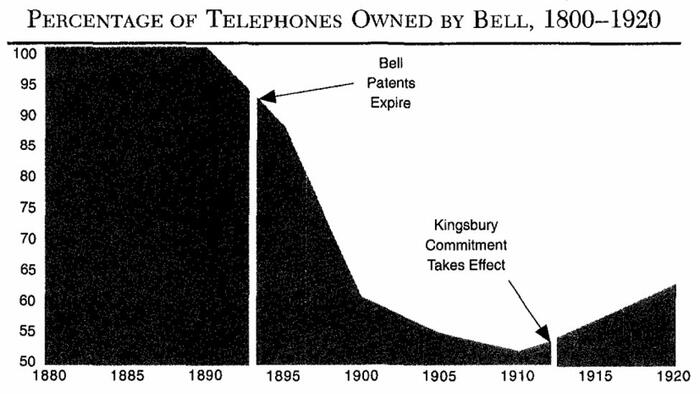
Before Theodore Vail’s transformative return to AT&T in 1907, the American telephone industry was a vibrant, often chaotic, arena of competition. Alexander Graham Bell’s foundational patents, issued in 1876 and 1877, initially granted the Bell System a powerful monopoly. However, upon their expiration in 1893 and 1894, a deluge of independent telephone companies flooded the market. This period, often dubbed the "Independent Era" (1894-1907), witnessed an explosion of innovation, aggressive price competition, and rapid expansion of service across the nation.
Thousands of local and regional telephone companies emerged, offering services that often undercut the Bell System’s rates. By 1907, the Bell System’s market share, though still significant, had been considerably eroded by these independents. Some estimates suggest that while Bell still dominated long-distance, local subscriber numbers were nearly evenly split between Bell and independent companies, with over 3,000 independent exchanges operating nationwide. This intense competition led to fragmented networks, with many communities served by multiple, non-interconnecting systems, creating inconvenience for subscribers and raising questions about efficiency and universal access. This fragmented landscape, while embodying genuine market entrepreneurship through product development and competitive pricing, also presented challenges that Vail would shrewdly exploit.
Theodore N. Vail’s Vision: Consolidation Through Regulation (1907-1912)
Theodore N. Vail, who had previously served as general manager for the Bell enterprise from 1878 to 1887, returned to the helm of AT&T as its president on April 30, 1907. His reappointment marked a decisive turning point, signaling a strategic shift away from competing head-on in a free market and towards a policy of aggressive consolidation and government-sanctioned regulation. Vail’s overarching vision, encapsulated in the resonant slogan "One Policy, One System, Universal Service," aimed to unify the disparate telephone networks under the Bell System’s control.
Vail’s strategy was multifaceted, focusing on the elimination of competitors through acquisition, cultivating strong relationships with policymakers and regulators, and expanding telephone service to the broader public. He recognized that a truly universal system, as he envisioned it, could not be achieved through unfettered market forces alone, particularly given the inherent challenges of interconnectivity and infrastructure duplication. Instead, he proposed a "middle ground" solution – regulated capitalism – that sought to combine the supposed efficiencies of private management with the stability and public trust conferred by government oversight.
Vail was remarkably transparent about his intentions. In AT&T’s 1910 Annual Report, he explicitly articulated his belief that "Effective, aggressive competition, and regulation and control are inconsistent with each other, and cannot be had at the same time." He further elaborated, "Control or regulation… means everything which is the opposite of and inconsistent with effective competition." This direct acknowledgment underscored his preference for a controlled environment, where competition was managed rather than unleashed. By 1917, after several successful efforts to limit competition, Vail unequivocally declared, "These two [competition and control/regulation] are absolutely inconsistent. If the public is getting the fullest advantage of control and regulation, no competition except destructive competition can exist."
Vail argued that a universal telephone system could not be accomplished by separately controlled or distinct systems, nor through competition "in the accepted sense." He believed that a single, unified system, under appropriate control and regulation, would offer superior service at a lower cost than either pure competition or a government-owned monopoly, while remaining self-sustaining. This argument skillfully appealed to both public desire for reliable, widespread service and the perceived inefficiencies of the competitive market.
Crucially, Vail also advocated for government protection for regulated companies. He asserted that "If there is to be state control and regulation, there should also be state protection." This protection, in his view, extended to shielding a corporation "striving to serve the whole community" from "aggressive competition which covers only that part which is profitable." He argued that governmental control should safeguard investors by ensuring "fair returns" and protect public utilities from competitors offering "unfair rates" – a thinly veiled reference to lower prices. Vail’s definition of acceptable competition was highly restrictive, allowing only that which "gives additional facilities or service" and was not merely "unnecessary duplication" or "selfish speculative object of forcing a consolidation or purchase." In essence, competition would be permitted only on terms dictated by AT&T and its regulatory allies.
The Progressive Era and the Specter of Antitrust
Vail’s aggressive strategy of acquiring independent telephone companies quickly drew the attention of the federal government. The early 20th century in America was characterized by the Progressive Era, a period marked by widespread public concern over the power of large corporations and trusts. The Sherman Antitrust Act of 1890, though initially inconsistently enforced, had gained significant teeth through landmark cases like the breakup of Standard Oil (1911) and the Northern Securities Company. There was a prevailing sentiment among the public and policymakers that unchecked corporate power could stifle economic opportunity and harm consumer welfare.
By 1912, the U.S. Justice Department, fresh from its high-profile victory against John D. Rockefeller’s Standard Oil, began to scrutinize AT&T’s rapid expansion. The company’s relentless acquisitions and its growing dominance in the burgeoning telecommunications sector raised red flags, triggering fears of an emergent telephone trust. The threat of a government-initiated antitrust lawsuit, which could potentially dismantle the Bell System, loomed large. This created a precarious situation for AT&T, forcing Vail to reconsider his expansion tactics.
The Kingsbury Commitment: A Strategic Retreat and Long-Term Victory (1913)
Facing the very real possibility of a legal battle that could fragment his unified vision, Vail orchestrated a masterful strategic maneuver known as the Kingsbury Commitment in December 1913. This agreement, reached between AT&T and the U.S. Attorney General, represented a pivotal moment, fundamentally altering the trajectory of the American telephone industry.

Under the terms of the Kingsbury Commitment, AT&T agreed to several concessions:
- Cessation of Acquisitions: AT&T pledged to stop acquiring independent telephone companies.
- Divestiture of Western Union: The company agreed to sell its holdings in Western Union Telegraph Company, a move to separate telegraph and telephone services and alleviate concerns about cross-market dominance.
- Interconnection for Independents: Crucially, AT&T committed to allowing independent telephone companies to interconnect with its vast long-distance network. This addressed a major grievance of independents, who often lacked access to Bell’s extensive intercity lines.
While these concessions appeared to be a victory for antitrust advocates and independent companies, Vail astutely transformed them into a long-term strategic advantage for AT&T. As industry historians Michael K. Kellogg, John Thorne, and Peter W. Huber noted, government officials ultimately concluded that "monopoly in communications was much more tolerable than monopoly in oil." The commitment, in effect, granted AT&T something far more valuable than the unfettered right to acquire: the implicit government acceptance of its dominant, albeit regulated, position in the telephone industry.
Richard Vietor, in Contrived Competition: Regulation and Deregulation in America (1994), succinctly captured the essence of Vail’s decision: "Vail chose at this time [around the Kingsbury Commitment] to put AT&T squarely behind government regulation, as the quid pro quo for avoiding competition. This was the only politically acceptable way for AT&T to monopolize telephony." Robert W. Garnet, author of The Telephone Enterprise: The Evolution of the Bell’s Horizontal Structure (1985), further elaborated, stating that Vail "embraced state regulation. In doing so, he broke with the company’s long-standing opposition to what [AT&T] management had traditionally regarded as an unwarranted intrusion on its prerogatives." After years of intense competition that had sapped the firm’s financial strength and undermined its efforts to build an integrated system, regulation became a "much-preferred alternative." The Kingsbury Commitment thus became the bedrock upon which AT&T built its enduring, government-sanctioned monopoly.
The Enduring Legacy of a Regulated Monopoly
The Kingsbury Commitment solidified AT&T’s status as a regulated public utility, setting the stage for over seven decades of a unique industrial structure in American telecommunications. This model of a "natural monopoly," where a single provider was deemed most efficient due to high infrastructure costs, shaped everything from pricing and service standards to technological innovation.
Impact on the Industry and Consumers:
- Universal Service: The commitment helped AT&T pursue its "Universal Service" goal, expanding telephone access across the nation, even to less profitable rural areas. This was often achieved through cross-subsidization, where revenues from lucrative long-distance services or urban areas helped offset the costs of extending service to remote locations.
- Stabilized Pricing and Service: Regulation, primarily by state public utility commissions (PUCs) and the Interstate Commerce Commission (ICC), aimed to ensure "just and reasonable" rates and reliable service. While this removed the volatility of competitive pricing, it also limited consumer choice and potentially stifled price reductions that might have occurred in a freer market.
- Innovation within Limits: The regulated monopoly structure provided AT&T, particularly through its renowned Bell Labs, with significant resources for research and development. Bell Labs produced groundbreaking innovations, including the transistor, fiber optics, and the UNIX operating system. However, the monopoly structure also meant that these innovations were often controlled and deployed by AT&T, rather than being openly licensed or stimulating broader market competition in their application. Independent manufacturers and service providers faced barriers to entry, often struggling to integrate with the Bell System or offer alternative products.
Economic and Political Implications:
- The "Triumph of Conservatism": Theodore Vail’s actions are a classic illustration of historian Gabriel Kolko’s thesis in The Triumph of Conservatism. Kolko argued that during the Progressive Era, many powerful businesses, far from being victims of government overreach, actively sought and shaped regulation to achieve stability, limit competition, and establish cartels or monopolies. For AT&T, regulation provided a shield against disruptive market forces and the existential threat of antitrust.
- Cronyism and Political Entrepreneurship: Vail’s career perfectly encapsulates the distinction between "market entrepreneurs" who succeed by creating superior products at lower costs, and "political entrepreneurs" who thrive through federal aid, vote-buying, and leveraging government policy. Vail’s transparent invitation for state intervention to secure a dominant market position at the expense of genuine competition is a prime example of cronyism – government intervention benefiting special interests at the public’s expense.
- Rothbard’s Insight: Economist Murray Rothbard’s observation that "Monopoly could be put over in the name of opposition to monopoly!" finds a clear parallel in AT&T’s story. Vail framed his quest for monopoly as a solution to the "chaos" of competition, promising universal service and efficiency, thereby legitimizing a market structure that fundamentally restricted consumer choice and entrepreneurial freedom.
In conclusion, Theodore N. Vail’s strategic leadership fundamentally reshaped the American telecommunications industry. Through a combination of aggressive business tactics and a politically astute embrace of regulation, he steered AT&T away from a competitive free market towards a government-sanctioned monopoly. The Kingsbury Commitment of 1913 was not merely a compromise to avoid antitrust litigation but a shrewd maneuver that secured AT&T’s dominant position for decades. This history offers a profound insight into the early 20th-century relationship between big business and government, demonstrating how "political entrepreneurship" can leverage public rhetoric and regulatory frameworks to establish and maintain powerful corporate interests, often at the long-term expense of broad market competition and consumer choice.

