
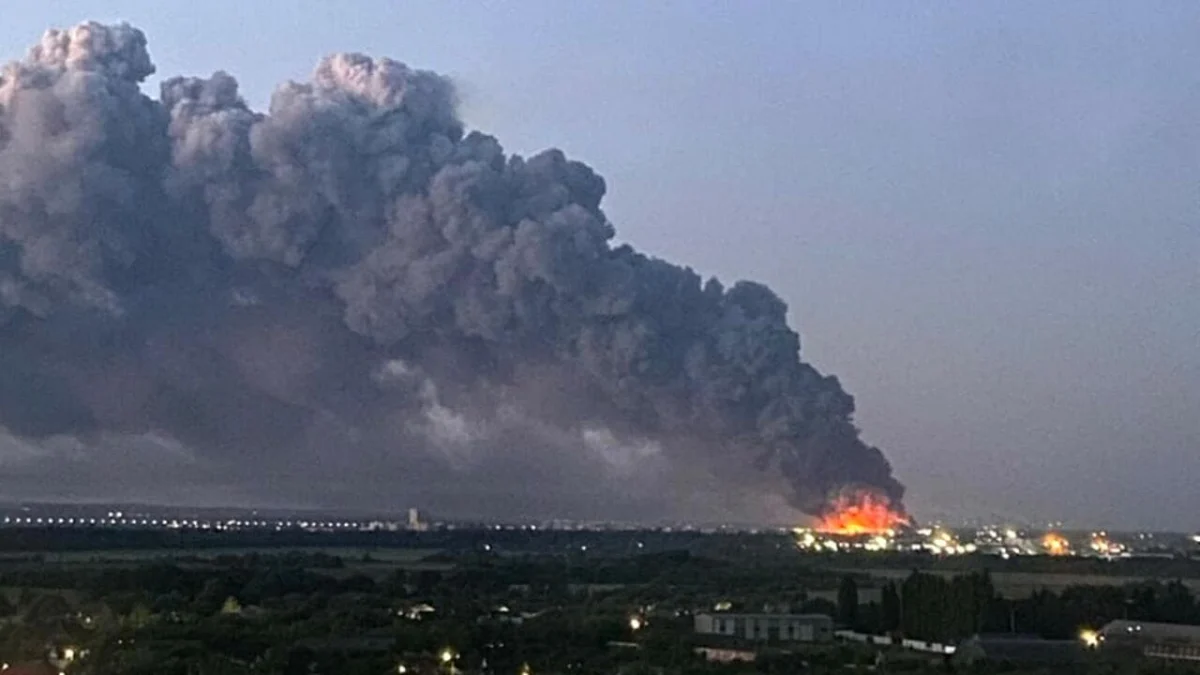
On Wednesday, Ukrainian forces launched a series of sophisticated drone attacks deep within Russian territory, successfully targeting a major Wildberries logistics facility in the Tambov region and the critical NORSI oil refinery in the Nizhny Novgorod region. These coordinated strikes represent a significant escalation in Ukraine’s strategy to inflict economic and logistical pain on the aggressor, bringing the direct consequences of the conflict further into Russia’s heartland. The Wildberries warehouse, located in Kotovsk, was not only struck for the second time this summer but was reported by Governor Yevgeny Pervyshov to have been "completely" destroyed in the ensuing conflagration, casting a massive, noxious plume of smoke over the city. Simultaneously, the NORSI oil refinery, a crucial asset owned by Lukoil and one of Russia’s most important energy facilities, reportedly suffered a forced shutdown following its own drone strike, contributing to soaring diesel prices and highlighting vulnerabilities in Russia’s industrial backbone. These actions align with Kyiv’s explicit commitment to raise the cost of the war for Moscow, demonstrating an evolving capacity to strike high-value targets far from the front lines.
Targeting Russia’s E-commerce Giant: The Wildberries Warehouse Attack
The attack on the Wildberries facility in Kotovsk, a city within the central Tambov region, underscores Ukraine’s calculated strategy to disrupt Russia’s domestic economy and logistical capabilities. Wildberries, often referred to as "Russia’s Amazon," is the country’s largest online retailer, holding a dominant market share in the Russian e-commerce sector. With billions in annual revenue and a vast network of suppliers and sellers, its logistics hubs are pivotal for distributing a wide array of consumer goods across Russia’s immense geographical expanse. The strategic importance of these facilities extends beyond mere retail; they form the backbone of a sprawling national distribution network essential for daily commerce and, according to Ukrainian intelligence, are susceptible to being repurposed or leveraged for dual-use supplies that could inadvertently or directly aid the Russian military effort. This perceived role in supporting the broader Russian war economy renders them legitimate targets in Kyiv’s eyes.
This latest strike marks the second time the Kotovsk warehouse has been targeted this summer, indicating a persistent operational objective. The previous incident on July 18 resulted in tragic human costs, with seven employees reportedly killed and 23 more hospitalized, underscoring the inherent dangers to civilian personnel working in facilities deemed strategic by Kyiv. The repeated targeting of this specific site, culminating in its "complete" destruction as confirmed by Tambov Governor Yevgeny Pervyshov following Wednesday’s strike, suggests a more potent and precise attack than previously, with the resulting fire consuming the entire complex. The scale of the blaze, as evidenced by circulating images and official statements, indicates extensive structural damage and loss of inventory.
The immediate aftermath of the attack saw the city of Kotovsk enveloped in a massive black cloud of smoke and smog, prompting urgent warnings from local authorities. Mayor Alexey Plakhotnikov took to social media to instruct residents to shelter in place, emphasizing the severe health risks posed by carbon monoxide and other combustion products. "A massive fire at the Wildberries warehouse complex, smoke and smog are quickly spreading throughout the city," Plakhotnikov wrote, adding, "To avoid carbon monoxide poisoning and combustion products, I strongly urge you to refrain from active movement around the city for the next two days. Keep your windows and balconies closed." Such directives highlight the significant public health and environmental consequences of these large-scale industrial fires, impacting local populations far beyond the immediate site of the explosion and potentially requiring extensive environmental monitoring and clean-up efforts.
Ukraine has explicitly justified targeting Wildberries facilities by asserting that the online retailer, despite its commercial façade, contributes to the Russian military’s sustainment through its logistical capabilities, thus rendering its hubs legitimate military targets under the laws of armed conflict. While specific evidence linking Wildberries directly to military supply chains is not always publicly detailed by Kyiv, the broad interpretation of "war economy" targets has become a hallmark of Ukraine’s long-range strike doctrine. Over a dozen key Wildberries logistics hubs have reportedly been hit in various attacks across Russia, indicating a concerted campaign to degrade Russia’s internal distribution networks and impose a tangible cost on its civilian-military industrial complex. The destruction of a facility of this magnitude will undoubtedly cause significant disruptions to Wildberries’ operations, leading to extensive inventory losses, delivery delays, and substantial financial setbacks for the company and the myriad small businesses that rely on its platform, thereby impacting consumer access to goods and the broader Russian economy. The symbolic impact of hitting such a recognizable consumer brand also serves to bring the reality of the war closer to the average Russian citizen.
Crippling Russia’s Energy Lifeline: The NORSI Refinery Strike
In a parallel and equally impactful strike, Ukrainian drones targeted Russia’s NORSI oil refinery in Kstovo, Nizhny Novgorod region, an enterprise of critical strategic importance to the Russian energy sector. Owned by the major Russian oil company Lukoil, the NORSI refinery is not merely another industrial target; it is one of Russia’s largest and most significant oil processing facilities. Its annual crude throughput capacity is estimated to be between 15 to 17 million metric tons, making it a cornerstone of Russia’s refined petroleum product output. This facility is a primary producer of various crucial fuels, including diesel, gasoline, jet fuel, and petrochemical products. Its output directly supports both civilian transportation, agriculture, and industrial operations, as well as providing critical fuel supplies for the Russian military’s ground and air forces.
The Ukrainian military confirmed the strike, stating that the refinery was "up in flames" following the overnight attack. While official Kremlin confirmation of the damage and operational status remained elusive in the immediate aftermath, regional unconfirmed reports quickly surfaced, indicating that the NORSI complex had "suffered a forced shut down." This operational halt has immediate and significant economic ramifications, particularly in the context of already volatile global energy markets. Reports suggest that diesel prices, a vital commodity for both military logistics and civilian transportation and agriculture, were soaring near all-time highs even before this incident, a trend that the NORSI shutdown is expected to exacerbate further. The disruption to such a major producer of diesel fuel can create supply shortages, drive up prices, and create bottlenecks in Russia’s vast internal transportation and agricultural sectors.
Videos circulating rapidly online, despite the lack of official Russian confirmation, provided compelling visual evidence of the extensive fire at the refinery, showing massive plumes of smoke and flames indicative of a substantial incident. The deliberate targeting of such a high-value energy asset aligns with Ukraine’s strategy to undermine Russia’s capacity to sustain its war effort and generate export revenues. Refineries like NORSI are crucial not only for domestic fuel supply but also for processing crude oil into products that are then exported, forming a significant portion of Russia’s state budget. Disrupting these operations directly impacts Russia’s financial resources available for military expenditure and its ability to maintain its economic stability under Western sanctions. The challenges of repairing or replacing such a large, complex industrial facility are immense, requiring specialized equipment, skilled labor, and significant time, potentially leading to a prolonged reduction in output.
The implications of a prolonged shutdown or significant damage to NORSI extend beyond immediate fuel prices. It could strain Russia’s internal logistics for fuel distribution, potentially forcing reliance on other refineries or even imports in certain regions, thereby creating bottlenecks and increasing costs. For a nation heavily reliant on its oil and gas sector for economic stability and state funding, such a strike represents a direct assault on its economic resilience and its ability to project power both domestically and internationally.
Ukraine’s Escalating Drone Campaign: A Broader Offensive

These strikes on the Wildberries warehouse and the NORSI refinery are not isolated incidents but rather integral components of Ukraine’s increasingly bold and effective long-range drone campaign. Over recent months, Kyiv has intensified its efforts to take the war directly to Russian territory, employing unmanned aerial vehicles (UAVs) to strike targets deep behind the front lines. This strategy serves multiple objectives: to degrade Russia’s military and economic capabilities, to exert psychological pressure on the Russian populace, and to demonstrate Ukraine’s evolving capacity for asymmetric warfare against a larger, conventionally superior adversary.
President Volodymyr Zelensky has repeatedly vowed to continue these punishing long-range drone strikes, articulating a clear rationale for this approach. In a post on X (formerly Twitter), Zelensky wrote, "The war must return to where it came from. Ukraine responds to Russian strikes, and we do so in a way that ensures the cost of the war for the aggressor inevitably rises." This statement encapsulates Ukraine’s strategic imperative: to make the conflict unsustainable for Russia by imposing escalating costs on its economy, infrastructure, and domestic stability. The overnight drone onslaught that resulted in the deaths of three people across Russia, as mentioned in initial reports, further underscores the widespread nature and lethal potential of these operations, extending beyond mere economic targets to include human casualties.
The chronology of these attacks shows a pattern of increasing frequency, sophistication, and depth. From military airfields and fuel depots closer to the border to now striking major logistics hubs and critical energy infrastructure hundreds of kilometers inside Russia, Ukraine’s drone capabilities are steadily expanding. While specific drone models are rarely confirmed, the use of long-range, often modified, and domestically produced UAVs has become a hallmark of these operations. This ongoing campaign also severely tests Russia’s air defense systems, forcing Moscow to divert valuable resources and personnel away from the front lines to protect its vast domestic assets. The reported inability to prevent significant damage or destruction in several high-profile strikes raises questions about the efficacy and comprehensive coverage of Russian air defenses against these persistent drone threats across its immense territory.
While residents of the Ukrainian capital brace for potential Russian ballistic missile responses—a grim reality of reciprocal strikes—Kyiv remains committed to its long-range offensive. This commitment signals a strategic shift, moving beyond purely defensive operations to proactively disrupt Russia’s war machine and internal stability. The psychological toll on Russian civilians witnessing these attacks, often broadcast widely on social media, further complicates the Kremlin’s efforts to maintain a narrative of normalcy and control.
Implications and Analysis
The recent Ukrainian drone strikes carry profound implications across economic, psychological, and military dimensions, shaping the trajectory of the ongoing conflict.
Economic Disruptions and Supply Chain Vulnerabilities: The destruction of a major Wildberries logistics center will undoubtedly disrupt consumer goods supply chains, leading to product shortages, delivery delays, and potentially higher prices for Russian consumers. This directly impacts the civilian economy and can erode public confidence. Coupled with the forced shutdown of the NORSI oil refinery, which affects vital fuel supplies, the combined economic pressure becomes significant. Russia’s economy, already under extensive Western sanctions, faces additional strains from direct physical damage to its industrial base. The soaring diesel prices, exacerbated by the refinery incident, will have cascading effects on transportation, agriculture, and industrial production, potentially fueling inflation and reducing overall economic output. The vulnerability of key infrastructure deep within Russia suggests that no economic sector is entirely immune from the conflict’s reach, forcing Moscow to divert resources towards repair and reconstruction rather than the war effort.
Psychological Warfare and Domestic Impact: One of the primary objectives of Ukraine’s deep strikes is psychological. By bringing the war home to Russian citizens, Kyiv aims to undermine public support for the conflict and create a pervasive sense of insecurity. The imagery of massive fires, dense smoke clouds over residential areas, and local authorities issuing shelter-in-place orders directly confronts ordinary Russians with the reality of the conflict. This contrasts sharply with the Kremlin’s narrative, which often portrays the "special military operation" as a distant, controlled affair. Such incidents can foster unease, resentment, and questions about the government’s ability to protect its own territory and citizens, potentially influencing public opinion and internal political dynamics over the long term, and putting political pressure on President Putin to demonstrate a stronger response.
Military Effectiveness and Future Trajectory: From a military perspective, these strikes demonstrate Ukraine’s growing capacity to conduct asymmetric warfare. Lacking parity in conventional air power, Ukraine leverages cost-effective drones to target high-value assets, forcing Russia to expend significant resources on defense. The success of these strikes indicates improvements in Ukrainian intelligence, drone technology, and operational planning. This strategy not only degrades Russia’s military-industrial complex by targeting logistics and energy but also forces Russia to divert air defense assets from the front lines, potentially creating vulnerabilities for Ukrainian forces to exploit. The continued commitment from President Zelensky suggests that these attacks will not only persist but may also become more frequent and target an even wider array of strategic locations across Russia, further testing the limits of Russia’s vast but not impenetrable air defense network.
The international community watches closely as this new phase of cross-border engagement unfolds. While Western allies generally support Ukraine’s right to self-defense, there are ongoing discussions about the potential for escalation, particularly if strikes target civilian areas or infrastructure with no direct military connection. However, by focusing on industrial and logistics hubs that Kyiv asserts support the war effort, Ukraine aims to maintain the moral high ground while increasing pressure on Moscow. The potential ripple effect on global energy markets, should Russian energy exports be consistently threatened, also adds a layer of international concern.
Conclusion
The simultaneous destruction of a major Wildberries logistics center and the operational halt of the NORSI oil refinery mark a critical juncture in the conflict, underscoring Ukraine’s evolving capabilities and its unwavering resolve to impose severe costs on Russia. These strikes are more than mere acts of retaliation; they are a calculated strategy to disrupt the aggressor’s economic and logistical lifelines, challenge its narrative of domestic security, and directly contribute to President Zelensky’s stated goal of raising "the cost of the war for the aggressor." As the conflict enters its next phase, the skies over Russia are increasingly becoming a new front, where Ukrainian ingenuity and determination are testing the limits of Russian defenses and potentially reshaping the strategic landscape of the war. The full extent of the damage and long-term implications of these strikes will continue to unfold, but their immediate impact signals a clear escalation in the intensity and reach of the conflict, pushing both sides towards new strategic calculations.

