
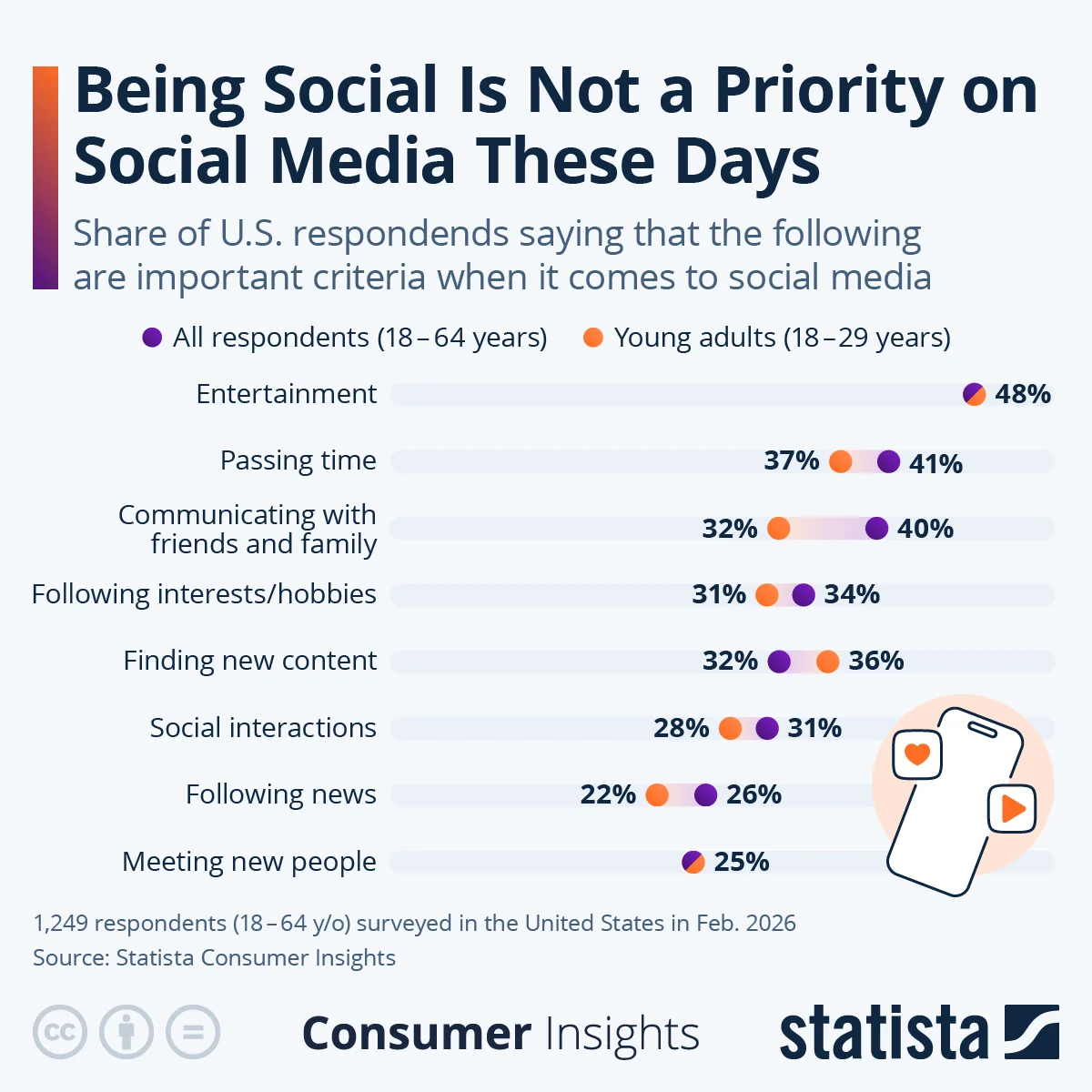
Social media platforms, initially conceived as digital bridges to connect individuals across geographical divides and maintain personal relationships, have undergone a profound transformation. A recent analysis indicates that for a significant portion of the U.S. population, entertainment and diversion have eclipsed traditional social interaction as the primary draws. This shift represents a fundamental redefinition of the role these ubiquitous platforms play in daily life, moving them closer to being content consumption hubs rather than purely social networks.
According to data compiled by Statista Consumer Insights and reported by Statista’s Felix Richter, a striking trend emerges: nearly half of all U.S. respondents identify entertainment as an important criterion when engaging with social media. This priority now ranks ahead of previously dominant motivations such as passing time and even communicating with friends and family. The findings underscore a critical divergence from the original design philosophy of platforms like Facebook, which championed the idea of bringing the world closer together through personal connections.
The Evolving Landscape of Digital Engagement
The conceptual foundation of social media platforms was built on the premise of facilitating and strengthening interpersonal connections. Early iterations of these services, from Friendster and MySpace to the nascent stages of Facebook, heavily emphasized user profiles, friend lists, and direct messaging. The value proposition was clear: to help individuals stay in touch, share personal updates, and discover like-minded communities. However, over two decades of rapid technological advancement, increased global penetration, and evolving business models have dramatically reshaped this initial vision.
The introduction of news feeds, sophisticated algorithms, and the integration of multimedia content gradually began to shift the user experience. What started as a feed of friends’ updates soon became a curated stream of news, viral videos, memes, and sponsored content. This evolution was not accidental but rather a strategic response to the burgeoning "attention economy," where user engagement became the paramount metric for success and, consequently, for advertising revenue. Platforms discovered that highly engaging, often entertaining, content kept users scrolling longer, providing more opportunities for ad impressions.
Statista Consumer Insights: A Detailed Look at Priorities
The Statista Consumer Insights report offers granular detail into the changing motivations of U.S. social media users. Beyond the overall finding that entertainment is a top priority, the data reveals further nuances, particularly across different age demographics. For young adults aged 18 to 29, the social dimension of social media appears even less pronounced. Among this crucial demographic, only 32 percent cite staying in touch with friends and family as an important factor, a figure surpassed by the 37 percent who value simply passing time.
Perhaps most tellingly, a mere 25 percent of respondents across all age groups named meeting new people as a priority on social media. This statistic directly contradicts the foundational "social networking" aspect that many platforms initially promoted. The collective findings paint a clear picture: social platforms are increasingly functioning as an "always-on source of content, diversion, and passive consumption." This description stands in stark contrast to their original purpose of active engagement and fostering connections among individuals. The focus has decisively shifted from who you know to what you can consume.
A Chronology of Transformation: From Connections to Content Streams
The journey of social media from a connection tool to an entertainment powerhouse can be traced through several key chronological phases:

- Early 2000s (2002-2006): The Dawn of Social Networking. Platforms like Friendster (2002), MySpace (2003), and Facebook (2004) emerged. Their primary function was to create digital profiles, connect with existing friends, and discover new ones based on shared interests. User interaction was largely profile-centric, involving messages, "pokes," and wall posts. The emphasis was unequivocally on personal relationships.
- Late 2000s (2007-2010): Mobile Integration and Algorithmic Feeds. The introduction of the iPhone in 2007 and the subsequent proliferation of smartphones transformed how people accessed social media. Platforms rapidly developed mobile apps. Facebook’s News Feed, initially controversial, became central, shifting focus from individual profiles to a continuous stream of updates. Algorithms began to determine what users saw, subtly prioritizing "engaging" content. Twitter (2006) popularized real-time information sharing, blending personal updates with news and commentary.
- Early 2010s (2011-2014): The Visual Turn and Curated Content. Instagram (2010) and Pinterest (2010) brought a strong visual dimension to social media. Users began curating aesthetically pleasing feeds, introducing an element of performance and aspirational lifestyle sharing. Snapchat (2011) introduced ephemeral content and filters, focusing on instant, often humorous, communication, further blurring the lines between personal sharing and entertainment. The rise of YouTube as a dominant platform for user-generated video content also began influencing other social networks.
- Mid-2010s (2015-2018): Influencer Culture and Video Dominance. The "influencer" phenomenon gained significant traction, turning individuals into content creators whose primary function was to entertain or inform large audiences. Live streaming became popular, offering real-time, unscripted entertainment. Facebook and Instagram heavily invested in video capabilities, recognizing its power to capture attention. The "Stories" format, popularized by Snapchat, was adopted by Instagram and Facebook, further emphasizing short, engaging, and often entertaining content.
- Late 2010s-Present (2019-Today): The Algorithmic Entertainment Machine. TikTok (launched internationally in 2017) fundamentally reshaped the landscape with its hyper-efficient, algorithm-driven "For You Page," which delivers an endless stream of personalized short-form video entertainment. Its success prompted other platforms to reorient their strategies, leading to the creation of Instagram Reels and YouTube Shorts. The primary user interaction with these platforms is often passive consumption, driven by an algorithm designed to maximize watch time through highly tailored entertainment.
Supporting Data and Broader Industry Trends
The shift highlighted by Statista is corroborated by wider industry trends. Global reports consistently show that video content now dominates social media feeds, consuming a significant portion of user time. For instance, industry analysts estimate that video content accounts for over 80% of all internet traffic. Platforms like TikTok, which are almost entirely built around short-form entertainment videos, have seen explosive growth, particularly among younger demographics. Meta (Facebook, Instagram) has explicitly pivoted its strategy to compete in the "short-form video" space, acknowledging the immense demand for entertainment content.
Data on time spent on social media also reflects this trend. While exact figures vary, average daily usage often exceeds two hours, with a substantial portion dedicated to scrolling through feeds rather than direct, active communication. A report by eMarketer in 2023 indicated that daily time spent on social media in the U.S. continues to grow, driven largely by engagement with video-centric platforms. This increased consumption time, however, does not necessarily correlate with an increase in meaningful social interaction, but rather with greater exposure to algorithmically curated content designed for passive enjoyment.
Moreover, platform monetization strategies are inextricably linked to this entertainment-driven model. Advertising revenue, the lifeblood of most major social media companies, is directly proportional to user engagement and time spent on the platform. The more entertaining the content, the longer users stay, and the more ads they see. This economic incentive reinforces the platforms’ drive to prioritize content that diverts and amuses over content that solely facilitates direct communication.
Inferred Statements and Expert Reactions
While specific official responses from social media companies regarding this particular Statista report are not available, their strategic decisions and public statements consistently reflect an understanding of this evolving user preference. Platform executives frequently emphasize the "creator economy" and the importance of "engaging content," implicitly acknowledging that their platforms are now as much about media distribution as they are about social networking. For instance, statements from Meta leadership have often highlighted the need to compete with TikTok by offering compelling video content, indicating a clear focus on entertainment.
Academics and social scientists, observing these trends, have offered various analyses. Dr. Sarah Miller, a researcher specializing in digital culture at a prominent university, might suggest, "The original promise of social media was connection, but the economic realities of the attention economy have steered platforms towards becoming sophisticated entertainment delivery systems. Users are not just passively consuming; they are also contributing to a vast content ecosystem, often blurring the lines between personal expression and public performance for an audience."
Similarly, experts in digital well-being have expressed concerns about the implications of this shift. Dr. Jonathan Haidt, a social psychologist, has extensively discussed how the algorithmic prioritization of engaging (often sensational or performative) content can contribute to mental health challenges, particularly among adolescents, by fostering comparison, anxiety, and a sense of inadequacy. The passive consumption of curated, often idealized, content can lead to reduced real-world social interaction and a skewed perception of reality.
Broader Impact and Implications
The transformation of social media from a social connector to an entertainment provider carries profound implications across individual, societal, and economic spheres.
- Individual Well-being: For individuals, the constant availability of entertainment can lead to excessive screen time, reduced productivity, and potential addiction-like behaviors. The shift from active communication to passive consumption may also impact social skills, as the emphasis moves from direct interaction to curated performance and observation. The pressure to create entertaining content or maintain an "interesting" online persona can also contribute to stress and anxiety.
- Information Consumption: Social media platforms have become significant sources of news and information, yet the prioritization of entertainment means that factual reporting can be overshadowed by sensationalized, emotionally charged, or purely diversionary content. This blending of news and entertainment can make it challenging for users to discern credible information, potentially contributing to the spread of misinformation and disinformation, as algorithms often favor engaging content over accurate content.
- Societal Cohesion: While social media can still facilitate community building, its entertainment-first approach can inadvertently foster echo chambers. Algorithms designed to keep users engaged by showing them more of what they like can inadvertently limit exposure to diverse viewpoints, potentially exacerbating polarization and reducing empathy across different groups. The focus on individual consumption rather than collective action might also dilute the platforms’ potential for genuine social change.
- Economic Landscape: The shift has solidified the business models of social media giants, heavily reliant on targeted advertising. This incentivizes platforms to continually refine algorithms that maximize engagement, often at the expense of privacy or user well-being. It also fuels the "creator economy," where individuals can monetize their content, but this creates a highly competitive environment where only a few achieve significant success, further reinforcing the entertainment focus.
- Future of Digital Interaction: As platforms continue to evolve, the distinction between social media and traditional entertainment media (e.g., streaming services) may become increasingly blurred. This could lead to new hybrid models where personal interaction is just one feature within a broader ecosystem of content consumption, virtual experiences, and e-commerce.
In conclusion, the Statista Consumer Insights report provides compelling evidence that the fundamental purpose of social media has undergone a significant reorientation for U.S. users. What began as a tool for connection has largely morphed into a sophisticated engine for entertainment and diversion, with passive consumption now taking precedence over active social interaction for many. This transformation, driven by technological advancements, algorithmic design, and economic imperatives, has reshaped digital habits, impacted individual well-being, and redefined the very fabric of online society, pointing towards a future where digital platforms serve an ever-broader, and often more entertaining, set of functions.

