

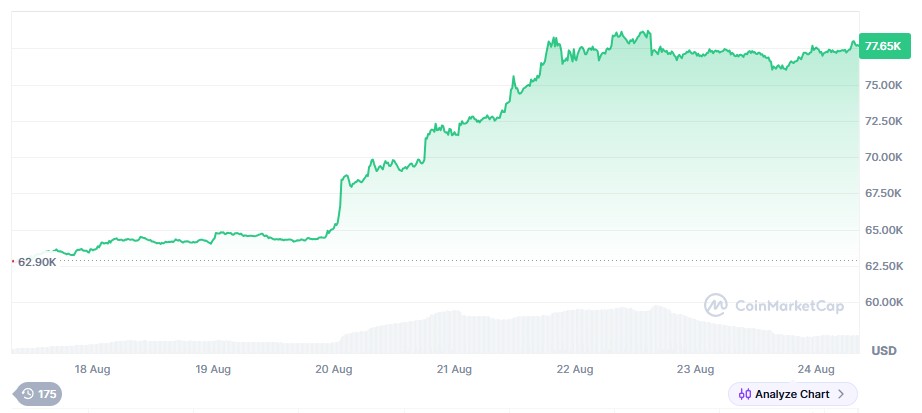
Confidence has surged back into cryptocurrency markets this week as Bitcoin (BTC) experienced a remarkable rally, gaining over 23% to trade around $77,559 at the time of writing. The digital asset briefly touched a high of $79,000 on Friday, signaling a potential shift in market sentiment that has left many investors and analysts questioning if the prolonged bear market has finally reached its end. This significant price movement is underscored by Bitcoin’s crossing of its 200-day moving average, a key technical indicator, for the first time since November 2025, a milestone often interpreted as a harbinger of sustained bullish momentum.
The resurgence has not been limited to Bitcoin. Major altcoins have also seen substantial gains, with Ethereum (ETH) climbing 31%, Solana (SOL) advancing 28%, and XRP (XRP) exhibiting an astonishing surge of 53%. This broad-based rally suggests a renewed appetite for risk assets within the digital currency space, driven by a confluence of factors including institutional adoption, macroeconomic shifts, and evolving regulatory discussions.
The influx of capital into spot Bitcoin and Ether exchange-traded funds (ETFs) has been a significant contributor to the market’s recovery. Last week alone, these instruments saw net inflows exceeding $2.61 billion, indicating strong institutional demand. This is further evidenced by Michael Saylor’s MicroStrategy, whose significant Bitcoin holdings have now crossed their breakeven point of $75,385, officially restoring Saylor’s reputation as a prescient Bitcoin visionary. Market sentiment is also reflected in the growing confidence in Bitcoin reaching new highs, with Polymarket odds suggesting a 48% probability of Bitcoin surpassing $90,000 before 2027.

The positive sentiment has also reverberated across the broader crypto-related equities market. Publicly traded companies with significant exposure to the digital asset ecosystem, including Canaan, Metaplanet, Coinbase, and Robinhood, have all experienced double-digit percentage gains in their share prices. This correlation highlights the interconnectedness of the crypto market with traditional financial instruments and investor confidence.
US Debt Policy Fuels Rush to Crypto and Precious Metals
The recent surge in cryptocurrency prices and the continued appeal of precious metals are increasingly being linked to the escalating U.S. national debt and its associated economic implications. This week, the U.S. debt ceiling crossed the $40 trillion mark, a figure accompanied by a palpable lack of a concrete plan for fiscal consolidation or debt reduction, beyond a general aspiration for economic growth. The annual cost of servicing this debt has now surpassed the expenditure on Medicare and stands as the second-largest government expense, trailing only Social Security.
Analysts, including those at The Kobeissi Letter, have attributed the rapid appreciation in both precious metals and cryptocurrencies to a potent combination of persistent inflation, record government deficit spending, and strategic U.S. Treasury policy. The Treasury Department’s commitment to at least double the size of certain debt buyback operations to $4 billion has been cited as a direct catalyst for the rally in these alternative asset classes. This policy aims to manage the supply of U.S. debt, potentially creating demand and influencing interest rates.
Prominent investors are increasingly vocal about the need to diversify portfolios in light of these fiscal challenges. Ray Dalio, the founder of Bridgewater Associates, has long advocated for a strategic allocation of portfolios to both gold and Bitcoin. Dalio suggests that approximately 15% of an investment portfolio should be allocated to gold, with a smaller but significant portion dedicated to Bitcoin, as a hedge against the potential fallout from the U.S.’s mounting debt obligations. He has previously warned that a significant U.S. debt crisis could materialize within the next three to five years if current fiscal trajectories remain unchanged. This sentiment underscores a growing belief among institutional investors that traditional financial systems may face significant headwinds, prompting a search for uncorrelated or inflation-resistant assets.
White House Engages Crypto Leaders for Regulatory Clarity
In a significant development, U.S. President Donald Trump has renewed his call for the passage of the CLARITY Act, a piece of legislation aimed at providing a more defined regulatory framework for the cryptocurrency industry. This push follows a series of meetings with key figures in the crypto space, including Coinbase CEO Brian Armstrong and Gemini co-founders Cameron and Tyler Winklevoss. Trump has urged members of Congress to expedite the passage of a "fair version" of the bill, asserting that such legislation is crucial for maintaining the United States’ competitive edge in the global digital asset landscape, particularly in relation to China. The CLARITY Act, which passed the House of Representatives in July 2025, is slated for a procedural vote requiring 60 votes for advancement.
Trump has described the bill as "very bipartisan," noting support from a significant number of Democrats. However, Democratic Senators have expressed reservations, indicating a reluctance to pass the bill without further concessions on ethics provisions. Senator Ruben Gallego, for instance, voiced skepticism regarding the President’s definition of "fair," suggesting that the President should not unilaterally determine the scope of regulation.
Adding another layer to the White House’s engagement with the crypto sector, President Trump’s remarks at the meeting reportedly caused a 20% surge in the price of Hyperliquid. He disclosed that Mike Selig, the Chair of the Commodity Futures Trading Commission (CFTC), is actively working to facilitate Hyperliquid’s integration into the U.S. market in a fully compliant and legal manner. This announcement highlights the administration’s focus on fostering innovation within a regulated environment.
SEC Proposes New Rules, Potentially Sparking ICO Resurgence
The U.S. Securities and Exchange Commission (SEC) has unveiled a set of proposed rules for the cryptocurrency industry, a move that could exert pressure on lawmakers to advance the CLARITY Act or, alternatively, catalyze a new wave of Initial Coin Offerings (ICOs). These proposed regulations, currently open for a 60-day public comment period, offer exemptions for crypto projects that meet specific criteria. Projects can issue up to $5 million in tokens within a four-year period, and up to $75 million within a 12-month period, provided they adhere to stricter reporting and structural requirements. Furthermore, a proposed safe harbor provision aims to exempt certain cryptocurrencies from being classified as "investment contracts," a designation that has historically led to regulatory scrutiny.

Commissioner Hester M. Peirce, often referred to as "Crypto Mom," has been a vocal advocate for regulatory clarity in the digital asset space. She has stated that "a whole generation has struggled" with the SEC’s application of "a set of inapt rules to crypto." Peirce views the SEC’s new proposed guidelines as a significant step towards "putting clear, sensible, enforceable rules in place for crypto offerings," suggesting a more pragmatic approach to digital asset regulation.
CFTC Chair Vows to Develop Independent Crypto Rules
In parallel to the SEC’s initiatives, Michael Selig, the Chair of the U.S. Commodity Futures Trading Commission (CFTC), has indicated that the commission is prepared to establish its own set of cryptocurrency regulations if the CLARITY Act fails to gain Senate approval. Selig has already directed CFTC staff to explore pathways for registered and non-registered entities to offer "crypto asset trading on a leveraged or margined basis" and to investigate developer protections.
Selig has articulated a clear stance: "We’re going to give CLARITY its breathing room for a vote, but if the Democrats cannot support a bipartisan work product, which reflects compromises from both sides of the aisle, and ultimately send a fair version of the bill to the President’s desk, then rest assured, I will direct CFTC staff to move swiftly to propose these new rules for the industry." This statement signals a proactive approach by the CFTC to address the regulatory vacuum in the crypto market, regardless of legislative outcomes.
Market Performance: Winners and Losers
At the close of the week, the cryptocurrency market displayed robust gains. Bitcoin (BTC) concluded the week with a 23.5% increase, trading at $77,559. Ethereum (ETH) saw a substantial 31.1% rise, reaching $2,456, while XRP (XRP) surged by an impressive 53.3% to $1.52. The total cryptocurrency market capitalization stood at an estimated $2.63 trillion, according to CoinMarketCap.

Among the top 100 cryptocurrencies by market capitalization, several altcoins delivered exceptional returns. Pump.fun (PUMP) led the pack with a remarkable 98.9% gain, followed closely by Ethena (ENA) at 98.3%, and Stacks (STX) with a 94.8% increase. Conversely, some cryptocurrencies experienced declines. JUST (JST) was down 4.3%, MemeCore (M) declined by 2.9%, and Sun (SUN) registered a 1% loss.
Top Prediction of the Week: Standard Chartered Revises Bitcoin Forecast Upwards
Geoff Kendrick, global head of digital asset research at Standard Chartered, has revised his year-end forecast for Bitcoin, suggesting that the cryptocurrency could reach its all-time high of $126,000 before the end of the year. Kendrick anticipates that the recovery may accelerate following October 6th. He noted that the recent rally was primarily driven by short liquidations, but crucially, inflows into spot Bitcoin ETFs have also begun to recover. Kendrick believes that low open interest in the market could create an environment conducive to further investor participation as prices continue to climb. "For the first time this year there is now a risk my end year forecast (of USD100k) is too low," Kendrick stated in a recent note, indicating a significant shift in his outlook.
Top FUD of the Week: Public Scrutiny Over Trump Family’s Crypto Investments
A recent poll conducted by Reuters/Ipsos has revealed that a majority of Americans believe it is inappropriate for President Donald Trump and his family to have profited billions through cryptocurrency investments while in office. The survey, which polled 1,166 individuals between August 14-17, found that 63% of respondents deemed these investments inappropriate. Notably, the poll indicated a partisan divide on the issue, with 69% of Republicans finding the investments appropriate, contrasting sharply with 92% of Democrats who responded negatively. This sentiment highlights ongoing public concern regarding the intersection of political power and personal financial gain in the burgeoning cryptocurrency sector.
Bitget CEO Offers Cautious Outlook for Year-End Bitcoin Price
Gracy Chen, CEO of Bitget, has offered a more tempered perspective on Bitcoin’s trajectory for the remainder of the year. Despite the recent surge, Chen expects Bitcoin to trade broadly around current levels, emphasizing the influence of interest rates and broader macroeconomic conditions on the cryptocurrency’s outlook. She pointed to the possibility of higher interest rates as a key factor that could exert downward pressure on prices. "If any of that happens, the price should go down, at least theoretically," Chen stated, noting Bitcoin’s increasing integration with traditional finance and its sensitivity to macroeconomic shifts. Chen predicted that Bitcoin’s year-end price could fluctuate within a $10,000 to $20,000 range, above or below current levels.

MANTRA Token Plummets Amidst Blockchain Halt
MANTRA’s native token experienced a significant decline, sinking to an all-time low of $0.004126 on Thursday evening, shortly before the MANTRA Chain ceased producing blocks. The MANTRA team announced a precautionary halt to the network while an unexplained incident was investigated. The project confirmed on Friday that it was "aware of an incident affecting MANTRA Chain" and had halted operations as a safety measure. At the time of the announcement, no root cause or timeline for resolution had been provided, and all network endpoints and transactions were frozen. This halt prevented any assets from moving on the MANTRA Chain, leading affected exchanges to pause deposits and withdrawals. The MANTRA team later announced on August 22nd that a vulnerability in the Cosmos-EVM module had been fixed, the network had resumed operations, and importantly, no user funds were affected.

