
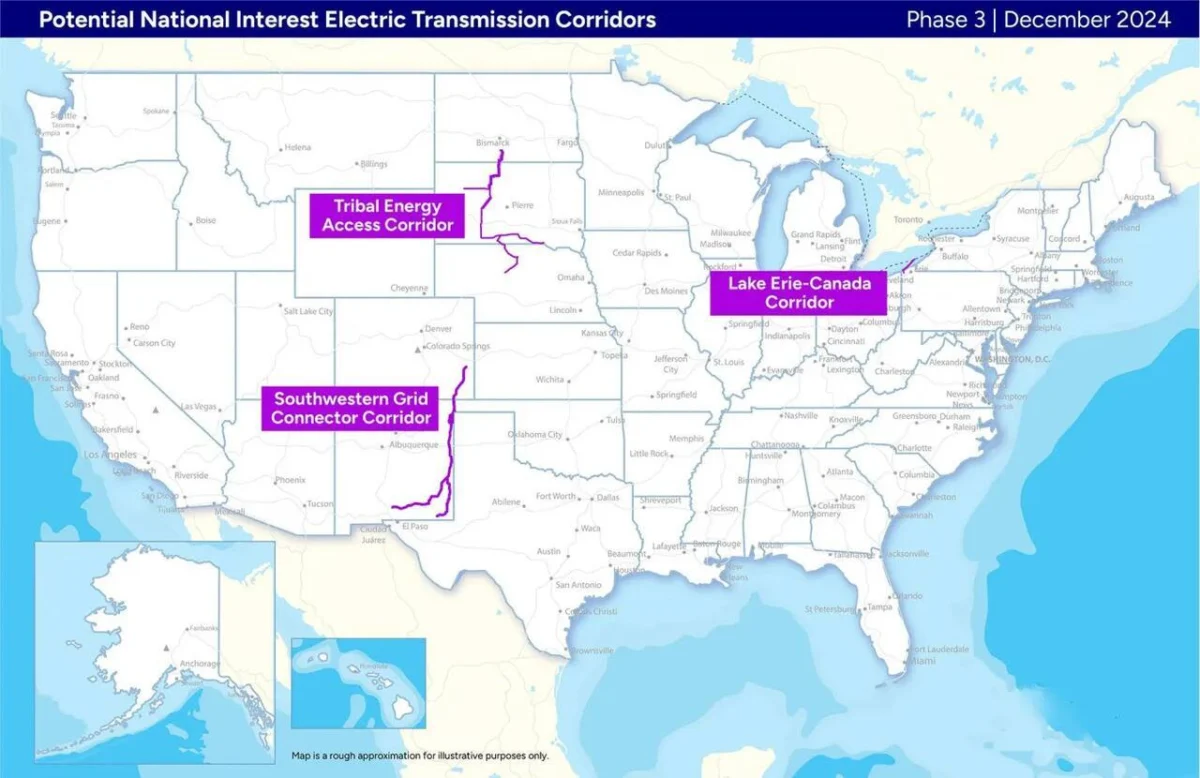
The U.S. Department of Energy (DOE) has announced the cancellation of three ambitious National Interest Electric Transmission Corridors (NIETCs), a move that marks a significant shift in federal strategy for grid modernization and has elicited a polarized response from various stakeholders. The projects, initially conceived to bolster grid reliability, facilitate renewable energy integration, and reduce consumer costs, included the Lake Erie–Canada Corridor, the Southwestern Grid Connector Corridor, and the Tribal Energy Access Corridor. This decision, quietly implemented by removing detailed project information from the DOE’s official webpage, comes despite the agency’s prior identification of these corridors as crucial for addressing pressing national energy needs.
Understanding National Interest Electric Transmission Corridors (NIETCs)
National Interest Electric Transmission Corridors are designated geographic areas where the Department of Energy determines that a lack of adequate transmission infrastructure significantly harms consumers and that the development of new transmission lines would advance vital national interests, such as enhancing reliability, reducing electricity costs, and promoting energy security. The legal framework for NIETCs originates from the Energy Policy Act of 2005 (EPAct 2005), which empowered the DOE to identify such corridors and, critically, granted the Federal Energy Regulatory Commission (FERC) backstop siting authority within these zones. This backstop authority allows FERC to issue permits for transmission lines under specific circumstances where state siting authorities either lack jurisdiction, fail to act on an application within a year, or deny a project. This provision was designed to overcome the notoriously complex and often protracted state-level permitting processes that frequently delay or outright prevent the construction of vital interstate transmission infrastructure.
Beyond expedited permitting, a NIETC designation also unlocks a suite of federal financing tools, primarily fostering public-private partnerships. These financial incentives and regulatory streamlining mechanisms were intended to accelerate the development of critical high-voltage transmission projects that are often too expensive, too risky, or too challenging to permit through conventional means. The overarching goal was to address what many experts describe as the Achilles’ heel of the U.S. power grid: an aging, fragmented transmission system ill-equipped to handle the demands of a rapidly evolving energy landscape, including the integration of vast new renewable energy sources and the increasing frequency of extreme weather events.
The Three Cancelled Corridors: A Closer Look at Their Intended Purpose
The three corridors that have been shelved were strategically chosen to address distinct, critical needs across different regions of the country. A cached version of the DOE’s webpage, dating from March 2026, provided insights into their initial scope and objectives:
-
Lake Erie–Canada Corridor: This corridor was designed to provide essential resource adequacy support to the PJM Interconnection, one of the largest wholesale electricity markets in the world, serving 65 million people across 13 states and the District of Columbia. The region faces growing concerns about grid reliability, particularly during peak demand periods and extreme weather. By facilitating cross-border transmission with Canada, the corridor aimed to enhance the resilience and stability of the PJM system, potentially allowing for the import and export of power to balance supply and demand more effectively and tap into Canada’s significant hydroelectric resources. Such interconnections are vital for regional energy security and can help mitigate the impacts of localized generation outages.
-
Southwestern Grid Connector Corridor: This project was envisioned to create crucial "cross-interconnection and interregional connections" between the Southwest Power Pool (SPP) and WestConnect regions. The U.S. electric grid is largely divided into three major interconnections – the Eastern, Western, and Texas (ERCOT) interconnections – with limited transfer capacity between them. This fragmentation hinders the efficient movement of power across vast distances, often leading to bottlenecks, higher costs, and reduced reliability. The Southwestern Grid Connector aimed to bridge some of these gaps, improving the ability to share diverse generation resources (e.g., solar from the Southwest, wind from the Great Plains) and enhance grid stability across a wide geographic area prone to energy demand fluctuations and climate challenges.
-
Tribal Energy Access Corridor: This corridor had a dual purpose: to facilitate Tribal energy and economic development by addressing a persistent lack of extra high-voltage transmission infrastructure in Tribal lands. Many Indigenous communities possess significant renewable energy potential, particularly for solar and wind, but are often isolated from the main grid or lack the necessary infrastructure to transmit power to demand centers. The Tribal Energy Access Corridor aimed to rectify this by enabling these communities to develop their energy resources, create economic opportunities, and improve their energy independence and resilience. It represented a direct effort to address historical underinvestment in infrastructure for Tribal nations and support their self-determination in energy development.
The cancellation of these projects effectively removes the federal designation that would have streamlined their permitting and provided access to specialized financing, leaving their future uncertain and potentially reverting them to traditional, often arduous, state-by-state development pathways.
The Department of Energy’s Stated Rationale and Contrasting Views
The DOE’s official current webpage on the NIETC process no longer includes details about these three projects, confirming their removal from active consideration. While a detailed public statement specifically outlining the reasons for this cancellation was not immediately available, the original UtilityDive report indicates that the framework for designation "had proved ineffective." This explanation suggests that the DOE may have determined the existing process, despite its statutory backing, was not yielding the desired results in terms of accelerating transmission development.
However, this rationale stands in stark contrast to previous assessments by the very same department. The DOE’s own National Transmission Needs Study, a triennial report published in July (presumably 2023, given the timeline), explicitly stated that NIETC designation "enables DOE and FERC to use valuable federal financing and permitting tools to spur construction or modification of transmission facilities within a NIETC." This study’s findings are supposed to form the very basis for NIETC designations, highlighting a potential inconsistency in the agency’s current position. The discrepancy raises questions about the internal evaluation process and whether the "ineffectiveness" cited refers to the legal framework itself, the practical challenges of implementation, or perhaps a re-evaluation of priorities.
Mixed Reactions from Stakeholders
The DOE’s decision has been met with a sharply divided response, reflecting the complex interplay of economic, environmental, and property rights considerations inherent in large-scale infrastructure projects.
Praise from Property Rights Advocates:
R-CALF USA, a cattle producer-only trade association, lauded the DOE’s move. The organization had previously raised significant concerns in 2024 regarding the potential for these corridors to disrupt independent livestock operations and result in the loss of essential grazing and haying lands. For agricultural communities, the prospect of new high-voltage transmission lines traversing their properties often brings fears of eminent domain, diminished land values, restricted farming practices, and visual impacts. R-CALF USA’s stance underscores a broader sentiment among some landowners and rural communities who view federal intervention in land use for infrastructure as an overreach and a threat to private property rights. Their applause signals a victory for those prioritizing local control and protection of agricultural land from large-scale development.
Criticism from Environmental and Clean Energy Advocates:
Conversely, prominent environmental and clean energy advocacy groups, including the Environmental Defense Fund (EDF) and Clean Air Task Force (CATF), sharply criticized the cancellation. These organizations view the decision as a significant setback for grid modernization, climate goals, and consumer protection.
Nicole Pavia, CATF’s Director of Clean Energy Infrastructure Deployment, articulated this frustration, stating, "If the goal is affordable, reliable, and secure electricity, we should be making it easier to build the infrastructure the grid needs – not dismantling federal frameworks designed to facilitate it." CATF specifically highlighted that the cancelled corridors were selected to "help address areas with significant transmission congestion," emphasizing that such congestion "increases costs and reduces reliability for ratepayers." Transmission bottlenecks prevent cheaper, often renewable, electricity from reaching consumers, forcing reliance on more expensive or less efficient local generation.
EDF echoed these concerns, pointing to the contradiction between the DOE’s stated "ineffectiveness" of the NIETC framework and its own National Transmission Needs Study, which previously endorsed the value of NIETC designations for leveraging federal financing and permitting tools. Environmental groups consistently argue that a robust, interconnected transmission grid is absolutely essential for integrating the vast amounts of renewable energy required to decarbonize the electricity sector and meet ambitious climate targets. Without sufficient transmission, new solar and wind farms often face curtailment (being forced to switch off) because there’s no way to deliver their power to market, undermining investment in clean energy.
Broader Context: The U.S. Grid Challenge and Federal Initiatives
The cancellation of these corridors occurs against a backdrop of urgent calls for comprehensive grid modernization across the United States. Experts widely agree that the existing transmission infrastructure, much of which was built decades ago, is inadequate for the 21st century’s energy demands. The challenges are multifaceted:
- Aging Infrastructure: Many lines are reaching the end of their operational life, requiring costly upgrades or replacement.
- Growing Demand: Electrification of transportation and buildings, coupled with data center expansion, is increasing overall electricity demand.
- Renewable Energy Integration: The transition from centralized fossil fuel plants to distributed renewable generation (often in remote areas) necessitates a fundamentally different grid architecture capable of transmitting power over long distances and handling variable output. The DOE estimates that the U.S. may need to double or even triple its transmission capacity by 2050 to meet clean energy goals.
- Extreme Weather Events: Climate change is leading to more frequent and intense storms, heatwaves, and wildfires, which stress the grid and cause widespread outages.
- Permitting Bottlenecks: The average timeline for permitting and constructing a major interstate transmission line can exceed a decade, involving approvals from multiple state agencies, local governments, and federal entities. This fragmented process is often cited as the single biggest barrier to grid expansion.
In recognition of these challenges, the Biden administration, through initiatives like the Infrastructure Investment and Jobs Act (IIJA) of 2021, has sought to bolster federal efforts to accelerate transmission development. The IIJA significantly expanded funding for grid infrastructure and included provisions aimed at strengthening federal permitting authorities. The DOE’s Office of Energy Dominance Financing, for instance, has been making multi-billion-dollar loans to build, rebuild, and reconductor transmission lines, as cited in the DOE’s release regarding other steps taken to modernize infrastructure. This indicates a broader federal commitment to grid improvements, even as specific mechanisms like NIETCs face re-evaluation.
Implications for Energy Policy and the Future of Transmission
The decision to cancel the NIETC designations for these three corridors carries several significant implications for U.S. energy policy and the future of transmission development:
- Slower Pace of Clean Energy Transition: Without the streamlined permitting and financial incentives of NIETC designations, the construction of these and potentially other future critical transmission lines is likely to face greater delays. This could impede the integration of renewable energy projects, making it harder and more expensive to meet climate goals and transition away from fossil fuels.
- Increased Consumer Costs: Continued transmission congestion translates directly into higher electricity costs for consumers. When the grid is unable to efficiently move power from the cheapest generation sources to demand centers, utilities are forced to dispatch more expensive local generators, a cost ultimately passed on to ratepayers.
- Uncertainty for Federal Permitting Authority: The "ineffectiveness" argument, if interpreted as a fundamental flaw in the NIETC framework, could signal a retreat from federal efforts to use backstop siting authority to overcome state-level permitting hurdles. This would leave grid developers largely at the mercy of often fragmented and slow state processes, potentially exacerbating the current permitting crisis.
- Impact on Regional Grid Reliability: The intended purposes of these corridors – improving resource adequacy for PJM, enhancing interregional connections in the Southwest, and enabling Tribal energy development – were all tied to strengthening grid reliability. Their cancellation could leave existing vulnerabilities unaddressed, increasing the risk of outages and grid instability.
- Political Signals and Property Rights Debate: The decision sends a clear signal that property rights concerns, particularly from agricultural stakeholders, can significantly influence federal infrastructure policy. While balancing national interest with local impacts is crucial, the cancellation could be seen by some as prioritizing opposition over broader grid needs.
- Focus on Alternative Mechanisms: While NIETCs are being shelved, the DOE’s broader commitment to transmission infrastructure through loans and other programs remains. This suggests a potential shift towards other federal tools, perhaps those that are perceived as less contentious or more direct in their implementation, though these may not offer the same comprehensive benefits of a designated corridor.
The U.S. faces a monumental task in modernizing its electricity grid to ensure reliability, affordability, and sustainability. The cancellation of these NIETC designations, while potentially addressing specific concerns from certain groups, adds another layer of complexity and uncertainty to an already challenging endeavor. The path forward will likely require innovative approaches, continued federal-state collaboration, and a renewed commitment to overcoming the persistent barriers to critical infrastructure development. The debate over the optimal balance between federal intervention, state authority, and local concerns in charting the nation’s energy future is far from over.

