
Just when the cryptocurrency market’s sentiment seemed to be plumbing new depths, the discovery of a critical entropy generation bug in the widely respected Coldcard hardware wallet served as a stark reminder that absolute security in the digital asset space remains an elusive ideal. The flaw, disclosed on July 31, has sent ripples of concern through the Bitcoin community, prompting a renewed examination of the foundational principles of hardware wallet security and the inherent trust placed in manufacturers.
The vulnerability, affecting multiple Coldcard devices, has already led to significant losses. Researchers at Galaxy Digital reported that attackers, exploiting this weakness, have successfully stolen over 1,596 Bitcoin, valued at a staggering minimum of $100 million, through a series of coordinated attacks. This incident has thrust into the spotlight a complex and often overlooked aspect of cryptocurrency security: the process by which hardware wallets generate the private keys that safeguard users’ digital wealth.
Unpacking the Coldcard Vulnerability: A Flaw in the Foundations of Randomness
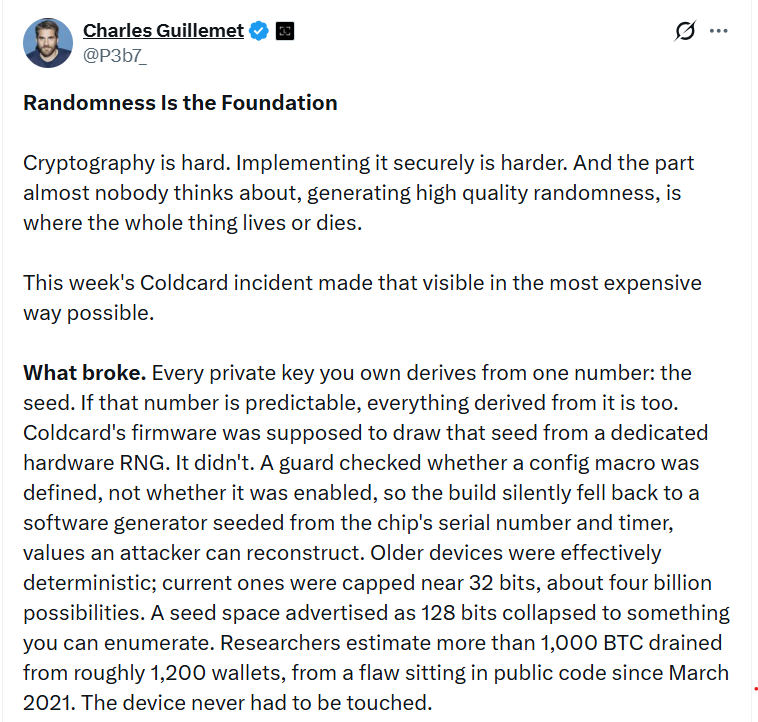
At its core, the Coldcard vulnerability did not exploit the underlying cryptography of Bitcoin itself, nor did it break any advanced encryption algorithms. Instead, the flaw struck at a far more fundamental element: the generation of randomness, or entropy. Every cryptocurrency wallet, to ensure the uniqueness and unpredictability of its private keys, relies on a robust source of random data. The strength of this randomness, known as entropy, directly correlates to the difficulty for an attacker to guess or reproduce a user’s private key.
The Coldcard bug, as detailed by Coinkite, the manufacturer, involved a “fallback path in seed generation that could produce weak entropy when generated on the device firmware itself.” This means that for affected devices, the random numbers used to create the wallet’s seed phrase were not sufficiently unpredictable. When randomness is compromised, it significantly narrows the vast cryptographic space of possible private keys, making them theoretically vulnerable to brute-force attacks or other methods of key derivation.
A Chronology of Discovery and Impact
The timeline of events began on July 31, 2023, when Coinkite issued a warning to its users. The company advised that wallets created on certain firmware versions of affected Coldcard devices should be considered at risk and recommended that users migrate their funds to newly generated wallets. This initial disclosure, however, was only the beginning.
In the days following Coinkite’s announcement, independent researchers began to delve deeper into the nature and extent of the vulnerability. A significant development came from researchers at Galaxy Digital, who, by August 2, had reported that over 1,596 Bitcoin had been stolen due to the exploit. This figure, representing over $100 million at the time of reporting, underscored the severity of the issue and the real-world financial implications for affected users.
The question of how such a critical flaw could remain undetected for an extended period quickly emerged. Dustin Dettmer, a Core Lightning developer, proposed a leading theory regarding the bug’s origin. He suggested that firmware changes implemented in 2021 may have inadvertently caused the issue. According to Dettmer’s analysis, code intended to interface with the hardware’s true random number generator (TRNG) might have instead disabled it. This would have forced the wallet creation process to revert to a weaker pseudo-random number generator (PRNG) available in the MicroPython environment, specifically the Yasmarang PRNG, which is known to be less robust.
Coinkite has not definitively confirmed this exact sequence of events but has stated that a full technical post-mortem will be published “soon.” A spokesperson for the company confirmed that “certain firmware versions had a fallback path in seed generation that could produce weak entropy when generated on the device firmware itself.” Importantly, they clarified that devices where users generated their own entropy through manual methods, such as rolling dice, were “not affected by this specific fallback path.”
The Broader Context: Weak Randomness in Digital Security
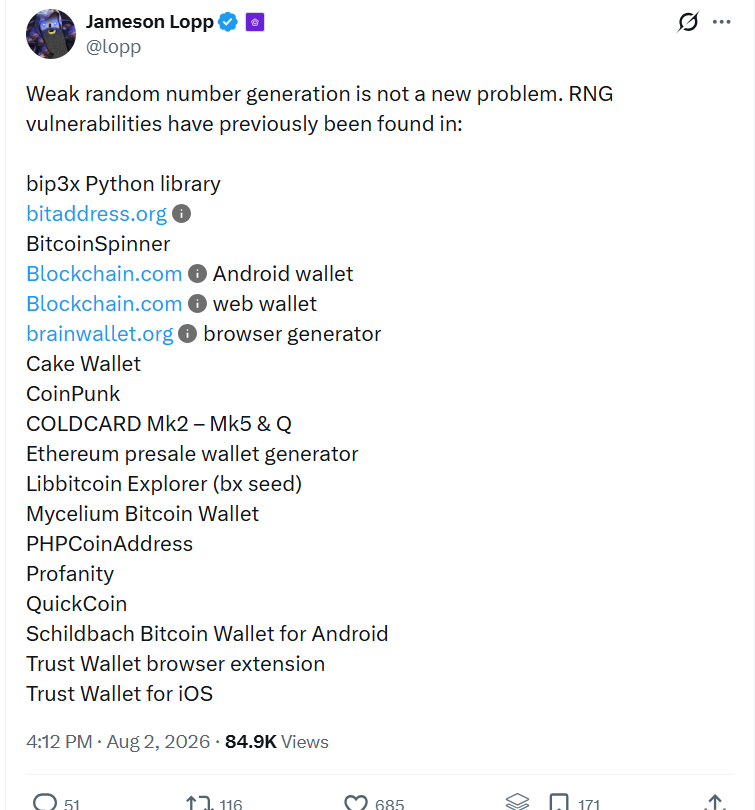
The problem of weak random number generation is not a novel one in the realm of digital security, and it has historically plagued various software and hardware implementations across different industries. Bitcoin security expert Jameson Lopp has previously highlighted instances where RNG vulnerabilities have affected a range of cryptocurrency wallets and libraries, including the Blockchain.com Android wallet and Trust Wallet. The recurring nature of such vulnerabilities underscores the inherent difficulty in achieving truly unpredictable randomness and the critical need for rigorous testing and auditing.
Vincent Bouzon, Director of Product Security at Ledger, explained the elusive nature of weak RNG flaws: “weak randomness passes output tests.” This means that compromised random number generators can still produce outputs that appear statistically random, making it exceedingly difficult to detect a vulnerability through standard testing procedures. This characteristic makes such bugs particularly insidious, as they can lie dormant for years, only to be discovered when exploited in real-world attacks.
Diverse Approaches to Secure Entropy Generation
The Coldcard incident has inevitably led to scrutiny of the security architectures employed by different hardware wallet manufacturers. While there is a universal consensus on the non-negotiable importance of secure entropy generation, the methods employed to achieve this vary significantly.
Ledger, for instance, places a strong emphasis on dedicated security hardware. Bouzon stated, “The generation of that entropy must be anchored in secure hardware, with an architecture that cannot silently downgrade to an untrusted software-based source.” Ledger devices utilize a true random number generator embedded within a certified Secure Element, a specialized chip designed for high security. This entropy source is certified under the AIS-31 PTG.2 standard, and the Secure Element itself undergoes Common Criteria certification, a rigorous international standard for evaluating IT security. Ledger’s stance is that the Coldcard incident was an “a failure in one specific implementation, not a verdict on secure self-custody.”
Trezor, another prominent hardware wallet manufacturer, adopts a layered approach to randomness. Their strategy involves combining entropy generated internally by the device with randomness supplied by the host computer. Newer Trezor models have also incorporated additional hardware-based entropy sources. Crucially, Trezor implements entropy checks to verify that the device has indeed contributed unpredictable randomness during the wallet creation process. Tomáš Sušanka, Trezor’s Chief Technical Officer, emphasized the industry-wide takeaway: “The takeaway for the whole industry is that randomness cannot depend on a single source or a single line of code being correct.”
Foundation, with its Passport wallet, also prioritizes multiple entropy sources. Their approach emphasizes transparency through open-source firmware with reproducible builds. This allows independent researchers to verify that the software running on the device aligns with the published code. Zach Herbert, Foundation’s CEO, explained that Passport combines randomness generated by separate hardware components before wallet creation. He also noted that while the bug was specific to Coldcard, the broader warning is that “this went unnoticed for more than five years while people trusted the product with life-changing amounts of money.”
The Debate on Trust, Transparency, and Verification
The divergence in approaches among Ledger, Trezor, and Foundation highlights a fundamental debate within the hardware wallet industry: how can users be most assured that their wallet’s security mechanisms, particularly entropy generation, are functioning correctly and remain uncompromised?
Ledger champions independent certification as the most robust form of assurance. Foundation leans heavily on the principles of open-source development, reproducible builds, and fostering an environment where external researchers can readily audit their systems. Trezor seeks a middle ground, combining open firmware with a multi-layered entropy generation strategy to avoid over-reliance on any single component.
Coinkite’s handling of security disclosures has also faced criticism. Several Bitcoin developers have voiced concerns about the company’s past responses to vulnerability reports and the absence of a traditional bug bounty program. Herbert of Foundation argues that actively engaging with external researchers and embracing open-source development are integral to building secure products.
Nick Percoco, Chief Security Officer at Kraken and formerly CSO at Uptake, views the Coldcard incident as a catalyst for the industry to adopt more stringent security standards, regardless of a manufacturer’s chosen design philosophy. He stated, “The Coldcard entropy failure should be a wake-up call for the entire hardware wallet industry.” Percoco argues that current certification schemes often focus on individual components without adequately verifying that production firmware is utilizing these components as intended.
Percoco has proposed an industry-specific assurance standard. This standard would mandate independent validation of entropy sources, rigorous verification that firmware correctly calls the intended hardware random number generator, and certifications that are explicitly tied to specific hardware and firmware versions. Beyond technical implementations, Percoco believes that the broader security culture within the industry needs to evolve, emphasizing bug bounty programs and constructive engagement with independent security researchers.
Implications for Bitcoiners and the Future of Self-Custody
For current Coldcard users, the immediate priority is to heed Coinkite’s guidance and migrate any funds believed to be held in potentially compromised wallets to new, securely generated wallets. This migration process, while disruptive, is essential to mitigate further risk.
Beyond the immediate concerns of Coldcard users, the incident serves as a crucial learning moment for the entire Bitcoin community. Experts like Michael Tanguma, Head of Product at Onramp Bitcoin, stress the importance of moving away from single points of failure. “Today, realistically, you want multisig and independently generated entropy,” Tanguma advises. “The mitigation that actually scales is architectural: setups where no single device, vendor or institution being wrong can lose the funds.” This points towards the growing importance of multi-signature (multisig) solutions, which require multiple private keys to authorize a transaction, thereby distributing trust and mitigating the risk associated with a single compromised device or service.
While the Coldcard incident has undeniably shaken confidence, it does not necessarily mean that all hardware wallets are inherently insecure. Rather, it has exposed a specific implementation flaw in one respected device, forcing a broader conversation about the critical, yet often opaque, processes that underpin self-custody. The vulnerability has, in essence, lifted the veil on the complex art of generating the cryptographic secrets that form the bedrock of Bitcoin ownership, prompting a necessary re-evaluation of trust, transparency, and the ongoing pursuit of robust digital security. The industry’s response to this challenge will undoubtedly shape the future of how individuals protect their digital assets in an increasingly complex technological landscape.

