

The U.S. housing market, a complex tapestry of economic forces and regulatory frameworks, presents distinct opportunities and challenges for real estate investors. Understanding the nuances of state-level legislation is paramount, particularly the concept of "landlord-friendliness" versus "tenant-friendliness." These labels, while seemingly simple, can profoundly impact an investor’s cash flow, return on investment, and overall success. This article will explore the characteristics that define a landlord-friendly state, identify the top five such states in 2026, and delve into why investors might still choose tenant-friendly markets, offering expert insights for navigating these diverse environments.
Defining Landlord-Friendliness in Real Estate
A landlord-friendly state is characterized by laws and regulations that generally favor property owners and simplify the management of rental properties. This typically translates into lower entry and operating costs for landlords, fostering a more predictable and potentially more profitable investment environment. It is crucial to emphasize that "landlord-friendly" does not equate to the absence of tenant protections. Every state enforces laws safeguarding renters’ rights, and responsible landlords prioritize understanding and adhering to these regulations to cultivate positive tenant relationships, which are fundamental to long-term success in the rental market.
The hallmarks of a landlord-friendly market often include a combination of the following factors:
Low Property Taxes: A Foundation for Stronger Cash Flow
Property taxes represent a significant ongoing expense for real estate investors. In 2026, effective property tax rates across the U.S. typically range from 0.25% to 2% of a property’s assessed value. While property taxes are often deductible, thereby reducing taxable income, higher rates in certain states directly diminish a landlord’s net operating income and consequently impact their capitalization rate (cap rate), a key metric for evaluating investment profitability. Furthermore, real estate taxes are subject to annual increases, meaning that investing in states with lower property tax burdens can help landlords retain more of their earnings, bolstering their cash flow and overall return. For example, states with robust property tax relief programs or lower statutory rates offer a distinct advantage in preserving profitability.
Absence of Rent Control: Flexibility for Long-Term Growth
Rent control measures are designed to ensure housing affordability and stability for tenants by imposing limits on how much landlords can charge for rent and dictating the frequency and magnitude of rent increases. While these policies aim to protect renters, they can present substantial financial hurdles for landlords. When the costs of essential services and operational expenses—such as insurance premiums, property taxes, management fees, and maintenance—rise, landlords operating under strict rent control may be unable to adjust rental income accordingly. This can lead to a stagnation of revenue growth, potentially forcing landlords to defer necessary maintenance or major repairs, thereby devaluing their investment properties. For new investors seeking predictable revenue streams and the flexibility to adapt to market conditions, states without rent control laws are often a preferred choice.
Streamlined Licensing and Permitting: Reducing Barriers to Entry
Becoming a landlord involves navigating a complex web of licenses and permits, which can vary based on property type, rental strategy (e.g., long-term versus short-term rentals), and geographic location. These can include business licenses, rental permits, occupancy certificates, and zoning compliance documentation. Some states impose stringent licensing requirements that can significantly increase initial setup costs and create administrative burdens. Landlord-friendly states typically simplify these processes, allowing investors to establish their rental property businesses with greater ease and lower upfront expenses. This reduced regulatory friction lowers the barrier to entry, making real estate investment more accessible.
Uncapped Security Deposits: Enhanced Tenant Screening and Protection
Security deposits serve as a crucial financial safeguard for landlords, protecting against potential losses from unpaid rent, utility bills, property damage beyond normal wear and tear, lease violations, and essential cleaning costs during tenant turnover. When states impose caps on security deposits, it can limit a landlord’s ability to cover these expenses, particularly in cases of significant damage. Moreover, a lower security deposit may not adequately reflect a tenant’s financial reliability, making it more challenging for landlords to assess tenant risk. States that do not cap security deposits offer landlords greater financial protection. However, it is important to note that even in these states, landlords are generally expected to set "reasonable" deposit amounts, often aligned with a percentage of the monthly rent.
Expedited Notice-to-Enter Requirements: Facilitating Property Management
The ability for landlords to access their rental properties without lengthy, legally mandated notice periods is essential for efficient property management. This includes conducting necessary inspections, performing routine maintenance, addressing urgent repairs, showing the property to prospective tenants or buyers, and responding to emergencies. While tenant privacy is a fundamental right, overly restrictive notice requirements can impede a landlord’s ability to maintain the property and minimize vacancies. In landlord-friendly states, notice periods are typically shorter, often ranging from 24 to 48 hours, allowing for timely interventions and smoother property operations.

Efficient Eviction Processes: Protecting Investment Value
While most landlords aim for harmonious tenant relationships, the reality of the rental market is that evictions, though infrequent for many, can become necessary. The eviction process can vary dramatically across the U.S., with timelines ranging from a few weeks to several months. In states where the eviction process is lengthy and complex, landlords can incur significant financial losses due to unpaid rent and ongoing property expenses. Extended eviction periods also increase the risk of tenants causing further damage to the property out of dissatisfaction. States that offer a more streamlined and cost-effective eviction process provide landlords with a critical mechanism to protect their investment and mitigate potential financial damage.
Additional Landlord Rights and Protections: Further Incentives
Beyond the core characteristics, some states offer additional rights and protections that enhance the landlord experience. These can include more flexible policies on late rent fees, immediate rights to dispose of abandoned property left by tenants, and state preemption laws that prevent local governments from enacting stricter rental regulations than those at the state level. These provisions further contribute to a more favorable operating environment for landlords. It’s important to acknowledge that not every state will possess all these attributes; rather, it is the collective balance of these characteristics that elevates a state into the top tier of landlord-friendliness. For instance, Texas, while offering no rent control and a relatively efficient eviction process, may have higher property taxes, representing a trade-off for investors.
Furthermore, it is crucial to recognize that local ordinances and city-level regulations can differ significantly from state laws. A state might be considered landlord-friendly overall, but a major metropolitan area within that state could have specific tenant-centric regulations that alter the investment landscape. Therefore, thorough research into the specific laws of a city or municipality is always recommended, regardless of the state’s broader classification.
The Top 5 Most Landlord-Friendly States in 2026
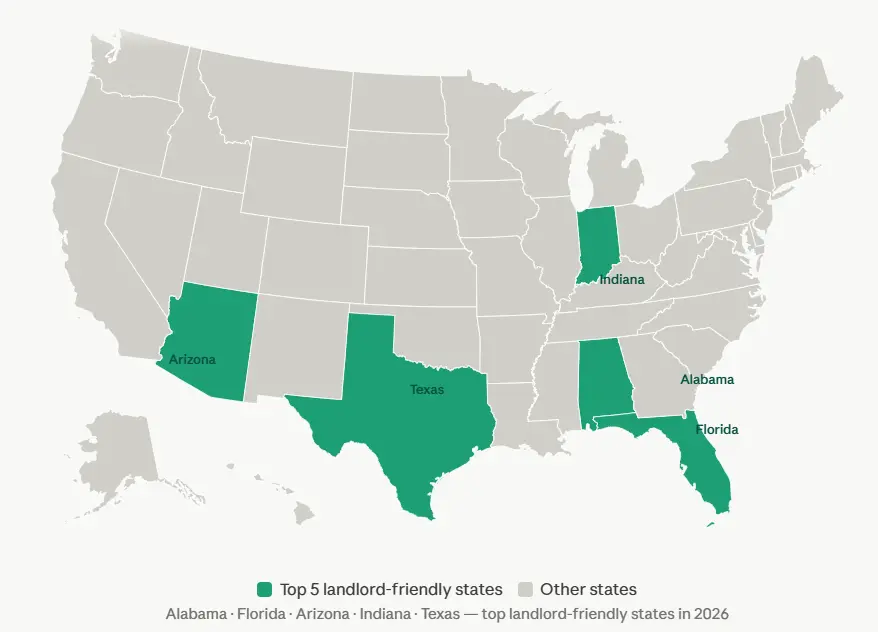
Based on an analysis of regulatory environments, tax structures, and tenant-landlord law specifics, the following five states are identified as being among the most landlord-friendly in the U.S. housing market for 2026:
Alabama
Alabama stands out as one of the states with minimal regulations impacting individual landlords. This lack of stringent oversight contributes to a more straightforward and less costly property management experience. The state generally features lower property taxes compared to national averages, and it does not implement rent control policies. The legal framework surrounding evictions is also relatively efficient, providing landlords with a predictable process should such action become necessary. The barrier to entry for new landlords is also comparatively low, with fewer complex licensing or permit requirements.
- Key Landlord-Friendly Features: Low regulatory burden, absence of rent control, efficient eviction process, lower property taxes.
- Top Landlord-Friendly City with High Average Cap Rate: Birmingham, known for its growing economy and relatively affordable housing market, often presents attractive cap rates for rental properties.
Florida
Florida has long been a popular destination for real estate investors, partly due to its favorable regulatory climate for landlords. The state generally avoids rent control measures, allowing landlords to adjust rents based on market demand and operating costs. Property taxes, while varying by county, are often managed within reasonable limits. The eviction process in Florida is typically more streamlined than in many other states, offering landlords a degree of certainty in dealing with problematic tenancies. Security deposit laws are also generally supportive of landlords, without restrictive caps that could limit their protective capacity.
- Key Landlord-Friendly Features: No rent control, generally reasonable property taxes, efficient eviction procedures, robust security deposit allowances.
- Top Landlord-Friendly City with High Average Cap Rate: Jacksonville, with its diverse economy and significant population growth, often exhibits strong rental demand and competitive cap rates.
Arizona
Arizona offers a compelling environment for landlords, characterized by a lack of rent control and a legal system that tends to favor property owners in disputes. The state’s property tax rates are generally moderate, and while subject to increases, they remain competitive. Arizona’s eviction process is considered one of the more efficient in the nation, allowing for relatively quick resolution of landlord-tenant issues. Furthermore, the state does not impose strict caps on security deposits, providing landlords with essential financial protection. The regulatory framework for rental properties is also less burdensome compared to many other states, simplifying the process of becoming and operating as a landlord.
- Key Landlord-Friendly Features: No rent control, moderate property taxes, swift eviction process, uncapped security deposits, less stringent regulations.
- Top Landlord-Friendly City with High Average Cap Rate: Phoenix, as a major metropolitan hub with a growing population and diverse job market, consistently offers opportunities for solid rental income and cap rates.
Indiana
Indiana presents a balanced approach to real estate investment, with laws that are largely supportive of landlords. The state does not enforce rent control, providing landlords with the freedom to set rents according to market dynamics. Property taxes in Indiana are typically lower than the national average, contributing to better cash flow for rental property owners. The eviction process is also designed to be efficient, minimizing the financial and logistical burdens associated with removing non-compliant tenants. The state’s regulatory environment is generally straightforward, making it accessible for both new and experienced investors.
- Key Landlord-Friendly Features: Absence of rent control, low property taxes, efficient eviction procedures, generally accessible regulatory framework.
- Top Landlord-Friendly City with High Average Cap Rate: Indianapolis, the state capital and a significant economic center, often provides attractive investment prospects with competitive rental yields.
Texas
Texas is renowned for its pro-business environment, which extends to its real estate market. The state has no statewide rent control, allowing landlords significant flexibility in rent pricing. The eviction process in Texas is also notably efficient, often completed within a matter of weeks, providing landlords with a crucial tool for managing their investments. Furthermore, Texas does not cap security deposits, offering landlords enhanced protection against potential tenant-related damages or defaults. While property taxes can be higher in some Texas markets compared to other landlord-friendly states, the combination of strong economic growth, robust rental demand, and favorable eviction laws makes it a top choice for many investors.
- Key Landlord-Friendly Features: No rent control, efficient eviction process, uncapped security deposits, strong economic growth driving rental demand.
- Top Landlord-Friendly City with High Average Cap Rate: Dallas, a major economic and cultural hub, consistently offers a dynamic rental market with opportunities for high cap rates due to strong population influx and corporate presence.
The Strategic Appeal of Tenant-Friendly Markets
While landlord-friendly states offer clear advantages, it is essential to understand why some sophisticated real estate investors strategically choose to invest in tenant-friendly markets. These decisions are rarely arbitrary and are often driven by deeper economic fundamentals. For instance, a recent Redfin report highlighted a significant increase in investor purchases in Milwaukee, Wisconsin, a market that, despite being in a generally landlord-friendly state, has seen its local regulations shift towards greater tenant protections. These new laws, which can prolong eviction timelines and impose stricter requirements for security deposits and inspections, represent a departure from the typical landlord-friendly playbook.
Daryl Fairweather, Chief Economist at Redfin, offers a critical perspective: "Landlord-friendly and tenant-friendly labels can be helpful, but they can be too broad to guide an investment decision on their own. What matters more is the underlying economics (fundamentals) of a market, like home prices, rent levels, job growth, and long-term demand. A landlord-friendly market with weak fundamentals can underperform a tenant-friendly market with strong population growth and tight supply, for example. I would suggest that investors should treat the regulatory environment as just one of many factors."
This perspective underscores that regulatory frameworks are only one piece of the investment puzzle. Markets with strong population growth, robust job creation, and high demand for housing can present lucrative opportunities even with more tenant-centric regulations. In some cases, a tenant-friendly market might offer more affordable entry points or higher potential for long-term appreciation, outweighing the perceived risks associated with stricter tenant protections.
Fairweather further cautions that "Landlord-friendly doesn’t always mean low risk. Typically in some of these markets, rapid investor activity has already driven up prices, which can compress yields. There’s also the risk of overbuilding or economic volatility. Just because regulations are favorable doesn’t mean the investment will perform well. Always start by paying close attention to fundamentals like affordability, migration trends, and local employment." This highlights the importance of due diligence beyond just the regulatory label, as market dynamics can create risks even in seemingly advantageous environments.
Expert Guidance for Investing in Tenant-Friendly Markets
For investors considering opportunities in tenant-friendly markets, particularly those with rent control, strategic planning is paramount. Fairweather advises, "In rent-controlled markets, cash flow starts with the purchase price. You need to buy at a basis that makes sense given future rent constraints. After that, focus on minimizing turnover and vacancy, since you might not be able to raise rents between tenants. Keeping units well-maintained and building good tenant relationships can reduce churn. I’ve seen some investors also look for properties where allowable increases like inflation-based adjustments or capital improvement passthroughs can help offset costs over time."
Additional expert tips for navigating tenant-friendly states include:
- Conservative Underwriting: Approach financial projections with a degree of caution, factoring in potential delays and limitations imposed by regulations.
- Professional Operations: Implement rigorous tenant screening processes, set rents appropriately from the outset, and maintain meticulous financial records.
- Detailed Regulatory Understanding: Thoroughly research and understand all local regulations, including notice periods for entry, eviction timelines, and rules governing rent increases.
- Leverage Local Expertise: Engage with experienced local property managers or legal counsel who are well-versed in the specific nuances of the tenant-friendly market.
Conclusion: Beyond the Label – A Data-Driven Approach
In the current real estate climate, the simplistic labels of "landlord-friendly" and "tenant-friendly" should not be the sole determinants of investment decisions. As Fairweather notes, "That’s increasingly true. What we’re seeing now is that investors are prioritizing fundamentals over labels. A market like Milwaukee, for example, may be considered tenant-friendly, but if it offers relatively affordable entry points and stable rental demand, it can still be attractive. Meanwhile, some traditionally landlord-friendly markets—like parts of Florida—have cooled due to rising prices and insurance costs. So today, the more important question is: ‘Does the deal make sense given the local market conditions?’ Regulation matters, but it’s not the whole story.”
Ultimately, successful real estate investment hinges on a comprehensive analysis of the deal’s numbers, the underlying market fundamentals, and the specific regulatory environment. By embracing a data-driven approach and thoroughly evaluating all relevant factors, investors can identify profitable opportunities and build sustainable portfolios in any market, regardless of its classification.

